
Key Takeaways
- Water dew point is a pressure-dependent temperature. Always quote the measurement pressure alongside the dew point value.
- Gas hydrates can form at temperatures well above 0 °C in high-pressure pipelines, making a low dew point essential even in tropical climates like Singapore.
- ISO 6327 (chilled mirror) is the primary reference method; ASTM D1142 and ISO 18453 are also widely referenced in commercial gas contracts.
- On-line dew point instruments (capacitive polymer, QCM, P₂O₅) must be calibrated against traceable humidity standards at least annually. More frequently in high-hydrocarbon or acid-gas environments.
- Singapore's Energy Market Authority sets maximum water dew point limits for gas entering the national transmission network under the Gas Act and Gas Network Code.
- Measurement uncertainty matters: a poorly calibrated sensor with ±3 °C uncertainty can give a false pass on a specification limit of −8 °C, allowing wet gas into the pipeline.
Definition: What Exactly Is Water Dew Point?
The water dew point of a gas is the temperature at which the partial pressure of water vapour in the gas equals the saturation vapour pressure of water at that temperature and total system pressure. In plain terms: it is the temperature to which the gas must be cooled, at constant pressure, before liquid water first appears on a surface. Below this temperature, water condenses; above it, all moisture remains as vapour.
Because the saturation vapour pressure of water is a function of both temperature and total pressure, the dew point of a gas changes when pressure changes. Even if the actual mass of water in the gas remains identical. A gas with a dew point of −5 °C at 70 bar will have a significantly different dew point when depressurised to atmospheric conditions. This is why all dew point specifications in gas contracts must state the reference pressure explicitly. ISO 18453 provides the correlation equations for converting between water content (in mg/m³) and dew point at various pressures for typical natural gas compositions.
The distinction between water dew point and hydrocarbon dew point is frequently confused. Hydrocarbon dew point refers to condensation of heavy hydrocarbons (C₅+), not water. Both are specified in gas quality standards, but they arise from entirely different chemical species and require different measurement techniques. This article addresses water dew point only.
Underlying Physics: Why Water Vapour Behaves This Way in Natural Gas
Natural gas as produced at the wellhead is typically saturated with water vapour at reservoir temperature and pressure. As the gas flows through production facilities and pipelines where temperatures and pressures change, the equilibrium between vapour and liquid phases shifts continuously. The fundamental relationship governing this behaviour is the Clausius-Clapeyron equation, which describes how saturation vapour pressure increases exponentially with temperature. A 10 °C rise in temperature roughly doubles the amount of water vapour the gas can hold before condensation occurs.
In pipeline conditions (pressures of 30 to 100 bar are common), the presence of dissolved gases such as methane, ethane, and CO₂ modifies the activity of water and shifts the dew point relative to pure-water steam tables. The Bukacek correlation (widely used in the gas industry) and the more rigorous AGA-8 equation of state account for these interactions. This is why simple lookup of water content from psychrometric charts calibrated for atmospheric air gives incorrect results for high-pressure natural gas streams.
A critical phenomenon specific to high-pressure natural gas is gas hydrate formation. Hydrates are non-stoichiometric crystalline inclusion compounds where water molecules form a hydrogen-bonded cage structure that traps small gas molecules (methane, ethane, propane, H₂S, CO₂). Unlike ice, hydrates can form at temperatures as high as 25 °C at pipeline pressures above 40 bar. The hydrate formation curve is determined primarily by gas composition and pressure; free liquid water must be present for hydrate nucleation. A dew point specification that keeps the gas below its water saturation point therefore eliminates the precondition for hydrate formation. This is the fundamental engineering reason for dew point control.
Consequences of Exceeding the Dew Point Limit
When natural gas in a pipeline exceeds its water dew point, liquid water accumulates in low points and dead legs of the piping system. The consequences are well-documented and costly:
1. Internal Corrosion
Liquid water in contact with carbon steel initiates electrochemical corrosion. When H₂S is present (even at ppm levels), the corrosion mechanism shifts to sulphide stress corrosion cracking (SSCC), which can cause sudden brittle failure in high-strength pipeline steels. CO₂ dissolved in water forms carbonic acid (H₂CO₃), creating a mildly acidic electrolyte that accelerates general corrosion rates by a factor of 10 to 100 compared to dry gas. The combined cost of internal corrosion to the global gas industry exceeds US$1 billion per year in maintenance and lost production.
2. Gas Hydrate Blockages
Hydrate plugs can form within hours of free water contacting a high-pressure gas stream. A plug can grow to completely block a 600 mm pipeline segment. Remediation requires costly depressurisation, sometimes methanol injection, and in severe cases, pipeline excavation. In offshore subsea pipelines where access is severely limited, a hydrate plug can render a pipeline unusable for weeks. Dew point control (achieved through glycol dehydration (TEG/MEG units), molecular sieve adsorption, or membrane separation), is the primary prevention strategy.
3. Metering and Instrument Errors
Liquid water slugs passing through an ultrasonic or turbine flow meter introduce velocity errors and can physically damage meter internals. Pressure transmitters with wet reference legs develop errors due to variable liquid head. Control valves and pressure regulators cavitate and fail prematurely. In fiscal metering applications (where gas volume determines billing between suppliers and buyers), these errors translate directly to commercial disputes and financial losses.
| Consequence | Mechanism | Typical Threshold | Applicable Standard |
|---|---|---|---|
| General corrosion | Electrochemical cell at steel surface with liquid water electrolyte | Any free liquid water present | NACE MR0175 / ISO 15156 |
| Sulphide stress cracking | H₂S + water → atomic hydrogen diffusion into steel lattice | >0.05 psia H₂S partial pressure with free water | NACE MR0175 / ISO 15156 |
| Gas hydrate formation | Water cages trapping methane/ethane at high pressure | Free water present, P > 30 bar, T < hydrate curve | AGA Hydrate Monograph |
| Flow meter error | Liquid slugs affect velocity/density measurement | Any liquid water at measurement point | AGA Report No. 9, OIML R 137 |
| Compressor damage | Liquid water causes cavitation and blade erosion | Any liquid water entrained in gas stream | ISO 13631 (compressor design) |
Measurement Methods for Water Dew Point in Natural Gas
Multiple analytical methods are available for measuring water dew point or water content in natural gas. The choice of method depends on the required measurement range, process conditions, available sample stream, and whether the application is laboratory-based or continuous on-line monitoring.
Chilled Mirror (Optical Condensation). ISO 6327
The chilled mirror hygrometer is the primary reference method, standardised in ISO 6327:1981 (and referenced in ASTM D1142). A polished metal mirror within a temperature-controlled enclosure is cooled progressively while the gas sample flows across its surface. An optical system (typically a photodiode and light source), detects the formation of dew by the change in reflectivity at the mirror surface. The temperature of the mirror at the moment of condensation is the dew point. Chilled mirror instruments offer very high accuracy (±0.1 °C to ±0.3 °C with calibration) and a wide measurement range, typically −60 °C to +40 °C dew point. They are the preferred method for laboratory reference measurements and custody-transfer applications. However, they require clean gas samples. Hydrocarbon condensates and glycol carry-over can coat the mirror and give false readings.
Electrolytic (Phosphorus Pentoxide) Sensors
The P₂O₅ (phosphorus pentoxide) sensor operates by electrolyzing all water from the gas stream. Current required to maintain the electrolytic cell is proportional to water content. This method is absolute (no calibration required in principle), extremely sensitive (sub-ppm water content), and is widely used for very dry gas applications (dew points below −40 °C). It is sensitive to contamination and requires clean, consistent gas flow rates.
Capacitive Polymer Sensors
Thin-film capacitive sensors change their dielectric constant in proportion to the amount of water adsorbed into a hygroscopic polymer layer. These are the most common on-line instruments in pipeline service due to their low cost, robustness, and ability to be installed directly in the process without sample conditioning. Their key limitation is sensitivity to heavy hydrocarbons, glycol, and methanol, which can saturate the polymer and cause permanent upward drift. Calibration every 3 to 12 months against a traceable humidity reference is essential. As explained in our guide to calibration intervals and how often instruments need calibration, the correct interval is determined by drift rate, consequence of error, and process conditions, for polymer sensors in high-hydrocarbon gas, quarterly calibration is often justified.
Quartz Crystal Microbalance (QCM) Sensors
A piezoelectric quartz crystal coated with a hygroscopic material changes its resonant frequency as water adsorbs to the coating. The mass change from adsorbed water is detected as a frequency shift. QCM sensors offer high sensitivity and fast response, and they are less susceptible to liquid hydrocarbon contamination than polymer sensors when properly coated. They are increasingly used in upstream applications where contamination risks are high.
Karl Fischer Titration. ASTM D1015 / ISO 760
Karl Fischer titration is a laboratory method that quantifies total water content by chemical reaction rather than measuring dew point directly. The water content result in mg/kg or mg/m³ is then converted to dew point using correlation equations from ISO 18453. It is useful for spot-checking and cross-validation but is not suitable for continuous on-line monitoring.
Need traceable calibration for your dew point or humidity instruments?
Unitest Instruments provides SAC-SINGLAS accredited humidity and dew point calibration with full measurement uncertainty statements. Accepted by ISO 9001 auditors and EMA-regulated operators across Singapore.
Calibration Implications for Dew Point Instruments
The accuracy of any water dew point measurement is only as good as the calibration of the instrument performing it. For gas pipeline applications where specification limits may be −8 °C or −10 °C at operating pressure, an instrument with an uncontrolled drift of ±3 °C provides essentially no assurance of compliance. Understanding measurement uncertainty is therefore central to any credible dew point monitoring programme.
Calibration of dew point instruments involves exposing the sensor to gas streams with known, traceable moisture content. Reference standards used include:
- Certified reference gas mixtures. Compressed gas cylinders containing precisely metered concentrations of water vapour in nitrogen or methane, certified by a national metrology institute (NMI) or an accredited laboratory. Typical uncertainties: ±0.5 to ±2 °C dew point equivalent.
- Two-pressure humidity generators. Saturate a gas stream at one pressure and temperature, then expand to a second pressure; the dew point at the second pressure is calculated from thermodynamic equations. Best uncertainty: ±0.1 °C dew point, making these the primary reference for calibration laboratories.
- Two-temperature humidity generators. Saturate a gas at one temperature, then heat without adding moisture; dew point equals the saturation temperature. Simpler than two-pressure generators but slightly less accurate.
- Saturated salt solutions. Provide fixed humidity points at known temperatures; useful for checking capacitive sensors at moderate humidity levels but not suitable for the very low dew points required in pipeline applications.
Calibration certificates issued by ISO/IEC 17025 accredited laboratories must include a stated measurement uncertainty with a coverage factor and confidence level (typically k=2, 95% confidence). This uncertainty must be considered when evaluating compliance with a specification limit. A process known as decision rule application, addressed in ILAC-G8:09/2019. An instrument reading −8.5 °C dew point with a calibration uncertainty of ±1.5 °C at k=2 cannot be confidently declared to be in compliance with a −8 °C specification limit using the guard band approach.
Singapore Regulatory Context
Singapore's natural gas supply chain is governed by the Energy Market Authority (EMA) under the Gas Act (Cap. 116A). All gas transported through the high-pressure transmission grid owned and operated by Gas Supply Pte Ltd (GSPL) must conform to the Gas Network Code, which specifies gas quality parameters including water dew point, hydrocarbon dew point, calorific value, Wobbe Index, total sulphur, and H₂S content.
Singapore receives natural gas via two main routes: the two Peninsular Gas System (PGS) pipelines from Malaysia (operated by PETRONAS Gas Berhad) and regasified LNG from the Singapore LNG (SLNG) terminal on Jurong Island. Gas from both sources is blended in the transmission system and must meet EMA specifications at the entry point to the network. For LNG-derived gas, the regasification process produces gas that is inherently very dry (dew point well below −50 °C at atmospheric pressure), but it must be checked after pressure let-down and blending as residual moisture from process equipment or pipework can be introduced.
Industrial consumers receiving gas at high pressure (petrochemical plants, power generation facilities, LNG bunkering operations), are required to install and maintain gas quality monitoring equipment including on-line dew point analysers. EMA inspections can require demonstration that these instruments are calibrated and traceable. For facilities operating under ISO 9001 quality management systems or subject to regulatory audit, understanding what a calibration certificate must contain is important for passing documentation reviews.
Singapore's tropical climate (with ambient temperatures consistently above 28 °C and high relative humidity), does not itself create risk of water condensation inside pressurised pipelines at typical operating pressures. However, the combination of high pressure and any free water makes hydrate formation a relevant risk even in tropical ambient conditions, justifying tight dew point specifications regardless of local climate.
Common Mistakes in Water Dew Point Measurement and Specification
Even experienced engineers and operators make predictable errors when working with natural gas dew point. The following are the most frequent and consequential:
Mistake 1. Failing to specify pressure alongside dew point
A dew point value without a reference pressure is ambiguous. "Dew point −8 °C" means something very different at 70 bar pipeline pressure versus at atmospheric pressure. Gas contracts and calibration certificates must always state the measurement pressure. ISO 6327 and ASTM D1142 both require this. When comparing readings from an on-line analyser (which measures at sample extraction pressure) to a contract specification (stated at delivery pressure), conversion using ISO 18453 is mandatory.
Mistake 2. Using atmospheric humidity instruments for high-pressure gas
Standard HVAC-grade humidity sensors and even laboratory hygrometers calibrated for atmospheric air are not suitable for high-pressure natural gas dew point measurement. The modified water activity in high-pressure multicomponent gas mixtures means that thermodynamic corrections are necessary. Using an uncorrected atmospheric instrument on a process sample that has been let down to atmospheric pressure introduces a systematic error that is often larger than the specification limit itself.
Mistake 3. Ignoring contamination effects on sensor drift
Capacitive polymer dew point sensors in upstream and midstream gas service are exposed to heavy hydrocarbons, glycol carry-over from dehydration units, methanol injection, and compressor lubricating oil mist. All of these contaminants absorb into the polymer sensing layer and cause permanent upward drift. The instrument reads wetter than the actual gas, potentially triggering false alarms. More dangerously, some contaminants cause downward drift, causing the instrument to read drier than actual and give a false pass on a specification limit. Regular calibration checks and mirror inspection (for chilled mirror instruments) catch this before it leads to pipeline failures.
Mistake 4. Confusing water dew point with hydrocarbon dew point
Pipeline gas quality specifications typically contain both a water dew point limit and a hydrocarbon dew point limit. These are measured by different instruments and controlled by different process units (dehydration for water, refrigeration/gas conditioning for hydrocarbons). Mixing up the two (especially when reading multicomponent gas analyser outputs), leads to incorrect process responses. ISO 6570 addresses hydrocarbon dew point specifically and should not be confused with ISO 6327 (water dew point).
Mistake 5. Relying on non-accredited calibration for fiscal and regulatory applications
For applications where dew point data supports commercial gas sales, regulatory compliance, or insurance claims, calibration certificates from non-accredited sources may not be accepted by auditors or counterparties. ISO/IEC 17025 accreditation provides independent third-party assurance that the calibration laboratory's methods, equipment, and uncertainty statements are technically sound and internationally comparable.
Frequently Asked Questions
Water dew point in natural gas is the temperature at a specified pressure at which the gas becomes saturated with water vapour and liquid water begins to condense. It is a direct indicator of the moisture content of the gas: the lower the dew point temperature, the drier the gas. For example, a dew point of −10 °C at pipeline pressure means the gas will not form liquid water unless its temperature falls below −10 °C at that pressure.
Water dew point is specified to prevent three serious operational problems: (1) corrosion of carbon-steel pipelines and compressor components by liquid water, especially when H₂S or CO₂ are also present; (2) formation of gas hydrates. Ice-like crystalline solids that can completely block pipelines at temperatures well above 0 °C; and (3) liquid slugs that damage flow meters, pressure regulators, and turbines. Most pipeline operators specify a maximum dew point of −8 °C to −10 °C at delivery pressure.
Key standards include: ISO 6327 (determination of water dew point, chilled mirror method), ASTM D1142 (water vapour content by measurement of dew point temperature), IP 319 (similar chilled mirror approach for the petroleum industry), and ISO 18453 (correlation of water content and dew point for natural gas). In Singapore, the Energy Market Authority (EMA) references international gas quality specifications aligned with these ISO and ASTM methods.
Water content expresses the mass of water vapour per unit volume or per unit mass of gas (e.g. mg/m³ or lb/MMSCF). Water dew point is a temperature at a given pressure. It is a more practical field measurement because it directly indicates the risk of condensation. The two quantities are interconvertible using equations of state (e.g. the Bukacek or AGA 8 correlations), but dew point is the preferred specification in pipeline contracts because it maps directly to operating conditions.
The primary reference method is the chilled mirror (optical condensation) hygrometer, standardised in ISO 6327. A polished mirror is cooled until dew forms on its surface; an optical detector identifies the condensation temperature. Secondary methods include: electrolytic (P₂O₅) sensors, quartz crystal microbalance (QCM) sensors, capacitive polymer sensors, and Karl Fischer titration (for water content, converted to dew point). On-line instruments used in gas pipelines require periodic calibration against traceable humidity standards, typically NIST-traceable or NMC-traceable certified reference gas mixtures.
Gas hydrates form when free water is present and the gas is under pressure, typically above 30 bar, at temperatures that can be well above 0 °C, in some cases as high as 25 °C for high-pressure methane streams. The precise hydrate formation temperature depends on gas composition, pressure, and the presence of inhibitors such as methanol or glycol (MEG/TEG). For this reason, pipeline specifications often require dew points of −8 °C to −15 °C at operating pressure to maintain a safe margin below the hydrate formation curve.
Natural gas dew point instruments should be calibrated against certified reference humidity standards traceable to national measurement standards. For chilled mirror instruments, calibration typically uses saturated salt solutions or NIST/NMC-traceable humidity generators spanning the range of interest (often −60 °C to +20 °C dew point). Calibration frequency depends on the instrument type and process conditions. Polymer sensors in hydrocarbon-rich streams may require quarterly calibration, while chilled mirror instruments in clean gas service may be calibrated annually. ISO/IEC 17025 accredited laboratories like Unitest Instruments can provide traceable calibration with measurement uncertainty statements.
Yes. The Energy Market Authority (EMA) of Singapore sets gas quality specifications for natural gas supplied through the national gas network under the Gas Act and associated Gas Network Code. These specifications include maximum water dew point limits to protect pipeline infrastructure and downstream equipment. Industrial consumers receiving gas via the high-pressure grid are subject to these specifications, and LNG importers receiving gas through the Singapore LNG terminal must meet EMA gas quality requirements before gas enters the transmission network.
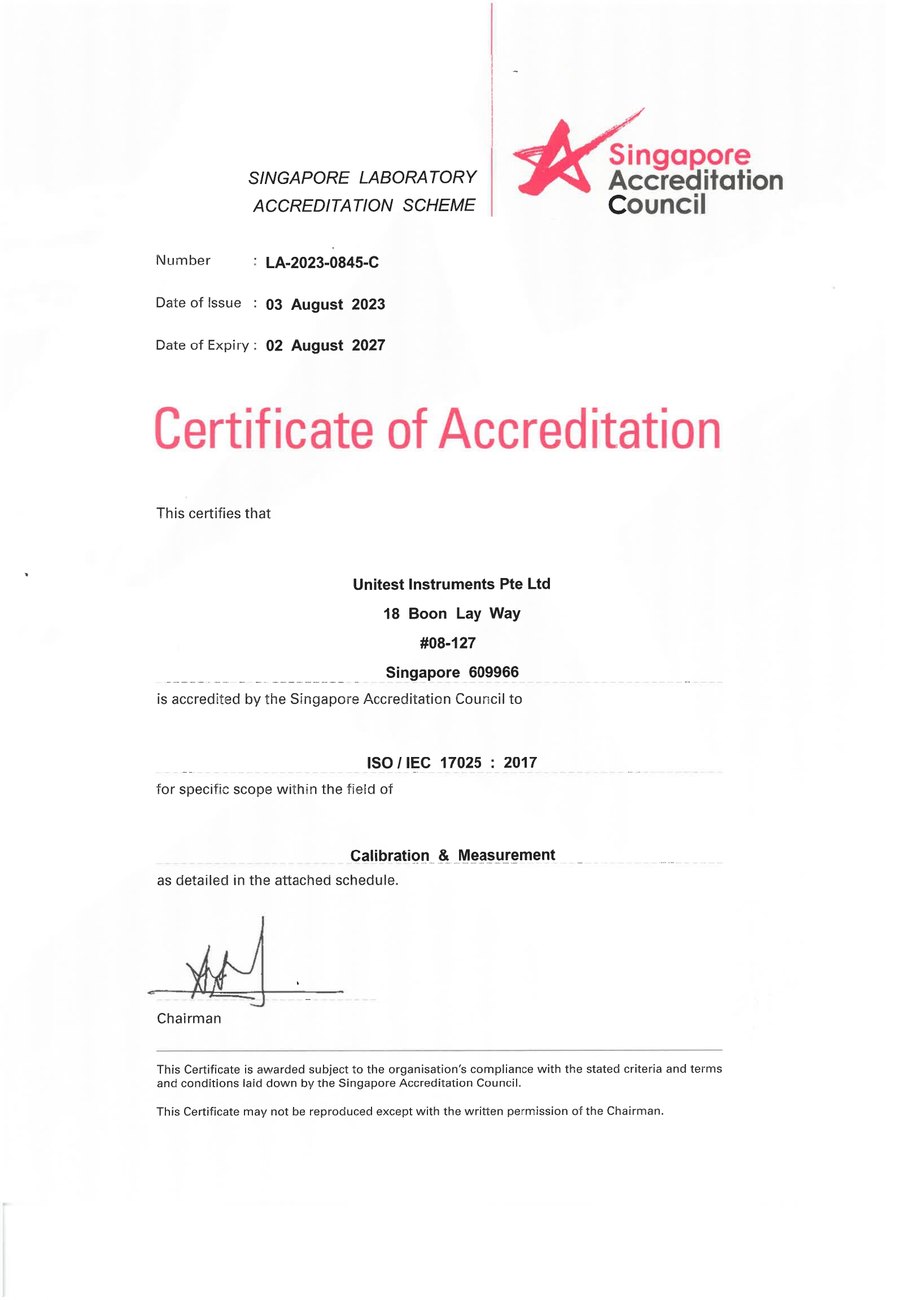
SAC-SINGLAS accredited calibration laboratory (Acc. No. LA-2023-0845-C) serving Singapore's industrial, pharmaceutical, and manufacturing sectors. All content reflects our ISO/IEC 17025 accredited scope and is reviewed by our technical calibration team.
Need humidity or dew point calibration in Singapore?
Unitest Instruments is SAC-SINGLAS accredited (Acc. No. LA-2023-0845-C) to ISO/IEC 17025. Same-week turnaround, certificates accepted by ISO 9001 auditors and EMA-regulated operators.