
Key takeaways
- A calibration certificate must state the expanded measurement uncertainty (e.g. ±0.15°C, k=2, 95% confidence). Without this, it is a measurement report, not a calibration certificate under ISO/IEC 17025.
- The accreditation body logo (SAC-SINGLAS, UKAS, A2LA) and certificate number confirm the certificate was issued under an accredited management system. Verify these are present and the accreditation is current at sac.gov.sg.
- The traceability statement links the calibration to national standards (NMC Singapore for SAC-SINGLAS labs) via a chain of reference instruments, each with their own calibration records.
- "As Found" and "As Left" data on the certificate tells you the instrument's condition before adjustment and its post-adjustment performance. Both are needed for process risk assessment.
- The scope of calibration (which measurement ranges and functions were calibrated), must match your actual use; a certificate that covers only part of the instrument's use range does not satisfy compliance for the uncovered ranges.
Why a calibration certificate is not the same as a service sticker
Walk through many Singapore SME facilities and you will find instruments with calibration labels affixed. Colour-coded stickers showing a calibration date, a due date, and a technician's initials. These labels serve a useful internal purpose: they allow operators to see at a glance whether an instrument is within its calibration interval. But a label is not a calibration certificate, and when an auditor asks for your calibration records, the sticker is not what they mean.
A calibration label is an internal tracking tool. An ISO/IEC 17025 calibration certificate is a formal measurement record. A technical document that captures the specific measurement results obtained during a specific calibration event, the reference standards used, the environmental conditions at the time, and the expanded uncertainty associated with each result. The certificate is the evidence; the sticker is merely a visual reminder that the evidence exists somewhere on file.
This distinction matters because ISO 9001:2015 clause 7.1.5 requires organisations to "retain appropriate documented information as evidence of fitness for purpose of the monitoring and measuring resources." Fitness for purpose cannot be demonstrated by a sticker. It requires data. Specifically, measurement data with stated uncertainties that allow a quality engineer to compare the instrument's actual performance against the maximum permissible error for its intended use. Without that comparison, no one can confirm the instrument was fit for purpose during the period it was in service.
Many Singapore SMEs receive instruments back from calibration service providers with a label and a slip of paper that records only pass/fail outcomes. This is a common gap in calibration management, and one that regularly generates findings in ISO 9001 surveillance audits. A pass/fail outcome, without the underlying measurement data and stated uncertainty, does not satisfy the documented evidence requirement. The certificate must contain the numbers.
The header: accreditation, certificate number, and lab identity
The first thing an auditor looks at when reviewing a calibration certificate is the header, and most of what they need to make an initial assessment is concentrated in the top section of the document.
The certificate title. A document issued under an accredited management system must be titled "Calibration Certificate" (or the equivalent in the relevant language). This is not a naming convention, under ISO/IEC 17025 §7.8, the title is a formal statement of the document type. A document titled "Service Record," "Measurement Report," or "Test Certificate" is not a calibration certificate and should not be filed as one in a quality management system.
The accreditation body logo and accreditation number. For SAC-SINGLAS accredited laboratories in Singapore, the certificate will carry the SAC-SINGLAS logo and an accreditation number in the format LA-2023-0845-C. This format encodes specific information: LA identifies it as a laboratory accreditation (as distinct from an inspection body or product certification); the year (2023) is the year of initial accreditation; the sequence number (0845) is the unique lab identifier; and C indicates the calibration scope. The accreditation number is the key to verification, enter it at sac.gov.sg to confirm the accreditation is current, what scope is covered, and when the last assessment was conducted. A logo without a verifiable accreditation number is a marketing claim, not an accreditation statement.
The issuing laboratory identity. The certificate must state the name, address, and contact details of the laboratory that performed the calibration. This matters because accreditation is location-specific. A laboratory accredited for its registered premises in Singapore is not automatically accredited to perform calibrations at a customer's site, unless on-site calibration is explicitly within its scope. If the certificate states a head-office address but the calibration was performed at a branch location, confirm that location is covered by the accreditation.
The certificate number. Every calibration certificate has a unique reference number that links it to the laboratory's internal quality records. If authenticity is ever challenged (if a customer or regulator questions whether a certificate was genuinely issued by the stated lab), the certificate number is the reference used to verify the record in the lab's management system.
Instrument identification. The serial number matters
The instrument description section of the certificate is the physical link between the document and the specific device in your possession. Every field in this section must be accurate and verified against the instrument itself.
The required fields are: make (manufacturer), model, serial number, and (where applicable), asset tag or internal equipment ID. Of these, the serial number is the most critical. An auditor checking calibration records will typically walk to the instrument and compare the serial number on the instrument's nameplate or label against the serial number on the certificate. If they do not match, the certificate does not belong to that instrument. This is a direct audit finding. Not a minor documentation gap, but evidence that the calibration record and the physical instrument are not connected.
Common causes of serial number mismatches include instruments that were replaced (and the new instrument was not sent for calibration before being put into service), instruments whose labels have been defaced or replaced, and simple transcription errors during certificate preparation. The last case (a typo in the serial number), is correctable by requesting an amended certificate from the issuing laboratory. The first case requires sending the replacement instrument for calibration before it is used in quality-critical measurements.
The asset tag field is your internal identification number. The identifier used in your calibration management register. Including this on the certificate makes it straightforward to link certificates to your asset register without manually cross-referencing serial numbers. If your calibration service provider does not include the asset tag, request that they do so or maintain your own cross-reference in the register. The goal is that any auditor, starting from either the instrument or the calibration record, can reach the other without friction.
The traceability chain. What "traceable to NMC" actually means
The section of the certificate that lists the reference instruments used is the foundation of the document's technical credibility. It is also the section that many certificate readers skip. A mistake, because this is where the metrological value of the certificate is actually established.
Traceability in metrology means that a measurement result can be linked to a reference (ultimately, to the SI units), through an unbroken chain of calibrations, each with a stated uncertainty. For a SAC-SINGLAS accredited laboratory in Singapore, the chain terminates at the National Metrology Centre (NMC), a division of A*STAR that maintains Singapore's national measurement standards. The NMC's standards are themselves linked to the international system through the BIPM (Bureau International des Poids et Mesures) via bilateral comparisons and mutual recognition arrangements.
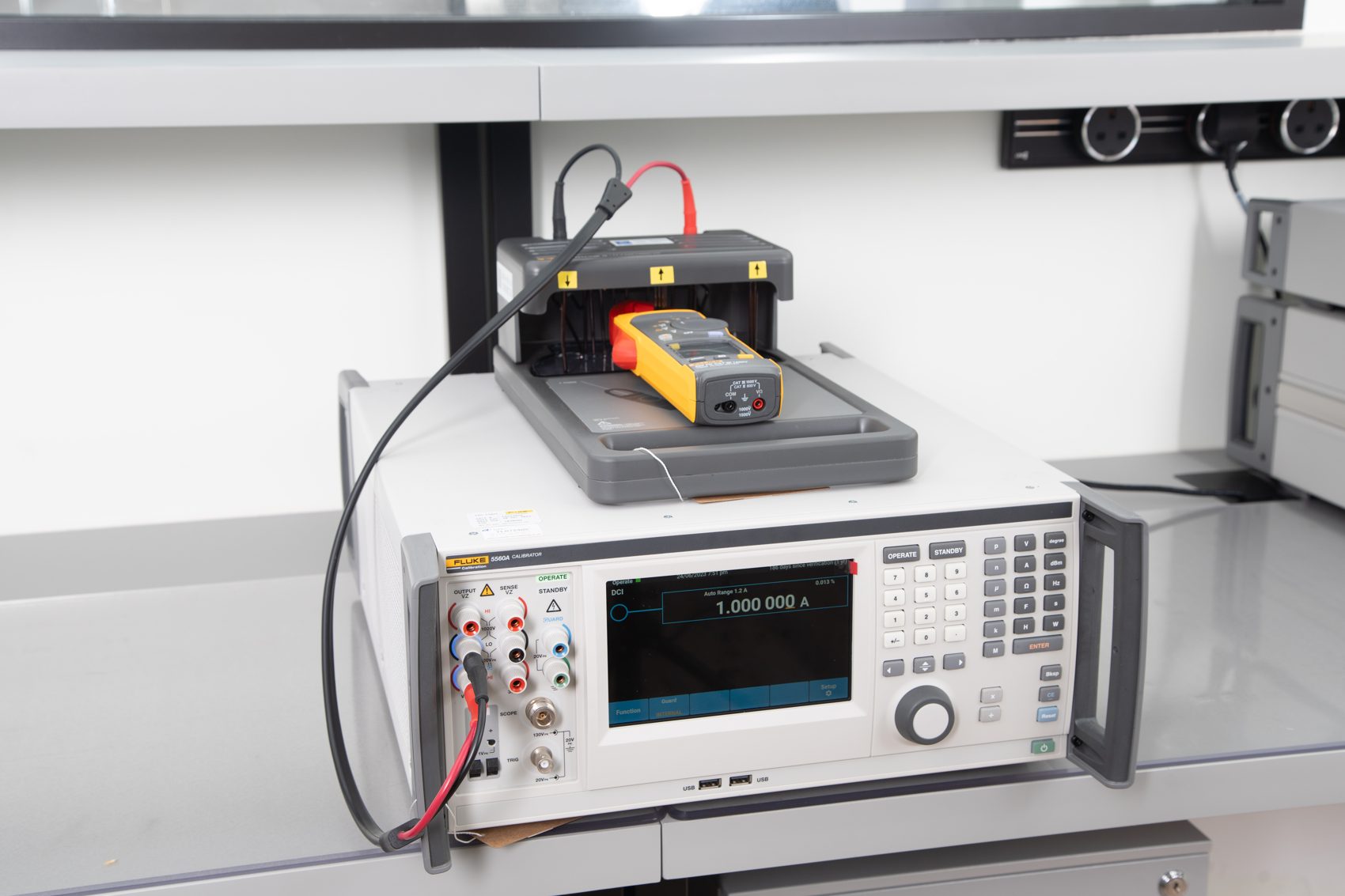
On a calibration certificate, the reference instruments section lists the specific standards used during the calibration, for example, a reference multimeter, a decade resistance box, or a precision temperature bath. Each of these should have its own calibration certificate number listed, which ties the reference's traceability into the chain. In an audit, a quality engineer may request those reference certificates to verify that the chain is intact and that the reference instruments were within their calibration intervals at the time of the calibration under review.
A gap in the traceability chain. A reference instrument whose own calibration had expired at the time of the calibration, or whose certificate does not itself state a traceable reference. Invalidates the traceability claim on the certificate. This is a critical finding in a GMP or regulatory audit, because without a verified traceability chain, there is no basis for confidence that the measurement corresponds to the SI unit being measured. The certificate states a number, but without traceability, there is no way to know what that number actually means in absolute terms.
The ILAC Mutual Recognition Arrangement (ILAC MRA) ensures that NMC traceability, and by extension SAC-SINGLAS accredited calibration, is accepted by overseas regulators and customers in all ILAC MRA member economies. This is particularly important for Singapore manufacturers supplying overseas markets where the calibration evidence must be acceptable to foreign authorities without re-verification.
Environmental conditions. Why the room temperature is on the certificate
ISO/IEC 17025 §6.3 requires laboratories to monitor and control environmental conditions that could affect calibration results, and to document those conditions on the certificate. For many calibrations, the conditions at the time of measurement directly affect the measurement result, which is why the temperature, humidity, and (for some parameters) atmospheric pressure appear on the certificate.
The standard reference temperature for most electrical and dimensional calibrations is 23°C ± 2°C, as specified in IEC 60068-1. Calibrations performed significantly outside this range may produce results that differ from the nominal values at reference conditions, because many measurement devices have temperature coefficients. Their output changes with temperature in a predictable way. A resistance calibration performed at 30°C, for example, will give a different result than one performed at 23°C for a platinum RTD, because the resistance of platinum changes with temperature. The environmental conditions on the certificate allow a metrologist to assess whether the measurement was made under conditions consistent with the device's specifications.
For pharmaceutical and regulated industries, the environmental conditions field carries additional weight. GMP guidelines for instrument qualification (including qualification of temperature-controlled storage rooms, autoclaves, and incubators), require that the calibration of reference thermometers used in the qualification be performed under documented, controlled conditions. The environmental conditions on the certificate are part of the qualification record.
If your process requires instruments that are calibrated under conditions closely matching your use environment (for example, a humidity sensor to be used in a 30°C/80%RH tropical storage environment), confirm with the calibration laboratory that their environmental conditions during calibration are documented and appropriate. Some laboratories offer calibration at customer-specified environmental conditions, which may be relevant for temperature-sensitive applications.
The results table: As Found, As Left, and what they tell you
The results table is the technical core of the calibration certificate. It contains the actual measurement data from the calibration, and it is the section most directly relevant to compliance and process risk assessment.
A well-structured results table will present, for each calibration point: the nominal value (the value the instrument was commanded to or set to), the measured value (what the reference standard measured the instrument to be producing), the error or deviation (the difference between nominal and measured), and the expanded uncertainty associated with that measurement point. This data appears in two forms: As Found and As Left.
As Found data
As Found data is the instrument's measured performance when it arrived at the laboratory, before any adjustment was made. This is the instrument's condition during the calibration interval. The period since its last calibration. As Found data answers the question: how well did this instrument perform while it was in service?
The As Found data is critical for process risk assessment. If the As Found deviation at any measurement point exceeds your maximum permissible error (MPE) (the tolerance you have defined for that instrument in your quality management system), then any measurements made with that instrument during the calibration interval may have been out of tolerance. This triggers a mandatory investigation under most quality management frameworks: What measurements were taken with this instrument during the interval? What product or process decisions were based on those measurements? Do any of those decisions need to be reviewed?
A calibration certificate that does not include As Found data is incomplete for compliance purposes. Without it, you cannot perform the interval-risk assessment that ISO 9001 and GMP frameworks require when an instrument is found to be out of specification.
As Left data
As Left data is the instrument's measured performance after any adjustment was made. If the instrument was within tolerance on arrival and no adjustment was needed, As Found and As Left data may be identical (or the certificate may state "no adjustment required" and present only one set of readings). If the instrument was adjusted, As Left data shows its post-adjustment performance. This is its verified starting condition for the next calibration cycle.
The As Left data is also the basis for setting the next calibration interval. If the As Left data shows the instrument performing comfortably within tolerance with significant margin, and the As Found data from successive calibrations shows minimal drift, there may be justification for extending the calibration interval. If As Found data consistently shows drift approaching the MPE, a shorter interval may be warranted.
Expanded uncertainty. The number that defines the certificate's value
The expanded uncertainty statement is, in many respects, the single most important technical element on a calibration certificate. It is also the element most frequently missing from certificates issued by non-accredited or under-resourced calibration providers, and its absence is the most common cause of calibration-related audit findings.
The expanded uncertainty is expressed as U = k × uc, where uc is the combined standard uncertainty (a quadrature combination of all identified uncertainty sources) and k is the coverage factor. For most calibration certificates, k=2 is used, which corresponds to approximately 95% confidence for a normal distribution. A certificate might state: "Expanded uncertainty U = ±0.15°C, k = 2, approximately 95% confidence."
Why does this matter? Because without a stated uncertainty, you cannot determine whether your instrument is fit for its intended purpose. Suppose your process requires temperature measurement accurate to ±0.5°C, and your instrument's specification is ±0.5°C. If the calibration certificate reports a deviation of +0.2°C with an expanded uncertainty of ±0.3°C, the true value of the deviation could be anywhere from −0.1°C to +0.5°C at 95% confidence. The instrument is confirmed to be within its specification only at the upper bound of that range. Your quality engineer needs this information to make a compliant fitness-for-purpose decision.
This is the guard band concept. When the calibration uncertainty is not negligible relative to the instrument's specification, a simple pass/fail judgment is technically incorrect, because the uncertainty means the instrument might be outside specification even when the measured deviation is within the specification limit. An accredited calibration certificate with stated uncertainty gives you the data to apply a guard band and make a defensible compliance decision.
Under ISO 9001:2015 clause 7.1.5, the requirement is explicit: when calibration or verification is carried out, "measuring equipment shall be calibrated or verified… against measurement standards traceable to international or national measurement standards; when no such standards exist, the basis used for calibration or verification shall be retained as documented information." The clause further requires the organisation to "determine if the validity of previous measuring results has been adversely affected" if the instrument is found to be out of specification. Neither of these requirements can be properly implemented without a calibration certificate that includes stated measurement uncertainty.
Certificates that include everything your auditor needs. Including stated uncertainty
Every Unitest SAC-SINGLAS calibration certificate includes As Found data, As Left data, stated expanded uncertainty, and full traceability to NMC Singapore. Ready for ISO 9001, GMP, and regulatory submission.
The scope of calibration. What was actually calibrated
A calibration certificate covers what was actually calibrated during the calibration event, and only that. This is the scope of calibration, and it is one of the most practically important sections of the certificate for ensuring your compliance posture is complete.
Consider a digital multimeter (DMM). A modern DMM measures AC voltage, DC voltage, AC current, DC current, resistance, continuity, capacitance, frequency, and temperature (with a thermocouple probe). Each of these functions has multiple measurement ranges. A full calibration of a DMM would cover every function and range relevant to its intended use. But many calibration providers (and many customers, when specifying calibration), cover only the most commonly used functions: DC voltage and resistance, for example.
If your compliance requirement covers the use of the DMM for AC current measurement, and the calibration certificate covers only DC voltage and resistance, the AC current function is uncalibrated, and the certificate does not satisfy compliance for that function. An auditor who looks at how the instrument is used and then reads the certificate scope will identify this gap immediately.
Before sending instruments for calibration, define the full scope of use (every measurement function and range used in your process), and confirm with the calibration laboratory that all of those functions and ranges are within their accredited scope. Request that the calibration cover all relevant functions. When you receive the certificate, check the results table against your intended use scope before filing the certificate.
The scope of calibration is also affected by the accreditation scope of the laboratory. A laboratory may be capable of calibrating a function but not accredited for it. A certificate covering measurements outside the laboratory's accredited scope may state clearly that those measurements are "not covered by the accreditation". A statement you should heed when assessing compliance. For regulated industries, only measurements within the accredited scope carry the full weight of the accreditation.
Common audit findings related to calibration certificates
The following ten findings appear regularly in ISO 9001, GMP, and regulatory audits of calibration records. Understanding them is the fastest way to identify and close gaps in your own calibration programme before an external auditor does.
- No measurement uncertainty stated. The most common finding. A certificate that presents readings or pass/fail results without stating the expanded uncertainty and coverage factor does not meet ISO/IEC 17025 requirements for a calibration certificate and does not satisfy ISO 9001:2015 clause 7.1.5. Request replacement certificates with stated uncertainty from any provider whose documents omit this.
- Certificate covers only part of the instrument's use range. The calibrated functions and ranges on the certificate do not fully cover the instrument's use in your process. The uncovered functions are not demonstrated to be fit for purpose. Re-specify the calibration scope to match actual use.
- Serial number on the certificate does not match the instrument. The physical link between document and instrument is broken. No other evidence compensates for this mismatch. Contact the laboratory immediately for a corrected certificate or recalibration.
- Calibration date is after the instrument's due date. A gap in calibration status occurred. The instrument was used in quality-critical measurements while overdue. This typically requires a documented investigation of potential impact on product or process decisions made during the gap period.
- No "As Found" data, only post-adjustment readings. Without As Found data, the interval-risk assessment cannot be performed. It is not possible to determine retrospectively whether measurements taken during the interval were within tolerance. This is particularly serious in GMP environments where batch records reference specific instrument readings.
- Reference instrument traceability chain not stated or incomplete. The certificate lists reference instruments used but does not state their own calibration certificate numbers, or the referenced certificates cannot be produced. Without a verifiable traceability chain, the measurement's connection to national standards is undemonstrated.
- Accreditation logo present but accreditation is no longer current. Laboratories can lose or voluntarily withdraw from accreditation. A certificate issued after accreditation lapsed carries the logo but the accreditation was not in force at the time of issue. Always verify accreditation currency at sac.gov.sg for the specific date of calibration.
- Certificate contains only pass/fail, with no measurement data. A pass/fail outcome, in isolation, does not demonstrate the measurement result, the deviation from nominal, the uncertainty, or the margin to the specification limit. It is not a calibration certificate. This is a particularly common finding for instruments calibrated by equipment manufacturers as part of a service contract.
- Calibration due date is missing. Without a stated due date, the calibration recall programme cannot operate. Best practice is for the calibration laboratory to state a recommended next calibration date on the certificate, which your calibration management system uses to generate recall alerts.
- Environmental conditions not recorded for temperature- or humidity-sensitive calibrations. For instruments whose performance depends on temperature (precision resistors, thermometers, humidity sensors), the absence of documented environmental conditions at the time of calibration makes the measurement result ambiguous and potentially unreproducible.
How to manage your calibration certificates. Practical systems
A calibration certificate that satisfies all technical requirements is of limited value if it cannot be located when an auditor asks for it. Calibration record management is a core competency in any quality management system, and the scale of solution should be proportionate to the number of instruments under management.
The calibration register. The minimum viable system is a structured register (most commonly a spreadsheet), that tracks every instrument subject to calibration. Each row in the register corresponds to one instrument and should capture: equipment ID (your internal asset number), description, make, model, serial number, calibration date, certificate reference number, calibration laboratory, laboratory accreditation number, next due date, and the measurement functions and ranges calibrated. The register provides the at-a-glance view of calibration status across the instrument fleet and the audit trail that an auditor will walk through.
Certificate filing. Physical certificates should be filed by instrument ID and date, with the most recent certificate readily accessible. Digital copies should be stored in a document management system or shared drive with consistent naming conventions (e.g. [AssetID]-[CalibrationDate]-[CertificateNumber].pdf). The file name should be sufficient to locate the correct certificate without opening it.
Recall alerts. The register should generate automatic recall alerts (typically 4 to 6 weeks before the due date), to allow sufficient time to arrange calibration and receive the certificate before the current calibration expires. Instruments that pass their due date without renewal should trigger an immediate process review: were they used in quality-critical measurements during the overdue period?
On-receipt verification. When a calibration certificate is received, verify it before filing. The verification checklist should include: (1) Is the title "Calibration Certificate"? (2) Does the accreditation number appear and is it current at sac.gov.sg? (3) Does the serial number match the instrument? (4) Is expanded uncertainty stated? (5) Are As Found and As Left data present? (6) Does the scope cover all intended use functions and ranges? (7) Is a due date stated? A certificate that fails any of these checks should be returned to the issuing laboratory with a request for correction before it is filed as a compliance record.
Calibration management software. For organisations managing more than fifty instruments, dedicated calibration management software (CMMS or LIMS modules) substantially reduces administrative burden and human error in recall management. Many enterprise quality management systems include calibration modules that link certificates to assets, generate recall alerts, and produce compliance reports for audit preparation. For ISO 9001-certified facilities and GMP-regulated operations, the investment in a proper calibration management system is typically justified by the reduction in audit findings and the elimination of the manual register maintenance burden.
The goal of the management system (whatever its scale), is that any auditor, starting from any instrument in the facility, can within minutes produce the current calibration certificate, verify its accreditation, confirm the serial number matches, locate the As Found and As Left data, identify the measurement uncertainty, and confirm the instrument remains within its calibration interval. That is the standard against which calibration management systems should be designed and maintained.
Reading a calibration certificate: a section-by-section reference
The table below consolidates every section of a standard SAC-SINGLAS accredited calibration certificate, what it contains, and why it matters for compliance.
| Certificate Section | What It Contains | Why It Matters |
|---|---|---|
| Certificate title & number | "Calibration Certificate" + unique reference number | The unique reference links to the lab's management system record; auditors use this to verify authenticity |
| Accreditation body logo & number | SAC-SINGLAS logo + "LA-2023-0845-C" format | Confirms accredited scope; verify at sac.gov.sg. A logo without a verifiable number is meaningless |
| Issuing laboratory | Lab name, address, contact | Confirms the actual calibration location (not a subcontracted lab unless declared) |
| Date of calibration | When the calibration was performed | Establishes the calibration validity period; the calibration interval clock starts here, not on receipt |
| Instrument description | Make, model, serial number, asset tag | Links the certificate to the specific physical instrument; serial number must match |
| Measurement standards used | Reference instruments with their own certificate numbers and uncertainties | The traceability chain. Each reference must itself be traceable to an NMI |
| Environmental conditions | Temperature, humidity, pressure at time of calibration | Required by ISO/IEC 17025; affects measurement uncertainty for temperature-sensitive instruments |
| Calibration procedure | Method reference (internal SOP or published standard) | Identifies the measurement protocol; critical for reproducibility and auditing the method |
| Results table (As Found) | Nominal value, measured value, error, uncertainty | The state of the instrument before any adjustment. Essential for process risk review of the interval |
| Results table (As Left) | Nominal value, measured value, error, uncertainty | Post-adjustment performance. The verified starting state for the next calibration cycle |
| Expanded uncertainty statement | U = [value], k = 2, ~95% confidence | The formal uncertainty claim. Required under ISO/IEC 17025 for a calibration certificate |
| Authorised signatory | Name and signature of technically responsible person | The individual who reviewed and approved the certificate; required under ISO/IEC 17025 §7.8 |
| Calibration due date | Recommended next calibration date | Advisory only (the customer's calibration programme sets the actual interval), but required for recall management |
Frequently asked questions
Yes, under ISO/IEC 17025, a calibration certificate must state the expanded measurement uncertainty for each calibration result. Without it, the document does not meet the requirements of an accredited calibration certificate and is technically a measurement report. ISO 9001:2015 clause 7.1.5 further requires that measuring equipment produce results with stated measurement uncertainties. A certificate that lists only readings or pass/fail outcomes, without uncertainty expressed as U = ±[value], k = 2, approximately 95% confidence, is non-conforming and will commonly trigger an audit finding. When evaluating a calibration provider, ask to see a sample certificate before engaging. The presence of a stated expanded uncertainty is a reliable indicator that the provider is operating to the standard.
As Found data records the instrument's measured performance before any adjustment, reflecting its condition during the calibration interval. It is critical for assessing whether measurements taken with the instrument during that period were within tolerance. If the As Found deviation exceeds your maximum permissible error, a retrospective process risk assessment is required. As Left data records post-adjustment performance. The instrument's verified starting condition for the next calibration cycle. Both sets of data are required for a complete compliance record. A certificate showing only one set of readings without distinguishing pre- and post-adjustment is ambiguous and insufficient for a thorough audit review.
Go to sac.gov.sg, navigate to Accredited Laboratories, and search by the laboratory's name or their stated accreditation number. For Unitest Instruments, the accreditation number is LA-2023-0845-C. The result shows whether the accreditation is currently active, the date of the most recent assessment, and the full scope of accreditation. The specific parameters and measurement ranges covered. Always verify that the parameter you required calibrated falls within the listed scope. Accreditation is scope-specific: a laboratory accredited for electrical parameters is not automatically accredited for pressure or temperature calibration, and results outside the scope are not covered by the accreditation even if the number appears on the certificate.
A pass/fail-only certificate does not meet the requirements of ISO 9001:2015 clause 7.1.5. The clause requires calibration to provide results with stated measurement uncertainties, which a pass/fail outcome cannot demonstrate. Without the actual measurement data (nominal value, measured value, deviation, and expanded uncertainty), there is no basis for confirming whether the instrument is fit for its intended use within your process tolerances. Auditors familiar with the 2015 revision will raise a non-conformance against a pass/fail-only certificate for instruments used in quality-critical measurements. Request that your calibration provider issue full data certificates, or seek an alternative accredited provider.
Yes, in most cases. Provided the issuing laboratory is accredited by a body that is a signatory to the ILAC Mutual Recognition Arrangement (MRA). UKAS (UK), A2LA, and NVLAP (US) are all ILAC MRA signatories, as is SAC-SINGLAS (Singapore). Under the ILAC MRA, certificates from accredited laboratories in member economies are recognised in all other member economies without re-calibration. Verify that the accreditation body is listed as an ILAC MRA signatory and that the accreditation is current for the specific parameter. For submissions to Singapore regulatory bodies such as HSA or CAAS, confirm the specific acceptance policy of that authority, as some may specify a preference for locally accredited certificates.
A serial number mismatch is a direct audit finding. The serial number is the physical link between the certificate and the specific instrument in your possession. If the numbers do not match, the certificate does not legally or technically belong to that instrument, and an auditor will question whether the instrument has ever been properly calibrated. If you discover a mismatch, contact the issuing laboratory immediately: a transcription error is correctable with an amended certificate, while a genuine instrument substitution requires sending the correct instrument for calibration before it returns to service. Do not attempt to resolve a mismatch by relabelling or remarking the instrument. This creates an even more serious compliance problem.
Retention periods depend on your compliance framework. ISO 9001:2015 requires documented information to be retained for periods determined in your quality management system. Typically a minimum of three years, though many QMSs specify five to seven years for calibration records. GMP-regulated environments often require retention for the life of the product plus one year, or longer for batch records tied to a specific product lot. Regulatory submissions may require supporting calibration records to be available for the duration of a licence or approval. Best practice is to retain all calibration certificates for at least the life of the instrument plus one full calibration cycle after disposal. Ensuring the historical record is complete if the instrument's past performance is ever questioned in a retrospective review.
Unitest Instruments Pte. Ltd. is a SAC-SINGLAS accredited calibration laboratory (ISO/IEC 17025, no. LA-2023-0845-C) based in Singapore. We calibrate electrical, temperature, pressure, humidity, and related instruments for manufacturers, service providers, and regulated industries across Singapore and the region. Every certificate we issue includes stated expanded uncertainty and full As Found / As Left data.
Get calibration certificates that satisfy every audit. Including stated uncertainty
Unitest issues SAC-SINGLAS accredited calibration certificates with full As Found/As Left data, stated expanded uncertainty, and NMC-traceable references. Every field that matters is included.
Verifiable at sac.gov.sg · Acc. No. LA-2023-0845-C · ISO/IEC 17025 accredited