
Key Takeaways
- Michell chilled-mirror instruments offer the highest accuracy and are themselves primary standards. Ideal for reference lab use and sub-ppm trace moisture verification.
- Vaisala DRYCAP sensors recover faster from moisture excursions, reducing downtime in production environments where wet upsets occasionally occur.
- Both brands require periodic calibration against traceable standards; neither is a set-and-forget instrument.
- For Singapore's ISO 8573-1 compressed-air compliance verification, either brand works well in Class 2–6; Michell has a clear edge at Class 1 (−70 °C).
- Total cost of ownership matters more than purchase price. Factor in sensor replacement, calibration frequency, and sampling system maintenance.
Why Dew Point Brand Selection Matters
Dew point measurement is not a commodity. At ambient humidity levels, most competent sensors will agree. But when measuring trace moisture in compressed gases, semiconductor process streams, or pharmaceutical-grade air (where the dew point might be −40 °C, −60 °C, or even −80 °C), instrument design, sensor technology, and calibration traceability determine whether your reading is reliable or misleading.
Michell Instruments (UK) and Vaisala (Finland) are the two names that appear most often in Singapore procurement specifications. Both have strong reputations, broad distributor networks, and decades of field experience. The choice between them is not about quality. It is about matching instrument characteristics to your specific measurement task.
As an ISO/IEC 17025 accredited laboratory that calibrates and supplies both brands, Unitest sees the differences not just on paper but on the calibration bench. This guide summarises what we observe and recommends clearly for each use case.
It is also worth being upfront about a common misconception in this category: neither brand is universally "the more accurate one." Accuracy in dew point measurement is range-dependent, application-dependent, and heavily influenced by sampling system design, calibration currency, and contamination history, far more than most procurement conversations acknowledge. A Vaisala DRYCAP probe correctly specified, well-sampled, and recently calibrated will often outperform a Michell Al₂O₃ sensor that is overdue for calibration or installed on a compromised sampling line, and the reverse is equally true. The brand comparison in this guide is meaningful primarily as a starting point for matching sensor technology to application requirements, not as a simple ranking of one manufacturer over the other.
Sensor Technology: The Core Difference
Michell: Chilled Mirror and Aluminium Oxide
Michell's flagship approach is the chilled-mirror hygrometer. A thermoelectrically cooled mirror whose surface temperature is servo-controlled to maintain the dew or frost point. Because the measurement depends on optical detection of condensation, it is a fundamental physical measurement rather than an inference from an impedance or capacitance change. Michell's chilled-mirror instruments (the S8000 series and Optidew range) are themselves used as primary reference standards and are traceable to national metrology institutes.
For trace moisture, Michell also produces the QMA series using aluminium oxide (Al₂O₃) sensors, which are capacitive but factory-characterised against the chilled mirror to achieve dew point uncertainty of ±1 °C or better across the −100 to 0 °C range. These are the workhorses for compressed-gas monitoring in refinery, pharmaceutical, and semiconductor applications.
Vaisala: DRYCAP Capacitive Polymer
Vaisala's proprietary DRYCAP technology uses a thin-film capacitive polymer sensor that is moisture-permeable and impedance-responsive. What sets DRYCAP apart from generic capacitive sensors is a patented chemical purge cycle: the sensor is periodically heated to purge absorbed contaminants and re-zero itself in the field. This gives Vaisala instruments a notable advantage in environments where the gas being measured occasionally carries hydrocarbons, silicones, or other contaminant species that would permanently drift a standard aluminium oxide sensor.
The DMT series covers −70 to +60 °C dew point, which covers nearly all compressed-air and industrial gas monitoring tasks. The Indigo series adds a modular platform with interchangeable probes. Vaisala instruments are not primary standards, but they are calibrated against traceable references at the factory and are stable enough to satisfy ISO 9001 and ISO 8573-1 audits when accompanied by a valid calibration certificate.
How a Chilled Mirror Hygrometer Actually Works
Because Michell's reference-grade instruments are built on this principle, it is worth understanding exactly what a chilled mirror does, since it explains both its accuracy advantage and its practical limitations. A small mirror, typically gold or rhodium-plated for a stable, well-characterised optical surface, is cooled by a thermoelectric (Peltier) element while an optical sensor continuously monitors the mirror's reflectivity. As the mirror cools, water vapour in the sample gas begins to condense onto its surface the instant the mirror reaches the dew point (or frost point, below 0°C), which changes the mirror's reflectivity in a way the optical sensor detects. A precision control loop then holds the mirror temperature at exactly the point where a thin, stable layer of condensation is maintained, neither growing nor evaporating, and a calibrated platinum resistance thermometer embedded in the mirror measures that equilibrium temperature directly. That measured temperature is, by definition, the dew point.
This is why chilled mirror technology is described as a fundamental, first-principles measurement rather than an inferred one: it does not rely on any material's absorption characteristics or an empirical calibration curve relating a secondary electrical property to humidity. It directly measures the physical condition under which condensation occurs. The trade-off is that it requires more careful engineering, precision optics, a stable Peltier cooling system, and a clean mirror surface, and it is generally a larger, more expensive, and more maintenance-intensive instrument than a capacitive polymer probe, which is exactly why Michell's chilled-mirror line is positioned as a reference/primary-standard instrument rather than a low-cost, install-everywhere production monitoring probe.
Sampling System Design: Often the Real Source of Error
A detail that gets less attention than sensor brand, but frequently matters more in practice, is the design of the sampling system delivering gas to whichever dew point instrument is installed. Trace moisture measurement is uniquely sensitive to sample handling because the internal surfaces of any tubing, fitting, or sample chamber the gas passes through can themselves adsorb and slowly desorb moisture, a phenomenon sometimes called the "memory effect." A sampling line that previously carried wetter gas, or one made from a hygroscopic material, can continue releasing trace moisture into a supposedly dry sample stream for hours or even days after conditions change, producing a dew point reading that lags well behind the gas stream's actual, current condition.
Best practice for trace moisture sampling, applicable to both Michell and Vaisala instruments, uses electropolished stainless steel tubing (never plastic or rubber, both of which are notably worse for moisture memory effects), minimises sample line length and unnecessary fittings, maintains adequate sample flow to purge the system promptly, and, where practical, avoids dead-legs or stagnant sections where moisture can accumulate. An excellent instrument on a poorly designed sampling system will produce misleading, slow-to-respond readings regardless of brand, and conversely a well-designed sampling system materially improves the real-world performance of either manufacturer's sensor. This is worth raising directly with whichever supplier is helping specify a new dew point monitoring point, since sampling system design is frequently treated as an afterthought relative to the instrument selection itself.
Head-to-Head Comparison Table
| Feature | Michell Instruments | Vaisala |
|---|---|---|
| Primary sensor technology | Chilled mirror (primary standard) + Al₂O₃ (process) | DRYCAP thin-film capacitive polymer |
| Measurement range (typical) | −100 to +20 °C Td (QMA); −75 to +20 °C Td (chilled mirror) | −70 to +60 °C Td (DMT series) |
| Accuracy (typical) | ±0.5 °C Td (chilled mirror); ±1–2 °C Td (Al₂O₃) | ±2 °C Td at −40 to +20 °C Td; ±3 °C Td at −70 °C Td |
| Self-purge / auto-calibration | No (requires external calibration) | Yes (DRYCAP chemical purge cycle) |
| Recovery after moisture excursion | Slow (hours for Al₂O₃); chilled mirror auto-recovers | Fast (minutes, aided by purge cycle) |
| Contaminant resistance | Moderate. Hydrocarbons can permanently drift Al₂O₃ | Good. DRYCAP purge removes many contaminants |
| Use as primary reference standard | Yes (chilled-mirror models) | No. Transfer standard only |
| Typical purchase price (process analysers) | SGD 4,000–12,000+ | SGD 3,500–9,000+ |
| Sensor replacement cost | Moderate (Al₂O₃); low (chilled mirror. No consumable) | Moderate (DRYCAP probe replacement) |
| ISO 8573-1 Class 1 (−70 °C) verification | Fully capable | Marginal. Accuracy specification degrades at −70 °C |
| ISO 8573-1 Class 2–6 verification | Fully capable | Fully capable |
| Data logging / connectivity | 4–20 mA, RS-232/485, optional Ethernet | 4–20 mA, RS-485 Modbus, Indigo platform with USB/LAN |
| Field serviceability | Moderate. Al₂O₃ sensors can be user-replaced; chilled mirror requires lab return | Good. DRYCAP probes are user-replaceable in the field |
| Singapore calibration availability | Available at Unitest (SAC-SINGLAS accredited) | Available at Unitest (SAC-SINGLAS accredited) |
Need your Michell or Vaisala dew point instrument calibrated in Singapore?
Unitest Instruments calibrates both brands against NMC-traceable references and issues ISO/IEC 17025 certificates accepted by ISO 9001 and GMP auditors. Same-week turnaround available.
Use Case Recommendations: Which Brand Wins?
Semiconductor and Electronics Manufacturing
Winner: Michell. Singapore's wafer fab and advanced packaging facilities typically specify process gas dew points of −70 °C or below for nitrogen purge, clean dry air, and specialty gases. At this measurement depth, Vaisala's DMT series approaches the limits of its accuracy specification (±3 °C at −70 °C), while Michell's QMA series and chilled-mirror instruments operate confidently below −80 °C with ±1–2 °C uncertainty. For source verification and process qualification reports, having a chilled-mirror primary standard in the reference chain provides the metrological rigour that equipment qualifications (IQ/OQ/PQ) demand.
Pharmaceutical and Medical Device Manufacturing (GMP)
Winner: Michell for primary standard; Vaisala for continuous monitoring. GMP compressed-air systems (Annex 1, USP <1237>) require verifiable dew points at −40 to −70 °C. Many Singapore pharmaceutical manufacturers use a Michell chilled-mirror instrument as their reference during qualification and periodic re-validation, while deploying Vaisala DMT series instruments for day-to-day continuous monitoring on production lines. The Vaisala DRYCAP purge cycle is advantageous here. Pharmaceutical production lines occasionally expose sensors to cleaning agents and process excursions, and fast recovery minimises line downtime.
Industrial Compressed Air (ISO 8573-1 Classes 2–6)
Winner: Vaisala. For most manufacturing, food processing, and general-industry compressed-air systems operating at dew points between −40 °C and +10 °C, Vaisala's DMT series is an excellent choice. It is straightforward to install, the DRYCAP probe is field-replaceable, and the instrument's accuracy is more than sufficient for ISO 8573-1 Class 2–6 compliance verification. The Vaisala Indigo platform also allows one display transmitter to serve multiple probe types, which simplifies multi-point monitoring system procurement.
Natural Gas and Hydrocarbon Process Streams
Winner: Michell (with caveats). In hydrocarbon-rich gas streams, both sensors are vulnerable, but differently. Michell Al₂O₃ sensors are susceptible to permanent drift from hydrocarbon absorption over time, requiring more frequent calibration or replacement. Vaisala's DRYCAP purge cycle can remove light hydrocarbon contamination but is not effective against heavy fouling. For natural gas pipelines, Michell offers dedicated trace moisture analysers (Condumax series) with instrument-design features (sampling system bypass, automatic contamination detection), that are specifically engineered for this application.
Calibration Reference Laboratory Use
Winner: Michell, unambiguously. If you are building a calibration laboratory or need a reference standard to verify other instruments, only the chilled-mirror principle provides the measurement fundamentality required by ISO/IEC 17025 accreditation bodies. Michell's S8000 and Optidew systems are widely accepted as primary reference standards by accreditation bodies including SAC-SINGLAS. Vaisala does not offer a chilled-mirror product and is not positioned for primary-standard use.
Calibration Considerations for Singapore Users
Regardless of brand, dew point instruments require periodic calibration at appropriate intervals against NMC-traceable references. This is not optional under ISO 9001, GMP, or any process quality system. It is a fundamental requirement for demonstrated measurement traceability.
The practical difference between Michell and Vaisala in a calibration context is that Michell Al₂O₃ sensors can drift more rapidly in contaminated gas service. We have seen drift of 3–5 °C over six months in installations with imperfect upstream filtration. Vaisala DRYCAP instruments in clean compressed-air service tend to show lower drift between calibrations, often holding within ±2 °C over a 12-month period. Neither is a substitute for calibration, but if you are choosing an interval, instrument type and environment should inform the decision.
It is worth understanding what a proper calibration certificate should contain before accepting one for either brand. A certificate that does not state measurement uncertainty for each calibration point, or does not reference an accreditation body, does not meet ISO/IEC 17025 requirements and may not satisfy your auditor.
A practical habit worth adopting for any trace-moisture fleet, regardless of brand, is logging as-found readings across successive calibrations rather than only reacting to a pass or fail on the most recent certificate. Because both Al₂O₃ and DRYCAP sensors can drift gradually before finally failing an as-found check outright, a probe showing a steadily widening error across two or three consecutive calibrations is telling you it is approaching the end of its useful service life well before it actually fails a tolerance check, and replacing or servicing it proactively is considerably cheaper than discovering a failed compressed-air quality record during a customer or regulatory audit.
Singapore Procurement Context
Both Michell Instruments and Vaisala products are available through authorised distributors in Singapore. Lead times for standard models are typically two to six weeks from stock. For specialised configurations (high-pressure sampling systems, ATEX/IECEx hazardous-area units, or custom sampling panels), allow eight to fourteen weeks and factor this into project schedules.
When writing procurement specifications for a Singapore project, avoid specifying a single brand by name unless there is a genuine technical justification (e.g. "chilled-mirror primary standard required"). For most compressed-air quality monitoring applications, a performance specification , "dew point range −70 to +20 °C Td, accuracy ±2 °C Td, with valid SAC-SINGLAS traceable calibration certificate". Allows competition and avoids procurement challenges under government tendering rules.
Unitest Instruments supplies both Michell and Vaisala instruments and can provide technical pre-bid advice to help you write an accurate performance specification for your application. We also calibrate instruments from both manufacturers at our SAC-SINGLAS accredited laboratory, so you can source, commission, and maintain your dew point instrumentation through a single accredited partner.
Response Time and Equilibration Lag: A Practical Difference That Rarely Appears on a Spec Sheet
How quickly an instrument's reading catches up with a genuine change in the sample gas's moisture content is a practical characteristic that matters enormously for process control decisions but is often absent, or buried in fine print, on manufacturer datasheets. A chilled-mirror instrument's response time is governed by how fast its Peltier element can drive the mirror to a new equilibrium temperature, which is generally fast for small step changes but can take several minutes to fully settle after a large humidity excursion, since the control loop is deliberately conservative to avoid overshoot that would damage measurement stability. Capacitive polymer sensors, including both Michell's Al₂O₃ and Vaisala's DRYCAP, respond according to how quickly water vapour diffuses into and out of the sensing film, which is itself a function of the current dew point level: response is markedly faster when moving toward a wetter condition than when drying out from a wet condition, because desorption of the last trace molecules from the polymer is an inherently slower process than initial absorption.
For a process where a genuine moisture excursion needs to trigger an alarm or an automated response within minutes, rather than being discovered on a periodic log review, this asymmetric response behaviour is worth testing under realistic conditions before an instrument is relied upon for automated control decisions, not just accepted on the strength of a "response time: T90 in X seconds" datasheet figure that was likely measured under idealised, single-direction step-change laboratory conditions.
Frequently Asked Questions
For sub-ppm trace moisture (below −60 °C dew point), Michell's chilled-mirror and aluminium oxide sensors typically offer superior accuracy and lower drift. Vaisala's DRYCAP technology is excellent down to about −70 °C Td and is faster to recover after moisture excursions, making it more practical for many industrial settings. For extremely dry gases such as semiconductor process gas or high-purity nitrogen, Michell is generally the more precise choice.
Not reliably with a single instrument. Ambient relative humidity measurement (10–95 % RH) and trace moisture measurement (−80 to −40 °C dew point) require fundamentally different sensor technologies and sampling systems. Vaisala's product line spans both ranges via separate instrument families; Michell's portfolio is similarly segmented. Using an instrument outside its rated range will produce unreliable readings and risks sensor damage.
Both manufacturers typically recommend annual calibration under normal operating conditions. In demanding environments (corrosive gases, high-pressure sampling, or pharmaceutical-grade compressed air), six-monthly calibration intervals are common. Your calibration interval should also be informed by your quality management system requirements (e.g. ISO 9001, GMP) and the criticality of the process being measured. See our article on how often to calibrate instruments for a detailed risk-based approach.
Yes. Unitest Instruments is SAC-SINGLAS accredited (Acc. No. LA-2023-0845-C) to ISO/IEC 17025 for humidity and dew point calibration. We calibrate and service instruments from both Michell and Vaisala, and our calibration certificates are traceable to NMC Singapore and accepted by ISO 9001 auditors. We also supply both brands, contact us for a quotation.
Relative humidity (RH) expresses water vapour content as a percentage of the maximum the air can hold at a given temperature. It changes as temperature changes even if the absolute moisture content is constant. Dew point temperature is the temperature at which air becomes saturated and condensation begins; it is an absolute measure that does not change with temperature. For process control and compressed-air quality, dew point is far more reliable than RH.
ISO 8573-1 defines three humidity classes relevant to most industrial users: Class 4 (≤+3 °C pressure dew point), Class 5 (≤+7 °C), and Class 6 (≤+10 °C). For instrument air and pharmaceutical applications, Class 1 (≤−70 °C) and Class 2 (≤−40 °C) apply. Both Michell and Vaisala offer analysers that cover these classes, but instrument selection must match the specific class you need to verify.
For semiconductor fab and advanced electronics requiring dew points below −60 °C in process gases such as nitrogen or argon, Michell's QMA series and its chilled-mirror primary standards are typically preferred because of their measurement traceability and sub-ppm resolution. Vaisala's DMT series is a strong alternative where faster response and lower maintenance burden are priorities, particularly for ambient-level cleanroom monitoring rather than ultra-dry process gas verification.
Ask for a calibration certificate that states: (1) the accreditation body and certificate number (e.g. SAC-SINGLAS LA-2023-0845-C), (2) traceability chain to a national metrology institute, (3) measurement uncertainty for each calibration point, (4) the calibration points used and the instrument's error at each point, and (5) the date of calibration and recommended recalibration date. A certificate lacking measurement uncertainty is not compliant with ISO/IEC 17025 and may not be accepted by auditors. Read our full guide on what a calibration certificate should contain for more detail.
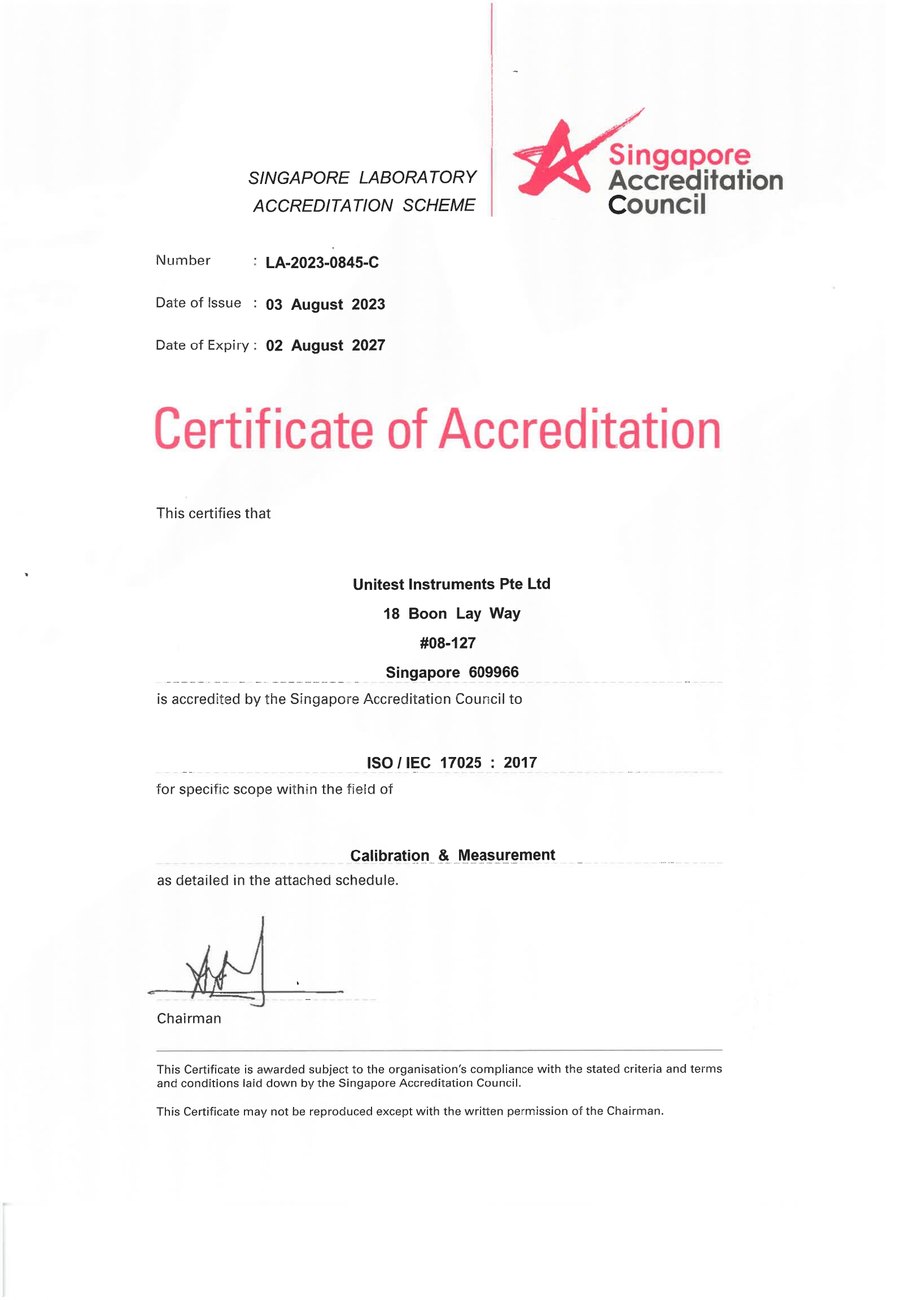
SAC-SINGLAS accredited calibration laboratory (Acc. No. LA-2023-0845-C) serving Singapore's industrial, pharmaceutical, and manufacturing sectors. All content reflects our ISO/IEC 17025 accredited scope and is reviewed by our technical calibration team.
Need dew point calibration in Singapore?
Unitest Instruments is SAC-SINGLAS accredited (Acc. No. LA-2023-0845-C) to ISO/IEC 17025. We calibrate Michell, Vaisala, and other dew point instruments with same-week turnaround. Certificates accepted by ISO 9001 and GMP auditors.