
Key Takeaways
- ISO 8573-1:2010 defines nine moisture purity classes by pressure dew point (PDP). Your instrument must measure low enough to verify your target class.
- Singapore's tropical climate (ambient RH routinely above 80%) puts far greater demand on dryers and dew point meters than temperate-climate specifications suggest.
- Aluminium oxide and polymer capacitive sensors suit routine monitoring; chilled mirror hygrometers are the reference standard for low-uncertainty or regulatory measurements.
- Newly purchased dew point meters should be calibrated at a SAC-SINGLAS accredited laboratory before first use. Manufacturer factory certificates alone do not satisfy ISO 9001 or HSA GMP audit requirements.
- Annual calibration intervals are common, but your documented interval review should be driven by measurement criticality and historical drift. Not just the manufacturer's default recommendation.
Who Needs a Dew Point Meter for Compressed Air?
Compressed air is the "fourth utility" of industrial Singapore. Alongside electricity, water, and gas, it powers pneumatic tools, actuators, instrumentation, spray coating, conveying systems, and cleanroom pressurisation across every major sector. Unlike the other utilities, however, its quality is generated on-site, with every compressor introducing ambient air, and Singapore's ambient air carries some of the highest moisture loads in the world.
Anyone operating a compressed air system where product quality, equipment reliability, or regulatory compliance depends on moisture control needs a dew point meter. In practice this includes: pharmaceutical manufacturers subject to HSA GMP requirements; food and beverage producers complying with SS 601 and ISO 22000; electronics fabricators with cleanroom or nitrogen-purging requirements; oil and gas facilities with instrument air circuits; hospitals and medical device manufacturers; and any factory holding ISO 9001 certification where compressed air is identified as a process utility.
A dew point meter also serves as a diagnostic tool. If your refrigerated or desiccant dryer is silently degrading, the dew point at the dryer outlet will rise (sometimes by 10–20 °C), before any visible symptom appears. Catching this early saves equipment, prevents product contamination, and avoids unexpected downtime.
Understanding ISO 8573: Purity Classes and What They Mean
ISO 8573-1:2010 is the international standard that defines compressed air quality classes for three contaminant types: solid particulate, water, and oil. For moisture, it specifies classes based on pressure dew point (PDP). The temperature at which water would condense in the air at system working pressure. The lower the PDP, the drier the air.
The table below summarises the moisture classes most relevant to Singapore industry. Note that Class 0 is user-defined and stricter than Class 1; it is typically specified for semiconductor processes and critical pharmaceutical applications.
| ISO 8573-1 Class | Max Pressure Dew Point | Typical Application | Dryer Type Required |
|---|---|---|---|
| Class 1 | −70 °C PDP | Pharmaceutical inhalation manufacturing, semiconductor | Heated desiccant or membrane |
| Class 2 | −40 °C PDP | Food direct contact, medical devices, analytical instruments | Desiccant (heatless or heated) |
| Class 3 | −20 °C PDP | Food non-contact, general instrumentation air | Desiccant or high-spec refrigerated |
| Class 4 | +3 °C PDP | General manufacturing, spray painting, pneumatic conveyors | Refrigerated dryer |
| Class 5 | +7 °C PDP | Non-critical pneumatic tools, construction air | Basic refrigerated dryer |
When selecting a dew point meter, ensure its measurement range extends at least 10 °C below your target class PDP. You need headroom to see when you are comfortably within spec, not just borderline. A meter with a low-end range of −60 °C is suitable for Class 2 verification; verifying Class 1 requires a chilled mirror instrument capable of −80 °C or lower.
How to Choose: Key Specification Criteria
Before comparing specific models, it helps to understand the four specification axes that determine whether an instrument is fit for your purpose.
Measurement Range
This is the most common mismatch error. Portable spot-check meters often have a lower limit of −40 °C or −60 °C PDP. Adequate for Class 2–5 verification but unable to confirm Class 1 compliance. If your process requires Class 1 air, you need a chilled mirror reference or a dedicated deep-range aluminium oxide transmitter, and you should budget accordingly.
Accuracy and Measurement Uncertainty
Published accuracy specifications are manufacturer claims under ideal conditions. The true figure for audit purposes is expanded measurement uncertainty as stated on a calibration certificate from an accredited laboratory. As explained in our article on measurement uncertainty in calibration, this combines sensor accuracy, environmental effects, calibration reference uncertainty, and repeatability. For most industrial dew point applications, a total expanded uncertainty of ±2 °C at a coverage factor of k=2 is acceptable; pharmaceutical and semiconductor applications may require ±1 °C or better.
Sampling Configuration: Portable vs. Fixed Transmitter
Portable meters with handheld sampling probes are suited to periodic verification rounds across multiple dryers or distribution points. Fixed transmitters installed in a sampling cell at the dryer outlet provide continuous monitoring with 4–20 mA or digital outputs to a BMS or SCADA system. Many facilities use both: a fixed transmitter for continuous alarm monitoring and a portable reference meter for quarterly verification.
Sensor Technology
Aluminium oxide sensors are the workhorses of compressed air monitoring. Robust, fast-responding, and capable of measuring down to −100 °C PDP. They require periodic recalibration because the sensor can drift, particularly after contamination events. Polymer capacitive sensors are common in mid-range portables; they are less prone to contamination but typically limited to −60 °C. Chilled mirror instruments are the reference standard for the lowest uncertainties and the widest range but are more expensive, slower-responding, and require clean sample gas. They are best used in a laboratory calibration setup rather than inline at a compressor.
Need your dew point meter calibrated in Singapore?
Unitest Instruments holds SAC-SINGLAS accreditation (Acc. No. LA-2023-0845-C) for humidity and dew point calibration. Our traceable certificates satisfy ISO 9001, HSA GMP, and SS 601 audit requirements. Same-week turnaround available.
Top Dew Point Meters for Compressed Air: Model Comparison
The following models represent the instruments most commonly used in Singapore's industrial sector, spanning portable spot-checkers through to laboratory-grade chilled mirror references. All are available through Unitest Instruments or its distribution partners including Michell Instruments, Rotronic (now Rotronic-Baumer), and Fluke.
| Model | Sensor Type | Measurement Range | Typical Accuracy | Best For | Est. Price Range (SGD) |
|---|---|---|---|---|---|
| Michell Easidew Portable | Aluminium oxide | −100 to +20 °C PDP | ±2 °C | Portable spot-checks, Class 1–5 | $3,500–$5,500 |
| Michell Optidew 501 | Chilled mirror | −80 to +60 °C PDP | ±0.15 °C | Lab reference, GMP/regulatory, Class 1 | $18,000–$26,000 |
| Michell MDM300 | Aluminium oxide | −100 to +20 °C PDP | ±1 °C | Fixed in-line continuous monitoring, Class 1–3 | $4,500–$7,000 |
| Rotronic DP70 | Polymer capacitive | −60 to +60 °C PDP | ±1.5 °C | Portable, Class 2–5, general manufacturing | $2,800–$4,200 |
| Fluke 971 | Polymer capacitive | −25 to +60 °C dew point (atmospheric) | ±0.5 °C | General HVAC/ambient; NOT for deep compressed air | $800–$1,200 |
A note on the Fluke 971: it is an excellent ambient humidity and dew point instrument, but its lower range limit of −25 °C means it cannot verify ISO 8573 Class 1, 2, or 3 compressed air, and it is not rated for pressurised sampling. It is appropriate for HVAC commissioning, room humidity verification, and atmospheric dew point monitoring. Not for compressed air purity classification. Including it in the table above is deliberate: many Singapore facilities already own a Fluke 971 and mistakenly attempt to use it for compressed air spot-checks. For that task, you need the Easidew Portable or DP70 as a minimum.
Michell Easidew Portable. Best All-Rounder
The Michell Easidew Portable is the most widely specified instrument for Singapore's industrial dew point verification. Its aluminium oxide sensor covers −100 to +20 °C PDP (sufficient for every ISO 8573 class including Class 1), in a rugged handheld package with a built-in sampling flow cell, rechargeable battery, and data-logging capability. The integrated pressure-rated sampling inlet accepts compressed air directly, reporting PDP without the need for manual correction factors. Its displayed value stabilises within 60–90 seconds at ambient temperatures, making it practical for surveying multiple dryers in a single site visit. Available from unitestshop.com.
Michell Optidew 501. Laboratory Reference Standard
When measurement uncertainty cannot be compromised. Pharmaceutical submission dossiers, SINGLAS-level calibration references, or dispute resolution between supplier and customer. The Optidew 501's chilled mirror technology delivers ±0.15 °C accuracy across its full range. It requires clean, filtered, and flow-controlled sample gas; it is not suited for direct in-line mounting at a compressor outlet. Its output is typically used as the reference in a calibration bath or dry-gas generator rig. If your SAC-SINGLAS calibration laboratory needs to offer dew point calibration services, the Optidew 501 is the reference instrument of choice. View the full product specification at unitestshop.com.
Michell MDM300. Best Fixed In-Line Transmitter
For continuous monitoring at a dryer outlet, the MDM300 transmitter provides 4–20 mA and RS-485 Modbus outputs directly compatible with most BMS and SCADA systems. Its sampling flow cell is designed for permanent in-line installation with a process connection and needle valve for flow adjustment. Because it operates continuously, it will detect transient dew point excursions that a periodic portable check would miss. Particularly important in Singapore's humidity-variable environment where a dryer may intermittently struggle during peak outdoor RH periods. The MDM300 should be calibrated on-site annually using a portable reference meter or removed and sent to a SAC-SINGLAS accredited laboratory.
Rotronic DP70. Versatile Mid-Range Portable
The Rotronic DP70 uses a polymer hygroscopic capacitive sensor calibrated from −60 to +60 °C PDP. While it cannot reach Class 1 depths, it covers Classes 2–5 with ±1.5 °C accuracy in a compact form factor with USB data transfer and a colour display. For food and beverage facilities targeting Class 2 or 3, or general manufacturing sites at Class 4–5, the DP70 hits a practical price point. Its sensor is also field-replaceable, which reduces downtime if a contamination event damages the sensor tip. View the Rotronic DP70 at unitestshop.com.
Calibration Requirements: What Singapore Auditors Actually Check
Purchasing the right instrument is only half the job. The other half is maintaining a calibration record that satisfies your quality management system, your regulatory requirements, and your customers. Understanding what auditors actually check (from ISO 9001 internal audits to HSA GMP inspections), prevents expensive surprises.
Auditors consistently look for three things: traceability, uncertainty, and interval justification. As we explain in detail in our article on accredited vs non-accredited calibration, only a certificate from a SAC-SINGLAS or equivalent ILAC-MRA signatory laboratory provides the unbroken traceability chain required by ISO/IEC 17025 and accepted by ISO 9001 auditors without further question.
A manufacturer's factory calibration certificate (issued before shipment), does not satisfy this requirement for ongoing use. It establishes the instrument's condition at time of manufacture; it does not certify its condition when you put it into service six months later, or confirm that it has been maintained in calibration since. Your first action on receiving any new dew point meter should be to submit it to Unitest Instruments for an initial SAC-SINGLAS accredited calibration and to establish your calibration baseline.
Singapore-Specific Considerations: Tropical Climate and Industry Context
Singapore's position just 1.4 degrees north of the equator creates calibration and measurement conditions that differ meaningfully from temperate-climate assumptions baked into much international technical guidance. Ambient temperatures of 32–35 °C and relative humidity regularly exceeding 85% mean that a compressed air system's dryer is working harder than its nameplate rating assumes, which in turn means your dew point meter needs to be in better condition, with tighter calibration currency, than in a temperate factory.
For facilities in Singapore's manufacturing heartlands (Jurong, Tuas, Senoko, Biopolis, one-north), the practical implications are: refrigerated dryers that are rated to Class 4 in European conditions may intermittently deliver Class 5 or worse on peak humid afternoons; desiccant dryers may regenerate less efficiently if their purge air is already moisture-loaded; and distribution pipework (particularly outdoor runs between buildings), will see wider temperature swings that can cause transient condensation even when the dryer outlet is within spec.
The solution is not to over-specify your dryer, but to monitor continuously and calibrate reliably. A calibrated fixed transmitter such as the MDM300 at the dryer outlet, cross-verified quarterly with a calibrated portable such as the Easidew Portable, gives you the evidence base to demonstrate control to any auditor, and to catch emerging dryer problems before they become product or equipment failures.
Singapore's manufacturing sector also operates under several standards and regulatory frameworks that reference compressed air quality either directly or indirectly. HSA's Good Manufacturing Practice guidelines for pharmaceutical manufacturers follow the PIC/S and EU GMP framework, which requires demonstrable control and monitoring of all utilities including compressed air. The Singapore Food Agency (SFA) and SS 601 govern food-contact air. The Ministry of Manpower's Workplace Safety and Health Act imposes general duty of care for equipment integrity that compressed air corrosion can undermine. Understanding your regulatory overlay helps determine whether you need a spot-check portable, a continuous transmitter, or both.
Frequently Asked Questions
Dew point is the temperature at which water vapour in a gas mixture begins to condense into liquid. In compressed air systems, a high dew point means moisture will condense inside pipework, pneumatic tools, and process equipment. Causing corrosion, contamination, and equipment failure. ISO 8573-1 defines compressed air purity classes using pressure dew point (PDP) as the key moisture parameter. For example, Class 1 requires a PDP of −70 °C or lower, while Class 4 allows up to +3 °C PDP. Monitoring dew point is therefore essential for verifying that your dryer system is performing correctly and that your compressed air meets the required purity class for the application.
ISO 8573-1:2010 defines nine purity classes for moisture, each specifying a maximum pressure dew point. Pharmaceutical manufacturing and electronics cleanrooms typically require Class 1 or 2 (PDP −70 °C to −40 °C). Food and beverage applications in contact with product require Class 2 or 3 (PDP −40 °C to −20 °C). General manufacturing, pneumatic tools, and instrumentation air commonly operate at Class 4 or 5 (PDP +3 °C to +7 °C). You should consult your equipment OEM specifications and any applicable regulatory requirements (such as those from Singapore's Health Sciences Authority (HSA) for pharmaceutical GMP environments), to determine the correct class.
A chilled mirror hygrometer uses a Peltier-cooled mirror to physically detect condensation under optical sensing, making it the most accurate dew point measurement method, typically ±0.1 °C or better. It is the reference technique used in primary calibration laboratories. Sensor-based dew point meters use capacitive polymer sensors or aluminium oxide sensors to infer dew point from electrical impedance changes as moisture is absorbed. They are faster, more portable, and lower cost, but typically carry uncertainties of ±1 °C to ±2 °C. For routine site monitoring and compressed air quality verification, sensor-based instruments are practical; for calibration reference or regulatory submission, chilled mirror instruments are preferred.
No. Standard relative humidity (RH) meters are designed for near-atmospheric pressure and ambient temperature ranges, typically 0–100 %RH at 10–40 °C. Compressed air can carry very low moisture levels corresponding to dew points of −70 °C or lower. Far below the detection range of a standard hygrometer. Additionally, most RH sensors are damaged by high-pressure sampling. A proper compressed air dew point meter includes a pressure-rated sampling cell, a low-dew-point sensor (aluminium oxide or chilled mirror), and a pressure-referenced measurement capability to report pressure dew point (PDP) rather than atmospheric dew point.
Most manufacturers recommend calibration every 12 months for aluminium oxide and polymer capacitive sensors used in compressed air monitoring. However, the actual interval should be determined by a documented calibration interval review. Considering how critical the measurement is, whether the instrument has been subjected to contamination or saturation events, and historical drift data from previous calibrations. For pharmaceutical GMP environments regulated by HSA Singapore, calibration records with traceable certificates are mandatory. Unitest Instruments provides SAC-SINGLAS accredited calibration for dew point meters, with certificates traceable to Singapore's NMC.
Pressure dew point (PDP) is the dew point measured at the actual working pressure of the compressed air system, typically 7 bar(g) or higher. Atmospheric dew point is the dew point of the same air sample after it has been reduced to atmospheric pressure. Because compression concentrates moisture, PDP is always higher than the atmospheric dew point of the same air. When a dew point meter samples air that has been depressurised to atmospheric before measurement, a correction factor must be applied to report PDP. Direct in-line meters that sample at line pressure report PDP directly. ISO 8573-2 specifies the sampling and measurement methods that determine whether your reported value is PDP or atmospheric dew point.
Yes, significantly. Singapore's ambient relative humidity routinely exceeds 80–90%, and ambient temperatures commonly reach 32–34 °C. This means the moisture load entering a compressor intake is substantially higher than in temperate climates. A refrigerated dryer that achieves a PDP of +3 °C in a European factory may deliver a PDP of +6 °C to +8 °C or higher on a humid Singapore day, potentially pushing the compressed air outside its specified purity class. Continuous dew point monitoring is strongly advisable for critical applications in Singapore. Particularly for facilities subject to GMP audits, food safety regulations, or ISO 9001 quality management.
A valid calibration certificate for a dew point meter should state: the unique instrument identifier (make, model, serial number); the calibration date and due date; the measurement points checked (typically covering the working range of the instrument); the reference standard used and its traceability chain back to a national measurement standard; the expanded measurement uncertainty at each point; and the laboratory's accreditation details. In Singapore, look for SAC-SINGLAS accreditation (ISO/IEC 17025). A certificate that simply states "calibrated" without uncertainty values or traceability information does not satisfy ISO 9001, GMP, or regulatory requirements. For more detail, see our guide on how to read a calibration certificate.
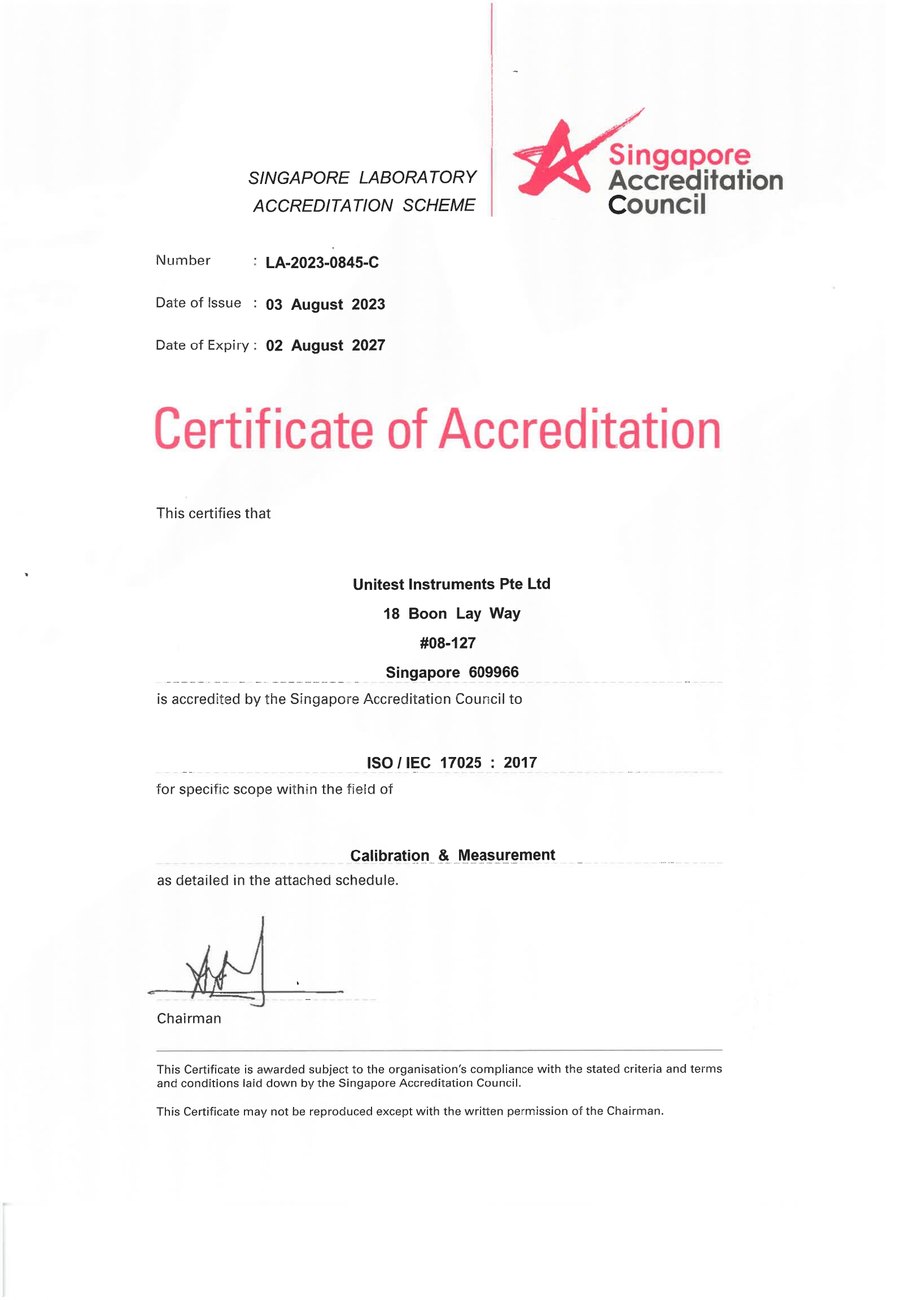
SAC-SINGLAS accredited calibration laboratory (Acc. No. LA-2023-0845-C) serving Singapore's industrial, pharmaceutical, and manufacturing sectors. All content reflects our ISO/IEC 17025 accredited scope and is reviewed by our technical calibration team.
Need dew point meter calibration in Singapore?
Unitest Instruments is SAC-SINGLAS accredited (Acc. No. LA-2023-0845-C) to ISO/IEC 17025. Same-week turnaround, certificates accepted by ISO 9001 auditors, HSA GMP inspectors, and SFA.