
Key Takeaways
- Rotronic uses capacitive polymer sensors suited to 0–100 %RH / dew points above −40 °C; Michell specialises in chilled-mirror and ceramic-oxide sensors that reach −80 °C dew point and below.
- For pharmaceutical GMP, cold chain, and cleanroom monitoring, Rotronic's HygroClip probe family is the more commonly specified option in Singapore.
- For ISO 8573-1 compressed air quality verification and gas drying processes, Michell instruments are the recognised industry standard.
- Rotronic instruments are generally lower cost at entry level; Michell carries a higher upfront price justified by extreme-range accuracy.
- Both brands require regular, traceable calibration by an accredited laboratory. Instrument accuracy alone does not satisfy ISO 9001, GMP, or HSA audit requirements.
Why Dew Point Instrument Choice Matters
Dew point measurement is not a single problem, it spans an enormous range. A pharmaceutical warehouse monitoring temperature and relative humidity operates in an entirely different world from a nitrogen gas drying skid or a compressed air system feeding a semiconductor fab. Choosing the wrong sensor technology for your operating range leads to one of two outcomes: paying a significant premium for capability you will never use, or under-specifying an instrument that drifts or gives unreliable readings at the extremes of its stated range.
In Singapore's industrial market, two brands dominate procurement discussions: Rotronic (a Swiss manufacturer, now part of Amphenol Advanced Sensors) and Michell Instruments (a UK manufacturer specialising in precision moisture and dew point analysis). Both have strong global reputations and established distributor networks locally. The question is never "which brand is better overall". It is "which is better for your application."
This is a genuinely common decision point for facilities and process engineers across Singapore's manufacturing base, from the electronics cleanrooms of Woodlands and Tampines to the petrochemical and gas processing facilities on Jurong Island, and getting it wrong is an expensive mistake in both directions: overspending on chilled-mirror precision for a warehouse humidity monitoring point, or underspecifying a polymer sensor for a compressed nitrogen line that will silently fail to deliver meaningful readings once concentrations drop below what the sensor can reliably detect.
As a SAC-SINGLAS accredited calibration laboratory that sells and calibrates both brands, Unitest is in the unusual position of having no commercial incentive to favour one over the other. The guidance below reflects what our technical team recommends to customers daily.
It is worth stating plainly, before getting into the technical comparison, that brand reputation alone is a poor basis for this decision. Both Rotronic and Michell are long-established, well-regarded manufacturers with genuine engineering depth behind their product lines, and neither company makes an inferior instrument within its own intended operating envelope. The failures we see at the calibration bench almost always trace back to an instrument being specified outside the range its sensor technology was actually designed for, a polymer probe pushed into sub-zero dew point service it was never meant to handle, or a chilled-mirror instrument deployed where a simpler, lower-maintenance polymer sensor would have done the job at a fraction of the cost and complexity. The goal of this guide is to help you avoid both of those mismatches.
Sensor Technology: The Fundamental Difference
The most important distinction between Rotronic and Michell is the underlying sensor technology each brand is built around. Understanding this shapes every other comparison.
Rotronic: Capacitive Polymer Sensing
Rotronic's core technology is the capacitive polymer humidity sensor. The same principle used by most mainstream humidity instruments. A hygroscopic polymer film changes its dielectric properties as it absorbs or desorbs water vapour, and this change is measured as a capacitance shift and converted to %RH or dew point. Rotronic's proprietary HygroClip sensor is manufactured with a tight calibration process that delivers excellent repeatability, long-term stability, and fast response across the 0–100 %RH range.
The practical limitation is physics: at very low dew points (below roughly −40 °C), the amount of water vapour present is tiny, and the capacitance change becomes so small that measurement uncertainty grows significantly. Contamination from solvents, corrosive gases, or condensation events can also permanently alter sensor response.
Michell: Chilled Mirror and Ceramic Oxide
Michell's flagship technology is the chilled-mirror hygrometer. A primary measurement method in which a mirror surface is cooled until condensation forms, and the temperature at which this occurs is measured directly as the dew point. Because the measurement is based on a physical phase transition rather than a film property, chilled-mirror instruments do not drift in the same way polymer sensors do. They are also the reference standard used in many National Metrology Institutes worldwide.
For process applications where a chilled mirror is impractical (high pressures, aggressive gases, continuous process monitoring), Michell offers ceramic aluminium oxide sensors. These operate by measuring the capacitance of an anodised aluminium layer whose oxide absorbs water. A technology that maintains meaningful sensitivity at dew points as low as −80 °C to −100 °C.
Why Polymer Sensors Struggle Below −40°C: The Underlying Physics
Understanding why Rotronic's capacitive polymer technology genuinely cannot compete with Michell's chilled-mirror and ceramic oxide instruments at very low dew points is worth a moment, because it explains why this is a physical limitation rather than simply a difference in manufacturing quality between the two brands. At a dew point of −60°C, the actual partial pressure of water vapour in the gas is extraordinarily small, several orders of magnitude lower than at typical ambient dew points around 10°C. A capacitive polymer sensor works by absorbing water vapour into its film and measuring the resulting dielectric change, and at these vanishingly low vapour concentrations, the amount of water available to absorb into the polymer becomes so small that the resulting capacitance signal approaches the sensor's own electronic noise floor, meaning any measurement uncertainty in the underlying electronics translates into a proportionally much larger dew point uncertainty at these extreme dry conditions.
Chilled-mirror technology sidesteps this problem entirely because it does not depend on absorbing a meaningful quantity of water into a sensing film; it directly detects the physical onset of condensation on a cooled surface, a phenomenon that occurs at a well-defined temperature regardless of how little total water vapour is present. Ceramic oxide sensors occupy a middle ground, using an anodised aluminium oxide layer with a much larger effective surface area and more favourable absorption characteristics than a polymer film, which is why they extend usable measurement range considerably further into sub-zero dew points than capacitive polymer technology can reach, without requiring the mechanical complexity of a full chilled-mirror optical system.
Warmed and Heated Sensor Variants: Solving the Condensation Problem
A practical complication in high-humidity environments, genuinely relevant to Singapore's climate, is that a humidity or dew point sensor exposed to conditions near saturation risks actual condensation forming directly on the sensing element itself, which produces a completely unreliable reading (typically pegged near 100% RH) until the condensation evaporates. Both Rotronic and Michell offer warmed or heated sensor variants specifically to address this: a small internal heater keeps the sensor element a few degrees above the surrounding air temperature, preventing condensation from forming on the sensing surface while a compensating algorithm calculates the true ambient RH or dew point based on the known temperature offset.
This feature is genuinely worth specifying for any Singapore application where the sensor might be exposed to near-saturation conditions: outdoor or semi-outdoor installations during heavy rain, refrigeration and cold-room doorways where warm humid air meets cold surfaces, or any process involving steam or high-humidity exhaust. Without a warmed sensor variant in these conditions, a facility can experience recurring, hard-to-diagnose measurement dropouts that look like sensor failure but are actually just condensation forming and clearing on a normal cycle, a pattern worth recognising before assuming the instrument itself is faulty and sending it for unnecessary repair.
Head-to-Head Comparison Table
The table below compares Rotronic and Michell across the dimensions most relevant to Singapore procurement decisions.
| Feature / Criterion | Rotronic (e.g. HC2, HygroFlex, HygroLog) | Michell (e.g. Optidew, Easidew, Optima) |
|---|---|---|
| Core sensor technology | Capacitive polymer (HygroClip) | Chilled mirror (primary); ceramic oxide (process) |
| Measurement range (%RH) | 0–100 %RH (most models) | Not primarily expressed in %RH; dew/frost point focus |
| Dew point range | Typically −40 °C to +60 °C Td | Down to −80 °C or lower (ceramic oxide / chilled mirror) |
| Typical accuracy (%RH) | ±0.8 %RH to ±1.5 %RH (model-dependent) | Not primary metric; dew point uncertainty ±0.1–0.2 °C Td |
| Long-term stability | Good; sensor replacement recommended every 2–3 years in harsh environments | Excellent (chilled mirror); ceramic oxide may need factory recal. after contamination |
| Best for ambient monitoring | Excellent. Warehouses, cleanrooms, cold stores, HVAC | Capable but over-specified for most ambient applications |
| Best for compressed gas / drying | Marginal. Accuracy degrades below −40 °C Td | Excellent. Industry reference for ISO 8573-1 verification |
| Data logging / BMS integration | Strong ecosystem. HygroWin, ROTRONIC Cloud, Modbus, Ethernet options | Good , 4–20 mA and digital outputs standard; less rich software ecosystem |
| Entry-level price (indicative SGD) | From ~S$500 (handheld) to S$1,500+ (transmitter with data logging) | From ~S$2,000 (ceramic oxide transmitter) to S$12,000+ (chilled mirror primary standard) |
| Pressure rating | Mostly low-pressure; some sample conditioning required for process gas | High-pressure versions available (up to 200 bar+) |
| Pharmaceutical / GMP acceptance | Very widely accepted; extensive validation documentation available | Accepted; less common for routine GMP monitoring |
| Calibration by Unitest (SAC-SINGLAS) | Yes. Accredited calibration available | Yes. Accredited calibration available |
Use Case Recommendations: Which Brand Wins Where
Pharmaceutical Stability Chambers and Cold Rooms
For pharmaceutical and life sciences applications (stability testing chambers, vaccine cold stores, cleanrooms operating to WHO or GMP guidelines), Rotronic is typically the better choice. The working range of 15–85 %RH sits squarely in the sweet spot of polymer sensor performance. Rotronic's data-logging infrastructure (HygroWin software, cloud monitoring, 21 CFR Part 11-compliant audit trails) is mature and well-supported by local distributors and calibration labs including Unitest. Rotronic probe replacement is straightforward and cost-effective when sensors age.
Compressed Air Systems and ISO 8573-1 Compliance
Singapore's manufacturing sector (from electronics and precision engineering to food processing), runs extensive compressed air networks. ISO 8573-1 specifies moisture content as one of the primary compressed air quality parameters, with Class 1 requiring a pressure dew point of −70 °C or below. At these levels, a polymer sensor simply cannot deliver reliable measurements. Michell's ceramic oxide transmitters (Easidew) and chilled-mirror analysers (Optidew) are the instruments of choice for this work. Their design accommodates elevated line pressures, sample conditioning for aggressive streams, and the sub-zero dew point ranges the standard demands.
HVAC, Building Management, and General Industrial Monitoring
For HVAC commissioning, building management systems, and general factory floor humidity monitoring (where the %RH range is well-defined and the environment is not chemically aggressive), Rotronic offers the better value proposition. The HygroFlex and HygroLog series provide robust, well-calibrated instruments at accessible price points, with strong connectivity for integration into existing BMS infrastructure.
Natural Gas, Process Gas, and Petrochemical Applications
In oil and gas, natural gas transmission, or any application involving corrosive or reactive gas streams, Michell's specialist expertise is clear. The brand's Condumax, Optima, and S8000 series instruments are designed for these demanding environments. Rotronic does not have a comparable product line for this segment.
Not sure which dew point instrument is right for your application?
Unitest sells and calibrates both Rotronic and Michell instruments. Our technical team can assess your measurement range, accuracy requirements, and process conditions, and give you an independent recommendation before you spend a dollar.
Calibration: What Singapore Procurement Teams Need to Know
Regardless of which brand you purchase, the instrument is only audit-compliant when it carries a current, traceable calibration certificate. This is a requirement (not a recommendation), under ISO 9001 clause 7.1.5, GMP Annex 15, and most HSA and NEA regulatory frameworks in Singapore.
There are two types of calibration certificate in the market: accredited and non-accredited. An accredited certificate is issued by a laboratory holding formal recognition from a body such as the Singapore Accreditation Council (SAC) under its SINGLAS programme. Unitest holds SAC-SINGLAS accreditation (Acc. No. LA-2023-0845-C) under ISO/IEC 17025, meaning our calibration results are traceable to Singapore's National Metrology Centre (NMC) and internationally recognised through the ILAC mutual recognition arrangement. For a detailed explanation of what an accreditation certificate actually contains and why it matters, see our guide on accredited vs non-accredited calibration.
A common procurement mistake is purchasing a Rotronic or Michell instrument through a distributor who issues a "certificate of calibration" that is not accredited. This document may look authoritative but will not satisfy a ISO 9001 auditor who asks to see measurement traceability. Unitest can calibrate instruments purchased anywhere. You do not need to have bought the instrument from us to use our calibration services.
Sample conditioning is another element worth budgeting for alongside the instrument itself, particularly for process gas applications where Michell instruments are typically deployed. Delivering a representative gas sample to the dew point analyser at an appropriate flow rate and pressure, without introducing moisture from the sampling system itself (via memory effect in tubing, as discussed for other dew point applications), requires a properly designed sample conditioning panel: pressure regulation, flow control, and, where necessary, filtration to protect the sensor from particulates or liquid carryover. Underinvesting in sample conditioning is one of the most common reasons a genuinely capable, correctly specified instrument still produces unreliable or slow-responding readings in the field, and it is worth discussing sample conditioning requirements with your supplier at the same time as selecting the instrument itself, rather than treating it as an afterthought once the analyser has already been installed.
Total Cost of Ownership: Looking Beyond the Purchase Price
Purchase price is the visible line on a budget. Total cost of ownership includes consumables, sensor replacement, annual calibration fees, and the cost of measurement failures. Where an out-of-tolerance instrument goes undetected and creates a product quality or regulatory incident.
For Rotronic instruments, the ongoing cost structure is generally predictable: annual calibration by an accredited lab, and sensor replacement every two to three years in normal conditions (or more frequently if sensors are exposed to condensation or solvents). Rotronic sensor probes are modular and can be swapped without replacing the transmitter body. A meaningful cost advantage over a full instrument replacement cycle.
For Michell chilled-mirror instruments, the ongoing costs include mirror cleaning and recertification, which requires skilled handling. Chilled-mirror instruments used in contaminating environments will need more frequent maintenance. However, the measurement stability of a well-maintained chilled-mirror instrument is exceptional. Some primary standards see drift measured in millidegrees per year, reducing the frequency of major recalibration campaigns.
When evaluating both brands for a Singapore procurement decision, ask the supplier or calibration lab for a five-year total cost projection inclusive of calibration, consumables, and expected sensor or component replacements. The answer often shifts the apparent cost comparison significantly.
Frequently Asked Questions
Rotronic instruments use capacitive polymer sensors, which are well-suited for ambient and near-ambient humidity ranges (typically 0 to 100 %RH, or dew points from about −40 °C to +60 °C). Michell specialises in chilled-mirror and advanced ceramic-oxide sensing technology, which extends usable range to very low dew points (−80 °C and below), making Michell the stronger choice for compressed gas, gas processing, and deep-dry applications where Rotronic sensors reach their accuracy limits.
For pharmaceutical cold rooms, cleanrooms, and storage monitoring. Where the dew point or RH range stays in the conventional band (roughly 10 to 90 %RH) and regulatory documentation is paramount. Rotronic is generally the preferred choice. Its HygroClip and HC2 probe families have strong data-logging ecosystems, widely accepted calibration traceability, and good integration with building management systems. Michell can also perform this role but its strengths lie elsewhere.
Michell is the industry reference for compressed air and gas drying. Its chilled-mirror instruments (e.g. the Optidew series) and ceramic-oxide transmitters (Easidew, Optima series) are designed for dew points as low as −80 °C or below, pressures up to several hundred bar, and aggressive gas streams. For ISO 8573-1 Class 1 or Class 2 compressed-air quality verification, Michell is the standard most Singapore facilities engineers and auditors recognise.
Yes. Unitest Instruments is a SAC-SINGLAS accredited calibration laboratory (Acc. No. LA-2023-0845-C) under ISO/IEC 17025, and we sell, service, and calibrate both Rotronic and Michell dew point and humidity instruments. Calibration certificates issued by Unitest are traceable to Singapore's National Metrology Centre (NMC) and are accepted by ISO 9001, GMP, and NEA/HSA auditors.
The calibration interval depends on sensor type, usage conditions, and your quality system requirements. For polymer-sensor instruments (such as Rotronic HygroClip) used in stable indoor environments, annual calibration is typical. For chilled-mirror instruments under demanding conditions, six-monthly calibration may be appropriate. Capacitive sensors exposed to chemical contaminants or condensation events should be recalibrated more frequently. See our detailed guide on how often to calibrate instruments for a structured decision framework.
Entry-level Rotronic humidity/dew point probes and transmitters are generally more affordable. Handheld or probe-style units typically start from S$500 to S$1,500 depending on configuration. Michell chilled-mirror instruments and high-end ceramic-oxide transmitters start from around S$2,000 and can exceed S$8,000–S$12,000 for primary-standard chilled-mirror analysers. The higher upfront cost of Michell instruments is offset in applications requiring sub-zero dew point accuracy that polymer sensors cannot reliably deliver.
If your quality management system is certified to ISO 9001, GMP, or similar standards, you are required to use instruments whose calibration is traceable to national or international measurement standards. An accredited calibration certificate (issued by a SAC-SINGLAS or equivalent accredited laboratory) provides this traceability. Non-accredited certificates (sometimes issued by equipment distributors), do not carry the same legal or audit weight. See our article on accredited vs non-accredited calibration for a full explanation.
Measurement uncertainty quantifies the range within which the true value is expected to lie. It matters greatly when comparing instruments: a Rotronic probe with ±1.5 %RH uncertainty is perfectly adequate for HVAC or storage monitoring, but would be insufficient for a pharmaceutical stability chamber requiring ±0.5 %RH. Similarly, a Michell chilled-mirror instrument may have a dew point uncertainty of ±0.1 °C or better, which is essential for verifying very dry gas streams. Always compare expanded uncertainty (U, k=2) figures in the instrument datasheet. Not just the nominal accuracy specification. Our guide on understanding measurement uncertainty explains how to read these figures correctly.
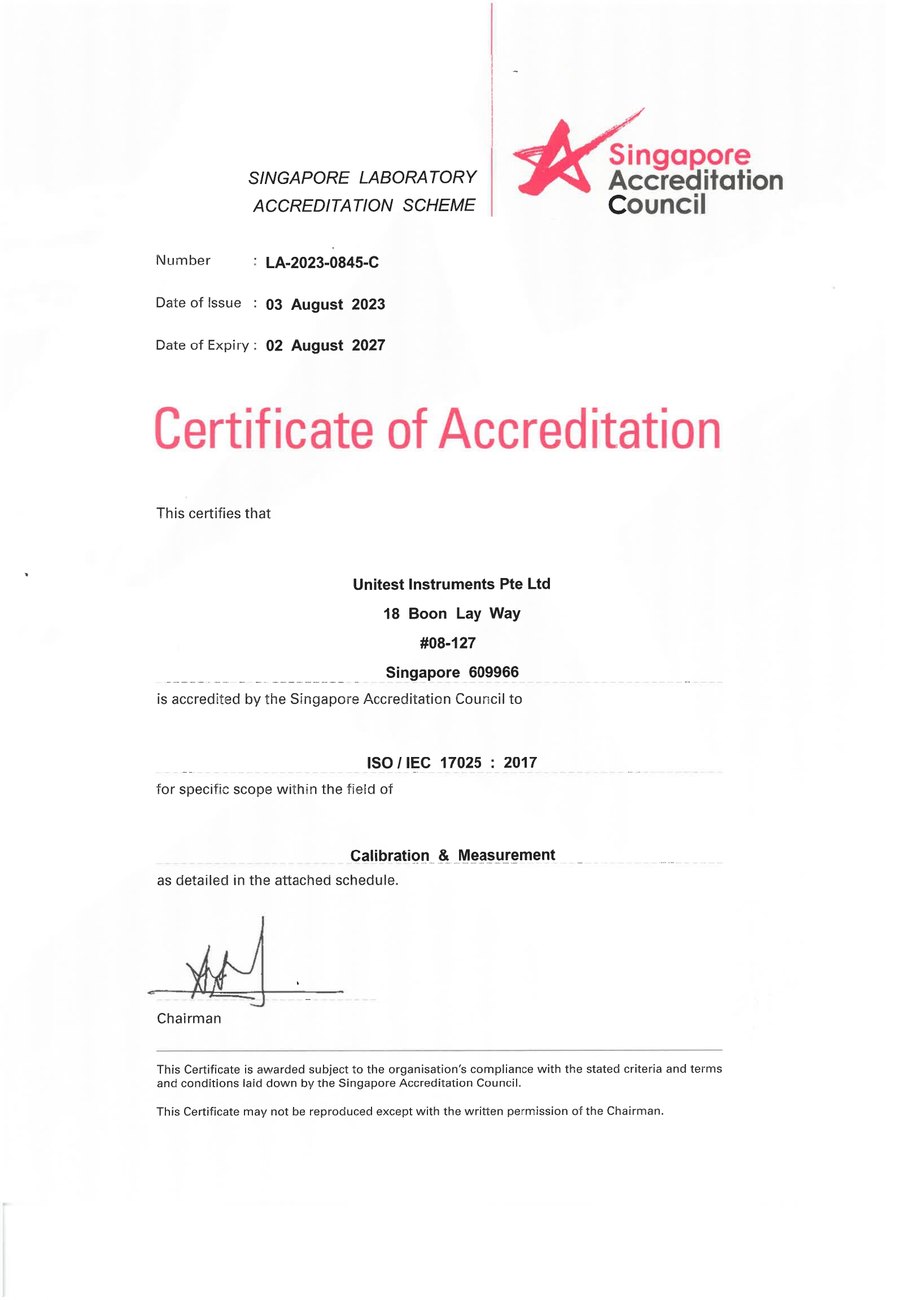
SAC-SINGLAS accredited calibration laboratory (Acc. No. LA-2023-0845-C) serving Singapore's industrial, pharmaceutical, and manufacturing sectors. All content reflects our ISO/IEC 17025 accredited scope and is reviewed by our technical calibration team.
Need dew point or humidity calibration in Singapore?
Unitest Instruments is SAC-SINGLAS accredited (Acc. No. LA-2023-0845-C) to ISO/IEC 17025. Same-week turnaround, certificates accepted by ISO 9001 auditors.