
Key Takeaways
- Dew point calibration requires a traceable chilled-mirror hygrometer or certified humidity generator as the reference standard, not a simple RH sensor.
- A compliant calibration certificate must include measurement uncertainty at a stated confidence level (typically k=2, 95%). This is the single most common gap found during ISO 9001 audits.
- SAC-SINGLAS accreditation (Acc. No. LA-2023-0845-C) means the laboratory is assessed against ISO/IEC 17025 and its certificates are accepted under the ILAC Mutual Recognition Arrangement internationally.
- Recommended calibration interval is 6–12 months; pharmaceutical (HSA GMP), semiconductor, and compressed-air monitoring applications typically require the shorter 6-month cycle.
- Singapore's MOM WSH Act, HSA GMP guidelines, and ISO 9001 quality systems all create effective obligations for periodic calibration of dew point instruments used in compliance monitoring.
- Laboratory calibration delivers lower uncertainty than field calibration and is required for critical applications; field calibration using portable references is only suitable for routine operational checks.
What Happens During Dew Point Meter Calibration?
Dew point meter calibration is the process of comparing your instrument's readings against a known, traceable reference standard under controlled laboratory conditions. The goal is to establish how closely your meter agrees with the true value at each measurement point, and to quantify the size of any disagreement in a way that is metrologically valid and legally defensible.
At Unitest Instruments, our SAC-SINGLAS accredited laboratory (Acc. No. LA-2023-0845-C) follows a structured calibration procedure. The instrument is first allowed to stabilise at laboratory temperature and pressure. Typically 23 ± 2°C and atmospheric pressure. The reference humidity generator or chilled-mirror hygrometer is then set to each calibration point in sequence, and the device under test is allowed to reach equilibrium before its reading is recorded. We capture at least three to five set points across the instrument's working range, recording both the reference value and the displayed reading at each point. The difference between them is the error, and we calculate the expanded measurement uncertainty (U) for each point.
After the measurement sequence, the calibration data is processed and reviewed by a technically competent person before the certificate is issued. If the instrument falls outside the manufacturer's stated specification at any point, this is flagged on the certificate and the customer is advised. Unitest does not adjust, repair, or trim instruments during calibration unless a separate adjustment service is requested. Maintaining the independence of the calibration result.
Reference Standards Used: What Traceability to NMC Singapore Means
The quality of a dew point calibration is only as good as the reference standard behind it. At an accredited laboratory, the reference chain is explicit and documented. For dew point and humidity calibration, the primary reference instruments are:
- Chilled-mirror hygrometers. The internationally accepted primary reference for dew point measurement. These instruments detect the temperature at which a mirror surface becomes saturated (dew point temperature) with a very high degree of accuracy, typically ±0.1 °C Td or better.
- Two-pressure and two-temperature humidity generators. Laboratory-grade devices that produce a stable, known relative humidity or dew point in a gas stream by controlling temperature and pressure with precision. These are used when generating a range of calibration points is required.
- Certified saturated salt solutions. Used for spot checks at fixed humidity points (e.g. 11.3% RH for LiCl, 75.3% RH for NaCl at 25°C), traceable to NIST or NMC.
All of Unitest's reference instruments are calibrated against Singapore's National Metrology Centre (NMC) or NMC-accepted national metrology institutes under the BIPM Mutual Recognition Arrangement. This creates an unbroken traceable chain from your dew point meter reading back to the SI unit of temperature (kelvin). As explained in our article on what calibration traceability means and why it matters, this chain is a mandatory requirement under ISO/IEC 17025. A laboratory that cannot demonstrate it is not accredited, regardless of what its marketing claims.
For users whose processes must meet international standards (pharmaceutical GMP, aerospace, or semiconductor manufacturing), traceability to NMC Singapore, as part of the APAC Metrology Programme, is accepted by auditors worldwide under the ILAC-MRA framework. This means your SAC-SINGLAS certificate from Unitest (Acc. No. LA-2023-0845-C) is recognised in more than 100 countries without additional local validation.
What Measurements Are Actually Made, and Why Each Matters
Dew point meters can express moisture content in several units: dew point temperature (°C Td), relative humidity (%RH), parts per million by volume (ppmv), or parts per million by weight (ppmw). The calibration must be performed in (or converted to), the unit the instrument displays and the user relies on for compliance decisions. Here is what is measured and why:
Dew Point Temperature (°C Td)
This is the most direct measurement. The reference standard generates a gas stream at a known dew point temperature, and the instrument's displayed dew point is compared against it. This is the preferred unit for compressed air monitoring (ISO 8573-1), pipeline gas quality control, and transformer oil moisture measurement.
Relative Humidity (%RH)
For instruments displaying %RH, calibration points are set at typically three to five levels across the range (e.g. 11%, 33%, 75%, and 95% RH). The laboratory environment temperature must be controlled tightly because %RH is temperature-dependent. A 1°C error in temperature translates to approximately a 3–5% RH error. Our laboratory maintains temperature stability to within ±0.5°C during humidity calibration.
Moisture in ppmv / ppmw
For trace moisture applications (LNG, specialty gas, or electronics manufacturing), dew points can be extremely low (e.g. −60°C Td or below). Calibration at these levels requires specialised low-dew-point generators and extended equilibration times. Unitest's accredited scope covers the ranges applicable to most industrial and commercial instruments; contact us to confirm coverage for very low dew points before booking.
Need Your Dew Point Meter Calibrated in Singapore?
Unitest Instruments issues SAC-SINGLAS accredited calibration certificates (Acc. No. LA-2023-0845-C) accepted by ISO 9001 auditors, HSA inspectors, and MOM compliance officers. Same-week turnaround available.
Field Calibration vs Laboratory Calibration: Which Do You Need?
One of the most common questions from facilities managers and quality engineers is whether on-site (field) calibration is acceptable, or whether the instrument must return to the laboratory. The answer depends on the application, the required uncertainty, and the audit framework you operate under.
| Factor | Field Calibration | Laboratory Calibration (SAC-SINGLAS) |
|---|---|---|
| Accuracy achievable | Limited by portable reference quality; typically ±1–3°C Td or ±2–5% RH | ±0.1–0.5°C Td or ±0.5–1% RH depending on range |
| Measurement uncertainty | Higher uncertainty; often not formally calculated | Formally calculated and stated on certificate (k=2) |
| Environmental control | Subject to site conditions (temperature, dust, vibration) | Controlled laboratory environment per ISO/IEC 17025 |
| Certificate acceptability | May not satisfy ISO 9001 auditors or regulatory bodies | Accepted internationally under ILAC-MRA framework |
| Traceability documentation | Depends on the field technician's reference instruments | Full chain to NMC Singapore documented on certificate |
| Suitable for | Operational spot checks; non-critical monitoring; interim verification | Compliance, ISO 9001, HSA GMP, MOM WSH, customer audits |
| Cost | Lower per visit; higher if repeated frequently | Higher per event; lower total risk cost |
For most compliance contexts in Singapore (ISO 9001 quality systems, pharmaceutical GMP, or MOM-regulated workplaces), laboratory calibration at a SAC-SINGLAS accredited facility is the required standard. Field calibration using portable references is best understood as an operational confidence check between formal calibration intervals, not a replacement for accredited laboratory calibration. Our article on accredited vs non-accredited calibration covers the audit and legal implications in detail.
What Your Dew Point Calibration Certificate Must Show
A calibration certificate is a legal document and a quality record. ISO/IEC 17025:2017 (Clause 7.8) sets out mandatory content for calibration certificates issued by accredited laboratories. For dew point meters calibrated under SAC-SINGLAS Acc. No. LA-2023-0845-C, the following items must appear:
- Laboratory identification. Name, address, SAC-SINGLAS accreditation number (LA-2023-0845-C), and ILAC-MRA endorsement statement.
- Instrument identification. Make, model, serial number, and asset or tag number (if provided by the customer).
- Calibration date. The actual date(s) the calibration measurements were performed, not the certificate issue date.
- Recommended due date. The next calibration date, based on the interval agreed with the customer or the laboratory's recommendation.
- Environmental conditions. Temperature, relative humidity, and atmospheric pressure in the laboratory at the time of calibration.
- Reference standards used. Identification of the reference instruments (make, model, serial number) and their own calibration traceability details (laboratory, certificate number, calibration date).
- Calibration results table. Nominal reference value, instrument reading, and calculated error at each calibration point.
- Expanded measurement uncertainty (U). Stated for each calibration point, with the coverage factor k and the corresponding confidence level (e.g. k=2, approximately 95%). This is the element most often missing from non-accredited certificates.
- Statement of conformance (optional but recommended). If the customer requests a pass/fail decision against a specification, this must reference the decision rule used (e.g. the shared risk rule per ILAC-G8).
- Authorised signature. Signed or authenticated by the technically responsible person.
If any of these elements are absent from a certificate you have received from another provider, the certificate may not satisfy your ISO 9001 auditor or regulatory body. Our article on how to read a calibration certificate provides a field-by-field walkthrough of what each element means and how to verify its correctness.
Singapore Regulatory Context: Where Dew Point Calibration Is Required
Singapore does not have a single omnibus statute that mandates dew point meter calibration across all sectors. Instead, obligations arise from a patchwork of sector-specific regulations, management system standards, and customer contract requirements. Understanding which framework applies to your facility determines how rigorous your calibration programme needs to be.
MOM Workplace Safety and Health (WSH) Act
Under the WSH Act and associated regulations, employers must ensure that all measuring instruments used to monitor workplace hazards or control safety-critical processes are fit for purpose. For facilities where moisture levels are a safety parameter (such as compressed gas systems, explosive atmosphere zones, or food processing environments), dew point meters used for safety monitoring should be calibrated at documented intervals. The WSH (General Provisions) Regulations require that measuring equipment be maintained and calibrated to ensure accuracy.
HSA Good Manufacturing Practice (GMP) for Pharmaceuticals
The Health Sciences Authority of Singapore enforces GMP guidelines aligned with ICH Q10 and PIC/S PE 009. These guidelines require that all instruments used in the manufacture, storage, and testing of pharmaceutical products be calibrated against certified reference standards. Clean room humidity monitoring and compressed air dew point monitoring in pharmaceutical facilities fall squarely within this scope. HSA inspectors routinely verify calibration certificates during facility audits. A certificate without measurement uncertainty will be flagged as a non-conformance.
ISO 9001:2015 Quality Management Systems
ISO 9001 Clause 7.1.5 requires organisations to "determine the monitoring and measuring equipment needed" and to ensure it is "calibrated or verified at specified intervals, or prior to use, against measurement standards traceable to international or national measurement standards." Dew point meters used in production quality control, incoming goods inspection, or environmental monitoring are within this scope. ISO 9001 does not mandate SAC-SINGLAS accreditation explicitly, but it requires traceability, which in practice means accredited calibration is the only defensible path.
BCA Green Mark and SS 554 (Clean Rooms)
Building and Construction Authority's Green Mark scheme, and Singapore Standard SS 554 for clean rooms, reference humidity measurement calibration as part of environmental monitoring compliance. Facilities operating in these frameworks should ensure their dew point and humidity instruments are calibrated by a SAC-SINGLAS accredited laboratory.
Calibration Interval Recommendations for Dew Point Meters
How often you calibrate your dew point meter depends on three factors: the application's criticality, the operating environment's severity, and the manufacturer's specification. As a guide, the following intervals are appropriate for most Singapore industrial contexts:
| Application | Recommended Interval | Rationale |
|---|---|---|
| Pharmaceutical manufacturing / HSA GMP | Every 6 months | GMP and HSA audit requirements; high consequence of error |
| Compressed air quality (ISO 8573-1) | Every 6–12 months | Continuous duty; sensor fouling risk; product quality impact |
| Semiconductor / electronics clean room | Every 6 months | Yield-critical; trace moisture sensitivity |
| HVAC / building management | Annually | Lower criticality; stable operating conditions |
| Food and beverage processing | Every 6–12 months | Moisture control is a food safety parameter |
| General industrial / research | Annually | Moderate criticality; manufacturer recommendation baseline |
| After repair, transport, or suspected damage | Immediately (before next use) | Calibration status is invalidated by physical events |
Our detailed guide on how to determine the right calibration interval covers the risk-based method for setting intervals. Including how to use historical calibration data to extend or shorten intervals with documented justification, as permitted by ISO/IEC 17025. The key principle is that the interval must be justified, documented, and reviewed periodically, not simply set and forgotten.
One practical consideration for Singapore's climate: the combination of high ambient humidity and temperature cycling (moving instruments between air-conditioned and non-air-conditioned environments) accelerates sensor drift in capacitance-based dew point sensors. If your instruments are used in field conditions with significant thermal cycling, consider shortening your calibration interval to 6 months regardless of the application category above.
Buying a Dew Point Meter: What to Check Before Calibration
If you are procuring a new dew point meter and plan to have it calibrated by an accredited laboratory, there are several instrument characteristics that affect what calibration can achieve and what certificate you will receive.
First, confirm the measurement principle. Chilled-mirror hygrometers are the most accurate but also the most expensive and require the most maintenance. Capacitance-sensor instruments are more practical for most industrial applications and are routinely calibrated in our laboratory. Electrolytic (P2O5) sensors are used for trace moisture and have specific calibration requirements. Optical (tunable diode laser) instruments offer very low dew points and fast response, but their calibration requires specialist equipment. Our laboratory accreditation (SAC-SINGLAS Acc. No. LA-2023-0845-C) covers the most common industrial dew point measurement technologies. Contact us to confirm coverage for specialist instruments before purchase.
Second, verify the instrument's stated accuracy specification. This determines the uncertainty budget available for calibration. An instrument with a ±3°C Td accuracy specification cannot be meaningfully calibrated to a ±0.1°C reference point because the reference uncertainty would be negligible compared to the instrument's own specification. Understanding this relationship (explored in detail in our article on measurement uncertainty in calibration) prevents the common mistake of over-specifying calibration requirements and adding cost without benefit.
You can browse and purchase a range of dew point meters (from portable field instruments to laboratory-grade chilled-mirror hygrometers), at unitestshop.com. When purchasing through Unitest, we can advise on the appropriate calibration interval and ensure your new instrument enters your calibration programme correctly from day one.
Frequently Asked Questions
During dew point meter calibration, the laboratory applies a series of known, stable reference humidity or dew point values (typically generated using a primary or secondary humidity generator), and records the instrument's displayed reading at each point. The difference between the reference value and the displayed value is the measurement error. The lab also evaluates measurement uncertainty, repeatability, and response stability. At Unitest Instruments (SAC-SINGLAS Acc. No. LA-2023-0845-C), calibration is performed across at least three to five set points spanning the instrument's stated working range, in accordance with ISO/IEC 17025.
Accredited laboratories use traceable reference standards including chilled-mirror hygrometers (the primary reference for dew point measurement), precision saturated salt solutions for fixed humidity points, and certified humidity generators that produce stable, known moisture levels in a controlled gas stream. These reference instruments are themselves calibrated and traceable to Singapore's National Metrology Centre (NMC) or an equivalent national metrology institute, ensuring an unbroken chain of traceability as required by ISO/IEC 17025.
A SAC-SINGLAS accredited dew point calibration certificate must include: the laboratory name and accreditation number (e.g. LA-2023-0845-C), the instrument's make, model, and serial number, calibration date and due date, the environmental conditions during calibration (temperature, pressure), the reference standard(s) used with their own traceability details, measured values at each calibration point alongside reference values and calculated errors, expanded measurement uncertainty (at a stated coverage factor, typically k=2 for 95% confidence), and the signature of a technically competent person. A certificate lacking measurement uncertainty is not compliant with ISO/IEC 17025.
The recommended calibration interval for dew point meters is typically 6 to 12 months, depending on usage intensity, operating environment, and the manufacturer's recommendation. In demanding industrial environments (such as compressed air systems, clean rooms, or pharmaceutical manufacturing), a 6-month interval is standard. For instruments used occasionally in controlled environments, an annual calibration may be sufficient. Singapore's MOM Workplace Safety and Health regulations and ISO 9001 quality management systems generally require that measuring instruments used for compliance or product quality be calibrated at documented, defined intervals.
While Singapore does not have a single regulation mandating dew point meter calibration universally, several frameworks create effective requirements. Facilities operating under ISO 9001 or ISO 14001 must calibrate monitoring instruments at planned intervals. Pharmaceutical manufacturers regulated by HSA must comply with GMP guidelines that specify calibration of humidity and dew point instruments. Workplaces under the MOM WSH Act must ensure measuring equipment used for safety-critical monitoring is fit for purpose, which includes regular calibration. BCA's Green Mark scheme and clean-room operators under SS 554 also reference humidity measurement calibration as part of compliance.
An accredited calibration (from a SAC-SINGLAS or ILAC-MRA recognised laboratory) provides a certificate that is internationally recognised, includes stated measurement uncertainty, and demonstrates traceability to national standards. A non-accredited calibration may not include uncertainty statements, may use reference instruments of unknown traceability, and will not be accepted by ISO 9001 auditors or regulatory bodies requiring third-party verified calibration. For compliance, supplier qualification, or legal defensibility, accredited calibration is required.
Some dew point meters can be calibrated on-site using portable reference standards, but this is subject to important limitations. On-site calibration is only as good as the reference equipment brought to the site. Portable references must themselves be recently calibrated and within specification. Laboratory calibration generally offers better accuracy, more controlled environmental conditions, and lower uncertainty values. For critical applications (pharmaceutical, aerospace, semiconductor manufacturing), laboratory calibration at a SAC-SINGLAS accredited facility is strongly preferred and sometimes mandated by audit requirements.
Standard turnaround at Unitest Instruments is 3 to 5 working days for most dew point meters. Same-week express calibration is available for urgent requirements, contact us to confirm availability. The calibration certificate is issued upon completion and accepted by ISO 9001 auditors, HSA inspectors, and MOM compliance officers. Instruments are returned with the certificate, and we can discuss loan instrument options upon request for minimising production downtime.
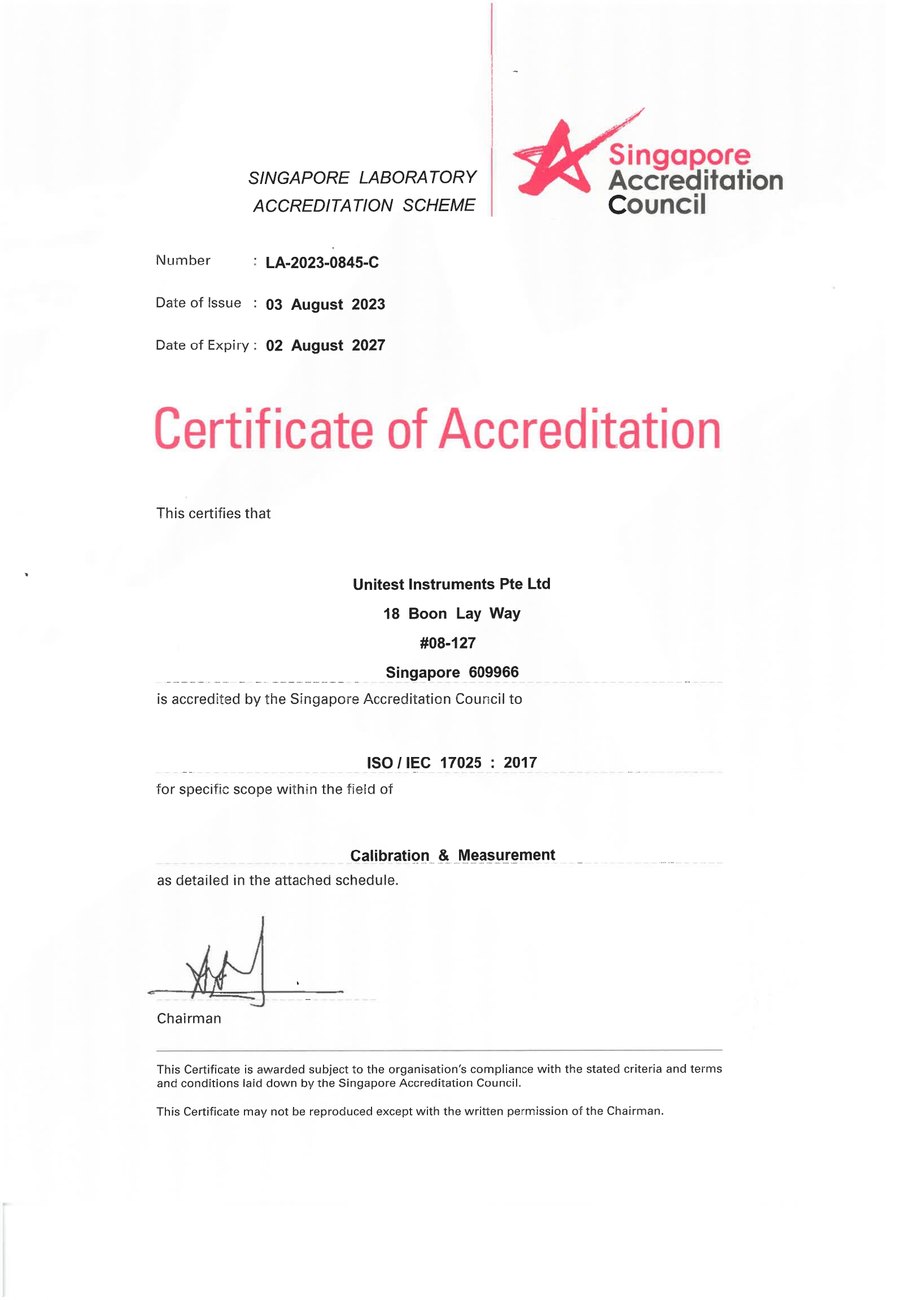
SAC-SINGLAS accredited calibration laboratory (Acc. No. LA-2023-0845-C) serving Singapore's industrial, pharmaceutical, and manufacturing sectors. All content reflects our ISO/IEC 17025 accredited scope and is reviewed by our technical calibration team.
Need dew point meter calibration in Singapore?
Unitest Instruments is SAC-SINGLAS accredited (Acc. No. LA-2023-0845-C) to ISO/IEC 17025. Same-week turnaround, certificates accepted by ISO 9001 auditors, HSA inspectors, and MOM compliance officers.