
Key takeaways
- Accreditation is third-party verification of a specific set of technical facts. Not a quality badge or a marketing claim.
- ISO 9001 clause 7.1.5 (2015 revision) explicitly requires calibration results with stated measurement uncertainties. Non-accredited certificates often omit this, causing audit findings.
- SAC-SINGLAS accreditation is publicly verifiable in two minutes at sac.gov.sg. Non-accredited labs offer no equivalent verification.
- Accreditation is scope-specific: confirm the lab covers your exact parameter and range before sending instruments.
- The price premium over non-accredited calibration is typically 15–30%. Far less than the cost of a non-conformance, recall, or rejected regulatory submission.
Why "accredited" is not a marketing claim
Many calibration providers use the word "accredited" loosely. Sometimes it means they hold ISO 9001, which certifies their quality management system, not their technical competence to produce traceable calibration results. Sometimes it refers to equipment once calibrated by a recognised lab. Occasionally it means nothing traceable at all.
In Singapore, only one designation carries the weight of independent technical assessment: SAC-SINGLAS accreditation, administered by the Singapore Accreditation Council (SAC) under the Ministry of Enterprise and Innovation. Accreditation to ISO/IEC 17025 means an accreditation body has conducted an on-site technical assessment (not a document review), and confirmed the lab's methods, traceability, uncertainty budgets, equipment, and staff competence meet the international standard for calibration laboratories.
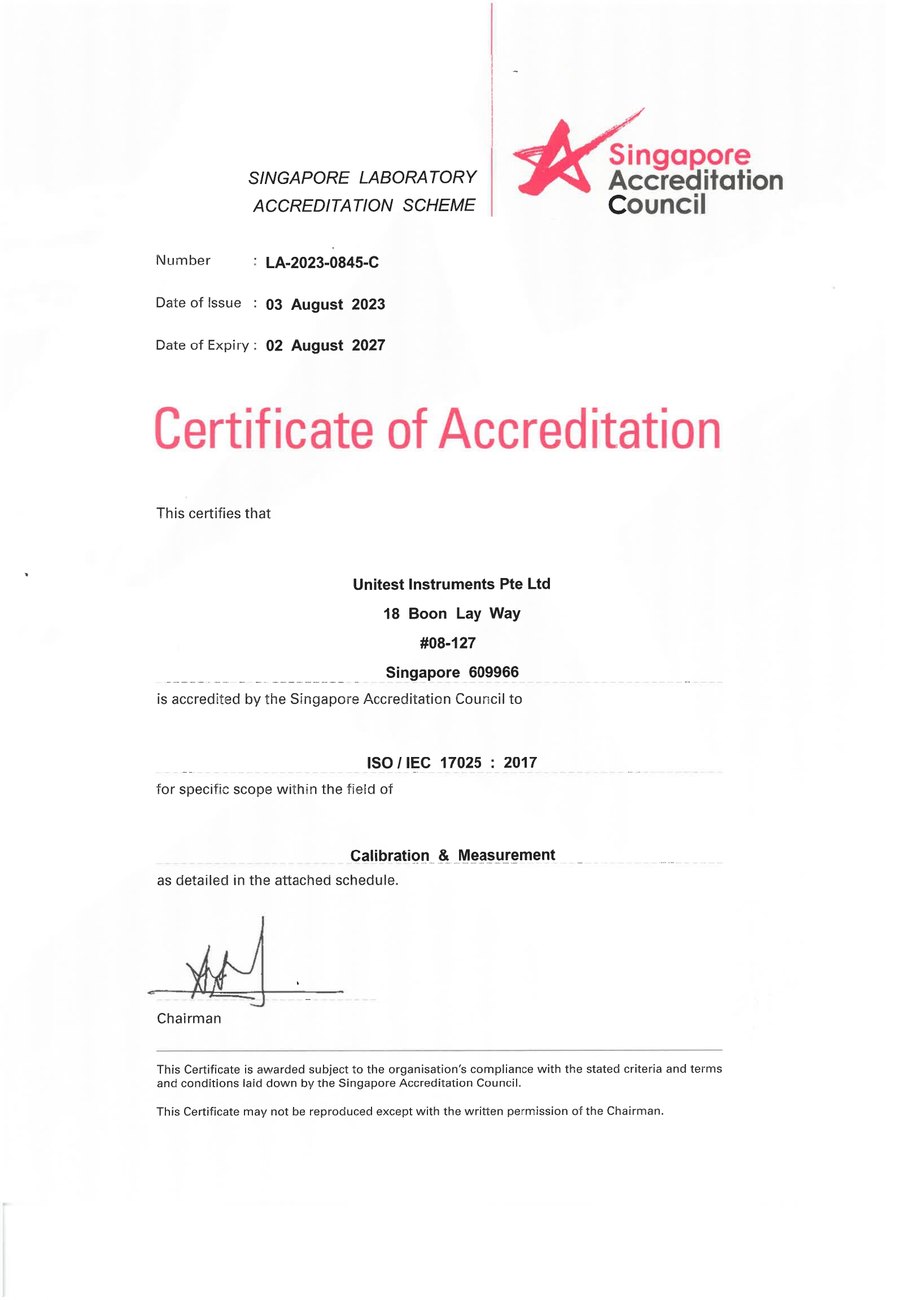
The accreditation number on a Unitest certificate (LA-2023-0845-C), is searchable on sac.gov.sg. Any procurement officer, auditor, or regulator can verify in under two minutes that the accreditation is live, what scope it covers, and when it was last assessed. That public, independently maintained verification is the fundamental difference between an accredited certificate and one issued by a lab that simply says it does good work.
What the accreditation assessment actually checks
When SAC assessors conduct an on-site assessment, they work through five areas that directly affect the reliability of every certificate issued.
Metrological traceability
Every reference standard in the lab must be traceable to a national metrology institute. In Singapore, that is the National Metrology Centre (NMC), a division of A*STAR. Traceable means there is an unbroken, documented chain of calibrations (each with a stated uncertainty), connecting the lab's reference instruments to the SI units at the NMC: the actual volt, the actual kelvin, the actual pascal. A non-accredited lab may state traceability on a certificate; the accreditation assessment has independently verified that it exists and is correctly maintained.
Measurement uncertainty
Every accredited certificate must state the measurement uncertainty for each result. This is not a tolerance. It is a quantified estimate of the doubt in the measurement, calculated from all identified uncertainty sources: the reference instrument's own uncertainty, the device under test's characteristics, temperature and humidity effects, the repeatability of repeat readings, and the resolution of the measurement system. SAC assessors technically review whether those uncertainty budgets are correctly identified, calculated, and reported. Non-accredited labs frequently omit uncertainty entirely, which is why their certificates regularly trigger findings under ISO 9001:2015 clause 7.1.5.
Method competence
The lab must demonstrate technical competence for each calibration method within its scope. Competence is assessed by reviewing the written procedures, witnessing calibrations in progress, and often through proficiency testing. Where the lab calibrates reference artefacts alongside other accredited labs, and results are compared. Methods outside the accredited scope cannot be legitimately covered by the accreditation reference on the certificate.
Equipment and environment
Reference instruments must be appropriate for the parameter and range, maintained to the required performance, and themselves calibrated on schedule. Environmental conditions (temperature, humidity, vibration), must be monitored and recorded during calibrations where they affect results. These controls are verified by assessors inspecting equipment logs, environmental monitoring records, and the calibration room itself.
Personnel competence
Every technician performing accredited calibrations must demonstrate their competence for the relevant parameters. Through training records, internal authorisation, and technical assessment. A lab cannot simply assign any available technician to perform an accredited calibration without documented evidence of their specific competence.
What the two certificates look like, and where the differences hide
At first glance, a certificate from a SAC-SINGLAS accredited lab and one from a non-accredited provider can appear nearly identical. Both state the instrument, the date, the technician, and a column of measurement results. The differences live in the details that determine whether the certificate actually does what you need it to do.
| Feature | SAC-SINGLAS Accredited Lab | Non-Accredited Lab |
|---|---|---|
| Independently assessed? | Yes, on-site by SAC, every 2–4 years plus annual surveillance | No. Self-declared only |
| Traceability verified? | Yes. Audited chain to NMC Singapore confirmed | Stated on certificate; not independently verified |
| Measurement uncertainty stated? | Mandatory on every accredited result | Often missing, abbreviated, or not calculated |
| Accreditation number verifiable? | Yes, free public lookup at sac.gov.sg | No equivalent verification available |
| ISO 9001 cl.7.1.5 acceptable? | Directly. Auditors accept on sight | Risk. Auditor may raise non-conformance |
| Suitable for GMP / HACCP audits? | Yes. Preferred by most auditors | Questioned. Traceability evidence may be requested |
| Accepted for regulatory submissions? | Yes. CAAS, NEA, HSA and most Singapore authorities | Usually not accepted without additional evidence |
| Recognised overseas (ILAC MRA)? | Yes. Recognised in 100+ economies | No equivalent international recognition |
| Typical price premium | 15–30% above non-accredited rates | Base reference |
The measurement uncertainty row is where most audit findings originate. ISO 9001:2015 clause 7.1.5 tightened the language from the 2008 version: it now explicitly requires that calibration produce results "with stated measurement uncertainties." A certificate that lists only pass/fail results, or raw readings without uncertainty, gives an auditor grounds to raise a non-conformance. The auditor is not being unreasonable. Without a stated uncertainty, there is no way to judge whether the measurement result is fit for its intended purpose.
When is non-accredited calibration acceptable?
There are legitimate situations where non-accredited calibration is the proportionate choice, and intellectual honesty about this matters.
Non-critical indicating instruments (gauges used only for reference, not for controlling product quality or triggering a compliance decision), may not need the full rigour of accredited calibration. If the gauge on the wall tells you roughly how full a storage tank is, but the actual quantity measurement uses a flow meter with full traceability, the indicating gauge may warrant only a periodic functional check rather than a traceable calibration certificate.
Measurements outside any lab's accredited scope. Bespoke sensors for novel R&D applications, prototype measurement systems, parameters that no accredited lab in the region currently covers. May require calibration by a technically competent provider who is not yet accredited for that scope. The key is documenting this decision and justifying it in writing.
Preliminary checks within an internal calibration program. Using an in-house calibrated reference to confirm an instrument has not drifted significantly before scheduling a full lab recalibration. Are a normal part of good calibration management and do not need to be performed by an external accredited lab.
What non-accredited calibration cannot do: satisfy an auditor who asks for traceability evidence under ISO 9001:2015, meet regulatory requirements that reference accredited calibration, provide the measurement uncertainty a quality engineer needs to assess instrument fitness for a tight-tolerance process, or be accepted in an overseas regulatory submission without additional investigation.
Compliance implications in Singapore
Singapore's quality and regulatory landscape increasingly references accredited calibration either explicitly or in practical effect across multiple sectors.
ISO 9001 audits. The 2015 revision tightened clause 7.1.5 to require measurement results with stated uncertainties. Auditors trained to the current standard know to look for traceability evidence and measurement uncertainty. An accredited certificate satisfies both on sight. Certificates without uncertainty, or where traceability is asserted but not demonstrated, draw a closer look that many non-accredited labs cannot survive.
Pharmaceutical GMP. The Health Sciences Authority (HSA) and international GMP guidelines (including Annex 15 qualification and validation, and WHO TRS 937), require critical instruments to be calibrated with reference standards traceable to national standards. For temperature mapping, pressure monitoring, humidity control, and balance verification in GMP-regulated environments, SAC-SINGLAS accredited calibration is the practical standard. Non-accredited certificates for critical instruments frequently draw observations during regulatory inspections.
HACCP and food safety. Temperature instruments used at critical control points in HACCP plans must be calibrated. SFA inspectors and food safety certification auditors (ISO 22000, FSSC 22000) accept accredited certificates without question. Non-accredited certificates raise questions about the reliability of the CCP data and may require supplementary evidence of traceability.
Regulatory and statutory submissions. Measurements used in submissions to CAAS, NEA, MOM, or other Singapore authorities are expected to carry documented traceability. SAC-SINGLAS accredited calibration is the standard mechanism for demonstrating that traceability. This matters in areas from environmental monitoring to occupational safety to aviation maintenance.
International export and recognition. SAC is a signatory to the ILAC Mutual Recognition Arrangement. A SAC-SINGLAS accredited certificate is automatically recognised in all ILAC MRA member economies (the US, EU member states, Australia, Japan, China, and more than a hundred others), without re-calibration. For Singapore manufacturers supplying overseas customers, this means calibration evidence issued locally is accepted globally.
Need calibration evidence that clears your ISO 9001 or GMP audit?
Every Unitest certificate states measurement uncertainty and carries full traceability to Singapore's NMC, built to satisfy clause 7.1.5 and GMP auditors on first review.
How to verify a lab's accreditation, and what to check
Verification is free and takes under two minutes.
- Go to sac.gov.sg and navigate to Accredited Laboratories.
- Search by the lab's name or their stated accreditation number.
- Check: Is the accreditation currently active? Has it lapsed or been suspended?
- Review the scope of accreditation. What parameters and ranges are covered?
- Confirm the lab's address matches where your instruments are actually being calibrated.
The scope step is critical and often skipped. Accreditation is scope-specific. A lab accredited for electrical calibration (voltage, current, resistance), may not be accredited for pressure or temperature. If your pressure gauge is calibrated by a lab whose accreditation only covers electrical parameters, the pressure certificate is not covered by the accreditation, even if the accreditation number appears on the document. Unitest's scope covers electrical, temperature, pressure, humidity, and related parameters. The full scope document is available on our accreditation page and downloadable directly from SAC.
What the price premium actually pays for
The cost difference between accredited and non-accredited calibration typically falls between 15% and 30% depending on the parameter, the number of instruments, and turnaround requirements. Understanding what that premium covers helps contextualise the investment.
The SAC assessment infrastructure. Accredited labs carry the cost of initial assessments, annual surveillance, proficiency testing participation, and periodic full reassessments. Ongoing costs that ensure the accreditation remains technically valid, not just administratively renewed.
The uncertainty calculation. Producing a correctly calculated measurement uncertainty for every calibration result requires time, expertise, and validated uncertainty budgets developed for each measurement method. This is non-trivial engineering work that a non-accredited provider typically does not invest in.
The reference standard chain. Accredited labs maintain reference instruments calibrated by an NMI or another accredited lab at a level of performance appropriate to the scope. These instruments are replaced or sent for recalibration when they go out of specification. A discipline enforced by the accreditation system, not just internal policy.
Viewed against these costs, the 15–30% premium looks different when set beside the alternative: a non-conformance during a major ISO 9001 surveillance audit, a GMP observation during an HSA inspection, a rejected regulatory submission requiring re-measurement with an accredited lab, or a product recall driven by suspect measurement data. In any of those scenarios, the cost of the non-accredited certificate substantially exceeds the premium you saved.
Making the right decision for your instruments
The practical question is not "accredited or not" in the abstract. It is: for this specific instrument, in this specific use, what level of evidence will I need to produce when someone asks?
If that someone includes an external auditor under ISO 9001, ISO 14001, ISO 13485, GMP or HACCP; a customer quality requirement; a Singapore regulatory body; or an overseas importer requiring ILAC-recognised evidence. The answer is accredited calibration, and the accreditation number on the certificate needs to match a live entry on sac.gov.sg when they check.
If the instrument is purely internal, non-critical, and its calibration history will never be reviewed outside your own team, a documented, proportionate approach may be defensible. Document the reasoning, review it periodically, and escalate if the instrument's role changes.
For most Singapore manufacturers, distributors, labs, and service providers, the quality-critical instruments in their operations benefit from accredited calibration. The measurement traceability and stated uncertainty are not bureaucratic overhead. They are the evidence that the measurement can be trusted, and that trust is what the instrument's role in your quality system depends on.
Frequently asked questions
Not universally, it depends on the application. For instruments used in legal-for-trade applications (commercial weighing, fuel dispensing, flow metering), the Weights and Measures Act requires periodic statutory verification by an approved verifier. For ISO 9001, GMP, HACCP, and most regulatory submissions, accredited calibration is effectively required because auditors and regulators ask for traceability and measurement uncertainty evidence that only an accredited certificate reliably provides.
Technically, ISO 9001 clause 7.1.5 requires calibration against traceable standards with stated uncertainties. It does not name ISO/IEC 17025 accreditation specifically. In practice, a non-accredited certificate frequently triggers audit questions because the auditor cannot independently verify the traceability chain or the uncertainty calculation. A SAC-SINGLAS accredited certificate removes that burden: most auditors accept it on sight. For a deeper comparison of the two standards, see our guide to ISO 17025 vs ISO 9001.
Go to sac.gov.sg and search under Accredited Laboratories. Enter the lab name or accreditation number. The result shows whether the accreditation is current, what scope is covered, and the validity period. Unitest Instruments holds accreditation no. LA-2023-0845-C. Always confirm the parameter you need falls within the lab's listed scope. Accreditation is scope-specific, and results outside the scope are not covered by the accreditation reference on the certificate.
Accreditation does not guarantee zero error. It guarantees that the lab's traceability chain has been independently verified, its measurement uncertainty calculations have been technically reviewed, and its staff competence has been assessed. That is substantially stronger than a self-declaration. What accreditation does provide is independent, publicly verifiable evidence of technical competence, which is different from claiming perfect measurements, which no measurement system can guarantee.
Measurement uncertainty quantifies the range within which the true value of a measurement lies, given the limitations of the equipment, method, and environment. A certificate might state: "100.0°C with an expanded uncertainty of ±0.3°C at 95% confidence." Without this, you cannot determine whether your instrument is fit for its intended tolerance. You only know what it reads. ISO 9001:2015 clause 7.1.5 explicitly requires calibration results with stated measurement uncertainties. See our full guide to measurement uncertainty.
SAC is a signatory to the ILAC (International Laboratory Accreditation Cooperation) Mutual Recognition Arrangement. This means SAC-SINGLAS accredited certificates are recognised in all ILAC MRA member economies (including the US, EU member states, Australia, Japan, China, and over a hundred others), without re-calibration or additional verification. For Singapore exporters, this means calibration evidence issued locally is accepted by overseas customers and regulators under the MRA framework. Learn more about SAC-SINGLAS and what it means.
Results for parameters outside the accredited scope are not covered by the accreditation, even if the accreditation number appears on the same certificate. The certificate should clearly indicate which measurements are accredited and which are not. Request the lab's current scope of accreditation before sending instruments and verify your required parameters (and the specific ranges), are listed. Unitest's full scope document is available on our accreditation page and directly from sac.gov.sg.
Unitest Instruments Pte. Ltd. is a SAC-SINGLAS accredited calibration laboratory (ISO/IEC 17025, no. LA-2023-0845-C) based in Singapore. We calibrate electrical, temperature, pressure, humidity, and related instruments for manufacturers, service providers, and regulated industries across Singapore and the region.
Send your instruments to Singapore's accredited lab
Unitest holds SAC-SINGLAS accreditation no. LA-2023-0845-C. Every certificate states measurement uncertainty and carries full NMC traceability. Ready for ISO 9001 and GMP audits.
Verifiable at sac.gov.sg · Acc. No. LA-2023-0845-C