
Key Takeaways
- ISO 8573-1:2010 classifies compressed air by three parameters: solid particles (Classes 0–6), water as pressure dew point (Classes 0–9), and oil total content (Classes 0–6).
- Class 0 is more stringent than Class 1 and has no fixed numeric limits. The supplier and buyer must define them contractually and verify with traceable instruments.
- Pressure dew point (PDP) is used instead of relative humidity because PDP is stable under varying temperature and line pressure; in Singapore's 85% RH ambient, refrigerant dryers only reach Class 4 PDP (+3°C). Desiccant dryers are required for Classes 1–2.
- All measurement instruments used for ISO 8573 verification (particle counters, dew point sensors, oil vapour analysers), must carry valid calibration certificates from an accredited laboratory.
- Singapore pharmaceutical facilities under HSA GMP and PIC/S PE 009 typically require ISO 8573-1 Class 1 particles and oil for product-contact compressed air.
What Is ISO 8573? The Standard's Scope and Purpose
ISO 8573 is a multi-part standard published by the International Organization for Standardization that defines how compressed air quality is described, measured, and classified. The core document, ISO 8573-1:2010, establishes the purity classes themselves. The companion parts (ISO 8573-2 through ISO 8573-9), specify the test methods for each contaminant category: oil aerosol, water, particle count, microbial content, gaseous contaminants, and viable organisms.
The standard was first published in 1991 and substantially revised in 2001 and again in 2010. The 2010 revision added Class 0 and restructured the particle classes to align with the size thresholds used in cleanroom standards (ISO 14644). The current edition is ISO 8573-1:2010; organisations still referencing the 2001 edition should note that particle class limits changed significantly between revisions.
Compressed air is the fourth utility in most industrial facilities, after electricity, gas, and water. Unlike those utilities, compressed air is generated on-site and its quality is entirely within the operator's control, and responsibility. The standard exists to give buyers, sellers, regulators, and auditors a common vocabulary for specifying what "clean compressed air" actually means in numerical terms.
The Three Contamination Categories Explained
1. Solid Particles
Solid particle contamination in compressed air originates from atmospheric dust ingested at the compressor intake, compressor wear debris (particularly carbon from oil-lubricated machines), pipe scale, and filter media shedding. ISO 8573-1:2010 classifies particles by concentration per cubic metre at reference conditions (1 bar absolute, 20°C, 0% relative humidity), counted in three size bands:
- 0.1–0.5 µm. Ultrafine particles, relevant to electronics and optics
- 0.5–1 µm. Fine particles, relevant to pharmaceutical sterile manufacturing
- 1–5 µm. Coarse fine particles, relevant to food, beverage, and general instrumentation
Particles larger than 5 µm are classified separately by mass concentration (mg/m³). The particle class is determined by the most restrictive size band that is not met. A system cannot claim Class 1 if it meets Class 1 limits in the 0.5–1 µm band but not in the 0.1–0.5 µm band.
2. Water. Expressed as Pressure Dew Point
Water is the most common and most damaging compressed air contaminant in tropical climates. ISO 8573-1 expresses water content as pressure dew point (PDP) rather than relative humidity or vapour pressure. PDP is the temperature at which condensation begins at the actual line pressure. This is the technically correct metric because: (a) it is independent of temperature variations in the pipework, (b) it is directly measurable with calibrated sensors, and (c) it scales predictably with changes in line pressure via the relationship between partial pressure and total pressure.
The relationship between atmospheric dew point and pressure dew point is governed by Raoult's Law and modified Dalton's Law. At 7 bar(g) (8 bar absolute), the PDP is approximately 17°C warmer than the atmospheric dew point for the same air mass. This means Singapore ambient air at +18°C atmospheric dew point (typical at 32°C/85% RH) becomes +35°C PDP after compression. Well above the ambient pipe temperature, guaranteeing condensation without drying treatment.
3. Oil. Total Content
Oil contamination in compressed air exists in three physical states (liquid droplets (aerosol), vapour, and adsorbed onto particulates), all of which must be counted in the total oil content figure. ISO 8573-1 expresses total oil as mg/m³ at reference conditions. Even oil-free compressors (those without oil-wetted compression elements) are not immune: atmospheric air contains approximately 0.05–0.5 mg/m³ of hydrocarbon vapour, which concentrates during compression. True Class 0 or Class 1 oil content can only be achieved with appropriate filtration and adsorption stages downstream of the compressor, and must be verified by measurement, not assumed from compressor type alone.
| Class | Particles (0.1–0.5 µm) /m³ | Particles (0.5–1 µm) /m³ | Particles (1–5 µm) /m³ | Water. Pressure Dew Point | Total Oil (mg/m³) |
|---|---|---|---|---|---|
| 0 | As specified (must be more stringent than Class 1 | As specified), more stringent than Class 1 | As specified. More stringent than Class 1 | ||
| 1 | ≤ 20,000 | ≤ 400 | ≤ 10 | ≤ −70°C PDP | ≤ 0.01 |
| 2 | ≤ 400,000 | ≤ 6,000 | ≤ 100 | ≤ −40°C PDP | ≤ 0.1 |
| 3 | , | ≤ 90,000 | ≤ 1,000 | ≤ −20°C PDP | ≤ 1 |
| 4 | , | , | ≤ 10,000 | ≤ +3°C PDP | ≤ 5 |
| 5 | , | , | ≤ 100,000 | ≤ +7°C PDP | , |
| 6 | , | , | ≤ 1,000,000 | ≤ +10°C PDP | ≤ 5 (liquid) |
| X | Exceeds Class 6 limits or not specified. Must be declared | ||||
Measurement Methods and Instrumentation
Specifying an ISO 8573 class is only meaningful if it can be verified by measurement. The companion standards ISO 8573-2 through ISO 8573-9 define the required measurement techniques. An ISO 8573 compliance claim without measurement data from correctly applied instruments is a specification, not a verified fact.
Particle Counting. ISO 8573-4
Optical particle counters (OPC) are the primary instrument for particle classification. A laser beam illuminates a known volume of air, and light scattered by particles is converted to a count and size distribution by a photodetector. Key requirements include: the instrument must be isokinetically sampled (the sample probe must be aligned with flow and the extraction velocity must match the stream velocity), and the OPC itself must be calibrated annually in accordance with ISO 21501-3:2019 using NIST-traceable particle standards. In Singapore, instruments must be calibrated by an accredited laboratory. A certificate from a non-accredited supplier is insufficient for regulatory or GMP purposes. See our guide on accredited vs non-accredited calibration for why this distinction matters in practice.
Dew Point Measurement. ISO 8573-3
Two primary instrument types are used: chilled mirror hygrometers (condensation technique, reference-grade, ±0.1°C uncertainty) and capacitive thin-film sensors (faster response, lower cost, ±2°C typical uncertainty). For formal ISO 8573 compliance testing, chilled mirror instruments are preferred for their traceability and low uncertainty. Capacitive sensors are acceptable for continuous process monitoring provided they are recalibrated regularly (typically every 6 to 12 months), against a reference standard, because the hygroscopic polymer film is susceptible to contamination drift from oil vapour and silicone compounds commonly found in compressed air systems.
Sampling pressure matters critically: the sensor must measure at line pressure if reporting PDP directly, or a correction must be applied if measuring at reduced pressure. Many in-the-field measurement errors arise from incorrect pressure compensation.
Oil Content. ISO 8573-2 and ISO 8573-5
Total oil measurement combines liquid/aerosol collection (typically on a glass fibre filter or impinger) with vapour adsorption on activated charcoal tubes, followed by solvent extraction and gravimetric or gas chromatographic (GC) analysis. This is a laboratory-based technique requiring a sampling period of at least 15 minutes at full flow. Inline FTIR analysers can provide real-time oil vapour monitoring but require periodic verification against the reference gravimetric method. The detection limit of the gravimetric method is approximately 0.003 mg/m³, sufficient to verify Class 1 oil (≤0.01 mg/m³).
Need calibration for your compressed air quality instruments?
Unitest Instruments calibrates dew point sensors, particle counters, and pressure gauges used in ISO 8573 verification, with traceable certificates accepted by GMP auditors and ISO 9001 assessors across Singapore.
Singapore Regulatory Context
Singapore does not have a single national compressed air standard equivalent to ISO 8573, but multiple regulatory frameworks reference or require ISO 8573-level classification in specific sectors.
Pharmaceutical. HSA GMP and PIC/S PE 009
The Health Sciences Authority (HSA) licenses pharmaceutical manufacturers under the Medicines Act (Cap. 176) and requires compliance with the ASEAN Common Technical Dossier (ACTD) and PIC/S Guide to GMP PE 009. Chapter 3 of PE 009 requires that gases (including compressed air) used in manufacturing must be of appropriate quality. In practice, Singapore pharmaceutical facilities apply ISO 8573-1:2010 Class 1 for both particles and oil in product-contact air streams. Certificates of analysis for compressed air quality must reference calibrated instrumentation, and the calibration certificates must be retained as part of the batch manufacturing record.
Food and Beverage. SS 583 and AVA/SFA Requirements
The Singapore Food Agency (SFA) and the now-restructured Agri-Food and Veterinary Authority (AVA) requirements for food-grade compressed air align with international food safety frameworks including FSSC 22000 and BRC Global Standard for Food Safety. Both frameworks specify that compressed air in direct contact with food or food-contact surfaces must meet at minimum ISO 8573-1 Class 2:4:1. Class 2 particles, Class 4 water (no liquid water present), and Class 1 oil. The Singapore Standard SS 583:2013 (Code of Hygienic Practice for the Handling of Food) does not prescribe specific ISO 8573 classes but requires that all utilities in food production areas be demonstrated as fit for purpose with supporting records.
Electronics Manufacturing
Singapore's semiconductor and precision electronics sector (a significant portion of the manufacturing GDP), operates under customer quality agreements and standards such as SEMI standards and JEDEC specifications. These typically demand the most stringent compressed air quality: ISO 8573-1 Class 1 particles (or Class 0 by contractual definition) to prevent particulate contamination of wafer surfaces and component assemblies. Compressed air used for pneumatic bonding tools and die-placement systems in Class 100 (ISO Class 5) cleanrooms must meet or exceed ISO 14644 cleanroom particulate requirements at the point of use.
Calibration Implications for ISO 8573 Compliance
Any instrument used to verify compressed air quality must carry a current, traceable calibration certificate. This is not merely good practice. It is a requirement of ISO/IEC 17025 (the standard for testing and calibration laboratories) and is mandated by virtually every quality management framework that references compressed air quality, including ISO 9001:2015 clause 7.1.5.2 (measuring equipment) and ISO 13485:2016 for medical devices.
For practical compliance, consider the following calibration intervals as a starting point, adjusting based on your measurement uncertainty requirements and instrument history. As explained in our article on how often to calibrate instruments, interval decisions should be driven by risk, instrument stability data, and the consequences of an out-of-tolerance reading.
| Instrument Type | Primary Calibration Method | Typical Interval | Key Drift Risk |
|---|---|---|---|
| Chilled mirror hygrometer | Reference humidity generator (traceable) | 12 months | Mirror contamination by oil, particulates |
| Capacitive dew point sensor | Comparison against chilled mirror | 6–12 months | Polymer film contamination, signal offset drift |
| Optical particle counter | ISO 21501-3 with traceable particle standards | 12 months | Laser power degradation, optics contamination |
| Pressure transmitter (for PDP correction) | Deadweight tester or reference gauge | 12 months | Sensor drift, temperature coefficient error |
| FTIR oil vapour analyser | Reference gas standards (gravimetric verified) | 12 months + quarterly zero check | Beam path fouling, detector drift |
An important but frequently overlooked point: the calibration certificate for a dew point sensor or particle counter should include a statement of measurement uncertainty. If your process requires compliance with ISO 8573-1 Class 1 water (PDP ≤ −70°C) and your sensor carries ±3°C uncertainty, you must demonstrate that the measured value plus the uncertainty (−70°C + 3°C = −67°C) still meets the limit. Or tighten your internal specification to −73°C to maintain conformance after adding the uncertainty. Understanding measurement uncertainty is not optional for rigorous ISO 8573 compliance; our detailed guide on measurement uncertainty explained walks through this calculation in depth.
Common Mistakes in ISO 8573 Specification and Verification
Mistake 1: Confusing the Compressor Type with Air Quality
A common misconception is that an "oil-free" compressor produces oil-free compressed air. Oil-free compressors use PTFE or carbon-ring technology in the compression stage and introduce no compressor oil, but they cannot remove hydrocarbon vapour already present in the atmosphere. Depending on the local air quality, oil-free compressors can still produce air with 0.05–0.3 mg/m³ total hydrocarbon content, which exceeds ISO 8573-1 Class 1 oil (≤0.01 mg/m³). Activated carbon adsorption filtration is always required to achieve Class 1 or Class 0 oil, regardless of compressor type.
Mistake 2: Specifying ISO 8573 Class Without Stating the Edition
The particle class limits changed substantially between ISO 8573-1:1991, ISO 8573-1:2001, and ISO 8573-1:2010. A contract or purchase specification that reads simply "ISO 8573 Class 2 particles" is ambiguous. Always cite the full edition: ISO 8573-1:2010. If a legacy system was designed to the 2001 edition, it may not meet the stricter 2010 Class 2 limits for fine particles.
Mistake 3: Measuring Dew Point at Atmospheric Pressure
Some operators measure dew point on a sample that has been depressurised to atmospheric conditions using a portable sensor. This introduces a systematic error: at atmospheric pressure, the partial pressure of water vapour is lower than at line pressure, so the atmospheric dew point reading is lower than the actual PDP. The magnitude of this error depends on line pressure, at 7 bar(g), the atmospheric dew point is approximately 17–20°C below the true PDP. Sensors must either be rated for inline measurement at line pressure, or a validated pressure correction must be applied to all atmospheric-pressure readings.
Mistake 4: Ignoring Point-of-Use Measurement
ISO 8573 compliance must be demonstrated at the point of use, not at the compressor outlet. Contamination can be introduced downstream through leaking pipe joints (which allow atmospheric ingress under cycling conditions), corroding pipework, incorrectly specified filter elements, and condensation in dead-leg sections. A system that delivers Class 2 air at the compressor house may deliver Class 5 air at the production line due to 150 metres of uninsulated pipework running through a hot warehouse. Mapping and verifying the system at representative points of use is the only way to ensure the class claimed is actually delivered.
Mistake 5: Not Retaining Calibration Records for Instruments Used in Testing
During GMP inspections and ISO 9001 audits in Singapore, auditors routinely request calibration records for the instruments used to generate quality data. Including the instruments used to verify compressed air quality. If the dew point sensor that generated your annual compressed air quality report had an expired calibration at the time of measurement, the entire body of quality evidence generated with it is technically compromised. A calibrated instrument with a current, traceable certificate from an ISO/IEC 17025 accredited laboratory is the only defensible evidence. Understanding what information a compliant certificate must contain is covered in our article on reading a calibration certificate.
Frequently Asked Questions
ISO 8573 is the internationally recognised standard that defines compressed air purity classes across three contamination categories: solid particles, water (expressed as pressure dew point), and total oil content. It provides a common language for specifying, verifying, and purchasing compressed air quality, which is critical in industries such as food and beverage, pharmaceuticals, electronics, and pneumatic measurement systems. Without a standard classification, two facilities could describe "clean air" in entirely different terms, making quality verification and regulatory compliance nearly impossible.
ISO 8573-1:2010 (the current edition) defines Classes 0 through 6 for solid particles and oil, and Classes 1 through 9 for water (pressure dew point). Class 0 is the most stringent (more demanding than Class 1), and requires the user to specify limits that are stricter than the Class 1 threshold. Class X applies when the contamination level exceeds Class 6 limits or is simply not specified. The classification is written as a three-part notation, for example ISO 8573-1:2010 [1:2:1], meaning Class 1 particles, Class 2 water, Class 1 oil.
Pressure dew point (PDP) is the temperature at which water vapour in compressed air begins to condense into liquid at the operating line pressure. It differs from atmospheric dew point because compression raises the partial pressure of water vapour, making condensation occur at a higher temperature for the same absolute moisture content. ISO 8573-1 uses PDP rather than relative humidity because RH changes with temperature and pressure, whereas PDP is a stable, pressure-referenced metric. For example, ISO 8573 Class 1 water requires a PDP of −70°C or below; Class 4 allows up to +3°C PDP, meaning condensation could occur at pipe temperatures near ambient in Singapore's climate.
ISO 8573 compliance is verified using a suite of instruments defined in the ISO 8573 parts 2 through 9 series. Solid particles are counted using optical particle counters (ISO 8573-4). Water content (pressure dew point) is measured with chilled mirror hygrometers or capacitive sensors (ISO 8573-3). Total oil content (which includes liquid, aerosol, and vapour fractions), is measured using gravimetric collection on activated charcoal tubes or by Fourier-transform infrared (FTIR) spectroscopy (ISO 8573-2 and ISO 8573-5). All measurement instruments used in an official verification must themselves be calibrated to traceable standards, ideally by an ISO/IEC 17025 accredited laboratory.
Singapore's Health Sciences Authority (HSA) aligns with PIC/S GMP guidelines (PE 009), which reference compressed air quality requirements consistent with ISO 8573-1 Class 1 for both particles and oil in direct-product-contact applications. The HSA GMP guidelines require that compressed air used in manufacturing, packaging, or any process that contacts the product or its container must be of demonstrably controlled purity with documented evidence. Many pharmaceutical facilities in Singapore specify ISO 8573-1:2010 [1:4:1] as a minimum, with sterile-fill areas often demanding Class 0 oil and Class 1 particles.
Yes. ISO/IEC 17025 and most regulatory frameworks (including Singapore's SAC accreditation requirements and HSA GMP), require that all measurement instruments used in quality-critical decisions have valid, traceable calibration certificates. Dew point sensors drift over time as their capacitive films absorb contaminants. Particle counters require annual calibration against NIST-traceable reference particles per ISO 21501-3. Oil vapour analysers require baseline verification. Without current calibration, any ISO 8573 compliance claim is unsubstantiated and may be rejected by auditors or during GMP inspections.
Class 1 is the most stringent class defined with explicit numeric limits in ISO 8573-1:2010. For particles, Class 1 requires fewer than 20,000 particles per cubic metre in the 0.1–0.5 µm range, fewer than 400 in the 0.5–1 µm range, and fewer than 10 in the 1–5 µm range. For oil, Class 1 specifies a total oil content of ≤0.01 mg/m³. Class 0 is a user-defined class that must be more stringent than Class 1 across all relevant parameters. It has no fixed numeric limit set by the standard itself, meaning the purchaser and supplier must contractually agree on the specific limits and the method of verification.
Singapore's year-round ambient conditions (typically 28–33°C dry bulb and 70–90% relative humidity), make moisture management in compressed air systems significantly more demanding than in temperate climates. Atmospheric air entering a compressor in Singapore at 32°C and 85% RH carries approximately 27 g/m³ of water vapour. After compression to 7 bar(g), this moisture concentrates eightfold. Without effective refrigerant drying (which typically achieves only +3°C PDP, ISO 8573 Class 4) or desiccant drying (capable of −40°C to −70°C PDP, Classes 2–1), condensation is virtually certain in pipework. Singapore facilities targeting ISO 8573 Class 2 or better for water must use desiccant dryers and verify PDP with calibrated sensors.
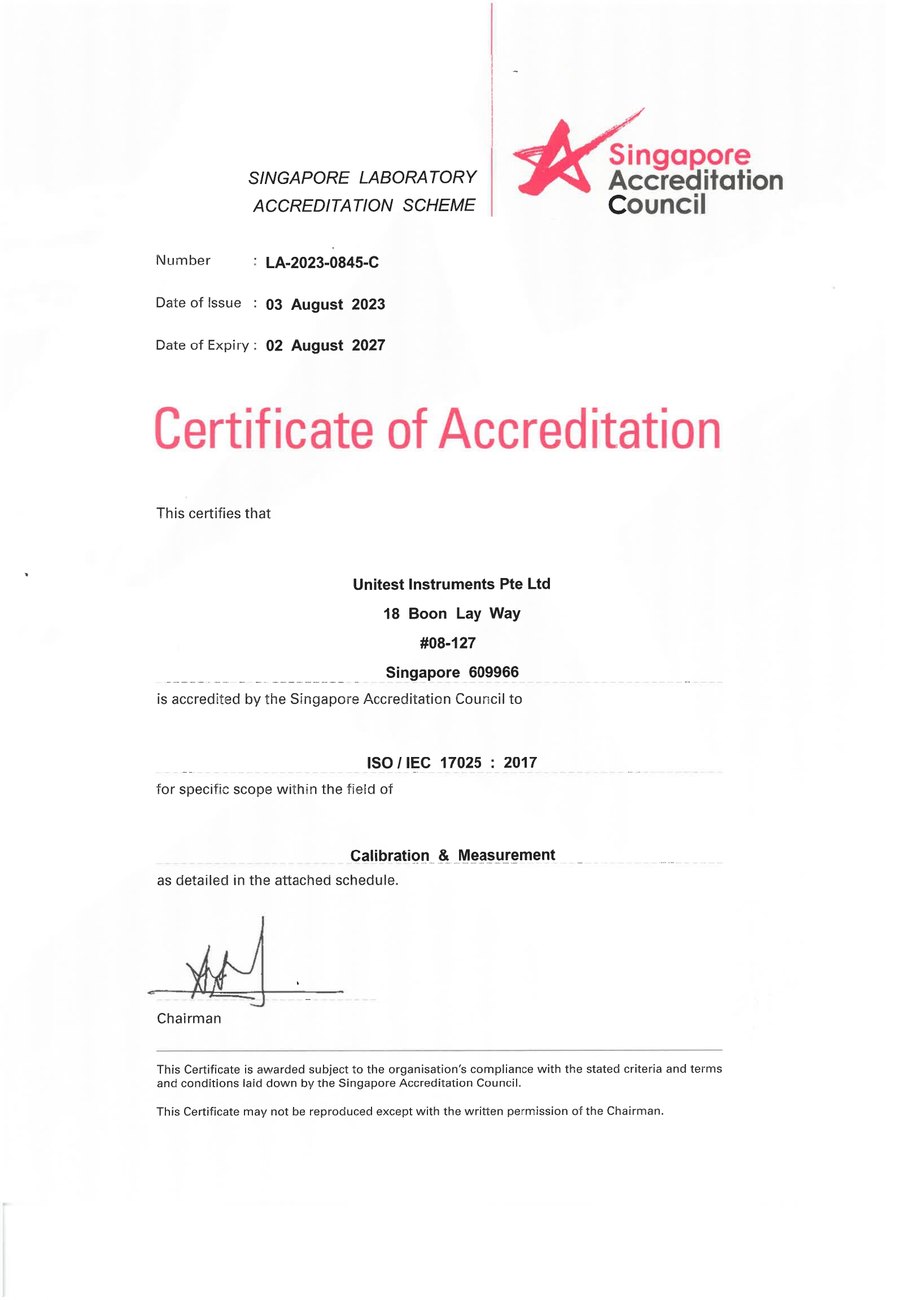
SAC-SINGLAS accredited calibration laboratory (Acc. No. LA-2023-0845-C) serving Singapore's industrial, pharmaceutical, and manufacturing sectors. All content reflects our ISO/IEC 17025 accredited scope and is reviewed by our technical calibration team.
Need compressed air instrument calibration in Singapore?
Unitest Instruments is SAC-SINGLAS accredited (Acc. No. LA-2023-0845-C) to ISO/IEC 17025. Same-week turnaround, certificates accepted by ISO 9001 auditors.