
Key Takeaways
- ISO 14644-1:2015 defines ISO Classes 1–9 using a mathematical formula: C = 10N × (0.1/D)2.08, where N is the class number and D is particle diameter in µm.
- The minimum number of sampling locations equals the square root of the room area in m² (rounded up), ensuring statistical representativeness of the classification.
- Optical particle counters must be calibrated to ISO 21501-4:2018 at intervals not exceeding 12 months. Flow rate accuracy is as critical as size accuracy.
- ISO 14644 recognises three occupancy states: as-built, at-rest, and operational. Particle counts differ significantly between states; personnel alone generate millions of particles per minute.
- Singapore HSA aligns pharmaceutical cleanroom requirements with EU GMP Annex 1 (2022), which mandates continuous real-time monitoring in Grade A and B zones, far beyond periodic classification surveys.
What ISO 14644 Actually Defines, and What It Does Not
ISO 14644 is not a single standard but a multi-part series published by the International Organization for Standardization. Part 1 (ISO 14644-1:2015, Classification of Air Cleanliness by Particle Concentration) is the foundational document that most industries reference when specifying a "cleanroom class." It replaced US Federal Standard 209E, which was officially withdrawn in 2001, though some older equipment specs still cite FED-STD-209 Class 100 or Class 10,000 equivalents.
What ISO 14644-1 defines precisely is the maximum permitted concentration of airborne particles (expressed in particles per cubic metre), at one or more specified particle sizes, measured under defined occupancy conditions. It does not define temperature, humidity, air pressure, microbial contamination, surface cleanliness, or garment requirements. Those are addressed in other standards: ISO 14644-4 (design and construction), ISO 14644-5 (operations), ISO 14698-1 (biocontamination control), and (for pharmaceutical applications), EU GMP Annex 1 and PIC/S guidance.
This distinction matters in practice. A facility can achieve an ISO 5 particle count classification while having unacceptably high microbial contamination if gowning and cleaning protocols are inadequate. ISO 14644-1 classification is a necessary but not sufficient condition for pharmaceutical GMP compliance.
The ISO Classification Formula and Particle Limits by Class
The ISO Class limits are not arbitrary round numbers. They are derived from a mathematical formula that scales logarithmically. For each ISO Class N and particle diameter D (in µm ≥ 0.1 µm), the maximum concentration in particles per cubic metre is:
Cn = 10N × (0.1 / D)2.08
The exponent 2.08 reflects empirical data on the size distribution of airborne particles in controlled environments. In practice, ISO 14644-1 Annex A tabulates the limits for the most commonly specified sizes. The table below lists the key values for the six most frequently cited particle sizes across all nine ISO Classes:
| ISO Class | ≥0.1 µm | ≥0.2 µm | ≥0.3 µm | ≥0.5 µm | ≥1 µm | ≥5 µm |
|---|---|---|---|---|---|---|
| ISO 1 | 10 | 2 | , | , | , | , |
| ISO 2 | 100 | 24 | 10 | 4 | , | , |
| ISO 3 | 1,000 | 237 | 102 | 35 | 8 | , |
| ISO 4 | 10,000 | 2,370 | 1,020 | 352 | 83 | , |
| ISO 5 | 100,000 | 23,700 | 10,200 | 3,520 | 832 | 29 |
| ISO 6 | 1,000,000 | 237,000 | 102,000 | 35,200 | 8,320 | 293 |
| ISO 7 | , | , | , | 352,000 | 83,200 | 2,930 |
| ISO 8 | , | , | , | 3,520,000 | 832,000 | 29,300 |
| ISO 9 | , | , | , | 35,200,000 | 8,320,000 | 293,000 |
Units: particles per cubic metre (particles/m³). Dashes indicate that concentration limits are not defined for that size at that class. Either because the calculated value exceeds 108/m³ (which is considered ambient air rather than cleanroom) or because the particle size is too small to be reliably measured by standard OPCs for that class.
A common mapping used in pharmaceutical contexts: EU GMP Grade A and B correspond roughly to ISO 5 at ≥0.5 µm (3,520 particles/m³), Grade C to ISO 7 (352,000 particles/m³), and Grade D to ISO 8 (3,520,000 particles/m³) under at-rest conditions. However, the EU GMP Annex 1 (2022 revision) also imposes ≥5 µm limits and operational state requirements that go beyond a simple ISO class mapping.
The Physics of Airborne Particle Behaviour in Cleanrooms
Understanding why particle counting works (and where it can mislead), requires a basic grasp of particle physics. Airborne particles in the 0.1–10 µm range are governed by three competing mechanisms: Brownian diffusion (dominant below ~0.3 µm, causing random motion), inertial impaction (relevant above ~1 µm, causing particles to follow straight-line trajectories and impact surfaces), and gravitational settling (significant above ~5 µm, with settling velocities following Stokes' Law).
The 0.3 µm size is particularly significant because it represents the peak of the "most penetrating particle size" (MPPS) for HEPA filters. The size at which diffusion and interception mechanisms are least efficient. This is why ISO 14644-1 and filter testing standards (ISO 29463, EN 1822) emphasise sub-micron particle performance.
In a cleanroom, HEPA or ULPA filtration removes particles from supplied air; the challenge is contamination generated within the room itself. Human occupants are by far the dominant internal source: a person standing still generates approximately 100,000 particles/minute of ≥0.5 µm; walking generates 10,000,000 particles/minute. This explains why operational classification results can be 10–100× worse than at-rest results, and why gowning discipline is critical in ISO 5 and cleaner environments.
Process equipment, materials, and even cleanroom construction materials (fibres from walls, flooring outgassing) contribute to the particle load. Electrostatic attraction can cause fine particles (below 1 µm) to deposit on surfaces faster than gravitational settling alone would predict. This is a consideration when interpreting particle count data in semiconductor fabs where sub-100 nm contamination can destroy device yields.
How Particle Counting Is Performed: Method and Instrumentation
The instrument of choice for ISO 14644-1 classification is the optical particle counter (OPC), also called a light-scattering airborne particle counter (LSAPC). The operating principle: a pump draws a controlled volumetric flow of air (typically 0.1–100 litres per minute depending on instrument class) through a laser beam. Each particle scatters light; a photodetector converts the scattered light pulse into a voltage signal whose peak amplitude correlates with particle size. The instrument bins particles by size channel and accumulates counts over the sampling period.
Sampling Protocol Under ISO 14644-1
The standard prescribes a statistically rigorous sampling protocol:
- Minimum locations: NL = √A (floor area in m²), rounded up. A 100 m² room needs at least 10 sampling locations.
- Minimum sample volume per location: Sufficient to detect 20 particles at the class limit concentration, for ISO 7 at ≥0.5 µm (352,000/m³), this works out to approximately 56.8 litres minimum per location.
- Statistical treatment: When three or more samples are taken per location, the mean is used. When only one sample per location is taken (permitted for large rooms with many locations), the 95th-percentile upper confidence limit (UCL) is calculated using Student's t-distribution.
- Probe position: Sampling probes should be positioned at working height (0.8–1.2 m above floor unless otherwise specified) and oriented to face the primary airflow direction for unidirectional flow zones.
ISO 14644-1 also distinguishes between classification (the formal determination of ISO Class, performed periodically) and monitoring (ongoing measurement during operations, addressed in ISO 14644-2). Classification requires the full statistical protocol; monitoring may use a simplified approach provided its adequacy has been demonstrated.
Isokinetic Sampling in Unidirectional Airflow Zones
In unidirectional flow (UDF) zones (where air moves in parallel streamlines, as in ISO 5 laminar flow hoods), the sampling probe inlet must be aligned with the airflow direction and the inlet velocity must match the local airflow velocity (isokinetic sampling). If the probe faces into faster-moving air than the sample inlet velocity, larger particles (above ~5 µm) are oversampled due to inertial effects; if slower, they are undersampled. Non-isokinetic errors of 20–30% in large particle counts are common in poorly executed classifications.
Need your particle counters calibrated to ISO 21501-4 in Singapore?
Unitest Instruments (Acc. No. LA-2023-0845-C) provides traceable calibration of optical particle counters for cleanroom classification, pharmaceutical GMP, and semiconductor facility compliance. Same-week turnaround available.
Calibration of Particle Counters: ISO 21501-4 Requirements
The accuracy of any cleanroom classification is only as good as the calibration of the particle counter used. The governing standard for OPC calibration is ISO 21501-4:2018 (Determination of Particle Size Distribution (Single Particle Light Interaction Methods), Part 4: Light Scattering Airborne Particle Counter for Clean Spaces). This standard specifies four key performance parameters that must be verified at calibration:
- Sizing accuracy and resolution: The instrument must correctly size NIST-traceable polystyrene latex (PSL) sphere aerosols within specified tolerances. For a 0.5 µm channel, the threshold size must be within ±10% of the nominal value.
- Counting efficiency: At the instrument's lower size limit, counting efficiency must be ≥50% (at 0.5× the nominal threshold) and approach 100% above 1.5× the threshold. This ensures the particle size distribution at the threshold is correctly characterised.
- False count rate: With particle-free air supplied to the inlet, the instrument must not exceed a defined false-count threshold. Typically <1 count per 5 minutes for instruments used in ISO 5 or cleaner environments.
- Flow rate accuracy: The volumetric flow rate must be verified against a traceable flow standard (e.g. a bubble flowmeter or electronic flow meter calibrated to NMC Singapore's standards). Flow rate error directly propagates to concentration error. A 5% flow error produces a 5% concentration error.
As explained in our guide to what a calibration certificate should contain, a valid ISO 21501-4 calibration certificate must state the measurement uncertainty for each parameter, the reference standard traceability chain, and the calibration date. ISO 14644-1 explicitly requires that classification results be obtained with instruments whose calibration is current and traceable.
The calibration interval for particle counters is a matter of both regulatory requirement and risk management. How often to calibrate instruments depends on instrument stability history, usage intensity, and the consequence of an out-of-tolerance reading. For particle counters used in pharmaceutical Grade A monitoring, annual calibration is the regulatory minimum; many facilities opt for 6-monthly calibration given the high consequence of a missed exceedance.
Measurement Uncertainty in Particle Counting
Particle counter calibrations carry non-trivial measurement uncertainty, arising from: PSL sphere sizing uncertainty (typically ±2–3%), particle generation repeatability, counting statistics (Poisson noise at low concentrations), and flow rate uncertainty. For a cleanroom operating close to its class limit, the combined uncertainty can be significant. A facility claiming ISO 5 classification at 3,400 particles/m³ (against a 3,520/m³ limit) should consider whether their OPC's measurement uncertainty renders that result statistically indistinguishable from a class exceedance.
This connects directly to the concept of measurement uncertainty. A rigorous classification report should include the expanded uncertainty of the particle count result and demonstrate that the upper uncertainty bound is still within the class limit. ISO/IEC Guide 98-3 (GUM) principles apply to particle counting as they do to any measurement.
Singapore Regulatory Context for Cleanroom Classification
Singapore operates several high-value industries that depend on cleanroom control: pharmaceutical manufacturing (regulated by the Health Sciences Authority, HSA), semiconductor fabrication (EDB-supported fabs operated by GlobalFoundries, Micron, and others), biomedical device manufacturing, and aerospace MRO. Each sector has slightly different regulatory demands around cleanroom classification.
Pharmaceutical: HSA GMP and EU Annex 1
Singapore HSA's Requirements for Medicinal Products (Manufacturing) align closely with the PIC/S Guide to GMP and, by extension, the EU GMP Annexes. The 2022 revision of EU GMP Annex 1 (Manufacture of Sterile Medicinal Products) introduced significant changes relevant to cleanroom classification:
- Continuous environmental monitoring (CEM) is now mandatory in Grade A and B areas during operations, not just periodic classification surveys. This requires fixed particle counter installations with data logging and alarm systems.
- Risk-based approach: Annex 1 requires a Contamination Control Strategy (CCS) document that links particle count limits to product risk. Parenteral products in Grade A vs. terminal sterilisation in Grade C have different consequences of a particle exceedance.
- ≥5 µm particles: The 2022 revision re-emphasises the ≥5 µm limit (29 particles/m³ in Grade A at-rest), which had sometimes been neglected in favour of the ≥0.5 µm limit. Exceedances at ≥5 µm can indicate personnel or process contamination events even when ≥0.5 µm counts are within limits.
Semiconductor and Electronics Manufacturing
Singapore's semiconductor fabs operate at ISO 3–5 cleanliness for wafer processing zones, with tool-level mini-environments potentially at ISO 1–2. SEMI standards (particularly SEMI F57 for ultrapure water and SEMI F21 for AMC) complement ISO 14644. The Singapore Semiconductor Industry Association (SSIA) and EDB do not publish a separate cleanroom standard. ISO 14644 is adopted directly, typically with customer-specified requirements from IDMs (Intel, TSMC, etc.) layered on top.
Medical Devices: SS 620 and ISO 13485
Singapore Standard SS 620 aligns with ISO 13485 for medical device quality management. Cleanroom requirements for medical device manufacturing follow ISO 14644, with additional guidance from ISO 11135 (sterilisation) and ISO 11607 (sterile packaging) where applicable. SAC accreditation under SINGLAS provides the measurement traceability required for ISO 13485 audits.
Common Mistakes in Cleanroom Particle Counting
After reviewing cleanroom qualification reports across pharmaceutical, semiconductor, and medical device facilities in Singapore, the following errors recur most frequently:
1. Using an Overdue or Uncalibrated Particle Counter
This is the most consequential error. An OPC whose calibration has lapsed may have drifted in sizing threshold or flow rate, producing systematically biassed results. A 10% upward drift in the flow rate makes the instrument appear to sample more volume than it does, underreporting concentration. A facility could falsely appear to be within class limits. All classification results obtained with an overdue instrument are invalid and may need to be repeated. The difference between accredited and non-accredited calibration is significant here. Only accredited calibration provides the documented uncertainty and traceability chain that regulators require.
2. Insufficient Sampling Volume
ISO 14644-1 requires a minimum sample volume sufficient to detect 20 particles at the class limit. For ISO 7 at ≥0.5 µm, this is 20 ÷ 352,000 m³ = 5.68 × 10⁻⁵ m³ = 56.8 litres. A 1 CFM (28.3 L/min) OPC needs at least 2 minutes per location. In practice, many operators run 1-minute samples (28.3 litres) (below the threshold), or rush sampling to save time. The result is statistically unreliable and invalid under ISO 14644-1 Annex B.
3. Not Purging Sample Tubing Between Locations
Particles deposited on the walls of sample tubing can be re-entrained by later sampling runs, artificially elevating counts at the next location. ISO 14644-1 recommends purging the tubing for at least one sampling period (or a defined volume equivalent) before taking a new sample location reading.
4. Classifying the Wrong Occupancy State
Labelling at-rest results as operational (or vice versa), is a documentation error with regulatory consequences. EU GMP Annex 1 requires both at-rest and operational classification for Grade A and B. The difference between states must be explicitly stated in the qualification protocol and report.
5. Ignoring Coincidence Error at High Concentrations
At very high particle concentrations (above approximately 70,000 particles/cm³ for a typical OPC with a sensing volume of ~10⁻⁴ cm³), two particles may simultaneously occupy the sensing zone, appearing as a single larger particle. This underreports actual count and skews the reported size distribution toward larger particles. Coincidence error is relevant when classifying ISO 8–9 spaces or during upset conditions. Most modern OPCs specify a maximum coincidence concentration in their datasheets. Classification should not be attempted above this limit without dilution.
Frequently Asked Questions
ISO 14644 is an international standard series that defines cleanroom and associated controlled environment classifications based on airborne particulate cleanliness. Part 1 (ISO 14644-1:2015) sets nine ISO Classes (ISO Class 1 through ISO Class 9) by specifying the maximum permitted concentration of particles per cubic metre at defined sizes, principally ≥0.1 µm, ≥0.2 µm, ≥0.3 µm, ≥0.5 µm, ≥1 µm, and ≥5 µm. The standard replaced the older US Federal Standard 209E in most regulated industries and is referenced by Singapore's Health Sciences Authority (HSA) for pharmaceutical GMP compliance.
ISO 14644-1 uses a formula-based approach where the maximum concentration C is calculated as C = 10N × (0.1/D)2.08, where N is the ISO Class number and D is the particle size in micrometres. In practice, the most commonly measured sizes are ≥0.5 µm and ≥5 µm because these correspond to the dominant contamination risks in semiconductor and pharmaceutical manufacturing. For very clean spaces (ISO Class 1–2), sub-0.1 µm ultrafine particles may also be monitored using condensation particle counters.
The minimum number of sampling locations (NL) is determined by the formula NL = √A, where A is the cleanroom floor area in square metres, rounded up to the nearest whole number. For example, a 25 m² cleanroom requires a minimum of 5 sampling locations. Each location is sampled with a minimum volume sufficient to detect at least 20 particles at the class limit concentration. ISO 14644-1 Annex B specifies a minimum single-sample volume of 2 litres for many configurations. Statistical treatment (95th percentile confidence limit) is then applied to determine classification.
ISO 14644-1 recognises three occupancy states: 'as-built' (facility complete, no equipment or personnel), 'at-rest' (equipment installed and functioning, no operating personnel), and 'operational' (normal production activity, personnel present). Classification results differ substantially between states because human activity generates large numbers of particles. A person walking generates approximately 10,000,000 particles per minute of ≥0.3 µm. Regulatory bodies such as the EU GMP Annex 1 and Singapore HSA specify which state applies for each grade. Most pharmaceutical cleanrooms are classified in both at-rest and operational states.
An optical particle counter draws a known volumetric flow rate of air through a laser sensing zone. Each particle that passes through scatters or diffracts light; the detector converts the scattered light pulse into an electrical signal whose amplitude is proportional to particle size. The instrument counts pulses in each size channel and reports concentration in particles per cubic metre or cubic foot. OPCs are calibrated against NIST-traceable polystyrene latex (PSL) spheres of certified diameter. Accurate flow-rate calibration is equally important. A 5% error in sampled volume produces a 5% error in reported concentration.
ISO 14644-1 requires that particle-counting instruments be calibrated at intervals not exceeding 12 months, with calibration traceable to national measurement standards. ISO 21501-4:2018 is the specific standard governing calibration of light-scattering airborne particle counters used for cleanroom classification. It specifies requirements for sizing accuracy, counting efficiency, false count rate, and flow rate. In Singapore, calibration by a SAC-SINGLAS accredited laboratory (such as Unitest Instruments, Acc. No. LA-2023-0845-C) provides the traceability chain required by HSA GMP inspections and ISO 9001 audits.
The most frequent errors are: (1) sampling with uncalibrated or overdue instruments. Even a well-functioning OPC can drift in sizing accuracy over 12 months; (2) insufficient sample volume per location, failing the 20-particle detection criterion; (3) using isokinetic sampling probes incorrectly, introducing turbulent bias; (4) failing to purge the sample tubing between locations, causing cross-contamination of counts; (5) classifying under 'as-built' conditions but labelling results as 'operational'; and (6) ignoring coincidence error, at very high concentrations, two or more particles in the sensing zone simultaneously are counted as one large particle, underreporting actual count.
Yes. Singapore's Health Sciences Authority (HSA) aligns pharmaceutical cleanroom requirements with the EU GMP Annex 1 (2022 revision) and the PIC/S Guide to GMP. Annex 1 introduces Grade A–D classification (roughly mapping to ISO 5–8) and mandates continuous real-time particle monitoring in Grade A and B areas during operations, not just periodic classification surveys. Additionally, HSA's Requirements for Medicinal Products (Manufacturing) reference ISO 14644-2 for ongoing monitoring frequency. Semiconductor fabs operating under Singapore Economic Development Board (EDB) incentives typically follow SEMI standards alongside ISO 14644, including SEMI F21 for airborne molecular contamination monitoring.
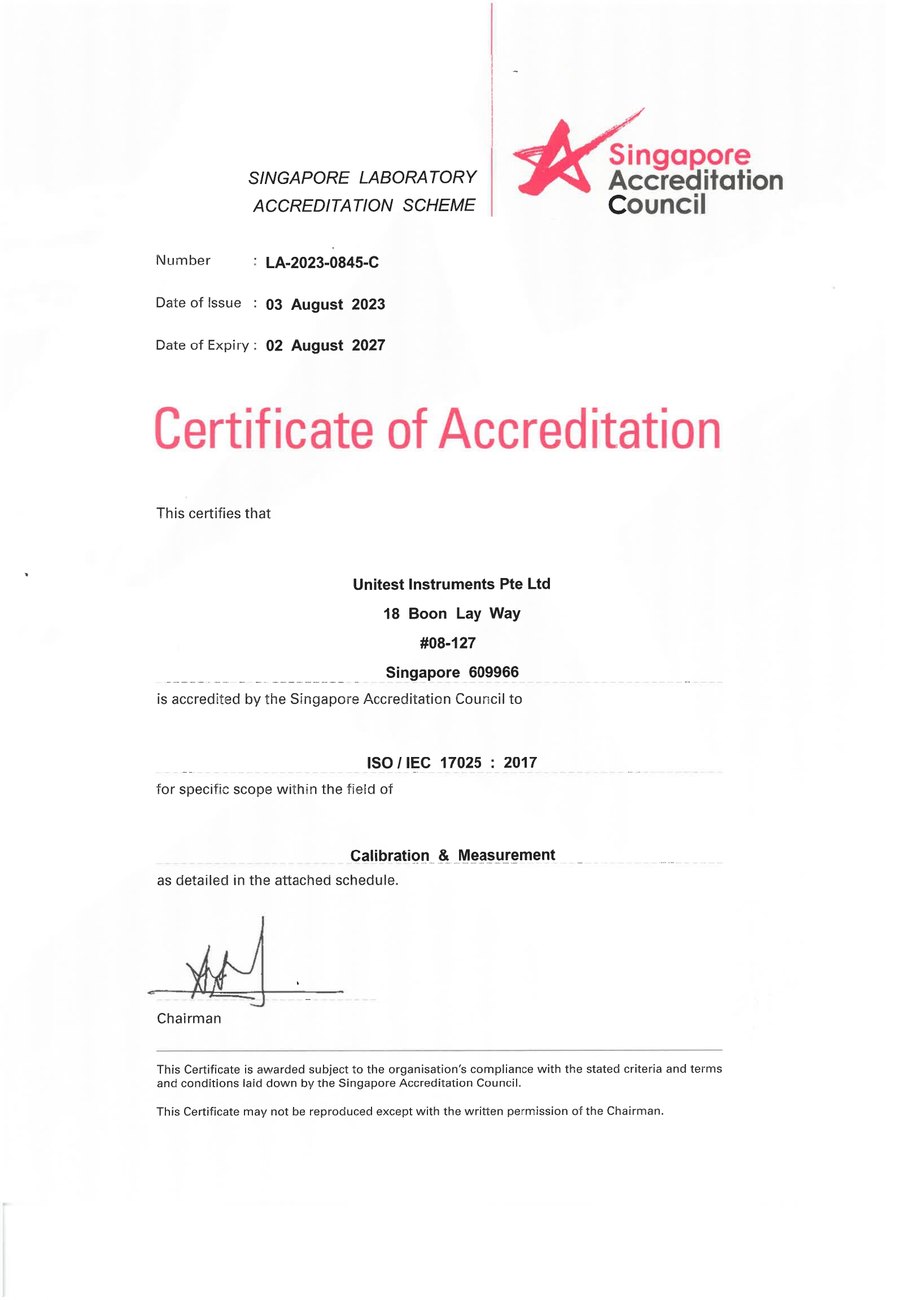
SAC-SINGLAS accredited calibration laboratory (Acc. No. LA-2023-0845-C) serving Singapore's industrial, pharmaceutical, and manufacturing sectors. All content reflects our ISO/IEC 17025 accredited scope and is reviewed by our technical calibration team.
Need particle counter calibration in Singapore?
Unitest Instruments is SAC-SINGLAS accredited (Acc. No. LA-2023-0845-C) to ISO/IEC 17025. Same-week turnaround, certificates accepted by ISO 9001 auditors and HSA GMP inspectors.