
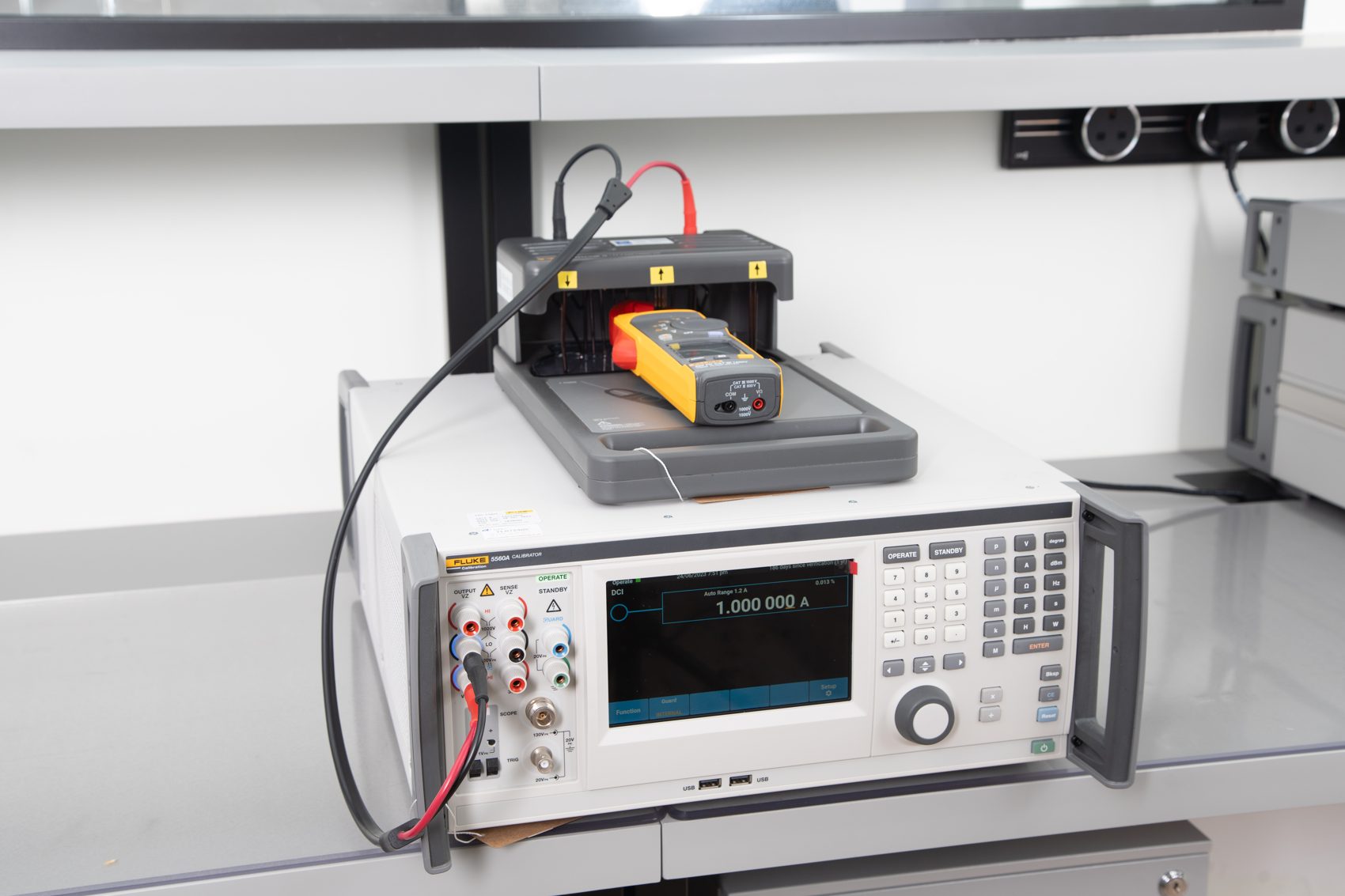
Key Takeaways
- ISO 8573 assigns separate purity classes (0 through 9) for particles, water, and oil. You must specify all three for your application.
- Singapore's MOM, HSA, SFA, and NEA each reference compressed air quality requirements in their respective regulated sectors.
- All instruments used for ISO 8573 compliance testing must carry calibration certificates traceable to the NMC. A SAC-SINGLAS accredited certificate closes audit loops with no further justification required.
- Pharmaceutical GMP facilities under HSA must perform requalification testing after any change to the compressor, dryer, filter, or distribution system.
- Company fines under the Workplace Safety and Health Act can reach S$500,000 for serious breaches linked to contaminated process air.
What ISO 8573 Is and Why It Matters in Singapore
ISO 8573 is a multi-part international standard published by the International Organization for Standardization that defines the purity requirements and test methods for compressed air. The standard covers three primary contaminant types (solid particles, water (expressed as pressure dew point), and oil (aerosol, vapour, and liquid combined)), and assigns each a numerical purity class from Class 0 (the most stringent, requiring user-defined limits) to Class 9 (the least stringent).
In Singapore, compressed air is used across a remarkably broad range of industries: semiconductor fabs, pharmaceutical manufacturers, food and beverage processors, hospitals, aerospace MRO facilities, and general engineering workshops. The quality of that air directly affects product purity, equipment longevity, and worker safety. Because Singapore operates within an internationally benchmarked regulatory framework, ISO 8573 has become the de facto compliance language for both regulators and third-party auditors.
Facilities managers and compliance officers operating in Singapore need to understand ISO 8573 not as an abstract technical standard but as a practical compliance obligation. The MOM's Workplace Safety and Health (WSH) framework, HSA's Good Manufacturing Practice (GMP) guidelines, and sector-specific codes of practice from NEA, SFA, and BCA all either directly reference compressed air quality or establish conditions under which ISO 8573 becomes the appropriate measurement framework.
The ISO 8573 Purity Class System Explained
The standard is structured around three independent purity class designations written in the format ISO 8573-1 Class X.Y.Z, where X is the particle class, Y is the water/humidity class, and Z is the oil class. Each number represents a maximum allowable concentration for that contaminant group. A designation of Class 1.2.1, for example, represents Class 1 for particles, Class 2 for water, and Class 1 for oil. A common specification for food contact and pharmaceutical packaging air.
| Purity Class | Particles (≥0.1 µm, per m³) | Pressure Dew Point | Total Oil (mg/m³) | Typical Application |
|---|---|---|---|---|
| Class 0 | User-specified, better than Class 1 | User-specified | User-specified | Critical pharma cleanrooms, semiconductors |
| Class 1 | ≤ 20,000 (≥0.1 µm) | ≤ −70 °C | ≤ 0.01 | GMP Grade A/B, sterile fill-finish |
| Class 2 | ≤ 400,000 (≥0.1 µm) | ≤ −40 °C | ≤ 0.1 | Pharmaceutical secondary packaging, medical devices |
| Class 3 | ≤ 90,000,000 (≥0.1 µm) | ≤ −20 °C | ≤ 1 | Food contact (non-direct), general manufacturing QC |
| Class 4 | ≤ 90,000,000 (≥1 µm) | ≤ +3 °C | ≤ 5 | Pneumatic tools, general workshop use |
Note that the water class (Y) uses pressure dew point rather than a mass concentration. A pressure dew point of −40 °C means that at the system operating pressure, the air will not condense water unless cooled below −40 °C. In Singapore's tropical climate, this is particularly important: ambient relative humidity regularly exceeds 80%, meaning untreated compressed air drawn from atmosphere will carry substantial moisture that a refrigerant dryer alone may not remove to the levels required for pharmaceutical or electronics applications.
Singapore's Regulatory Landscape for Compressed Air Quality
Unlike some jurisdictions where ISO 8573 is purely voluntary, Singapore's regulatory framework creates binding obligations for compressed air quality in several sectors. Understanding which agency governs your facility helps you determine which standard and testing frequency apply.
Ministry of Manpower (MOM). Workplace Safety
Under the Workplace Safety and Health Act (Cap. 354A), employers must provide and maintain safe working environments. Where compressed air is used in breathing air applications, spray painting, abrasive blasting, or respiratory protection, MOM's WSH regulations (including the Factories (Medical Examinations) Regulations and relevant Codes of Practice) require that the air supply meets defined quality limits. Breathing air for self-contained breathing apparatus and supplied-air respirators must comply with SS 547 (the Singapore Standard for breathing air quality), which aligns with ISO 8573 particle and oil limits.
Health Sciences Authority (HSA). Pharmaceutical GMP
HSA's GMP guidelines for pharmaceutical manufacturers in Singapore (aligned with the PIC/S PE 009 Guide to GMP) explicitly require that compressed air used in or near product must be of defined quality, documented, and periodically tested. HSA inspectors will request compressed air qualification records during facility audits. Critical compressed air (Grade A/B environments) must be tested to Class 1 or Class 2 levels for particles and oil, and requalification is mandatory after system changes.
Singapore Food Agency (SFA). Food Manufacturing
Under the Sale of Food Act and SFA's licensing conditions for food factories, compressed air that contacts food products directly must be free of contamination. SFA's Food Factory Licensing Framework references compressed air quality as part of the HACCP-based hazard control plan. Class 1.2.1 or Class 1.4.1 is commonly specified for direct food-contact air in Singapore food factories, and auditors will check whether instruments used for testing carry current, traceable calibration certificates.
BCA, NEA, and PUB
The Building and Construction Authority (BCA) references ventilation and air quality standards in building codes, which can affect compressed air systems in integrated mechanical and electrical (M&E) systems in large facilities. The National Environment Agency (NEA) governs environmental discharges. Oil-contaminated condensate from compressed air systems must be managed as a scheduled waste. PUB's industrial water quality guidelines apply where compressed air systems interact with water treatment processes.
Need calibration certificates for your compressed air testing instruments?
Unitest Instruments is SAC-SINGLAS accredited (Acc. No. LA-2023-0845-C) to calibrate the dew point meters, particle counters, and pressure instruments used in ISO 8573 compliance testing. Certificates traceable to Singapore's NMC, accepted by MOM, HSA, and ISO 9001 auditors.
Step-by-Step Compressed Air Compliance Process
Achieving and maintaining ISO 8573 compliance is not a one-off event. It is a documented cycle of specification, installation qualification, performance qualification, periodic monitoring, and re-qualification. Here is the process that Singapore facilities managers typically follow.
Step 1. Specify the Required Purity Class
Begin with a process risk assessment. Identify every compressed air use point and classify each by the quality class required. Document the specification in a User Requirement Specification (URS) or equivalent quality document. For GMP-regulated facilities, this specification must be approved and controlled under your document management system. The specification drives equipment selection (compressor type, dryer type, filter grade) and test method selection.
Step 2. Design and Commission the System
Select compressor, dryer, and filter combinations capable of consistently achieving the specified class. In Singapore's climate, refrigerant dryers typically achieve a pressure dew point of +3 °C. Adequate for Class 4 and sometimes Class 3 water, but insufficient for pharmaceutical applications where desiccant dryers capable of −40 °C or lower are required. Installation Qualification (IQ) documents the installed system against the design specification.
Step 3. Perform Operational Qualification (OQ) Testing
OQ testing verifies that the system produces air meeting the specification under defined operating conditions. This is the formal ISO 8573 compliance test. You will need calibrated instruments for each contaminant class you are measuring:
- Particle counting (ISO 8573-4): Optical particle counters measure the number concentration of particles at defined size thresholds. These must be calibrated to traceable standards.
- Pressure dew point (ISO 8573-3): Chilled mirror hygrometers (primary method) or calibrated capacitance sensors measure moisture content at line pressure.
- Total oil content (ISO 8573-2 and ISO 8573-5): Gravimetric methods, FTIR, or catalytic oxidation detectors measure total oil (aerosol + vapour + liquid). Detection limits below 0.01 mg/m³ are required for Class 1 oil.
- Microbiological (ISO 8573-7): Impaction or membrane filtration samplers collect airborne microorganisms for incubation and colony-forming-unit counting. Mandatory for pharmaceutical Grade A/B air.
Step 4. Document and Issue the Compliance Report
OQ results must be compiled in a formal test report that includes the test date, ambient conditions, sample points, instrument serial numbers and calibration certificate references, measured values, applicable purity class limits, and a pass/fail determination. In Singapore's pharmaceutical sector, this report is a GMP quality document subject to version control and retention for the lifetime of the product plus a defined period (typically five years minimum).
Step 5. Establish Ongoing Monitoring and Periodic Re-Testing
Once qualified, compressed air systems require ongoing monitoring. For pharmaceutical facilities, this may mean continuous online dew point and particle monitoring at critical points, supplemented by periodic full ISO 8573 testing (annually as a minimum). For general manufacturing under ISO 9001, the quality management plan should define re-testing frequency based on risk. Typically annual for critical applications, biennial for non-critical. Any change to the system (new compressor, filter cartridge type change, distribution system extension) triggers a change-control process and re-qualification test. As discussed in our guide on how often calibration should be performed, the same risk-based principles apply to the instruments used to monitor your compressed air system.
Calibration Instrument Requirements for ISO 8573 Testing
The integrity of an ISO 8573 compliance test depends entirely on the calibration status of the instruments used. An uncalibrated dew point meter or a particle counter last calibrated three years ago does not provide defensible compliance evidence, and a Singapore HSA inspector or ISO 9001 auditor will check calibration certificates as a matter of routine.
For each instrument category, the following calibration requirements apply:
- Chilled mirror dew point meters: Primary reference instruments for moisture measurement. These must be calibrated against reference humidity generators traceable to national humidity standards. Calibration interval is typically 12 months, or sooner if the instrument shows drift. An accredited calibration certificate is the standard evidence requirement.
- Capacitance dew point sensors: Faster and more portable than chilled mirror instruments but prone to contamination from oil or aggressive chemicals. Calibration intervals are typically 6–12 months. Cross-check against a chilled mirror reference at each calibration event is best practice.
- Optical particle counters (OPC): Calibrated using NIST-traceable or NMC-traceable particle size standards. Calibration includes verification of counting efficiency, false count rate, and size channel accuracy. Annual calibration is standard; quarterly for critical pharmaceutical applications.
- Pressure gauges and transmitters used in sampling: Must be calibrated to ensure sampling is performed at the correct line pressure. Pressure errors directly affect mass concentration calculations. See our article on ISO/IEC 17025 calibration requirements for the traceability chain that applies to all these instruments.
- Flow meters: Accurate flow measurement is required for gravimetric oil determination. Calibration of the sample flow meter ensures volume accuracy in the oil concentration calculation.
In Singapore, the highest level of instrument calibration traceability is provided by certificates issued by SAC-SINGLAS accredited laboratories operating under ISO/IEC 17025. These certificates carry the SAC-SINGLAS mark and include a full uncertainty statement. Both required by the most stringent audit frameworks, including HSA GMP and aerospace AS9100.
Penalties and Consequences for Non-Compliance in Singapore
Failing to maintain compressed air quality to specified ISO 8573 classes is not merely an audit finding. It carries legal, financial, and operational consequences that can be severe in Singapore's tightly regulated industrial environment.
MOM Enforcement Under the WSH Act
Where contaminated compressed air contributes to a workplace incident or occupational illness, MOM can prosecute under the Workplace Safety and Health Act. The maximum financial penalty for a body corporate is S$500,000 for a first offence; for a responsible individual (such as a facility manager who failed to implement required controls), the maximum is S$200,000 and/or two years' imprisonment. MOM also has the power to issue Improvement Notices and Prohibition Notices. The latter stops operations immediately and is publicly notifiable.
HSA GMP Enforcement
For pharmaceutical manufacturers, an HSA GMP inspection finding related to compressed air quality can result in a Critical or Major deficiency classification. Critical deficiencies require immediate corrective action and may trigger batch recalls if product contamination cannot be ruled out. Repeat failures or failure to close out deficiencies within the agreed timeline can lead to suspension of the manufacturer's licence to manufacture or import pharmaceuticals, effectively halting production.
SFA and Food Safety Enforcement
SFA can issue stop-manufacture orders and require product recalls where contaminated compressed air has affected food safety. Costs of recall, destruction, and third-party verification are borne by the manufacturer. SFA may also publicise enforcement actions, with significant reputational consequences for Singapore-based food exporters.
Commercial and Insurance Consequences
Beyond regulatory action, non-compliance with ISO 8573 invalidates many equipment warranties, can void product liability insurance cover, and disqualifies facilities from certain export markets and customer qualification programmes. The cost of a full annual compressed air quality test and instrument calibration programme is a fraction of any one of these downstream costs.
Frequently Asked Questions
ISO 8573 is the internationally recognised family of standards that specifies purity classes for compressed air used in industrial, pharmaceutical, food, and manufacturing processes. In Singapore it is referenced by MOM under the Factories Act, by HSA for pharmaceutical GMP facilities, and by accreditation bodies requiring documented air quality in controlled environments. Compliance is not voluntary in regulated sectors. Audit findings and GMP inspections will check that your compressed air meets the declared purity class.
ISO 8573 addresses three primary contaminant groups: solid particles (dust, aerosols), water (pressure dew point and liquid water content), and oil (total oil content including aerosol, vapour, and liquid). Each group is assigned a separate purity class from Class 0 (cleanest, user-specified) through Class 1 to Class 9 depending on the application. Microbiological contamination is addressed in a companion standard, ISO 8573-7.
Purity class selection depends on the end use. Pharmaceutical manufacturing (GMP Grade A/B cleanrooms) typically requires Class 1 or Class 2 for particles and oil, with a pressure dew point of −40 °C or lower. Food contact applications generally target Class 1.2.1. General manufacturing and pneumatic tools can operate at Class 3 or Class 4 for particles. Your process risk assessment, regulatory guidance (HSA for pharma, SFA for food), and equipment manufacturer requirements all feed into the correct class selection.
Testing frequency is driven by your risk classification and regulatory framework. GMP-regulated facilities under HSA typically require at least annual testing with more frequent monitoring (quarterly or continuous online monitoring) for critical production air. ISO 9001-certified facilities should define frequency in their quality management plan. Annual testing is a common baseline. After any significant change to the compressor, filtration, or distribution system, a full requalification test is mandatory regardless of the schedule.
Testing to ISO 8573 requires a suite of calibrated instruments. Particle counters measure solid particle concentrations per ISO 8573-4. Chilled mirror or capacitance hygrometers measure pressure dew point per ISO 8573-3. Oil mist detectors and photoionisation detectors measure total oil content per ISO 8573-2 and ISO 8573-5. All instruments used in compliance testing must hold current calibration certificates traceable to national standards, in Singapore, that means traceability to the National Metrology Centre (NMC).
Penalties vary by sector and the severity of the breach. Under the Workplace Safety and Health Act (administered by MOM), failing to maintain safe working environments (which includes contaminated process air leading to occupational illness), can result in fines up to S$500,000 for companies and up to S$200,000 plus imprisonment for responsible individuals. In the pharmaceutical sector, HSA can suspend or revoke GMP licences and manufacturing authorisations. In food manufacturing, SFA can issue stop-manufacture orders. In all cases, the commercial risk of a product recall or liability claim substantially exceeds the cost of testing.
Yes. Any instrument used to demonstrate compliance with ISO 8573 must be calibrated at appropriate intervals with certificates traceable to national standards. In Singapore, traceability runs to the NMC at A*STAR. Instruments calibrated by a SAC-SINGLAS accredited laboratory (such as Unitest Instruments, Acc. No. LA-2023-0845-C) carry the highest level of documented traceability and are accepted without challenge by MOM, HSA, and third-party ISO 9001 auditors.
In-house testing is permitted provided your instruments are within calibration and your procedures are documented. However, for GMP-regulated environments under HSA, or where test results will be presented to regulators, using an accredited third-party testing service or at minimum having your instruments calibrated by an accredited laboratory provides a higher level of defensibility. An accredited calibration certificate closes the audit loop because the traceability chain is independently verified.
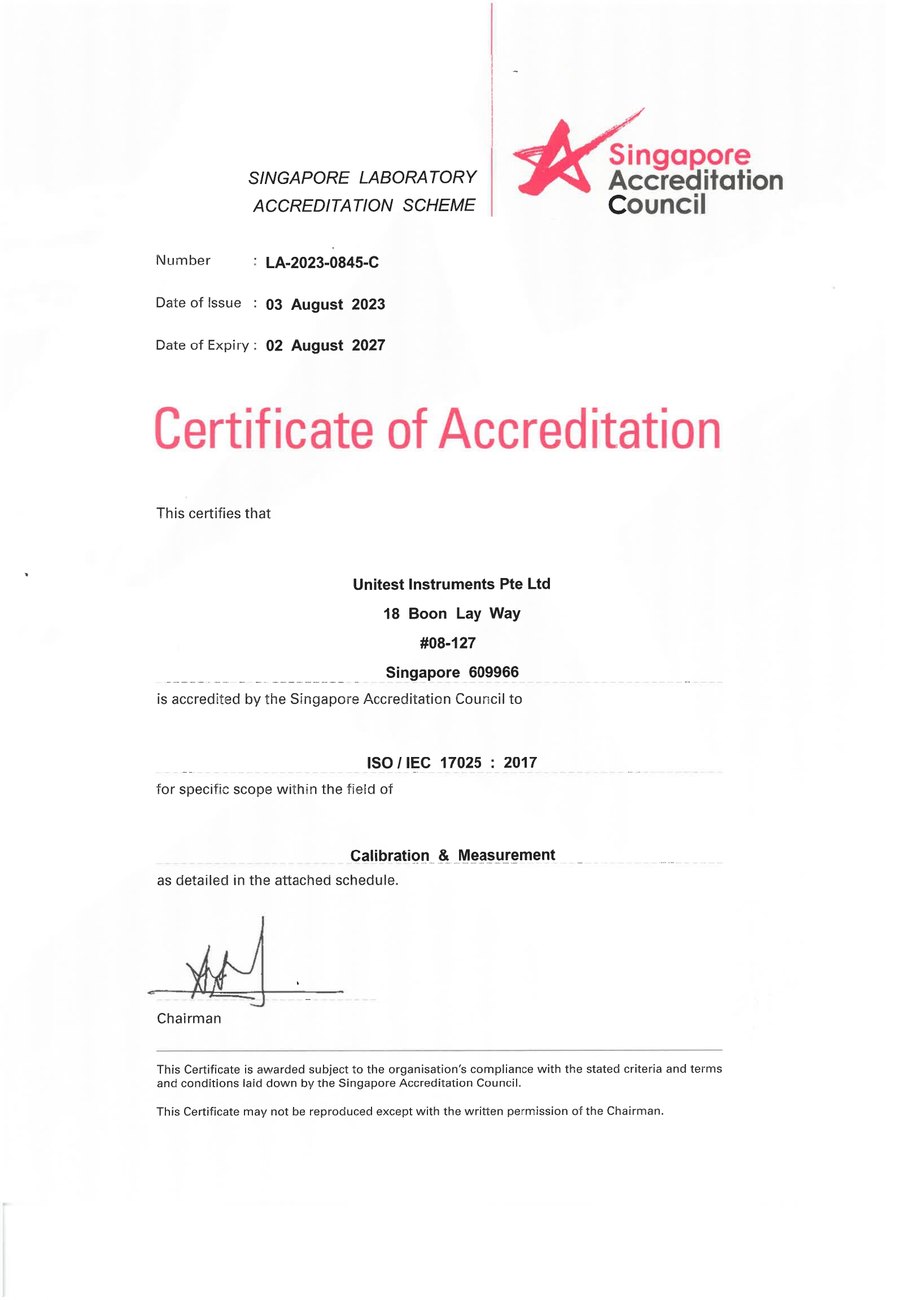
SAC-SINGLAS accredited calibration laboratory (Acc. No. LA-2023-0845-C) serving Singapore's industrial, pharmaceutical, and manufacturing sectors. All content reflects our ISO/IEC 17025 accredited scope and is reviewed by our technical calibration team.
Need compressed air instrument calibration in Singapore?
Unitest Instruments is SAC-SINGLAS accredited (Acc. No. LA-2023-0845-C) to ISO/IEC 17025. Same-week turnaround, certificates accepted by ISO 9001 auditors, MOM, and HSA GMP inspectors.