
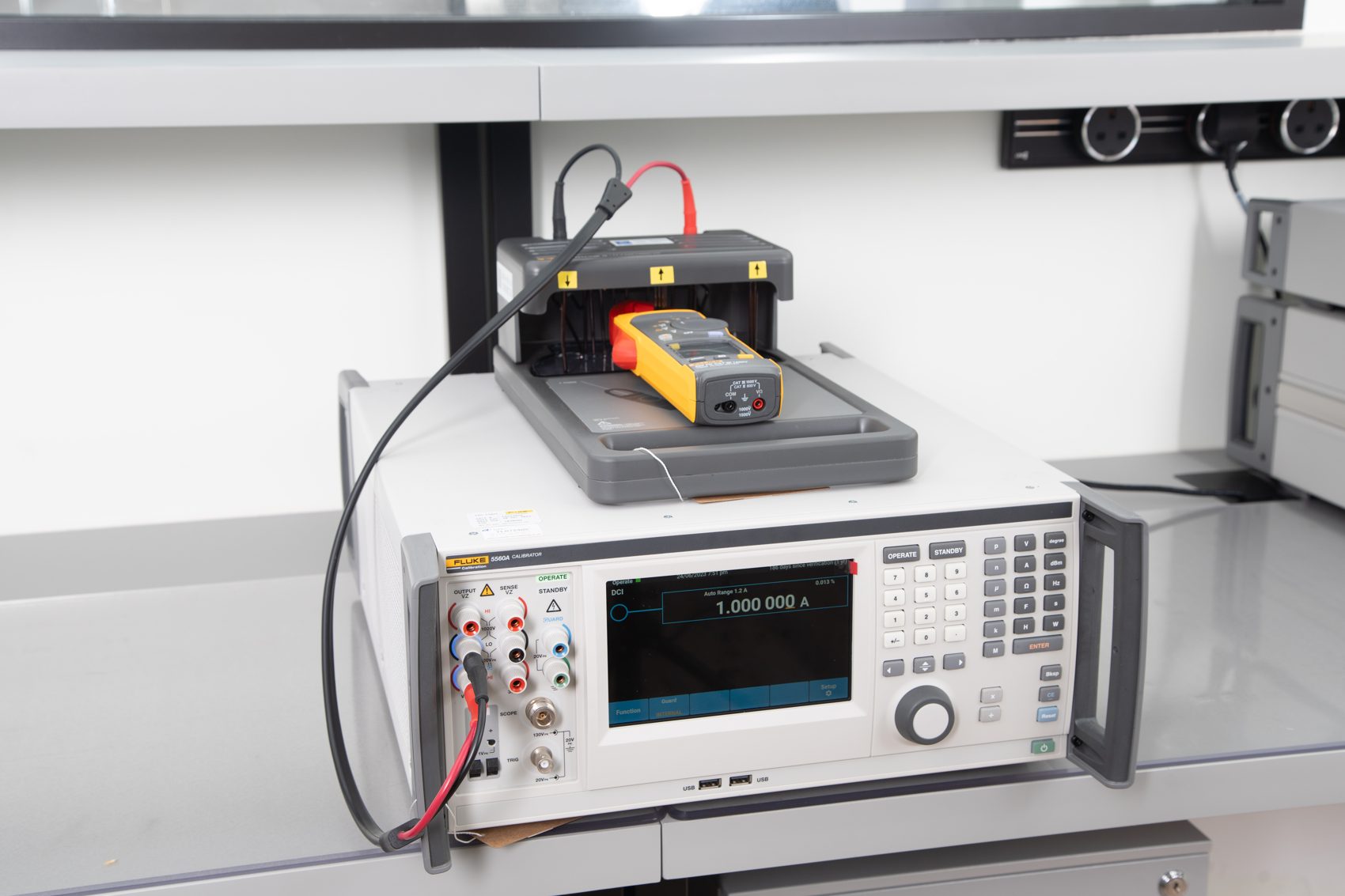
Key Takeaways
- Singapore's NEA IAQ Guidelines cap CO₂ at 1,000 ppm; BCA Green Mark Platinum targets 800 ppm. Instruments must be calibrated to verify compliance.
- Only NDIR (Non-Dispersive Infrared) sensors are suitable for regulatory IAQ monitoring. Avoid "eCO2" or electrochemical proxies for compliance work.
- NDIR sensors drift 1–3% per year; an uncalibrated instrument can be 50–100 ppm off within 2–3 years, risking false compliance or failed audits.
- SAC-SINGLAS accredited calibration certificates (Acc. No. LA-2023-0845-C) from Unitest Instruments are accepted by BCA, ISO 9001 auditors, and MOM inspectors.
- Multi-parameter instruments (CO₂ + temperature + RH + CO) reduce equipment costs and simplify site surveys. The Fluke 975 and Rotronic CF8 both cover this scope.
Who Needs a CO₂ Monitor in Singapore?
Carbon dioxide monitoring has moved well beyond the niche of laboratory scientists. In Singapore, three converging pressures have made CO₂ monitors a standard fixture in commercial buildings, healthcare facilities, schools, and food manufacturing plants.
First, regulatory requirements: the NEA's Indoor Air Quality Guidelines (2021 revision) set a 1,000 ppm CO₂ limit for occupied commercial spaces, and the Ministry of Manpower's Workplace Safety and Health Act applies similar principles to factories. BCA's Green Mark 2021 scheme scores ventilation performance using real CO₂ measurements, not just design calculations.
Second, post-pandemic awareness: CO₂ concentration is the most practical real-time proxy for ventilation adequacy and airborne infection risk in enclosed spaces. Facilities managers who installed CO₂ monitors during COVID-19 have largely kept them running, recognising that high CO₂ also correlates directly with reduced cognitive performance. A productivity issue, not just a health one.
Third, Green Mark and tenant ESG commitments: major commercial tenants and REITs now report indoor environmental quality as part of their sustainability disclosures. CO₂ data logged over time provides the evidence trail required for GRI, GRESB, and local BCA submissions.
If you manage a commercial building, run an engineering consultancy doing M&E commissioning, operate a pharmaceutical or food production facility, or provide FM services to healthcare clients, a calibrated CO₂ monitor is a non-negotiable part of your instrument set.
What to Look for in a Compliance-Grade CO₂ Monitor
Not all CO₂ monitors are created equal. The specifications that matter for regulatory compliance in Singapore are different from the specs that matter for a home hobbyist. Here is what to evaluate before you buy.
Sensor Technology: NDIR Only
NDIR (Non-Dispersive Infrared) is the only sensor type suitable for compliance monitoring. NDIR sensors measure CO₂ directly by detecting how much infrared light at the 4.26 µm wavelength is absorbed by the gas in the measurement chamber. A measurement that is inherently stable, species-specific, and calibratable against a reference gas. Premium NDIR sensors include an automatic baseline correction (ABC) function and a reference detector to compensate for lamp ageing.
Many budget monitors advertise "CO₂ monitoring" but use metal oxide semiconductor (MOS) sensors that measure total VOCs and back-calculate an estimated CO₂ equivalent (labelled "eCO2" or "equivalent CO₂"). These are not suitable for compliance work. They measure different gases and their readings are not reproducible between units or over time.
Accuracy and Resolution
For BCA Green Mark monitoring, you need accuracy of ±50 ppm or better (many quality instruments achieve ±30 ppm ±3% of reading). Resolution should be 1 ppm. At the 800 ppm Green Mark threshold, a ±100 ppm instrument cannot reliably distinguish compliant from non-compliant, which is why calibration against a traceable reference standard matters so much.
Data Logging and Connectivity
Spot measurements are useful for troubleshooting; regulatory submissions require time-series data. Look for instruments with internal data logging (minimum 8,000 records), USB or Bluetooth export, and compatible software. For continuous fixed monitoring, BACnet or Modbus connectivity allows integration into a building management system (BMS).
Multi-Parameter Capability
Singapore's IAQ assessments rarely cover CO₂ alone. SS 553 and NEA guidelines address temperature, humidity, CO, and PM2.5 as well. An instrument that measures CO₂, temperature, relative humidity, and CO in a single unit saves you carrying four separate instruments to site and simplifies calibration logistics. You send one unit to the lab instead of four.
Top CO₂ Monitors Available Through Unitest
The following instruments are stocked and supported in Singapore through Unitest Instruments and its brand partners. All are calibratable in our SAC-SINGLAS accredited laboratory. Prices are indicative in SGD and subject to change, contact Unitest for current pricing.
| Model | Sensor Type | CO₂ Range / Accuracy | Additional Parameters | Price Range (SGD) | Best For |
|---|---|---|---|---|---|
| Fluke 975 AirMeter | NDIR (dual-beam) | 0–5,000 ppm / ±75 ppm ±5% | Temperature, RH, CO, air velocity | S$2,800–3,400 | M&E commissioning, BCA Green Mark surveys |
| Rotronic CF8 | NDIR (single-beam, ABC) | 0–10,000 ppm / ±30 ppm ±2% | Temperature, RH (Rotronic HC2 probe) | S$3,200–4,000 | Pharmaceutical, cleanroom, precision IAQ |
| Comark N2000 Series | NDIR | 0–5,000 ppm / ±50 ppm ±3% | Temperature, RH | S$1,400–1,800 | Food production, cold chain facilities |
| Amprobe CO290 | NDIR | 0–9,999 ppm / ±50 ppm ±5% | Temperature, RH, dew point | S$900–1,200 | Budget compliance surveys, schools, SME offices |
| Michell Instruments XTP601 | NDIR (transmitter, fixed) | 0–5,000 ppm / ±2% of reading | 4–20 mA / RS-485 BMS output | S$1,600–2,200 | Fixed BMS-integrated monitoring, large commercial buildings |
All five models above are available through unitestshop.com. Singapore's specialist source for calibration-grade measurement instruments from Fluke, Rotronic, Comark, Amprobe, and Michell. Unitest holds local stocks and provides full after-sales support including accredited calibration.
Need your CO₂ monitor calibrated for BCA Green Mark or SS 553 compliance?
Unitest Instruments provides SAC-SINGLAS accredited CO₂ sensor calibration (Acc. No. LA-2023-0845-C) with traceable certificates. Same-week turnaround available. Accepted by BCA, ISO 9001 auditors, and MOM inspectors.
Model Deep-Dives: Which Instrument Is Right for Your Application?
Fluke 975 AirMeter. The M&E Engineer's Field Tool
The Fluke 975 is the instrument you will most commonly see on a Singapore M&E commissioning site or BCA Green Mark survey. Its five-parameter capability (CO₂, temperature, relative humidity, carbon monoxide, and air velocity) means a single instrument covers the core of a SS 553 ventilation assessment. The rubberised housing is drop-tested, and the large backlit display is readable in plant room lighting conditions.
For BCA Green Mark submissions, the Fluke 975's dual-beam NDIR sensor and data logging (up to 9,900 records) provide the time-stamped evidence trail that assessors require. It connects via USB to Fluke's PC-Link software for report generation. Send it to Unitest annually for SAC-SINGLAS calibration and your certificate will be accepted without question at any BCA audit. Available at unitestshop.com.
Rotronic CF8. Pharmaceutical and Precision Applications
The Rotronic CF8 is the instrument of choice when accuracy matters more than portability. Used widely in Singapore's pharmaceutical manufacturing sector (GMP Annex 1, WHO guidelines), cleanrooms, and hospital HVAC commissioning, the CF8 pairs Rotronic's industry-leading humidity measurement technology with a high-performance NDIR CO₂ sensor. Its ±30 ppm base accuracy (before calibration uncertainty) is among the tightest of any handheld instrument in its class.
The CF8 supports Rotronic's HW4 software for data management and GMP-compliant audit trails. If you are monitoring a pharmaceutical cleanroom or a hospital operating theatre where a 50 ppm measurement error could affect a GMP deviation report, the Rotronic CF8 is the appropriate tool. It is calibratable in Unitest's accredited laboratory to the same scope as our temperature and humidity instruments. Available at unitestshop.com.
Michell XTP601. Fixed Installation and BMS Integration
For permanent deployment in commercial buildings, the Michell XTP601 transmitter outputs a 4–20 mA signal or RS-485 Modbus directly to your BMS. It is designed for wall-mount installation in occupied spaces (offices, conference rooms, classrooms), and provides continuous CO₂ monitoring without staff intervention. The XTP601 series is popular among Singapore facility managers who need to demonstrate ongoing BCA Green Mark compliance rather than point-in-time survey results.
Fixed transmitters require periodic removal and bench calibration. Unitest provides a loan-instrument service so your monitoring is not interrupted during calibration, contact us for details. Available at unitestshop.com.
Why SAC-SINGLAS Calibration Is Non-Negotiable
Understanding the difference between accredited and non-accredited calibration is essential before you submit any CO₂ data to a regulator. An accredited calibration certificate is not just a piece of paper. It is a legally defensible statement that your instrument's readings are traceable to Singapore's National Metrology Centre (NMC) and that the calibration was performed under a quality management system independently audited by SAC.
For CO₂ monitors specifically, this matters because:
- NDIR sensors drift. Even premium sensors lose accuracy as the infrared source ages and the optical path accumulates contamination. Annual calibration detects this drift before it leads to compliance failures.
- Auditors ask for accreditation scope. BCA Green Mark assessors, ISO 9001 auditors, and MOM inspectors are increasingly specific. They want to see that the calibration laboratory is accredited for the parameter being measured, not just any ISO 17025-accredited lab. Unitest's SAC-SINGLAS scope (Acc. No. LA-2023-0845-C) explicitly covers CO₂ measurement.
- Measurement uncertainty must be reported. An accredited calibration certificate states the expanded uncertainty of the calibration result. This allows you to demonstrate (quantitatively), that your measurement results are valid even accounting for instrument error. Understanding measurement uncertainty is critical when your readings are close to a regulatory threshold.
Non-accredited "calibration" services (including many instrument dealer services and in-house zeroing procedures), do not provide this traceability chain. They may adjust your instrument, but they cannot certify that the adjustment is traceable to a national standard.
Singapore Standards and Industry Applications
Singapore's regulatory landscape for indoor air quality is more structured than most people realise. Here is a summary of the key standards and how CO₂ monitoring fits into each.
| Standard / Scheme | CO₂ Limit / Target | Monitoring Requirement | Typical Instrument |
|---|---|---|---|
| NEA IAQ Guidelines 2021 | 1,000 ppm (8-hr TWA) | Periodic surveys; continuous for large buildings | Fluke 975, Amprobe CO290 |
| BCA Green Mark 2021 | 800 ppm (Platinum/GoldPLUS) | Logged data over commissioning period | Fluke 975, Michell XTP601 |
| SS 553:2016 | Indirect (via outdoor air rates) | Commissioning verification; demand-control ventilation | Fluke 975, Rotronic CF8 |
| MOH / MOHH Healthcare | 1,000 ppm (general); stricter for OR | Continuous BMS monitoring in clinical areas | Michell XTP601, Rotronic CF8 |
| GMP Annex 1 (Pharma) | Per facility risk assessment | Continuous, GMP audit trail required | Rotronic CF8 + HW4 software |
| SFA Food Factory | Ventilation adequacy | Survey during SFA licence inspection | Comark N2000, Fluke 975 |
Note that for BCA Green Mark, the scheme does not mandate a specific instrument model. It mandates that measurements be taken with calibrated instruments and that the results be logged with sufficient time resolution to demonstrate compliance over the assessed period, typically a working week at minimum.
Setting Up Your CO₂ Monitoring Programme
Buying the right instrument is only the first step. A credible IAQ monitoring programme in Singapore also requires a documented procedure, regular calibration, and a clear reporting chain. Here is a practical setup checklist.
- Define your measurement locations. For BCA Green Mark, measure in representative occupied zones. Not near supply air diffusers (CO₂ will be diluted) and not in dead zones. Typically 1.1 m above finished floor level, at least 1 m from walls.
- Set your logging interval. For compliance, 5-minute or 15-minute averages are standard. Continuous 1-second logging fills memory unnecessarily and makes data analysis harder.
- Establish a calibration schedule. Book your CO₂ monitors for annual SAC-SINGLAS calibration at Unitest Instruments. If you have multiple instruments, stagger the calibration dates so you always have a calibrated unit available on site.
- Document your instrument's calibration status. Keep calibration certificates with the instrument or in a central register. An instrument with an expired calibration certificate is, for compliance purposes, an uncalibrated instrument. The same as not having one at all.
- Review data regularly. A CO₂ monitor that logs data nobody reads is a wasted investment. Set up monthly reviews and threshold alerts. Most data logging software supports email alerts when CO₂ exceeds 800 or 1,000 ppm.
Common Deployment Mistakes That Skew Compliance Data
Even a properly specified, calibrated CO₂ monitor produces misleading data if it is sited incorrectly, and a handful of siting errors recur across Singapore commercial buildings. The most frequent is mounting a fixed transmitter directly above a doorway or beside an operable window, where fresh outdoor air short-circuits the measurement zone and produces a reading that flatters the space's actual ventilation performance in the occupied zone further away. A related error is siting a wall-mounted sensor too close to a return-air grille, where the sensor effectively measures the building's exhaust air composition rather than the air occupants are actually breathing, understating peak occupied-zone CO₂ by a meaningful margin during high-occupancy periods. NEA and BCA guidance both point toward measuring in the breathing zone of representative occupied areas, roughly 1.1 metres above finished floor level and away from direct supply or return airflow, precisely because these siting shortcuts produce data that looks compliant on paper while occupants in the actual room experience materially different conditions.
A second class of mistake is procedural rather than physical: taking a single spot measurement immediately upon entering a space, before the sensor has had time to equilibrate to the room's actual CO₂ concentration. NDIR sensors typically need one to two minutes of stable dwell time in a new environment before the reading settles, and a technician who walks in, takes an instant reading, and moves on can record a value still influenced by the corridor or lobby air the instrument was previously exposed to. For BCA Green Mark and NEA compliance surveys specifically, relying on brief spot checks rather than a full logged period across a representative working day is also a common shortfall; occupancy-driven CO₂ buildup typically peaks in mid-afternoon on a fully occupied floor, and a survey conducted only during a quiet morning period will not capture the ventilation system's actual worst-case performance.
Troubleshooting Common CO₂ Monitor Problems
When a CO₂ monitor's readings seem implausible, either persistently too high, too low, or erratic, a short diagnostic sequence usually identifies the cause before assuming the instrument itself has failed. First, check the sensor's zero and span history against its calibration certificate; an NDIR sensor reading a suspiciously elevated baseline even in fresh outdoor air (which should read close to 420 ppm in Singapore's ambient atmosphere) is showing classic drift and is due for recalibration regardless of its scheduled interval. Second, inspect the optical path for physical contamination, dust, condensation, or oil mist accumulating on the sensor's optical window is a common cause of erratic or sluggish readings in food production and light industrial environments, and a simple visual inspection combined with a manufacturer-approved cleaning procedure often resolves the issue without requiring a full recalibration. Third, for battery or USB-powered handheld instruments, verify power supply stability, since some NDIR sensors draw a current spike during their infrared source pulse that a marginal battery cannot sustain, producing intermittent low readings that disappear once the instrument is run on fresh batteries or external power. Any instrument that continues to show implausible readings after these checks should be pulled from service and sent for accredited calibration immediately rather than continuing to log data that may already be compromising a compliance record.
Frequently Asked Questions
Singapore's NEA Indoor Air Quality Guidelines recommend CO₂ levels below 1,000 ppm (parts per million) in occupied spaces, measured as an 8-hour time-weighted average. The BCA Green Mark scheme sets a tighter target of 800 ppm for high-performance buildings. At 1,000–2,000 ppm occupants typically report drowsiness and reduced concentration; above 2,500 ppm cognitive performance degrades measurably. Fresh outdoor air in Singapore is approximately 420 ppm.
Yes. Even high-quality NDIR CO₂ sensors drift over time (typically 1–3% per year), which means an uncalibrated instrument can give readings that are 30–100 ppm off after two or three years. For BCA Green Mark submissions, SS 553 compliance audits, or any regulatory reporting, calibration certificates traceable to a national measurement standard are required. Unitest Instruments provides SAC-SINGLAS accredited CO₂ sensor calibration (Acc. No. LA-2023-0845-C) with certificates accepted by BCA and ISO 9001 auditors.
NDIR (Non-Dispersive Infrared) sensors are the gold standard for CO₂ measurement. They work by measuring how much infrared light is absorbed by CO₂ molecules in the sample gas. A fundamentally stable and specific method. Electrochemical sensors are cheaper but measure CO₂ indirectly by detecting VOCs or other proxies (sometimes labelled "eCO2"); they are not suitable for regulatory compliance or precision IAQ work. All models recommended in this guide use genuine NDIR technology.
For BCA Green Mark submissions, you need a monitor with a calibrated NDIR sensor, data-logging capability, and a certificate traceable to a national metrology institute. The Fluke 975 AirMeter and Rotronic CF8 are commonly used in Singapore M&E compliance work because they combine multi-parameter measurement (CO₂, temperature, humidity, CO) with data storage and are supported by SAC-SINGLAS accredited calibration from Unitest Instruments.
Most instrument manufacturers recommend annual calibration for NDIR CO₂ monitors used in commercial settings. If the monitor is used for regulatory compliance (BCA Green Mark, SS 553, pharmaceutical cleanrooms), annual calibration is the minimum. Instruments used continuously in harsh environments (high humidity, temperature extremes, or dusty conditions), may need calibration every 6 months. Unitest recommends reviewing the manufacturer's calibration interval guidelines alongside our article on how often calibration is needed.
Consumer monitors (under S$200) are useful for general awareness but are not suitable for compliance submissions. They typically lack traceable calibration certificates, have wide accuracy tolerances (±100 ppm or more), and often use cheaper sensor types that require frequent zeroing. For BCA Green Mark, MOM workplace audits, or ISO 14644 cleanroom monitoring, use an instrument with an accredited calibration certificate. The cost difference between a consumer device and a compliant instrument is small compared to the risk of a failed audit.
A comprehensive IAQ assessment in Singapore should include: CO₂ (ventilation indicator), temperature (thermal comfort, SS 554), relative humidity (mould risk, NEA guideline 55–70% RH), PM2.5 (particulate matter, especially relevant post-COVID), TVOC (volatile organic compounds from furniture and cleaning products), and carbon monoxide (CO) in carparks or kitchens. Multi-parameter instruments like the Fluke 975 or Rotronic CF8 measure several of these simultaneously, reducing the number of instruments you need to bring to site.
The key standards are: SS 553:2016 (Code of Practice for Air-Conditioning and Mechanical Ventilation in Buildings), which specifies minimum outdoor air supply rates that indirectly control CO₂; NEA's Indoor Air Quality Guidelines (2021), which set the 1,000 ppm CO₂ limit; BCA Green Mark 2021, which targets 800 ppm for Green Mark Platinum and GoldPLUS; and MOHH guidelines for healthcare facilities. Pharmaceutical manufacturers must also comply with GMP Annex 1 and may need ISO 14644 cleanroom monitoring. Unitest's accredited calibration scope covers instruments used in all of these contexts.
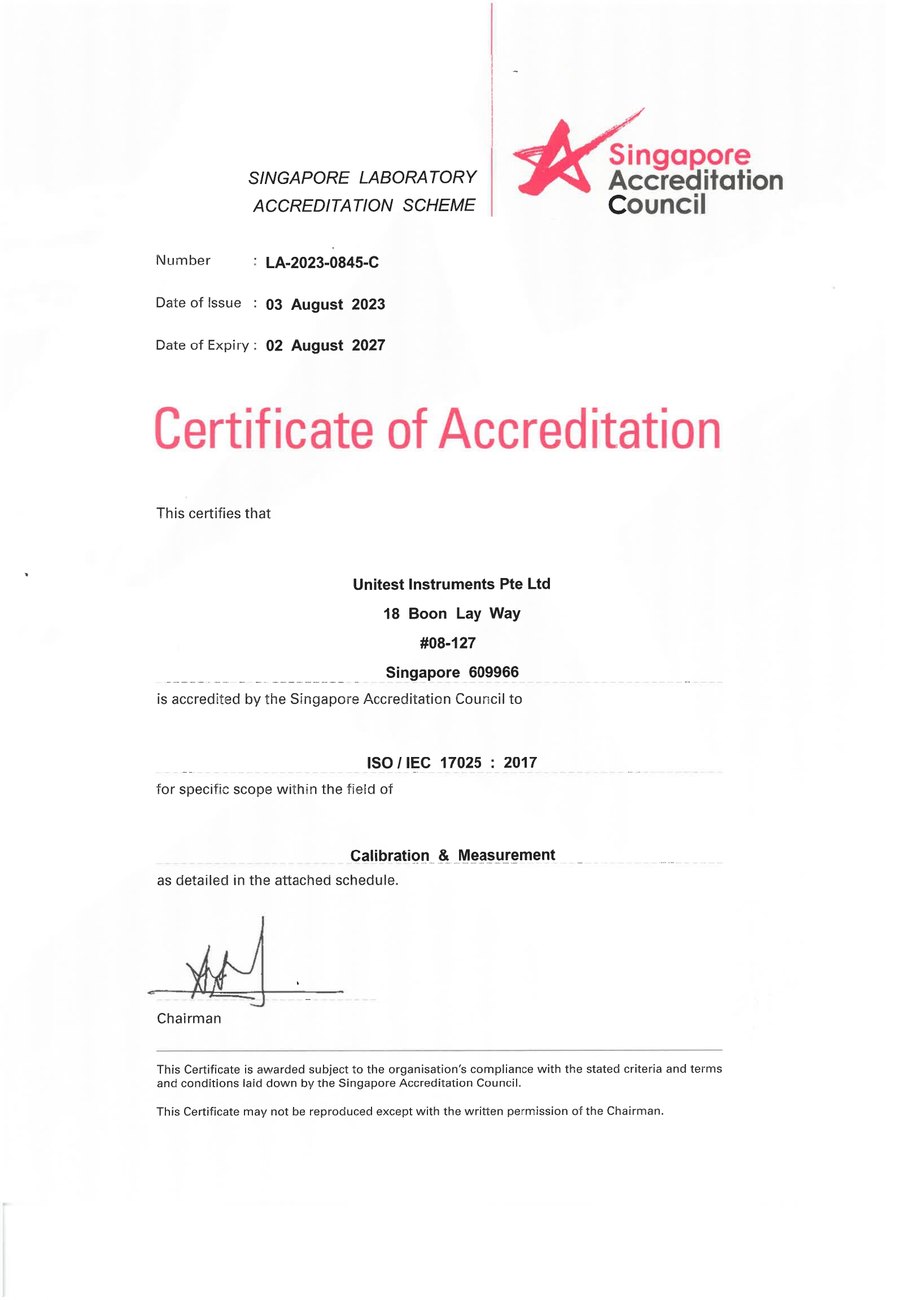
SAC-SINGLAS accredited calibration laboratory (Acc. No. LA-2023-0845-C) serving Singapore's industrial, pharmaceutical, and manufacturing sectors. All content reflects our ISO/IEC 17025 accredited scope and is reviewed by our technical calibration team.
Need CO₂ monitor calibration in Singapore?
Unitest Instruments is SAC-SINGLAS accredited (Acc. No. LA-2023-0845-C) to ISO/IEC 17025. Same-week turnaround, certificates accepted by ISO 9001 auditors and BCA Green Mark assessors.