
Key Takeaways
- Formazin is the primary international reference standard for turbidity, defining the NTU scale under ISO 7027 and EPA Method 180.1.
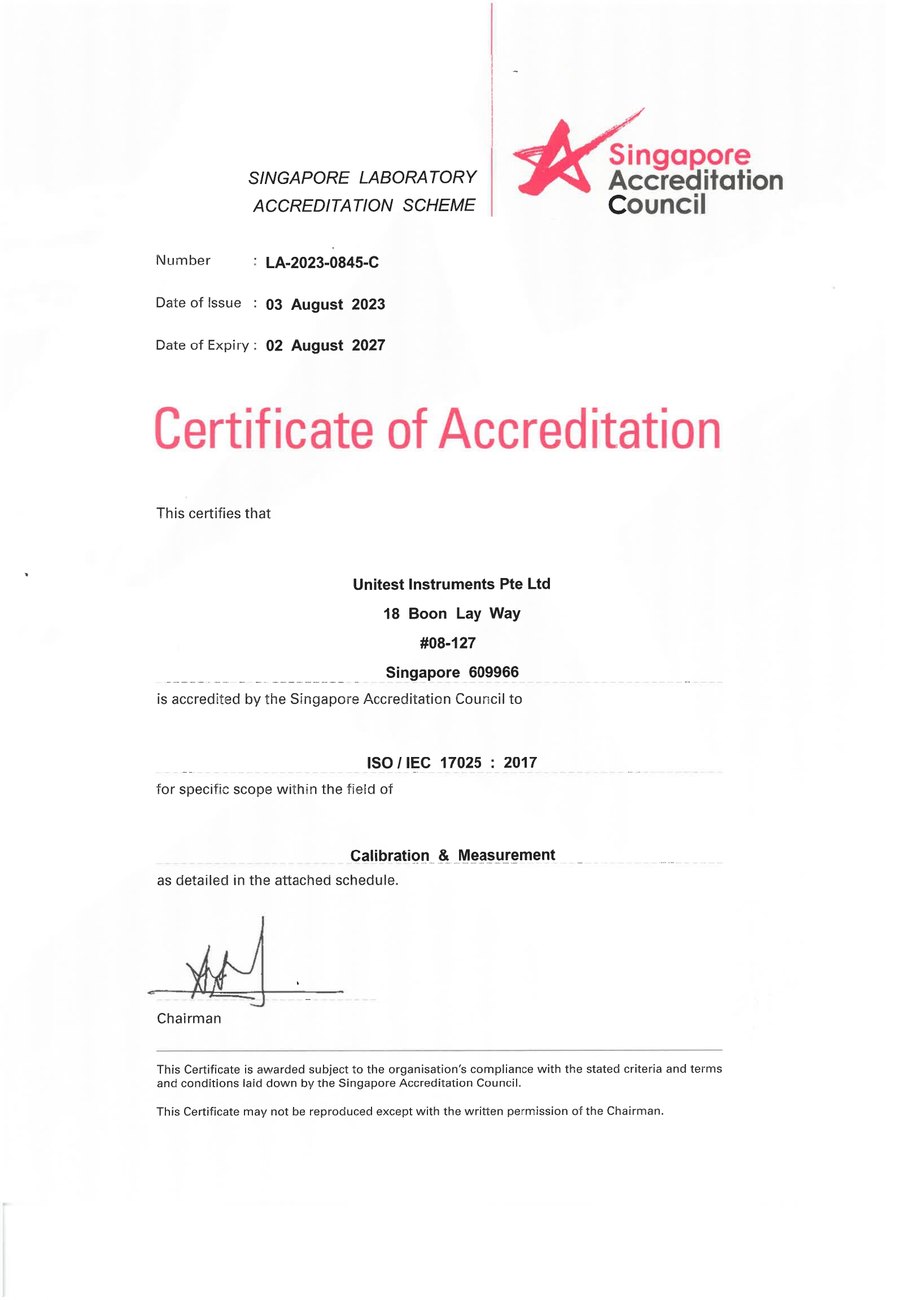
- SAC-SINGLAS accredited calibration (Acc. No. LA-2023-0845-C) provides full traceability to Singapore's National Metrology Centre. Required for regulatory submissions to PUB, NEA, and BCA.
- A compliant calibration certificate must include measurement uncertainty in NTU, not just a pass/fail statement.
- Recommended calibration interval is 12 months for most applications, 6 months for PUB-regulated and NEA-licensed facilities.
- Non-accredited calibration lacks traceability evidence and is typically rejected by ISO 9001 auditors and regulatory inspectors.
What Is Turbidity and Why Does NTU Traceability Matter?
Turbidity measures the optical clarity of water. Specifically, how much suspended particulate matter scatters a beam of light passing through the sample. The Nephelometric Turbidity Unit (NTU) is the standard measurement unit defined by ISO 7027, calibrated by measuring the scattered light at a 90-degree angle relative to the incident beam. A perfectly clear sample reads 0 NTU; Singapore's drinking water standard (PUB) requires turbidity below 1 NTU at the point of supply.
Traceability to a national standard matters because turbidity is inherently an optical measurement. Different instrument designs, lamp wavelengths, detector geometries, and sample cell geometries all introduce systematic differences. Without anchoring every instrument to the same formazin-defined NTU scale via a continuous chain of calibrations traceable to a national metrology institute, readings from two different turbidimeters on the same sample can legitimately differ by 10–20%. For regulatory reporting, process control, and third-party audits, that ambiguity is unacceptable. Traceability is what converts a meter reading into a measurement with a known and defensible uncertainty.
In Singapore, the national measurement authority is the National Metrology Centre (NMC), a division of A*STAR. Accredited laboratories (including Unitest Instruments (SAC-SINGLAS Acc. No. LA-2023-0845-C)), maintain reference standards that are periodically calibrated by or against NMC, creating the unbroken chain that ISO/IEC 17025 demands. When you receive a calibration certificate from a SAC-SINGLAS accredited laboratory, you are receiving documentary proof of that chain.
The Formazin Standard: Primary Reference for NTU
Formazin is a white polymer suspension synthesised by reacting hydrazine sulfate with hexamethylenetetramine (hexamine) in water. ISO 7027 specifies the exact synthesis procedure: a 4000 NTU formazin primary standard is prepared, then diluted to produce working standards at lower concentrations. The formazin suspension scatters light in a well-characterised, highly reproducible manner, which is why it was chosen as the international anchor for the NTU scale.
In practice, primary formazin stocks are hazardous (hydrazine is a suspected carcinogen), difficult to prepare consistently, and have a limited shelf life once diluted. For routine laboratory calibration, two types of more stable secondary standards are used:
- Styrene Divinylbenzene (SDVB) polymer bead suspensions. Stable, sealed vials with certified NTU values traceable to primary formazin. These are the most common secondary standard in ISO/IEC 17025 accredited laboratories.
- Gelex (gel-based) standards. Solid polymer gels that approximate specific NTU values. These are useful for field instrument checks but are not equivalent to liquid formazin for full laboratory calibration purposes.
At Unitest Instruments, our turbidity calibration uses SDVB secondary standards with certified traceability certificates, which in turn have been verified against our higher-level reference standards calibrated in accordance with SAC-SINGLAS requirements. This multi-level traceability chain is documented on every calibration certificate we issue.
For a deeper explanation of how traceability chains work in a calibration laboratory context, see our article What Is Traceability in Calibration?. It covers the concept from first principles with Singapore-specific examples.
What Happens During Turbidity Meter Calibration: Step by Step
When you submit a turbidity meter to a SAC-SINGLAS accredited laboratory for calibration, the process follows a structured sequence that satisfies ISO/IEC 17025 requirements:
1. Instrument Inspection and Condition Assessment
The laboratory technician examines the meter for physical damage, checks the sample cell for scratches or deposits that could affect readings, and verifies that the instrument powers up and functions correctly. Any anomalies are documented. If the instrument is non-functional, calibration cannot proceed and the submitter is notified.
2. Environmental Conditioning
The instrument and reference standards are allowed to equilibrate to laboratory conditions (typically 23°C ± 2°C), before measurements begin. Turbidity readings are sensitive to temperature because it affects the refractive index of both the sample and the reference suspension.
3. Measurement at Multiple Calibration Points
The instrument is measured against reference standards at a minimum of five points spanning its working range. A typical calibration for a 0–1000 NTU instrument uses reference points at approximately 0.1, 1, 10, 100, and 800 NTU. For each point, multiple repeat readings are taken and averaged to reduce random error. The laboratory records the instrument's indication against the certified reference value.
4. Error and Uncertainty Calculation
The calibration error (the difference between the instrument's reading and the reference standard's value) is calculated at each point. The laboratory then calculates the expanded measurement uncertainty (accounting for reference standard uncertainty, repeatability, resolution, and environmental factors), expressed in NTU at a 95% confidence level (coverage factor k = 2). This is the most technically demanding step and the one most often omitted in non-accredited calibration. Understanding how uncertainty is calculated and reported is covered in detail in our article Measurement Uncertainty Explained.
5. Calibration Certificate Issue
The laboratory issues a calibration certificate that documents all measurements, reference standards used, environmental conditions, calibration date, next recommended calibration date, and the laboratory's SAC-SINGLAS accreditation number. At Unitest Instruments, all certificates carry Acc. No. LA-2023-0845-C and are issued under our ISO/IEC 17025 accredited scope.
Book Your Turbidity Meter Calibration in Singapore
Unitest Instruments (Acc. No. LA-2023-0845-C) calibrates benchtop and portable turbidimeters with full formazin traceability to NMC Singapore. Certificates accepted by PUB, NEA, and ISO 9001 auditors.
Field Calibration vs. Laboratory Calibration: Which Do You Need?
Turbidity meters are used in two broad contexts in Singapore: fixed laboratory analysis and field monitoring. The calibration requirements differ significantly between these settings. The table below summarises the key differences to help you determine which type of calibration your instrument requires.
| Factor | Field Calibration (On-Site) | Laboratory Calibration (Accredited) |
|---|---|---|
| Standards used | Portable gelex or sealed SDVB vials carried to site | Certified SDVB standards traceable to NMC Singapore |
| Calibration points | Typically 1–3 points (spot check) | Minimum 5 points across full working range |
| Measurement uncertainty | Not formally calculated or reported | Calculated and reported at 95% confidence |
| Certificate type | Site service report / instrument logbook entry | ISO/IEC 17025 calibration certificate with SAC-SINGLAS number |
| Accepted by regulators | Not for regulatory submissions. Internal QC only | Yes. PUB, NEA, BCA, ISO 9001 auditors |
| Recommended frequency | Before each measurement campaign or daily in continuous monitoring | 6–12 months depending on application |
| Who performs it | Instrument operator using manufacturer's procedure | SAC-SINGLAS accredited laboratory (e.g. Unitest Instruments) |
Field calibration (sometimes called a "calibration check" or "standardisation"), is performed by the operator using portable reference standards to verify the instrument is reading within acceptable limits. It is an essential part of good measurement practice but does not substitute for laboratory calibration. Think of field calibration as the daily operational check; laboratory calibration as the annual legal certification.
For instruments used in continuous process monitoring (for example, an online turbidimeter on a water treatment plant filtration train), the instrument should be removed periodically and sent for laboratory calibration, while the installed instrument is replaced with a calibrated spare to avoid production downtime.
Singapore Regulatory Context: Who Requires Traceable Turbidity Calibration?
Several regulatory and compliance frameworks in Singapore either explicitly require or functionally mandate traceable turbidity calibration certificates from an accredited laboratory. Understanding which framework applies to your facility is essential for choosing the right calibration service.
PUB. Water Supply and Trade Effluent
PUB's Water Supply (Amendment) Act and the Sewerage and Drainage (Trade Effluent) Regulations set turbidity limits for potable water and for trade effluent discharged to sewers. Facilities that self-monitor turbidity for compliance reporting are expected to use properly calibrated instruments. PUB's Code of Practice on Sewerage and Sanitary Works recommends that instruments used for compliance monitoring be calibrated by an accredited laboratory. A SAC-SINGLAS certificate from a laboratory such as Unitest Instruments (Acc. No. LA-2023-0845-C) satisfies this requirement.
NEA. Environmental Monitoring and Trade Effluent Discharge
NEA-licensed environmental monitoring companies must use calibrated instruments when submitting measurements for Environmental Impact Assessments (EIA) or pollution control orders. The Environmental Protection and Management Act does not prescribe the exact calibration method but NEA inspectors regularly request calibration certificates as part of audit checks. Accredited calibration is the only defensible response to such a request.
BCA and Construction Site Stormwater
The Building and Construction Authority's environmental control requirements. Enforced in part through site-specific discharge consent conditions under NEA's Environmental Pollution Control (Trade Effluent) Regulations. Specify that stormwater runoff from construction sites must not exceed defined turbidity thresholds before discharge to public drains. Site contractors are required to monitor and log turbidity, and many site-specific discharge consents explicitly require that monitoring instruments be calibrated at defined intervals.
ISO 9001 and Internal Quality Management
Facilities operating under ISO 9001 Quality Management Systems are required by clause 7.1.5 to ensure that measuring equipment used for product and process quality control is calibrated against standards traceable to national or international standards. For turbidity measurements used in quality decisions (for example, in beverage, pharmaceutical, or semiconductor manufacturing), a SAC-SINGLAS calibration certificate directly satisfies this clause. Non-accredited calibration may be challenged by external auditors during ISO 9001 surveillance audits.
What a Compliant Calibration Certificate Must Show
Not all calibration certificates are equal. Many organisations discover during an audit that their certificates are non-compliant because they were issued by a non-accredited provider or because critical information is missing. The checklist below covers every element that a turbidity calibration certificate must contain to be compliant with ISO/IEC 17025 and accepted by Singapore regulators. For a full breakdown of calibration certificate requirements across all instrument types, see our article Calibration Certificate Explained: What Every Line Means.
- Laboratory identification and SAC-SINGLAS accreditation number. Must state the laboratory's name and accreditation number (e.g. Unitest Instruments, LA-2023-0845-C) on the certificate face.
- Instrument identification. Make, model, serial number, and asset/tag number of the instrument calibrated.
- Calibration date and location. The date(s) calibration was performed and the laboratory address.
- Reference standards used. The certified value of each reference standard, its own certificate number, and its traceability statement back to NMC Singapore or equivalent national metrology institute.
- Calibration results. The nominal (reference) value and the instrument's actual indication at each calibration point, both in NTU.
- Measurement uncertainty. The expanded uncertainty in NTU at each calibration point, stated with the coverage factor and confidence level (typically U = ±x NTU, k = 2, 95% confidence). This is the single most commonly missing element in non-accredited certificates.
- Environmental conditions. The temperature (and relative humidity where relevant) at the time of calibration.
- Next calibration due date. The laboratory's recommended recalibration date based on the instrument's drift and the application.
- Authorised signature. The certificate must be signed or electronically authorised by an approved signatory of the accredited laboratory.
Turbidity Calibration Intervals: How Often Is Enough?
The calibration interval for a turbidity meter is not fixed by a single regulation. It depends on the instrument type, the application, the operating environment, and the consequences of measurement error. The starting point is to understand the instrument's drift: how much does the reading change between calibrations when the instrument is not adjusted? Drift is characterised over time by comparing successive calibration results.
For a detailed treatment of how calibration intervals are determined and adjusted over an instrument's lifecycle, our article Calibration Interval: How Often Should You Calibrate? covers the risk-based methodology recommended by ISO/IEC 17025 and the ILAC-G24 guideline. The general guidance for turbidity meters in Singapore is:
- 12 months. Standard interval for most industrial, manufacturing, and environmental monitoring applications using benchtop instruments in controlled laboratory conditions.
- 6 months. Recommended for PUB-regulated water treatment facilities, NEA-licensed environmental laboratories, and pharmaceutical manufacturing where turbidity feeds into batch release decisions.
- 3 months. Appropriate for portable field instruments used in harsh environments (construction sites, outdoor field surveys) where physical knocks, temperature extremes, and cell contamination can accelerate drift.
- After any event. The meter should be recalibrated after any significant event: dropping the instrument, replacing the lamp, cleaning the sample cell with abrasives, or detecting a sudden unexplained shift in readings.
Frequently Asked Questions
During turbidity meter calibration, the instrument is verified and adjusted against a set of certified formazin or SDVB reference standards covering the meter's working range, typically 0.1, 1, 10, 100, and 1000 NTU. The laboratory records the meter's reading at each reference point, calculates measurement error, determines measurement uncertainty, and issues a calibration certificate traceable to a national metrology standard. In Singapore, accredited laboratories like Unitest Instruments (SAC-SINGLAS Acc. No. LA-2023-0845-C) trace these reference standards back to the National Metrology Centre (NMC) to satisfy ISO/IEC 17025 requirements.
NTU stands for Nephelometric Turbidity Unit. The measurement unit defined by ISO 7027 and EPA Method 180.1 for quantifying water cloudiness caused by suspended particles. It matters for calibration because turbidity meters measure scattered light at 90°, and the NTU scale must be anchored to a certified formazin reference to be meaningful across instruments. Without NTU traceability to a national standard, readings from different meters cannot be reliably compared, and regulatory submissions may be rejected by PUB, NEA, or ISO 9001 auditors.
The primary international reference standard for turbidity is formazin (defined in ISO 7027). In accredited laboratory practice, more stable secondary standards (Styrene Divinylbenzene (SDVB) polymer bead suspensions or gelex gel standards), are used for routine calibration, provided they are themselves certified and traceable to primary formazin. At a SAC-SINGLAS accredited laboratory such as Unitest Instruments (Acc. No. LA-2023-0845-C), all secondary standards carry their own traceability certificates back to NMC Singapore, and this chain is documented on the calibration certificate issued to you.
For most industrial and process monitoring applications, 12 months is standard. PUB-regulated water treatment facilities and NEA-licensed environmental monitoring laboratories should calibrate every 6 months. Portable field instruments used outdoors or on construction sites should be calibrated every 3 months due to higher drift risk. The instrument should also be recalibrated after any significant physical event (dropping, lamp replacement, or a sudden unexplained shift in readings), regardless of the scheduled interval.
A compliant ISO/IEC 17025 turbidity calibration certificate must include: the laboratory name and SAC-SINGLAS accreditation number (e.g. LA-2023-0845-C); instrument make, model, and serial number; calibration date and next due date; reference standards used with their own traceability chain; measured values at each calibration point; expanded measurement uncertainty in NTU at 95% confidence; environmental conditions at calibration; and an authorised signature. Certificates that omit measurement uncertainty are not ISO/IEC 17025 compliant and may be rejected by auditors and regulators.
Yes. PUB's Sewerage and Drainage Act, NEA's Environmental Protection and Management Act, and BCA stormwater discharge requirements all impose turbidity limits that facilities must monitor and report. While the regulations typically do not specify "SAC-SINGLAS calibration" by name, regulators and auditors request calibration certificates as evidence of measurement validity, and only SAC-SINGLAS accredited certificates satisfy that request definitively. ISO 9001 clause 7.1.5 further requires traceable calibration for all measurement equipment used in quality decisions.
Accredited calibration (SAC-SINGLAS, ISO/IEC 17025) provides an internationally recognised certificate with full NMC traceability, formal measurement uncertainty, and independent third-party assurance of the laboratory's technical competence. Non-accredited calibration (performed in-house or by a non-accredited service provider), may adjust the instrument correctly but lacks independent quality assurance, provides no formal uncertainty statement, and will not satisfy regulatory bodies or ISO 9001 auditors. For regulatory submissions and audit evidence in Singapore, accredited calibration is the only defensible option. See our article Accredited vs Non-Accredited Calibration for a full comparison.
Yes. Unitest Instruments (SAC-SINGLAS Acc. No. LA-2023-0845-C) provides accredited turbidity meter calibration at our ISO/IEC 17025 laboratory in Singapore. We calibrate benchtop and portable turbidimeters across all major brands (including Hach, HANNA Instruments, and YSI), and issue fully traceable calibration certificates with measurement uncertainty statements. Same-week turnaround is available for most instruments. Contact us via our contact page to request a quote or arrange drop-off.
SAC-SINGLAS accredited calibration laboratory (Acc. No. LA-2023-0845-C) serving Singapore's industrial, pharmaceutical, and manufacturing sectors. All content reflects our ISO/IEC 17025 accredited scope and is reviewed by our technical calibration team.
Need turbidity meter calibration in Singapore?
Unitest Instruments is SAC-SINGLAS accredited (Acc. No. LA-2023-0845-C) to ISO/IEC 17025. Same-week turnaround, certificates accepted by ISO 9001 auditors, PUB, and NEA.