
Key Takeaways
- Amprobe and Fluke share the same corporate parent (Fortive) but are distinct product lines positioned at different price and performance tiers.
- Fluke clamp meters typically achieve ±1.5% AC current accuracy vs ±2.0–2.5% for equivalent Amprobe models. A meaningful gap when measurement uncertainty must be documented.
- For routine maintenance and general field work, Amprobe delivers genuine value; for compliance-driven, safety-critical, or regulated-industry use, Fluke's tighter spec is worth the premium.
- Both brands require periodic calibration. An uncalibrated instrument (regardless of brand), can exceed its stated accuracy spec significantly in Singapore's humid conditions.
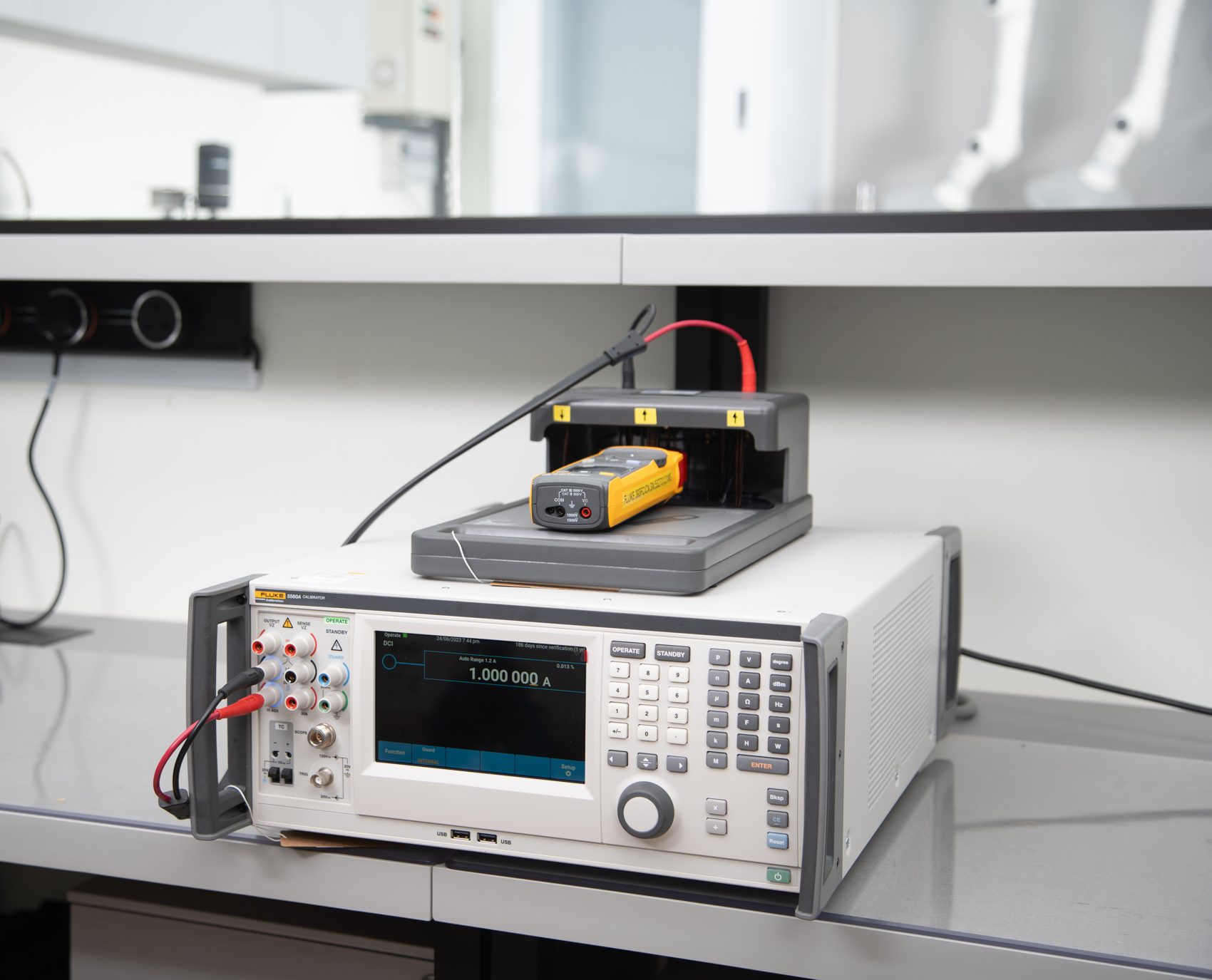
- Unitest Instruments sells both brands and provides SAC-SINGLAS accredited (Acc. No. LA-2023-0845-C) calibration for both, so you can consolidate procurement and calibration with a single supplier.
The Corporate Relationship, and Why It Matters
When you compare Amprobe and Fluke side by side, you are comparing two brands that sit under the same corporate roof. Fortive Corporation, the industrial technology conglomerate spun out of Danaher in 2016, owns both. This is not merely a trivia footnote. It explains several observable facts about both product lines: shared component sourcing, broadly compatible form factors, and overlapping model naming conventions.
What it does not mean is that the instruments are equivalent. Fortive runs Fluke and Amprobe as separate brands with distinct engineering mandates. Fluke targets professional electricians, industrial engineers, and metrology-conscious buyers who demand the tightest specifications and the most comprehensive product ecosystem available. Amprobe targets value-oriented buyers. Field service technicians, general contractors, and procurement teams who need a reliable instrument at a lower acquisition cost.
Understanding this context stops buyers from making two common mistakes: assuming Amprobe is simply a "cheap Fluke" (it is a purpose-built value product, not a downgraded one), and assuming Fluke's premium is purely brand markup (it reflects genuine specification differences that matter in specific applications).
Specification Comparison: What the Numbers Actually Show
The most reliable way to evaluate any clamp meter is to examine the manufacturer's specification sheet, not marketing copy. The table below compares representative mid-range models from each brand (the Fluke 376 FC and the Amprobe AMP-330), which are broadly comparable in intended use case and price tier within their respective brand lines.
| Feature / Specification | Fluke 376 FC | Amprobe AMP-330 |
|---|---|---|
| AC Current Range | 0.1 A – 1000 A | 0.1 A – 600 A |
| AC Current Accuracy | ±1.5% + 5 digits | ±2.0% + 5 digits |
| DC Current Measurement | Yes (iFlex flexible probe) | No (AC only on jaw) |
| AC Voltage Range | 600 V | 600 V |
| AC Voltage Accuracy | ±0.5% + 3 digits | ±1.0% + 3 digits |
| Resistance | Up to 60 MΩ | Up to 40 MΩ |
| Frequency Measurement | 45 Hz – 1 kHz | 50/60 Hz (fixed range) |
| True RMS | Yes | Yes |
| Data Logging / Wireless | Yes (Fluke Connect app) | No |
| CAT Safety Rating | CAT IV 600 V / CAT III 1000 V | CAT III 600 V |
| IP / Ingress Rating | IP40 | IP40 |
| Display | Backlit, 6000 count | Backlit, 4000 count |
| Jaw Opening | 58 mm | 30 mm |
| Approximate SGD Price | S$550 – S$750 | S$180 – S$280 |
| Warranty | 3 years | 1 year |
Several differences stand out immediately. The Fluke 376 FC supports DC current measurement via its iFlex flexible probe. A capability the AMP-330 does not offer at all on the jaw. The Fluke also achieves a tighter voltage accuracy specification (±0.5% vs ±1.0%), a higher CAT rating (CAT IV 600 V vs CAT III 600 V), a larger jaw opening (58 mm vs 30 mm for routing around larger bus bars), and wireless data logging via the Fluke Connect ecosystem. These are not cosmetic differences.
Where Amprobe Wins: The Real Value Case
Amprobe's lower price point is not the only reason to choose it. The brand makes a genuinely sensible choice in several real-world Singapore procurement scenarios.
Multi-instrument fleet procurement
A facilities management team equipping six technicians across a building portfolio faces a straightforward arithmetic reality: six Amprobe AMP-330 units cost roughly the same as two Fluke 376 FC units. If the use case is routine preventive maintenance (checking motor current draws, verifying panel load balances, confirming circuit continuity), the Amprobe specification is more than adequate. Having an instrument in every technician's kit eliminates the bottleneck of shared tools, which reduces response time to faults and lowers operational risk far more than the incremental accuracy difference between brands.
General contracting and installation work
Electrical contractors doing installation verification (confirming phase current, checking load distribution at the distribution board, testing continuity), rarely need the measurement granularity that a ±1.5% instrument provides over a ±2.0% one. For these applications, Amprobe is genuinely sufficient. The savings can be directed to other parts of the project budget without meaningful compromise to the quality of the electrical work.
Training environments
Polytechnics, ITE colleges, and in-house training programmes in Singapore frequently equip lab benches with clamp meters that will see heavy student use, potential mishandling, and regular replacement cycles. Amprobe units at a third of the Fluke price allow institutions to maintain larger inventories without exceeding equipment budgets, and the accuracy difference is immaterial in a learning context.
Where Fluke Wins: The Justification for the Premium
Regulated and safety-critical environments
Pharmaceutical manufacturing facilities operating under Good Manufacturing Practice (GMP), data centres with documented maintenance programmes, semiconductor fabrication plants, and any facility where energy or electrical measurements feed into a quality management system (ISO 9001, ISO 50001) need instruments whose measurement uncertainty can be formally declared. Fluke's tighter specifications, combined with a traceable calibration certificate from an ISO/IEC 17025 accredited laboratory, produce a defensible measurement uncertainty budget. As we explain in our guide to measurement uncertainty, the instrument's accuracy specification is one of the key inputs to that budget. A tighter spec reduces the combined uncertainty figure, which matters when you are submitting data to auditors or regulators.
Applications requiring DC current measurement
Battery systems, UPS installations, solar PV DC distribution, electric vehicle charging infrastructure, and telecommunications rectifier systems all involve DC current. The Amprobe AMP-330's jaw only measures AC. Fluke's iFlex probe or DC-capable models such as the Fluke 375 FC directly address this gap. In Singapore's growing EV charging and solar installation market, this specification difference has real procurement implications.
High-current bus bar applications
The 58 mm jaw opening on the Fluke 376 FC versus the AMP-330's 30 mm makes a practical difference when clamping around large bus bars in main distribution boards or MV panel feeders. A jaw that cannot physically fit around the conductor being measured is not a specification shortcoming. It is a usability failure in the field.
Wireless data logging and remote monitoring
Fluke Connect allows readings to be logged and time-stamped wirelessly, transmitted to a smartphone or tablet, and compiled into reports without manual transcription. For facilities engineers conducting load surveys, commissioning reports, or energy audits (increasingly relevant under Singapore's Enhanced Energy Efficiency Fund requirements), this capability eliminates transcription errors and dramatically reduces documentation time. Amprobe has no equivalent ecosystem at this price tier.
Need calibration for your Amprobe or Fluke clamp meter?
Unitest Instruments calibrates both brands to traceable ISO/IEC 17025 standards. Certificates accepted by ISO 9001 auditors across Singapore. Same-week turnaround available.
The Calibration Dimension: What Both Brands Share
One aspect of the Amprobe vs Fluke decision that rarely appears in buying guides is the calibration equation. Both brands, regardless of their out-of-box accuracy specifications, will drift over time. Singapore's high ambient humidity and temperature accelerate this drift. Humidity promotes oxidation of contact surfaces and affects the Hall-effect sensors used in clamp measurement. An instrument operating beyond its calibration interval may read outside its stated accuracy specification without any visible indication to the user.
This matters because the choice of brand does not eliminate the need for periodic calibration. It simply sets the baseline specification against which drift is measured. A Fluke 376 FC that has not been calibrated for three years may perform no better than a freshly calibrated Amprobe AMP-330. The practical implication for Singapore buyers: the calibration programme you put in place matters as much as the brand you choose.
Our article on how often to calibrate instruments covers the factors that should govern your calibration interval decision. Including usage intensity, environmental conditions, and the criticality of the measurements being made. As a SAC-SINGLAS accredited laboratory (Acc. No. LA-2023-0845-C), Unitest calibrates both Amprobe and Fluke clamp meters and issues certificates that are accepted by ISO 9001, ISO 45001, and IRAS energy audit requirements.
Singapore Procurement Context: Total Cost of Ownership
Singapore's procurement environment for test and measurement equipment has some specific characteristics that should inform the Amprobe vs Fluke decision beyond the purchase price.
Government and statutory board procurement
Agencies procuring under GeBIZ or equivalent frameworks often specify that instruments be calibrated by an accredited laboratory before deployment. The brand name matters less than the calibration traceability. Both Fluke and Amprobe satisfy this requirement when calibrated by Unitest or another SAC-SINGLAS accredited laboratory. Buyers who select Fluke purely for brand credibility in a GeBIZ context may be over-specifying; what the specification actually requires is a traceable calibration certificate, not a specific brand.
Total cost of ownership over a five-year horizon
When you factor in annual calibration costs (broadly similar for both brands), battery replacements, and the probability of accidental damage requiring replacement, the total cost gap between a fleet of Amprobe instruments and a fleet of Flukes narrows, but does not disappear. Fluke's three-year warranty versus Amprobe's one-year warranty reduces the out-of-pocket cost of early-life defects. Fluke's more robust build quality, evidenced by its higher drop ratings in third-party durability tests, correlates with lower mid-life replacement frequency. For a team that treats instruments hard, the Fluke premium partly pays for itself over a five-year horizon through lower replacement frequency.
Resale and residual value
Fluke instruments retain significantly better residual value in Singapore's secondary market. For facilities management companies that periodically refresh their equipment fleets, the Fluke's resale value partially offsets the higher purchase cost. Amprobe instruments have a smaller secondary market and lower residual values. Not because they are inferior, but because the primary market for used instruments skews toward professional buyers who prefer the Fluke ecosystem.
Recommendation Summary: Which Brand for Which Buyer
Rather than a single winner, the honest answer is a use-case matrix:
| Buyer Profile | Recommended Brand | Primary Reason |
|---|---|---|
| ISO 9001 / GMP / regulated facility engineer | Fluke | Tighter accuracy spec reduces measurement uncertainty budget; better audit documentation |
| Electrical contractor doing installation verification | Amprobe | Accuracy adequate for purpose; significant cost saving per unit |
| Facilities management team (multi-technician fleet) | Amprobe | Lower per-unit cost allows full-team instrument coverage |
| Data centre or UPS / DC system engineer | Fluke | DC current capability required; Amprobe jaw-only models are AC only |
| MV distribution board / large bus bar applications | Fluke | Larger jaw opening (58 mm) physically necessary |
| Energy audit / load survey reporting | Fluke | Wireless data logging (Fluke Connect) eliminates transcription errors |
| Training institution / polytechnic lab | Amprobe | Cost allows higher quantity; accuracy difference immaterial for learning |
| Mixed fleet (some critical, some routine) | Both | Fluke for critical measurement points; Amprobe for routine checks |
There is no shame in building a mixed fleet. Many Singapore facilities teams use Fluke instruments at the critical measurement points in their preventive maintenance programme (motor starter current checks, transformer loading, UPS output verification), and Amprobe instruments for routine panel checks and load balancing surveys. This approach optimises spend without compromising measurement quality where it actually matters.
Why Clamp Meters Drift Differently From Multimeters
A clamp meter's current measurement relies on a jaw-mounted Hall-effect sensor or current transformer reading the magnetic field generated by the conductor passing through it, a fundamentally different measurement mechanism from a multimeter's direct-contact voltage or resistance measurement, and it introduces failure modes specific to the clamp form factor that are worth understanding regardless of which brand you own. The jaw's closure faces (the two halves of the ferrite or iron core that meet when the jaw closes around a conductor) are the single most common source of unexplained accuracy drift on both Amprobe and Fluke clamp meters: dust, oxidation, or a hairline gap from repeated mechanical wear at the closure point introduces an air gap in the magnetic circuit that changes the sensor's calibration characteristic, and because the jaw still closes and clicks shut normally, this degradation is completely invisible to the user in normal operation. Singapore's plant floor environments (metal dust from machining, general industrial grime, and the corrosive effect of sustained high humidity on the ferrite surface) accelerate this specific failure mode more than in drier climates, which is a genuine, climate-specific reason Singapore users should not assume a manufacturer's temperate-market calibration interval recommendation is conservative enough.
A second clamp-specific consideration is measurement position sensitivity: unlike a multimeter's fixed-geometry test leads, a clamp meter's reading can vary slightly depending on where within the jaw opening the conductor sits and whether the conductor is centred versus off-axis, an effect known as position error that is more pronounced on lower-cost jaws with less refined internal field-shaping and generally smaller on Fluke's higher-end models, which is one of the less publicised reasons for the accuracy specification gap between the two brands beyond the headline percentage figures. Technicians can partially mitigate this by developing a consistent habit of centring the conductor in the jaw opening every time, a small technique discipline that measurably improves repeatability on any clamp meter, but it does not substitute for periodic calibration, which is the only way to catch the jaw-contamination drift described above before it produces a reading a maintenance decision is then based on.
Building a Fleet Calibration Programme Across a Mixed Amprobe/Fluke Inventory
Facilities that adopt the mixed-fleet approach recommended above, Fluke at critical measurement points and Amprobe for routine checks, should resist the temptation to calibrate the two tiers on different rigour standards just because their purchase price differs. An Amprobe unit used for routine panel checks still feeds into maintenance decisions, and a drifted routine-tier instrument giving a falsely reassuring reading on a loaded circuit is a real operational risk even if it never touches a formal quality record. The defensible approach is a single calibration standard applied consistently across the whole fleet (the same SAC-SINGLAS accredited certificate, the same interval logic based on usage intensity and environment, the same out-of-tolerance investigation trigger), with the brand and price tier only affecting which instruments get flagged as "critical measurement point" for audit purposes, not which instruments get calibrated properly in the first place. Unitest's batch calibration service is built around exactly this kind of mixed fleet, processing both brands under the same accredited scope so a facilities team managing twenty Amprobe units and five Fluke units at critical points receives a consistent certificate format and due-date register across the entire inventory, rather than two disconnected calibration histories that are harder to audit together.
Frequently Asked Questions
Amprobe is a brand owned by Fortive Corporation, the same parent company that owns Fluke. This means they share some engineering DNA and supply-chain infrastructure, but they are distinct product lines positioned at different price tiers. Fluke occupies the premium segment with tighter accuracy specifications and a more extensive accessories ecosystem, while Amprobe is designed to deliver solid performance at a lower price point. Ideal for budget-conscious procurement or applications where best-in-class accuracy is not the primary requirement.
Fluke clamp meters generally carry tighter accuracy specifications. Mid-range Fluke models such as the Fluke 376 FC achieve ±1.5% basic AC current accuracy, while comparable Amprobe models (e.g. AMP-330) are typically rated at ±2.0–2.5%. For routine maintenance checks, this difference is rarely decisive. For metrological applications, quality-management audits, or ISO 9001 compliance work where measurement uncertainty must be documented, the tighter Fluke specification is worth the premium. Both brands can be calibrated to a traceable standard, unitest holds SAC-SINGLAS accreditation (Acc. No. LA-2023-0845-C) for both.
Yes. Unitest Instruments is a SAC-SINGLAS accredited calibration laboratory (Acc. No. LA-2023-0845-C) that calibrates both Amprobe and Fluke clamp meters to ISO/IEC 17025 standards, with full traceability to Singapore's National Metrology Centre (NMC). Calibration certificates issued by Unitest are accepted by ISO 9001 and ISO 45001 auditors across Singapore and the region.
Most manufacturers recommend annual calibration for clamp meters used in routine industrial or maintenance applications. However, the optimal interval depends on usage intensity, environmental conditions (humidity and temperature extremes accelerate drift), and the criticality of measurements. Instruments used in safety-critical or compliance-driven environments (such as pharmaceutical facilities or government facilities under IRAS energy audits), are often calibrated every six months. Unitest can advise on interval-setting based on historical calibration data from your specific instruments.
For professional electrical engineers, facilities managers in regulated industries (pharma, data centres, semiconductor fab), and any team that must produce documented measurement uncertainty for audits, Fluke's tighter specifications and stronger build quality justify the premium. For general contractors, maintenance technicians doing routine checks, or teams equipping multiple field engineers on a tight budget, Amprobe delivers excellent value without meaningful compromise in everyday accuracy. The decision ultimately hinges on the risk cost of a wrong measurement versus the purchase-price difference.
A clamp meter measures AC (and sometimes DC) current non-invasively by clamping around a conductor, no circuit interruption is required. A multimeter measures voltage, resistance, and current, but measuring current requires breaking the circuit and placing the meter in series. Many modern clamp meters include full multimeter functions, making them versatile single-instrument solutions for field electricians. If your primary need is current measurement on live conductors without downtime, a clamp meter is the right tool.
Singapore's tropical climate (high humidity, temperatures of 28–34°C) accelerates corrosion and can affect sensor drift. Prioritise instruments rated CAT III 600V or CAT IV 300V for distribution-panel work. Look for IP54 or better ingress protection ratings if the instrument will be used in outdoor or industrial environments. Both Fluke and Amprobe offer models meeting these standards. After purchase, ensure the instrument is calibrated before first use and at regular intervals. Drift in humid environments can exceed the manufacturer's stated accuracy spec if left unchecked.
Yes. Unitest Instruments is an authorised distributor and calibration service provider for both Amprobe and Fluke in Singapore. You can purchase, have calibrated, and receive a SAC-SINGLAS accredited calibration certificate for instruments from both brands through a single vendor relationship. This simplifies procurement, eliminates the need to manage multiple supplier relationships, and ensures your entire test-and-measurement fleet is on a unified calibration schedule.
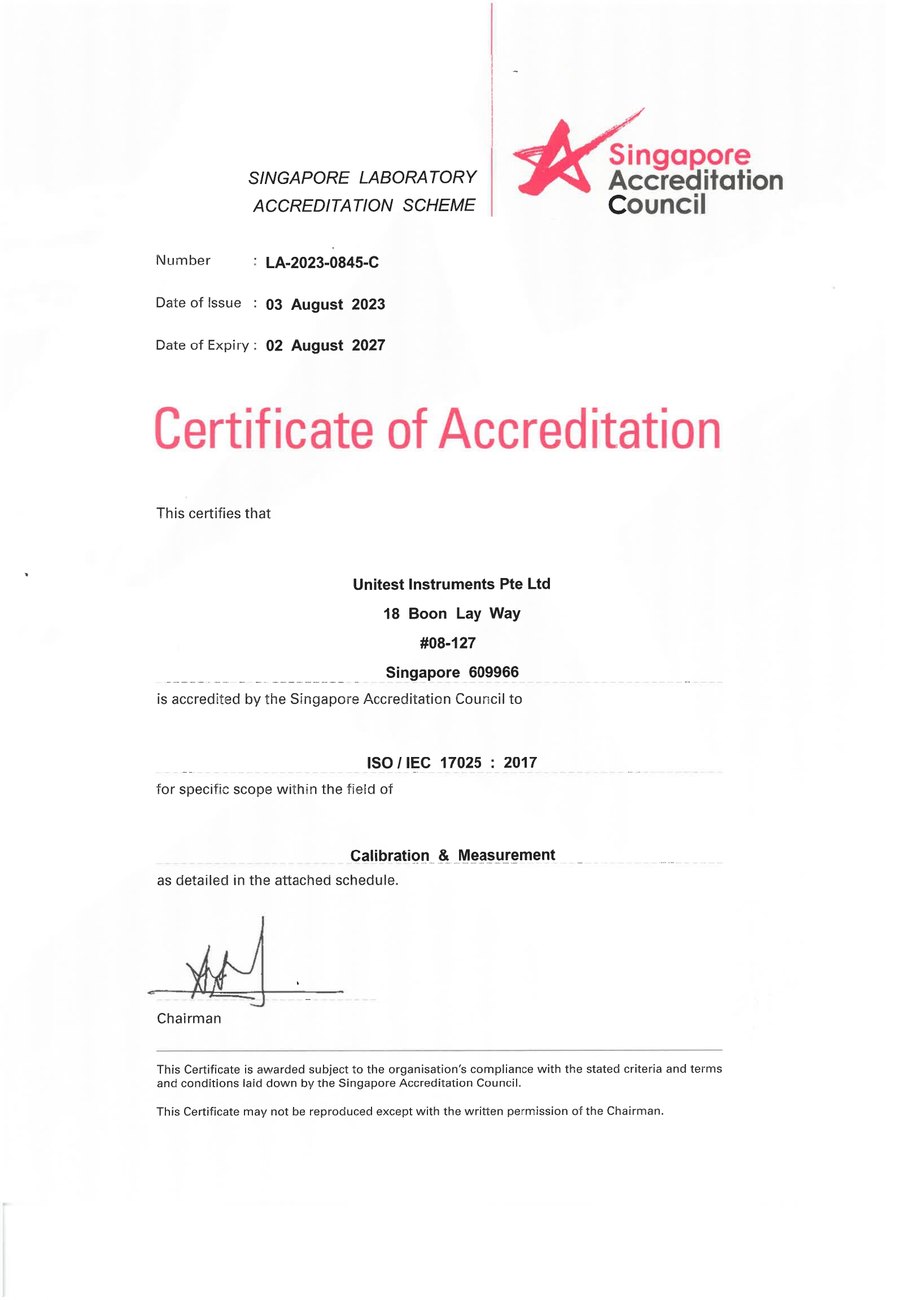
SAC-SINGLAS accredited calibration laboratory (Acc. No. LA-2023-0845-C) serving Singapore's industrial, pharmaceutical, and manufacturing sectors. All content reflects our ISO/IEC 17025 accredited scope and is reviewed by our technical calibration team.
Need clamp meter calibration in Singapore?
Unitest Instruments is SAC-SINGLAS accredited (Acc. No. LA-2023-0845-C) to ISO/IEC 17025. We calibrate Amprobe and Fluke instruments with same-week turnaround. Certificates accepted by ISO 9001 auditors.