
Key Takeaways
- Benchtop meters offer higher resolution (±0.001 pH) and built-in GLP logging; portable meters trade accuracy for mobility (±0.01–0.02 pH typical).
- For Singapore regulatory environments (NEA effluent, HSA pharma, food manufacturing), either format is acceptable provided calibration is traceable to NMC Singapore.
- Mettler-Toledo dominates laboratory benchtop applications; Hanna Instruments offers the widest portable range across price points, but neither brand is universally "better."
- Electrode quality and maintenance have a larger day-to-day impact on measurement reliability than the meter electronics alone.
- Total cost of ownership for a benchtop setup (meter + electrode + calibration) is typically S$2,000–S$7,000; for a quality portable, S$800–S$3,000.
Why the Choice Between Benchtop and Portable Matters More Than You Think
pH measurement sits at the centre of quality control in Singapore's food manufacturing, pharmaceutical, water treatment, and chemical processing industries. A wrong reading (by as little as 0.1 pH units), can mean a batch rejection, an audit non-conformance, or in regulated applications, a product safety incident. The instrument format you choose shapes how easily your team can achieve and sustain measurement accuracy under real working conditions.
The choice is not simply about portability. It is about matching instrument capability to the measurement environment, the required accuracy, the calibration workflow, and the total cost your organisation is willing to carry. This guide is written from the perspective of a SAC-SINGLAS accredited calibration laboratory that handles both formats every week, not a product catalogue.
Benchtop pH Meters: Strengths and Limitations
Benchtop pH meters are mains-powered instruments designed to sit on a laboratory bench, connected to a stable electrode system. Their power supply allows for higher-precision analogue-to-digital conversion, low-noise amplification of the electrode signal, and sophisticated temperature compensation algorithms. Research-grade benchtop meters such as the Mettler-Toledo S500 SevenExcellence and the HORIBA F-72 achieve pH resolutions of ±0.001 pH. Meaningful when you are characterising buffer solutions, validating analytical methods, or running GMP batch-release testing.
Most GLP-capable benchtop meters include built-in data logging with timestamped records, USB or RS-232/Ethernet connectivity, and audit-trail functions that satisfy 21 CFR Part 11 and GMP record-keeping requirements. Multi-channel units can measure pH, conductivity, dissolved oxygen, and ion concentration simultaneously. Useful in water-quality laboratories running multiple parameters against the same sample.
The limitations are straightforward: benchtop meters are not designed to leave the laboratory. They require a mains socket, a stable surface, and protection from vibration and splash. If your measurement point is a production tank, a reservoir, or a construction site soil sample, a benchtop is the wrong tool regardless of its accuracy specification.
Portable pH Meters: Strengths and Limitations
Portable pH meters run on batteries, are housed in ruggedised enclosures rated to IP54 or higher, and are designed to operate in the hands of a technician at the measurement point. The best portable meters (such as the Hanna Instruments HI9829 multiparameter probe and the Mettler-Toledo S2 Seven2Go), achieve ±0.01 to ±0.02 pH, which is entirely adequate for environmental compliance monitoring, in-process checks, and field QA work.
Battery life is a real operational constraint. A portable meter used intensively in the field will need charging or battery replacement mid-shift. Electrode conditioning is also more difficult in the field: there is no controlled temperature environment, rinsing between samples is less consistent, and storage conditions vary. These factors collectively introduce measurement uncertainty that even a well-specified portable meter cannot fully compensate for electronically.
For Singapore's climate, the high ambient humidity and temperature (28–35°C year-round) affect both electrode response time and buffer stability. Field calibration with buffer sachets (which are convenient but less precisely characterised than laboratory-grade buffer solutions), introduces additional uncertainty that widens the effective measurement band versus the stated specification.
Need your pH meter calibrated with a traceable certificate?
Unitest Instruments calibrates both benchtop and portable pH meters under our SAC-SINGLAS accreditation. Certificates are accepted by ISO 9001 auditors, NEA, and HSA across Singapore.
How a pH Electrode Actually Works, and Why It Ages Regardless of the Meter
Both benchtop and portable pH meters rely on the same fundamental sensing principle: a glass combination electrode develops a small voltage across a thin, specially formulated glass membrane in proportion to the difference in hydrogen ion activity between the sample solution and a sealed internal reference solution. This voltage, on the order of tens of millivolts per pH unit (theoretically about 59.16 mV per pH unit at 25°C, known as the Nernstian slope), is what the meter's electronics amplify and convert into a displayed pH reading. Understanding this is genuinely useful for a buyer, because it explains why the meter's own electronics are rarely the limiting factor in day-to-day accuracy. The electrode is.
Glass pH electrodes age and degrade regardless of which brand of meter they are connected to. The glass membrane's response slope gradually decreases as the glass surface ages and its ion-exchange sites become less responsive, the reference junction (where the internal reference solution contacts the sample) can become clogged or poisoned by certain sample matrices (proteins, sulfides, and heavy metals are common culprits), and the internal reference electrolyte itself can become depleted or contaminated over the electrode's service life. A meter with excellent electronics connected to a tired, poorly maintained electrode will produce readings no better, and often measurably worse, than a mid-range meter connected to a fresh, well-maintained electrode. This is precisely why the article's key takeaways note that electrode quality and maintenance affect day-to-day reliability more than the meter's own specification, and it is worth budgeting for electrode replacement as a routine consumable cost rather than treating a failing electrode as a meter fault.
Calibration Points, Buffer Quality, and Why a 2-Point Calibration Is Not Always Enough
Before taking a measurement, both meter formats require calibration against buffer solutions of known pH, typically at two or three points bracketing the expected sample range (commonly pH 4.01, 7.00, and 10.01). A 2-point calibration establishes the electrode's actual slope and offset between two buffer points and is adequate for many routine applications, but a 3-point calibration additionally checks and corrects for non-linearity in the electrode's response across a wider range, which matters more when samples span a broad pH range or when the application specifically requires validated accuracy near both acidic and alkaline extremes.
Buffer solution quality itself is an underappreciated variable. Laboratory-grade buffer solutions, properly stored, sealed, and within their expiry date, are characterised to a tight tolerance and are the appropriate reference for any application requiring defensible accuracy. Buffer sachets and open, repeatedly used buffer bottles are more convenient for field use but are more susceptible to contamination, CO2 absorption (which measurably shifts the pH of alkaline buffers over time), and evaporation-driven concentration changes, all of which widen the effective uncertainty of a field calibration relative to a controlled laboratory calibration using fresh, sealed buffers. For applications where the calibration itself needs to be defensible under audit, using fresh buffer for every calibration, tracking buffer lot numbers and expiry dates, and discarding buffer that has been open longer than the manufacturer's stated in-use period are all worth building into a documented procedure, regardless of meter format or brand.
Temperature Compensation: Automatic vs Manual, and Why It Matters
The Nernstian slope relating electrode voltage to pH is itself temperature-dependent, meaning a pH reading taken without correcting for sample temperature carries a real, quantifiable error that grows the further the sample temperature is from the temperature at which the electrode was calibrated. Most modern benchtop and mid-to-high-end portable meters include automatic temperature compensation (ATC), using a built-in or attached temperature probe to continuously correct the reading in real time, while lower-cost portable meters sometimes rely on manual temperature compensation, requiring the operator to measure sample temperature separately and enter it into the meter, or in the simplest instruments, no compensation at all.
For Singapore's operating conditions, where a sample might be measured at anywhere from a chilled 4°C cold-chain product to a 40°C-plus effluent discharge point, temperature compensation is not a minor convenience feature. A meter without functioning ATC, or an operator who forgets to manually update the temperature setting, can introduce an error of several hundredths of a pH unit purely from temperature mismatch, an error that is entirely avoidable and has nothing to do with the electrode's underlying accuracy. When comparing meter specifications, confirming that ATC is genuinely automatic (using a live temperature probe) rather than a fixed, user-entered manual value is worth checking explicitly rather than assuming from the product name alone.
Head-to-Head: Mettler-Toledo vs Hanna Instruments
For Singapore laboratories evaluating a purchase, the two brands that appear most consistently in tenders and procurement discussions are Mettler-Toledo and Hanna Instruments. They are not direct substitutes. Mettler-Toledo is strongest at the laboratory end, while Hanna Instruments offers the widest portable range across price points. Here is an honest comparison across the criteria that matter most.
| Feature / Criterion | Mettler-Toledo (SevenExcellence / Seven2Go) | Hanna Instruments (HI5522 / HI9829) |
|---|---|---|
| Best use case | GLP laboratory QC, pharma, regulated food manufacturing | Field sampling, environmental monitoring, mid-range lab QC |
| pH accuracy (benchtop) | ±0.001 pH (SevenExcellence S500) | ±0.002 pH (HI5522 lab series) |
| pH accuracy (portable) | ±0.01 pH (Seven2Go Pro) | ±0.01 to ±0.02 pH (HI9829/HI98193) |
| GLP data logging | Yes. Full audit trail, USB/Ethernet, 21 CFR Part 11 ready | Yes on lab series (HI5522); limited on portable entry models |
| IP rating (portable) | IP67 (Seven2Go) | IP67 (HI9829) / IP65 (HI98193) |
| Electrode ecosystem | InLab range. Wide, well-characterised; proprietary connector | HI series. Wide range; BNC connector on most models (universal) |
| Approx. price (Singapore, excl. GST) | Benchtop S$3,500–S$6,500 / Portable S$900–S$2,200 | Benchtop S$1,200–S$3,800 / Portable S$220–S$2,000 |
| Electrode replacement cost | S$180–S$620 (InLab series) | S$80–S$380 (HI series) |
| Calibration serviceability | Calibrated by Unitest (SAC-SINGLAS); MT service centre in SG | Calibrated by Unitest (SAC-SINGLAS); Hanna distributor network SG |
| Honest trade-off | Superior lab instrument; higher system cost; proprietary electrode lock-in | Excellent value for field/process use; some models lack robust GLP logging |
Which Format Is Right for Your Singapore Use Case?
Pharmaceutical and Food Manufacturing QC Labs
If your QMS operates under HSA GMP, TP (Technical Procedure) requirements, or FSSC 22000, the requirement for documented calibration, data integrity, and audit trails points firmly toward a benchtop meter with GLP logging. The Mettler-Toledo S400 or S500 series, or the Hanna HI5522 lab bench meter, are the practical shortlist. Both can produce electronic records that survive an HSA or BRC audit. Your calibration certificate from an accredited laboratory (see our article on how to read a calibration certificate), is the document the auditor will check, not the instrument brand.
Environmental Monitoring and Water Treatment
NEA-regulated effluent discharge monitoring requires pH readings at the point of discharge, which may be at a drain, a holding pond, or a sampling chamber that is nowhere near a laboratory bench. Here, a robust portable meter with IP67 rating and a replaceable combination electrode is the right tool. The Hanna HI9829 multiparameter probe is widely used across Singapore's water treatment, construction, and industrial effluent sectors. Pair it with a formal calibration schedule (every 6 months at minimum) and document your field calibration against buffer solutions to close the traceability gap. Our guide on how often to calibrate covers this in detail.
Research Laboratories and Universities
For research applications where pH is a method variable (buffer preparation, cell culture media, electrochemistry), a benchtop meter with ±0.001 pH resolution is the appropriate choice. The investment is justified by the reproducibility it brings to published experimental data. Most university procurement in Singapore uses Mettler-Toledo or HORIBA benchtop meters, often with separate combination electrodes selected for the specific matrix (low ionic strength, high temperature, protein-rich solutions).
Construction Sites and Soil Testing
Soil pH sampling for construction-phase NEA environmental monitoring is almost always done with a portable meter. The priority is ruggedness and simplicity over resolution: a ±0.05 pH measurement uncertainty is acceptable for soil classification. Entry-level portable meters from Hanna (HI98130 or HI9813) are commonly used in Singapore's construction sector for this purpose, with calibration carried out every 6 months or before each project phase.
Calibration: The Factor That Matters Most, Regardless of Format
The most important decision in pH meter management is not benchtop versus portable. It is whether your calibration programme produces evidence that an auditor will accept. A benchtop meter that has not been calibrated by an accredited laboratory in three years is less defensible than a portable meter with a current SAC-SINGLAS certificate, even if the benchtop has better electronics.
ISO/IEC 17025 accredited calibration establishes the measurement uncertainty of your specific instrument at the time of calibration, referenced to national measurement standards. The certificate documents this formally. Understanding measurement uncertainty (see our article on measurement uncertainty explained), is essential for correctly interpreting what your pH meter's readings actually mean for product or process decisions.
Unitest Instruments calibrates pH meters across both format types under SAC-SINGLAS accreditation Acc. No. LA-2023-0845-C. We use NIST-traceable buffer solutions and calibrated reference standards to characterise your instrument's actual performance. The resulting certificate is accepted by ISO 9001, ISO 14001, GMP, and NEA auditors across Singapore. Turnaround is typically same-week for standard instruments.
It is worth distinguishing between two related but different activities that are sometimes confused: the daily or before-use buffer calibration an operator performs on the meter themselves, and the periodic formal calibration an accredited laboratory performs on the meter and electrode system as a whole. The operator's buffer calibration adjusts the instrument's working slope and offset for that day's use and is essential good practice, but it does not by itself establish a traceable, documented uncertainty for the instrument the way an accredited laboratory calibration does, using calibrated reference standards and a formal uncertainty budget. Both activities matter, and a quality system that relies on daily buffer calibration alone, without periodic accredited verification, has a real gap that an auditor is likely to identify.
Procurement Checklist for Singapore Buyers
Before committing to either format, work through these questions with your team:
- Where will measurements be taken? Fixed bench = benchtop. Any mobile or on-site sampling = portable.
- What accuracy does your SOP or regulation require? Check your QMS procedure or the relevant standard (e.g. ASTM D1293 for water, Ph. Eur. for pharma) for the required measurement uncertainty.
- Does your QMS require GLP data logging? If yes, verify the specific meter model supports this, not all portable meters do.
- What is your electrode replacement budget? Electrodes degrade and must be replaced typically every 12–18 months. Factor this into total cost of ownership.
- Who will perform calibration, and at what interval? Build the calibration cost and turnaround time into your instrument management plan from day one.
- Is the instrument on your supplier's Singapore service network? Both Mettler-Toledo and Hanna have Singapore-based distributor support; verify the same for HORIBA if considering that brand.
Unitest Instruments sells both benchtop and portable pH meters from the major brands and can advise on instrument selection based on your specific application, budget, and calibration requirements. Without being tied to a single brand's margin targets.
Frequently Asked Questions
Benchtop pH meters are mains-powered instruments designed for fixed laboratory use, offering higher accuracy (typically ±0.001 pH), larger displays, multi-channel input, and advanced data logging. Portable pH meters are battery-operated handheld devices suited for field or on-site sampling, with ruggedised housings and simplified operation. The core trade-off is accuracy and features versus mobility and convenience.
Benchtop meters are generally more accurate. Research-grade benchtop models such as the Mettler-Toledo S500 Series achieve ±0.001 pH resolution, compared to ±0.01 to ±0.02 pH for most portable units. However, high-end portable meters from brands like Hanna Instruments (HI9829) can reach ±0.02 pH, which is sufficient for most field compliance and process-monitoring applications.
Most pH meters used in quality-critical applications should be calibrated before each use or at minimum daily, using fresh NIST-traceable buffer solutions. For ISO 9001 or GMP environments, the instrument itself must also undergo periodic formal calibration by an accredited laboratory (typically every 6 to 12 months), to establish a traceable calibration record. See our article on calibration intervals for detailed guidance.
Yes, provided the portable meter is calibrated by a SAC-SINGLAS accredited laboratory and the calibration certificate documents traceability to national measurement standards. The instrument format (portable vs benchtop) is secondary; what matters to ISO 9001 auditors is that the calibration certificate is valid, traceable, and within the defined calibration interval for your QMS.
Unitest Instruments supplies and calibrates pH meters from leading brands including Mettler-Toledo, Hanna Instruments, and HORIBA, across both benchtop and portable formats. Calibration is performed under our SAC-SINGLAS accreditation (Acc. No. LA-2023-0845-C) to ISO/IEC 17025, with certificates traceable to Singapore's National Metrology Centre.
The most common buffer standards are pH 4.00, 7.00, and 10.01 (NIST/DIN values). A two-point calibration using pH 4.00 and 7.00 is standard for acidic sample ranges; a three-point calibration spanning the full measurement range is recommended for research applications. Always use fresh, unexpired buffer solutions and discard after each calibration session to avoid contamination.
Entry-level portable pH meters start from around S$200 to S$600, while mid-range field meters with data logging can cost S$800 to S$2,000. Laboratory benchtop meters typically range from S$1,200 for basic models to S$6,000 or more for GLP-compliant research-grade units. Total cost of ownership should also include calibration, electrode replacement (every 12–18 months), and buffer solutions.
NEA effluent discharge monitoring and HSA pharmaceutical manufacturing guidelines do not mandate a specific meter format, but they do require that measurement equipment is calibrated and traceable to recognised standards. In practice, most regulated facilities in Singapore use benchtop meters for laboratory QC and portable meters for in-process or field checks, with both subject to documented calibration schedules.
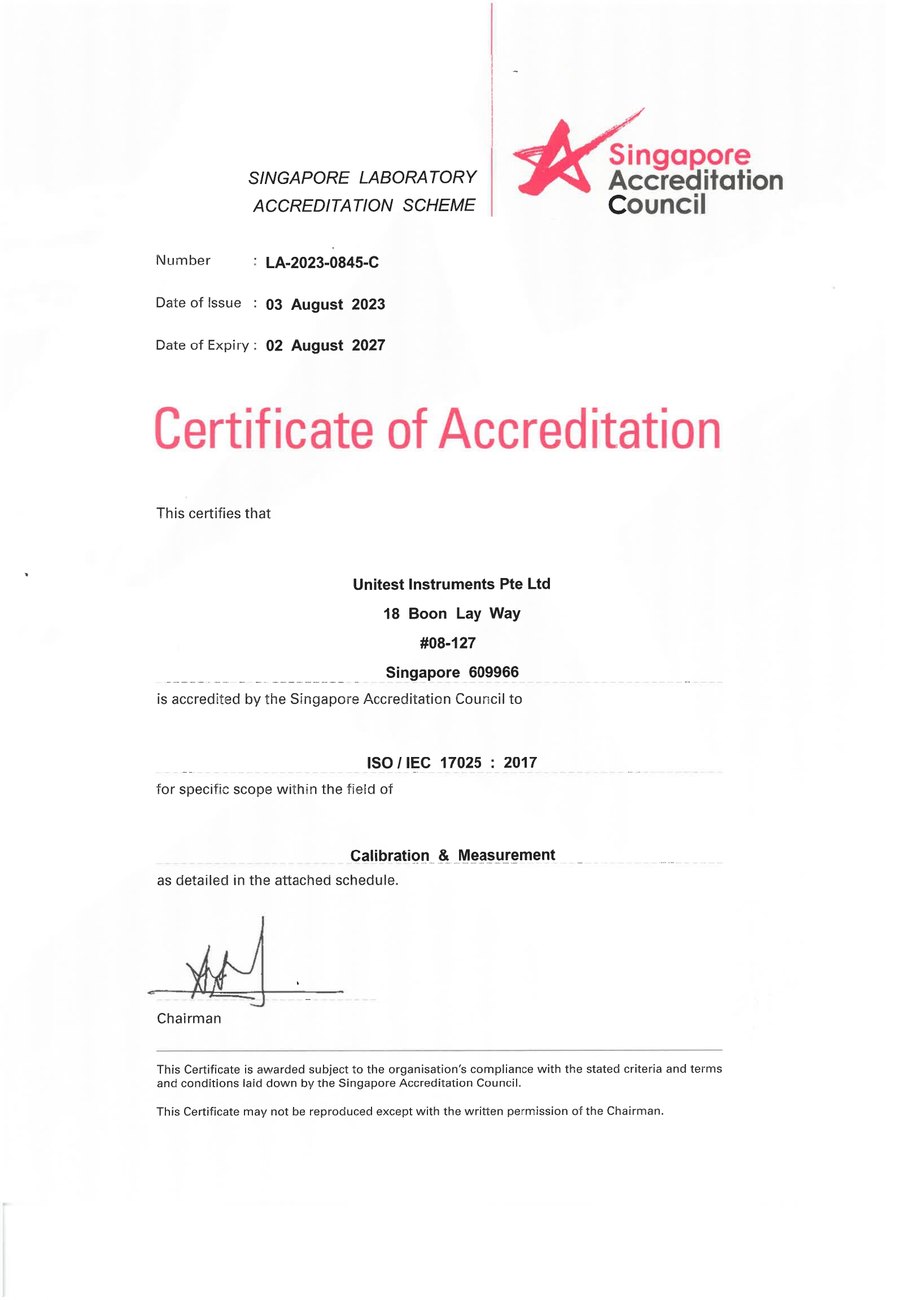
SAC-SINGLAS accredited calibration laboratory (Acc. No. LA-2023-0845-C) serving Singapore's industrial, pharmaceutical, and manufacturing sectors. All content reflects our ISO/IEC 17025 accredited scope and is reviewed by our technical calibration team.
Need pH meter calibration in Singapore?
Unitest Instruments is SAC-SINGLAS accredited (Acc. No. LA-2023-0845-C) to ISO/IEC 17025. Same-week turnaround, certificates accepted by ISO 9001 auditors.