
Key Takeaways
- NTU and FNU are not interchangeable. They use different light sources and give different readings in coloured water, though they agree closely (within ~5%) in clear samples.
- ISO 7027 / FNU is the internationally preferred standard; EPA 180.1 / NTU is the US regulatory default. Singapore laboratories and regulators generally reference NTU but accept ISO 7027 instruments.
- PUB sets Singapore's drinking water turbidity limit at 1 NTU; below 0.5 NTU is the operational target to ensure effective chlorination.
- Formazin is the primary reference standard for turbidity calibration and must itself be traceable to a national metrology institute for accredited results.
- Turbidity above 1 NTU can shield Cryptosporidium and Giardia from chlorine and UV disinfection, making it a direct microbiological risk indicator.
Defining Turbidity: The Optical Basis
Turbidity describes the optical clarity of a liquid. Specifically, how much a suspension of particles impedes the transmission of light. When a beam of light enters a water sample, particles in the water (whether inorganic sediment, biological cells, oil droplets, or colloidal matter) interact with that beam in two fundamental ways: they absorb some of the light energy, and they scatter the remainder in multiple directions. Turbidity measurement captures this scattering effect.
The governing physics is Mie scattering theory, which describes how particles with diameters comparable to the wavelength of incident light scatter photons. For particles much smaller than the wavelength, Rayleigh scattering dominates. In practice, natural water bodies contain a distribution of particle sizes (from sub-micron colloidal clay to large sediment flocs), meaning the real-world scattering behaviour is a composite of multiple optical phenomena. This is why two water samples with identical suspended solids concentrations by mass can have very different turbidity values if their particle size distributions differ.
A turbidimeter (also called a nephelometer when configured for 90-degree detection) shines a collimated light beam through the sample and uses a photodetector positioned at 90 degrees to the beam axis to quantify the scattered signal. The 90-degree geometry minimises the interference from transmitted light and provides the most sensitive and reproducible response across the range of 0.001 to approximately 4,000 turbidity units.
NTU vs FNU: Understanding the Unit Difference
The two dominant turbidity units (NTU and FNU), both quantify 90-degree nephelometric scattering and both use formazin as their primary reference standard. The critical difference is the light source wavelength, which has meaningful practical consequences.
| Parameter | NTU (EPA 180.1) | FNU (ISO 7027) |
|---|---|---|
| Light source | White tungsten lamp (broad visible spectrum) | Near-infrared LED at 860 nm ±60 nm |
| Detection angle | 90° | 90° |
| Primary standard | Formazin (FTU) | Formazin (FTU) |
| Regulatory context | US EPA, US drinking water regulations | ISO, EU, Singapore, most international frameworks |
| Sensitivity to colour | Higher. White light absorbed by coloured samples | Lower. Infrared less affected by colour |
| Typical range | 0.01 – 4,000 NTU | 0.001 – 4,000 FNU |
In clear, colourless water (such as treated drinking water), the numerical difference between an NTU and FNU reading from the same sample is typically less than 5%, and instruments calibrated to either standard will agree within measurement uncertainty. However, in coloured water (such as peat-laden reservoir water, wastewater, or industrial effluent), the white-light NTU instrument will record a higher apparent turbidity than the infrared FNU instrument, because the visible-spectrum source is partially absorbed by dissolved colour compounds (chromophoric dissolved organic matter). For this reason, ISO 7027 / FNU is the more robust method for environmental and industrial applications where sample colour may vary.
In Singapore, PUB references NTU in its drinking water quality standards, consistent with WHO Guidelines for Drinking-water Quality, but modern laboratory turbidimeters supplied to accredited labs are almost universally ISO 7027-compliant instruments using 860 nm sources. When reporting, laboratories should clearly state the method and unit used, and any conversion assumptions, to avoid regulatory ambiguity.
Need a calibrated turbidimeter for water quality compliance?
Unitest Instruments provides traceable turbidimeter calibration to ISO 7027 and EPA 180.1, with SAC-SINGLAS accreditation (Acc. No. LA-2023-0845-C). Certificates accepted by PUB, NEA, and ISO 9001 auditors.
Why Turbidity Matters: Health and Regulatory Significance
Turbidity is not merely an aesthetic water quality parameter. It is a frontline indicator of microbiological risk. The World Health Organisation's fourth-edition Guidelines for Drinking-water Quality (2011, updated 2022) state explicitly that turbidity must remain below 1 NTU before chlorination can be considered effective, and below 0.3 NTU for UV disinfection to achieve the required 3-log (99.9%) inactivation of Cryptosporidium and Giardia.
The mechanism is physical shielding. Suspended particles (clay, biological flocs, algal aggregates), can physically harbour protozoan oocysts, bacterial cells, and viral particles, preventing disinfectants from reaching and inactivating them. A 1991 US EPA study found that even at 1 NTU, UV disinfection efficacy was reduced by approximately 25% relative to a sample at 0.1 NTU. At 5 NTU, some chlorine-resistant pathogens can survive at normal treatment doses.
Singapore Regulatory Framework
In Singapore, the regulatory landscape for turbidity spans several authorities:
- PUB (Drinking Water): Maximum turbidity of 1 NTU at the point of distribution, consistent with WHO guidelines. Treatment plants target 0.1–0.3 NTU at the filter effluent stage.
- NEA (Trade Effluent Discharge): The NEA Trade Effluent Regulations do not directly specify turbidity limits for most discharge categories, but total suspended solids (TSS) limits of 50–400 mg/L apply depending on the receiving water body. Turbidity serves as a real-time surrogate for TSS in continuous monitoring systems.
- MOM / SS 636 (Workplace Water): SS 636:2018 (Code of Practice for water services) references turbidity as part of water quality in industrial and building services contexts.
Turbidity Measurement Methods: Instruments and Standards
Several standardised measurement methods govern how turbidimeters are designed and operated. Understanding which method your instrument implements is essential before comparing results across laboratories or reporting to regulators.
ISO 7027-1:2016 (FNU/FAU)
The current international standard is EN ISO 7027-1:2016, "Water quality (Determination of turbidity), Part 1: Quantitative methods." It specifies a monochromatic near-infrared source at 860 nm (±60 nm), detection at 90 degrees, and expresses results in FNU (Formazin Nephelometric Units). Part 2 (ISO 7027-2:2019) covers semi-quantitative visual comparison methods for field use. ISO 7027 is the preferred method for accredited laboratories in Singapore, Europe, and most jurisdictions outside the United States.
US EPA Method 180.1 (NTU)
EPA 180.1 specifies a white tungsten lamp source, a detector at 90 ±30 degrees, and results in NTU. It was developed for US drinking water compliance monitoring and remains the regulatory default under the Safe Drinking Water Act. Its white-light source means it responds to sample colour as well as particle scattering. A known limitation acknowledged in subsequent revisions.
ASTM D1889 (NTU)
ASTM D1889, "Standard Test Method for Turbidity of Water," covers both nephelometric and visual turbidity methods. It is referenced in industrial process water quality specifications and is commonly cited in material testing laboratories alongside other water quality parameters.
Ratio Turbidimetry
Modern turbidimeters often include multiple detectors. A 90-degree nephelometric detector, a forward-scatter detector, and a transmitted-light detector. Ratio turbidimeters compute the ratio of 90-degree scatter to forward scatter, which reduces the influence of instrument stray light and ambient light intrusion. This technique extends the reliable measurement range to above 1,000 NTU and is essential for process control applications in wastewater treatment, mining, and food processing.
Calibration Requirements and Traceability
A turbidimeter reading is only as reliable as its calibration. Instrument calibration involves two steps: verifying the instrument's optical linearity using reference standards at multiple turbidity levels, and confirming the zero (stray-light blank) using reagent-grade water with turbidity below 0.02 NTU. Both steps must use reference standards with documented traceability.
Formazin: The Primary Reference Standard
Formazin is the universally accepted primary standard for turbidity calibration. It is a hydrazine-formaldehyde condensation polymer that produces a stable, reproducible scattering suspension. A freshly prepared 4,000 FTU (Formazin Turbidity Unit) stock is diluted to prepare working standards at the required verification points. Formazin degrades over time and is sensitive to temperature and UV exposure; NIST-certified formazin stock solutions have a typical shelf life of 30 days after preparation and one year for sealed commercial preparations.
For accredited turbidimeter calibration under ISO/IEC 17025, the formazin working standards must themselves be traceable to a national metrology institute. In Singapore, this traceability chain flows through the National Metrology Centre (NMC) at A*STAR, which maintains the national measurement standards for photometric and optical quantities. Unitest Instruments' calibration services (Acc. No. LA-2023-0845-C) provide formazin-traceable turbidimeter calibration with a documented uncertainty budget, as required for regulatory-grade evidence.
Secondary and Commercial Standards
Formazin is a hazardous substance (hydrazine is a suspected carcinogen) and requires careful handling in line with MOM workplace safety requirements. For routine field verification, manufacturers supply sealed polymer standards made from Styrene Divinylbenzene (SDVB) beads or other proprietary formulations. These secondary standards are more stable and safer but must be referenced against a formazin-based primary calibration. They cannot substitute for primary calibration in an accredited framework.
Common Mistakes in Turbidity Measurement
Despite turbidity being a relatively simple measurement in concept, it is one of the most error-prone tests in routine water quality programmes. The following systematic errors are observed regularly in field and laboratory settings.
1. Bubble Interference
Air bubbles introduced during sample collection or transfer scatter light exactly like particles and will produce falsely elevated readings. Samples should be collected with minimal agitation, stored with minimal headspace, and allowed to degas before measurement. Portable turbidimeters with bubble-trap sample cells significantly reduce this error.
2. Scratched or Dirty Sample Cells
The optical cell (cuvette) through which the sample is measured must be clean and scratch-free. Micro-scratches on the cell surface scatter light and introduce a background offset. Cells should be inspected before each measurement run and replaced at any sign of scratching or clouding. Fingerprints on the cell exterior are a common source of elevated blank readings.
3. Sample Storage and Preservation
Turbidity can change rapidly after collection as particles settle, flocculate, or biological growth occurs. The standard protocol (ISO 5667-3) recommends measuring turbidity within 24 hours of collection, storing samples at 4°C in the dark, and using pre-rinsed amber glass or HDPE containers. Chemical preservation is not appropriate for turbidity samples as it alters the particle suspension.
4. Stray Light at Low Turbidity
At very low turbidity levels (below 1 NTU), instrument stray light (light that reaches the detector by paths other than sample scattering), becomes a significant source of positive bias. High-quality laboratory turbidimeters specify a stray-light level below 0.015 NTU. Instruments with stray light above 0.02 NTU are not suitable for measuring potable water quality at the sub-0.5 NTU range required for disinfection monitoring.
5. Using the Wrong Unit or Method Standard
Reporting NTU when the instrument uses a 860 nm source (i.e. it is actually measuring FNU) is a documentation error that can cause compliance issues if the regulator's limit is specified under a different method. Always document the instrument make/model, light source, measurement standard (ISO 7027 or EPA 180.1), and unit in the test report. This is a mandatory requirement under ISO/IEC 17025 reporting obligations and is specifically checked by SAC-SINGLAS during accreditation assessments.
6. Skipping Temperature Equilibration
The refractive index of water changes with temperature, which affects light scattering. If a sample is significantly colder or warmer than the instrument's optical cell, a refractive index mismatch occurs at the cell wall, introducing error. Samples should be equilibrated to ambient laboratory temperature before measurement. Typically 20–25°C for Singapore laboratory conditions.
Turbidity in Industrial and Process Applications
Beyond drinking water compliance, turbidity measurement is used across a wide range of industrial sectors in Singapore and the region. In pharmaceutical manufacturing (GMP-regulated facilities under HSA), water-for-injection (WFI) systems use online turbidimeters to monitor membrane integrity and detect contamination events in real time, with turbidity specifications typically below 0.2 NTU. In semiconductor fabrication, ultrapure water systems maintain turbidity at or near the detection limit of high-performance laboratory instruments (<0.001 NTU).
Food and beverage manufacturers use turbidity as a batch-release parameter for beverages, process water, and cleaning-in-place (CIP) validation. A sudden rise in rinse-water turbidity after a CIP cycle indicates incomplete removal of residuals and triggers a re-clean before the next production run. Marine and offshore engineering contractors measure ballast water turbidity to meet International Maritime Organisation (IMO) ballast water management standards (D-2) under the Ballast Water Management Convention, ratified by Singapore in 2017.
In all industrial contexts, turbidimeters used for compliance or batch-release decisions should be calibrated by an accredited laboratory at defined intervals. As with any measurement instrument, the calibration interval should be set based on instrument stability data. A topic covered in our article on calibration intervals and how often instruments should be calibrated.
Frequently Asked Questions
Turbidity is an optical property of water that describes how much suspended particles (including sediment, algae, bacteria, and colloidal matter), scatter and absorb light passing through the sample. It is measured using a turbidimeter (or nephelometer) that shines a beam of light through the water and detects how much light is scattered at 90 degrees to the original beam. The result is expressed in Nephelometric Turbidity Units (NTU) under the EPA 180.1 method, or in Formazin Nephelometric Units (FNU) under ISO 7027.
NTU (Nephelometric Turbidity Unit) and FNU (Formazin Nephelometric Unit) both measure turbidity by 90-degree light scattering, but they use different light sources. NTU, defined by the US EPA method 180.1, uses a white tungsten lamp with a broad visible-spectrum output. FNU, defined by ISO 7027 and EN ISO 7027-1:2016, uses near-infrared light at 860 nm (±60 nm). Because the light sources differ, readings in NTU and FNU are not numerically identical, especially in coloured water samples. ISO 7027 / FNU is the international standard preferred in Europe, Singapore, and most accreditation frameworks. For clear, colourless water, the numerical difference between NTU and FNU is typically less than 5%.
PUB (Singapore's national water agency) sets the drinking water turbidity limit at 1 NTU for treated tap water, consistent with the World Health Organisation (WHO) Guidelines for Drinking-water Quality (4th edition). At the point of distribution, turbidity should ideally remain below 0.5 NTU to ensure that disinfection by chlorination is fully effective, as higher turbidity can shield microorganisms from UV and chlorine treatment.
Turbidity directly affects the efficacy of water disinfection. Suspended particles can shelter bacteria, viruses, and protozoa (such as Cryptosporidium and Giardia) from UV radiation and chlorine. The WHO guideline states that turbidity must be below 1 NTU before chlorination, and ideally below 0.3 NTU for effective UV disinfection. At 1 NTU, up to 99% of pathogens can be shielded from UV doses that would otherwise achieve 3-log (99.9%) inactivation. This is why water treatment plants treat turbidity as a direct indicator of microbiological risk, not just an aesthetic parameter.
Calibration frequency depends on how frequently the instrument is used, the accuracy requirements, and the regulatory context. For regulatory compliance (such as PUB-permitted industrial discharge monitoring), turbidimeters should be calibrated at minimum annually by an accredited laboratory. High-use instruments in process control or water treatment plants are typically calibrated every 3 to 6 months. Formazin primary calibration standards should be freshly prepared or sourced from certified suppliers, as they degrade over time and can introduce systematic errors.
The primary reference standard for turbidity calibration is formazin, a polymer suspension with reproducible scattering properties, used to define the Formazin Turbidity Unit (FTU). Formazin is referenced in both ISO 7027 and ASTM D1889. Secondary standards include Styrene Divinylbenzene (SDVB) beads and EPA-approved polymer standards for field instruments. Stray-light verification is performed using a low-turbidity reagent-grade water blank (ideally below 0.02 NTU). For accredited calibration, the formazin stock solution must itself be traceable to a national metrology institute, in Singapore, traceability flows through the National Metrology Centre (NMC) at A*STAR.
ISO 7027 (current edition: EN ISO 7027-1:2016, Water quality (Determination of turbidity), Part 1: Quantitative methods) is the internationally recognised method for measuring turbidity in water using near-infrared light at 860 nm. It defines measurement in FNU (Formazin Nephelometric Units) at 90-degree detection angle. Part 2 (ISO 7027-2:2019) covers semi-quantitative methods. ISO 7027 is the preferred standard in Singapore, the European Union, and most jurisdictions operating under ISO/IEC 17025-accredited laboratory frameworks. Turbidimeters designed for ISO 7027 compliance must use a 860 nm LED or laser source, whereas EPA 180.1 instruments use a white-light tungsten lamp.
Turbidity and total suspended solids (TSS) are correlated but not identical. Turbidity measures optical scattering, while TSS is a gravimetric measurement (mass per volume). A site-specific turbidity-to-TSS regression curve can be developed using simultaneous measurements, and this surrogate relationship is used extensively in stormwater monitoring and industrial effluent compliance under NEA discharge standards in Singapore. However, the relationship changes with particle size, shape, and composition, so a calibrated correlation must be established and validated for each specific water source. Using a universal conversion factor without site-specific validation will produce inaccurate TSS estimates.
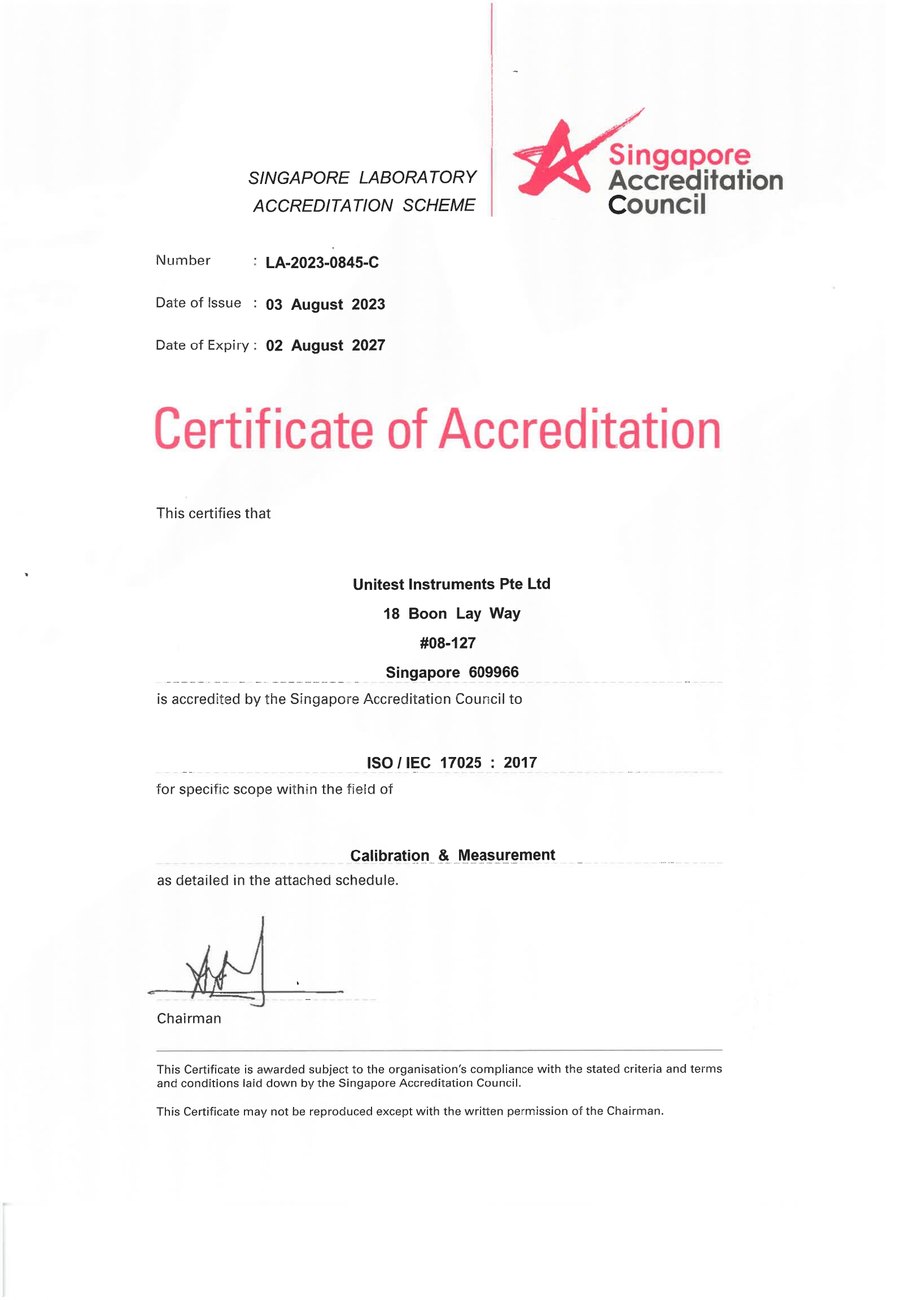
SAC-SINGLAS accredited calibration laboratory (Acc. No. LA-2023-0845-C) serving Singapore's industrial, pharmaceutical, and manufacturing sectors. All content reflects our ISO/IEC 17025 accredited scope and is reviewed by our technical calibration team.
Need turbidimeter calibration in Singapore?
Unitest Instruments is SAC-SINGLAS accredited (Acc. No. LA-2023-0845-C) to ISO/IEC 17025. Same-week turnaround, certificates accepted by ISO 9001 auditors, PUB, and NEA.