
Key Takeaways
- True-RMS measurement is non-negotiable for VFD-driven HVAC systems. Average-responding meters can read 10–40% low on distorted waveforms.
- Built-in K-type temperature input turns a clamp meter into a two-in-one diagnostic tool for delta-T measurements and refrigerant charge checks.
- Singapore's SS 553 and BCA commissioning requirements expect calibrated instruments with traceable certificates. A shop-floor sticker is not sufficient.
- CAT III 1000 V or CAT IV 600 V rating is the minimum for working near commercial HVAC distribution boards.
- Wireless logging (Fluke Connect) reduces transcription errors on multi-system service calls and produces audit-ready records automatically.
Who Needs a Specialist HVAC Clamp Meter?
A general-purpose clamp meter from a hardware store will measure current, but it will not do the job reliably on modern HVAC equipment. Singapore's commercial building stock runs overwhelmingly on inverter-driven systems: variable-frequency drives (VFDs) on AHU fans, DC inverter compressors in split systems, and variable-speed chiller pumps. These loads produce non-sinusoidal current waveforms that fool average-responding meters into giving readings that are systematically too low.
The consequence is real: undersized protection devices, missed overload conditions, and commissioning records that do not reflect actual operating current. For any technician servicing SS 553-regulated buildings (which includes virtually all commercial premises in Singapore), a documented calibration certificate is also mandatory at commissioning and annual maintenance. A clamp meter that lacks a SAC-SINGLAS traceable certificate puts your sign-off at risk.
HVAC technicians specifically need clamp meters that handle: true-RMS AC current on VFD loads, built-in or probe-based temperature measurement for supply/return delta-T, a jaw large enough to fit around multi-core HVAC cables, and a minimum CAT III 1000 V safety rating for panel work.
Key Specifications Explained
True-RMS vs Average-Responding
RMS (root mean square) is the mathematically correct way to express the heating effect of an AC current. Average-responding meters apply a fixed conversion factor (1.1107×) that only works for perfect sinusoidal waveforms. When the waveform is distorted (as it always is downstream of a VFD), the average-responding result is wrong. True-RMS meters sample the waveform digitally and compute the correct RMS value regardless of wave shape. On a typical VFD-driven fan, the measurement error of an average-responding meter is 15–30%; on a badly distorted drive output, it can exceed 40%.
Temperature Input
K-type thermocouples are the industry standard for HVAC temperature work. They cover −40 °C to +1372 °C. Far more range than needed for air or refrigerant measurement, but the wide range means the probe is not stressed at typical HVAC operating temperatures (−10 °C to +70 °C). A clamp meter with a built-in thermocouple socket lets you measure compressor inlet current and discharge-line temperature in a single connection, saving a separate thermometer and reducing the chance of cross-referencing errors in your service record.
CAT Rating and Safety
IEC 61010 overvoltage categories define how much transient energy a meter's input protection can absorb before it fails dangerously. HVAC work spans CAT II (outlet-fed equipment) through CAT III (fixed installation distribution panels). For chiller plant rooms fed directly from the main switchboard, CAT IV exposure is possible. The safe minimum for commercial HVAC panel work in Singapore is CAT III 1000 V; CAT IV 600 V provides additional margin when working close to the utility supply point.
Jaw Opening and Conductor Size
The jaw opening determines the maximum cable diameter the meter can clamp around. Residential mini-split cables (2.5–6 mm²) fit easily through any 30 mm jaw. However, large commercial systems (90-tonne chillers, 100 kW AHUs), run 95–185 mm² single-core conductors that require a jaw opening of 52 mm or more. Check the maximum conductor diameter in the meter specifications before purchasing for plant room work.
Top Clamp Meters for HVAC Work. Model Comparison
All five models below are available through unitestshop.com and can be submitted for SAC-SINGLAS calibration immediately upon purchase. Prices shown are indicative SGD retail; contact Unitest for volume or project pricing.
| Model | AC Current Range | True-RMS | Temperature | DC Current | Jaw Opening | CAT Rating | Price Range (SGD) | Best For |
|---|---|---|---|---|---|---|---|---|
| Fluke 902 FC | 0.1–400 A | Yes | K-type built-in (−20 to +200 °C) | No | 34 mm | CAT III 600 V | $380–$450 | Split systems, FCUs, residential & light commercial |
| Fluke 376 FC | 0.1–1000 A AC | Yes | K-type (via iFlex) | Yes (1400 A DC w/ iFlex) | 52 mm | CAT III 1000 V / CAT IV 600 V | $650–$780 | Chiller plants, AHUs, VFD-heavy systems |
| Fluke 324 | 0.1–400 A | Yes | K-type (socket) | No | 34 mm | CAT III 600 V | $260–$310 | Budget-conscious technicians; split-system maintenance |
| Amprobe AMP-330 | 0.1–1000 A AC | Yes | K-type (socket, dual input) | Yes (1000 A DC) | 51 mm | CAT III 1000 V / CAT IV 600 V | $480–$560 | Commissioning engineers; simultaneous delta-T + current |
| Fluke 771 mA Process Clamp | 4–20 mA (process loop) | Yes | No | Yes (4–20 mA DC) | 7.5 mm (process cable) | CAT II 600 V | $520–$600 | BAS/control wiring; verifying 4–20 mA actuator signals |
Model Deep-Dives
Fluke 902 FC. Best All-Round HVAC Clamp Meter
The Fluke 902 FC was designed specifically for HVAC and building-services technicians. Its most distinctive feature is the built-in K-type thermocouple socket positioned alongside the jaw. You can measure compressor current and supply-duct temperature simultaneously without swapping probes. The Fluke Connect wireless module transmits readings to the Fluke Connect app, which logs timestamped data and generates shareable service reports without manual transcription.
At 400 A full scale with 0.1 A resolution, it covers everything from a 9,000 BTU residential unit (typically 4–6 A) to a 36,000 BTU commercial cassette (typically 14–18 A at full load). The 34 mm jaw comfortably handles the 4 mm² to 16 mm² single-core cables used in most Singapore split and packaged systems. The CAT III 600 V rating is appropriate for sub-distribution work; for work at the main distribution board, use the Fluke 376 FC instead. View the Fluke 902 FC on unitestshop.com.
Fluke 376 FC. Best for Commercial Chiller Plant Rooms
The 376 FC steps up to 1000 A AC and adds DC current measurement via the optional iFlex flexible current probe (rated to 2500 A AC / 1400 A DC). The 52 mm jaw handles the 120–185 mm² single-core conductors common in large chiller starters. The CAT III 1000 V / CAT IV 600 V dual rating means you can work confidently close to the 400 V / 22 kV boundary in Singapore's typical chiller plant rooms without downgrading the safety category.
The iFlex probe also solves a practical problem: it can snake around busbars and conductors in cramped switchboard compartments where a rigid jaw will not fit. If you are commissioning a central plant or doing BCA-mandated periodic energy audits, the 376 FC's data logging and Fluke Connect integration produce the current measurement records that BCA's Green Mark and SS 591 compliance processes expect. View the Fluke 376 FC on unitestshop.com.
Amprobe AMP-330. Best for Commissioning Engineers
The Amprobe AMP-330 stands out for its dual K-type thermocouple inputs, which let a commissioning engineer measure supply-air and return-air temperature simultaneously while reading compressor current, three measurements on one instrument. At 1000 A AC / 1000 A DC with a 51 mm jaw and CAT III 1000 V / CAT IV 600 V rating, it covers the same chiller-plant territory as the Fluke 376 FC at a somewhat lower price point. Amprobe instruments are manufactured to the same Fluke quality standards (both brands are Fortive companies) and fall within Unitest's SAC-SINGLAS calibration scope. Browse Amprobe instruments on unitestshop.com.
Calibrate Your New Clamp Meter Before First Use
Unitest Instruments issues SAC-SINGLAS traceable calibration certificates accepted by BCA, ISO 9001, and SS 553 auditors. Same-week turnaround for most electrical instruments.
Singapore Context: Standards and Compliance
Singapore's HVAC sector operates under a layered set of standards that collectively require calibrated instrumentation. SS 553:2016 (Code of Practice for Air Conditioning and Mechanical Ventilation) mandates that all measurements used for system commissioning, performance verification, and maintenance be taken with calibrated instruments traceable to national standards. In Singapore, that traceability chain runs through the National Metrology Centre (NMC) under A*STAR. The same traceability referenced in Unitest's SAC-SINGLAS certificates.
For Green Mark projects, BCA's Technical Guide requires energy measurement data (including motor current draw), to be recorded with instruments of documented accuracy. An uncalibrated clamp meter or a meter with only a manufacturer's conformance sticker does not satisfy this requirement. The auditor will ask for the calibration certificate number, issue date, and uncertainty statement. Only a SAC-SINGLAS accredited certificate provides all three.
The Singapore Electrical Licensing Board (ELB) and the Energy Market Authority (EMA) additionally require that licensed electrical workers use properly maintained test equipment. While calibration interval is not mandated by legislation, the practical standard in Singapore's FM and M&E contracting community is annual calibration, with six-monthly intervals for instruments used on critical infrastructure such as data centre cooling.
Understanding what a calibration certificate actually contains (and what distinguishes an accredited certificate from a non-accredited one), is important background for any compliance discussion. Our article on accredited vs non-accredited calibration explains the difference in plain English, and our calibration certificate explained guide walks through every field on a SAC-SINGLAS certificate so you know exactly what to hand your auditor.
How to Choose the Right Model for Your Application
Use the decision logic below to narrow your choice:
- Residential and light commercial (split systems, FCUs up to 36,000 BTU): The Fluke 902 FC or Fluke 324 handles everything you will encounter. The 902 FC's wireless logging and integrated temperature probe justify the price premium for technicians doing multiple service calls daily.
- Commercial chiller plants and large AHUs (above 50 kW motor loads, large cable cross-sections): The Fluke 376 FC or Amprobe AMP-330 is required. The 52 mm jaw and 1000 A range are not optional at this level.
- BAS and controls work (verifying 4–20 mA actuator signals, DDC loops): The Fluke 771 mA Process Clamp is a purpose-built tool that measures milliamp-level DC process signals non-invasively. It is not a substitute for a full-range clamp meter but is invaluable for controls commissioning.
- Commissioning engineers who need to log multiple measurements simultaneously: The Amprobe AMP-330's dual thermocouple inputs give you supply-air temperature, return-air temperature, and compressor current from one instrument. A significant efficiency gain on a multi-system commissioning site.
Calibration: What to Do When Your Meter Arrives
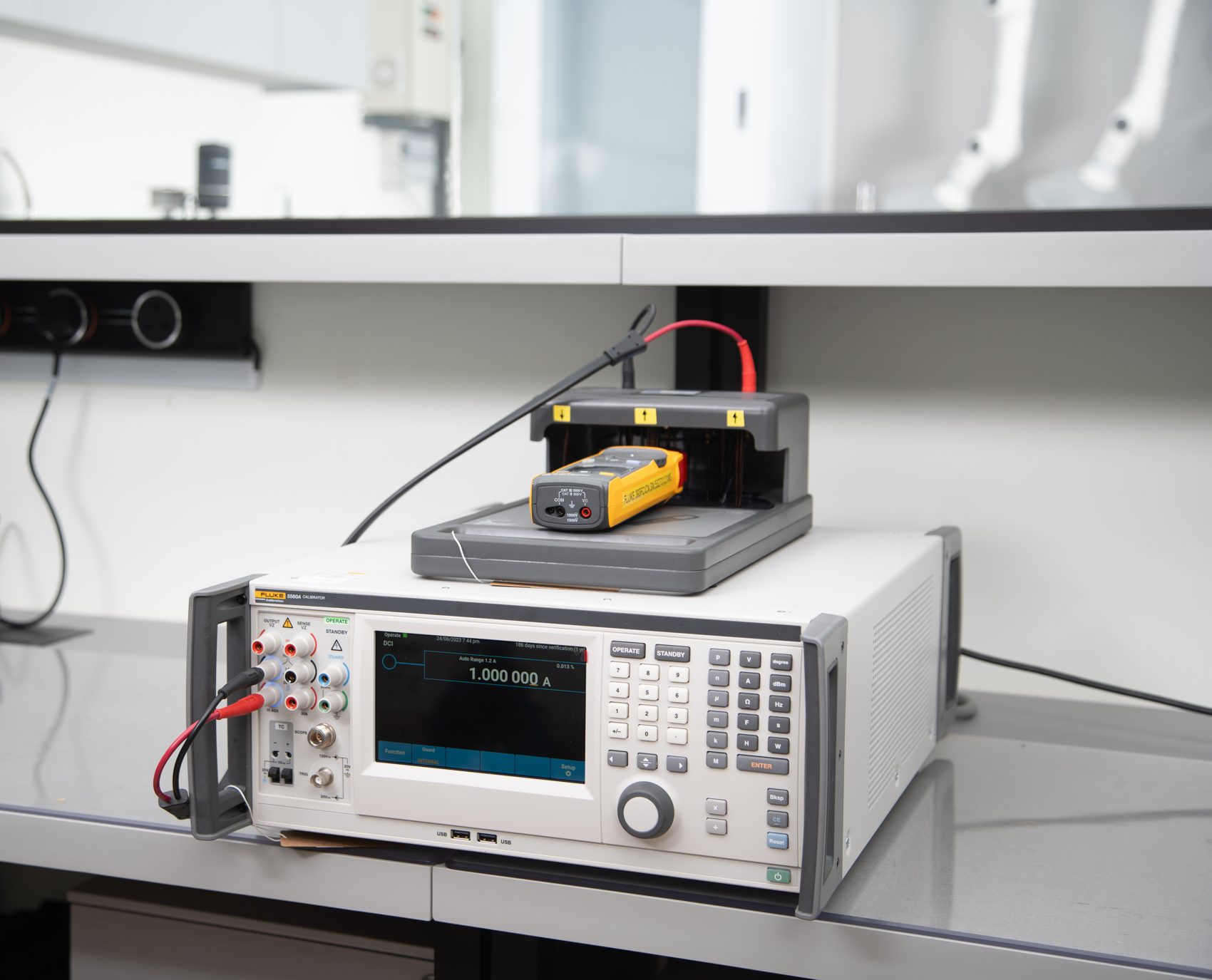
A new clamp meter from the manufacturer ships with a factory conformance declaration, not an accredited calibration certificate. The factory process verifies the instrument meets its published specification at manufacture, but it does not provide the traceable uncertainty statement required by ISO/IEC 17025 and accepted by SAC-SINGLAS auditors. For instruments that will be used in SS 553 commissioning or ISO 9001-governed maintenance, you need to send the meter to an accredited laboratory before first use.
At Unitest Instruments (SAC-SINGLAS Acc. No. LA-2023-0845-C), the calibration process for a clamp meter covers AC current at multiple test points across the full range, DC current (where applicable), AC/DC voltage, and resistance. We issue a certificate that lists each measured value, the reference standard used, and the measurement uncertainty. Expressed as an expanded uncertainty at k=2 (95% confidence level). This format satisfies the requirements of both ISO/IEC 17025 and the SS 553 commissioning documentation checklist.
For ongoing calibration, the practical interval for most HVAC clamp meters is 12 months. Instruments subjected to heavy use, accidental overload, or physical shock should be re-calibrated immediately after any such event rather than waiting for the scheduled interval. Our article on how often to calibrate instruments covers the risk-based approach to setting calibration intervals in more detail.
Common Measurement Mistakes That Skew HVAC Readings
Even a properly calibrated clamp meter will give a misleading reading if it is used incorrectly, and in HVAC service work the same handful of mistakes recur across technicians of every experience level. Recognising them is as important as owning the right instrument.
Clamping Multiple Conductors Together
The single most common error is clamping around a bundled cable that carries both the live and neutral (or two phases) instead of isolating a single conductor. Because the currents in opposite directions largely cancel inside the jaw, the meter reads close to zero even though the circuit is fully loaded. On three-phase compressor feeds this shows up as a reading a fraction of the expected value, technicians unfamiliar with the failure mode sometimes conclude the compressor is under-loaded and skip a genuine fault. Always separate individual conductors at a termination point or junction box before clamping.
Jaw Position and Conductor Centring
Clamp meters are most accurate when the conductor sits in the centre of the jaw, perpendicular to the jaw face. Off-centre placement, or clamping at an angle, can introduce 1–3% additional error on budget meters and up to 5% on units with worn or slightly misaligned jaw cores. On a compressor near its rated current limit, this margin is the difference between a pass and a fail against SS 553 acceptance criteria. Technicians working in cramped switchboard compartments should use a flexible current probe (iFlex-type) rather than forcing a rigid-jaw meter into a poor clamping angle.
Ignoring Inrush and Transient Readings
DC inverter compressors and VFD-driven fans draw a brief inrush current at start-up that can be several times the running current. Reading the display immediately after start-up, before the drive has ramped to steady state, produces a value that has nothing to do with the running load the circuit protection is sized for. Wait at least 60–90 seconds after start-up, or use the meter's min/max or inrush-capture function, before recording a commissioning figure.
Caring for Your Clamp Meter Between Calibrations
A calibration certificate documents accuracy at a single point in time; how the instrument is handled in the following months determines whether that accuracy holds until the next scheduled calibration. Three practices make the biggest difference for HVAC field instruments. First, store the meter in its case with the jaw closed and the test leads coiled loosely rather than tightly wound, as sharp lead bends accelerate insulation fatigue and can eventually cause intermittent open circuits that are difficult to diagnose in the field. Second, avoid dropping the meter onto concrete plant room floors. Even when the housing survives visually intact, the jaw core alignment can shift by a fraction of a millimetre, enough to introduce a systematic offset that will only be caught at the next calibration. Third, check the battery condition regularly. Many clamp meters do not flag low-battery conditions with a hard cutoff; instead, accuracy silently degrades as supply voltage drops, particularly on meters with backlit displays or wireless logging enabled. Replacing batteries proactively before a commissioning job, rather than reactively when the display dims, avoids an entire day's readings being called into question later. Technicians managing a fleet of instruments across multiple job sites should keep a simple logbook noting any drop, overload event, or exposure to moisture. This record, cross-referenced against the next calibration result, is exactly the kind of evidence ISO/IEC 17025 laboratories look for when justifying whether an interval should be shortened or can safely be extended.
Frequently Asked Questions
True-RMS (root mean square) measurement is the single most important specification for HVAC use. HVAC systems drive variable-frequency drives (VFDs) and variable-speed compressors that produce non-sinusoidal waveforms. A true-RMS clamp meter accurately measures distorted AC waveforms, whereas an average-responding meter can read 10–40% low on VFD-driven loads. A dangerous underestimate when sizing protection devices or diagnosing overcurrent conditions.
Yes, for most HVAC diagnostic work. Measuring supply-air and return-air temperature differential (delta-T) is one of the fastest ways to verify refrigerant charge and airflow. A clamp meter with a K-type thermocouple input (such as the Fluke 902 FC or Amprobe AMP-330), lets you measure current draw and temperature from the same instrument, reducing the number of tools you carry on a service call.
For most Singapore commercial HVAC systems, a clamp meter with a range of at least 400 A AC is sufficient for fan coil units and split systems. For chiller plants and large AHUs, a 1000 A AC range is recommended. Residential mini-split compressors typically draw 5–25 A, so any 400 A range provides adequate headroom and resolution. Also ensure the meter can measure milliamp-level currents (down to 0.1 A) for diagnostic work on control circuits.
Most instrument manufacturers and ISO 9001 quality systems recommend calibrating clamp meters every 12 months. In demanding HVAC environments (high humidity, heavy vibration from compressors, frequent use), a 6-month calibration interval is prudent. Singapore's BCA and SS 553 compliance audits may require documented calibration certificates with traceable uncertainty statements. Unitest Instruments (SAC-SINGLAS Acc. No. LA-2023-0845-C) issues certificates that are accepted by ISO 9001 and BCA auditors.
IEC 61010 overvoltage categories define the transient protection level of electrical test equipment. CAT III (600 V or 1000 V) covers distribution panels, fixed installations, and motor control centres, suitable for most HVAC work. CAT IV covers the origin of the installation: outdoor service entry, utility meters, and primary overcurrent protection. For chiller plant rooms connected close to the switchboard supply, a CAT IV 600 V or CAT III 1000 V clamp meter is the safer choice.
Only if the clamp meter is specifically rated for DC current measurement. Many basic clamp meters measure AC only. HVAC systems with variable-frequency drives, heat pumps with DC inverter compressors, or rooftop units tied to solar PV systems may require DC current readings. Look for models with Hall-effect sensors that support both AC and DC, such as the Fluke 376 FC or Amprobe AMP-330, which cover up to 2500 A DC and 1000 A DC respectively.
SS 553:2016 (Code of Practice for Air Conditioning and Mechanical Ventilation) requires that measurements used for commissioning, maintenance, and compliance testing be performed with calibrated instruments traceable to national standards. In Singapore, traceability runs through the National Metrology Centre (NMC) under A*STAR. A SAC-SINGLAS accredited calibration certificate (such as those issued by Unitest Instruments), provides the documented traceability chain required by SS 553 and BCA audits.
Jaw opening (conductor diameter capacity) matters when clamping around large cables or bus bars. For residential and light commercial HVAC, a 30–40 mm jaw opening handles standard single-core cables. For large commercial chiller plants with 120 mm² or larger cables, look for clamp meters with jaw openings of 52 mm or more. The Fluke 376 FC offers a 52 mm jaw, while the Fluke 902 FC is optimised for HVAC with a 34 mm jaw suited to most split and packaged unit wiring.
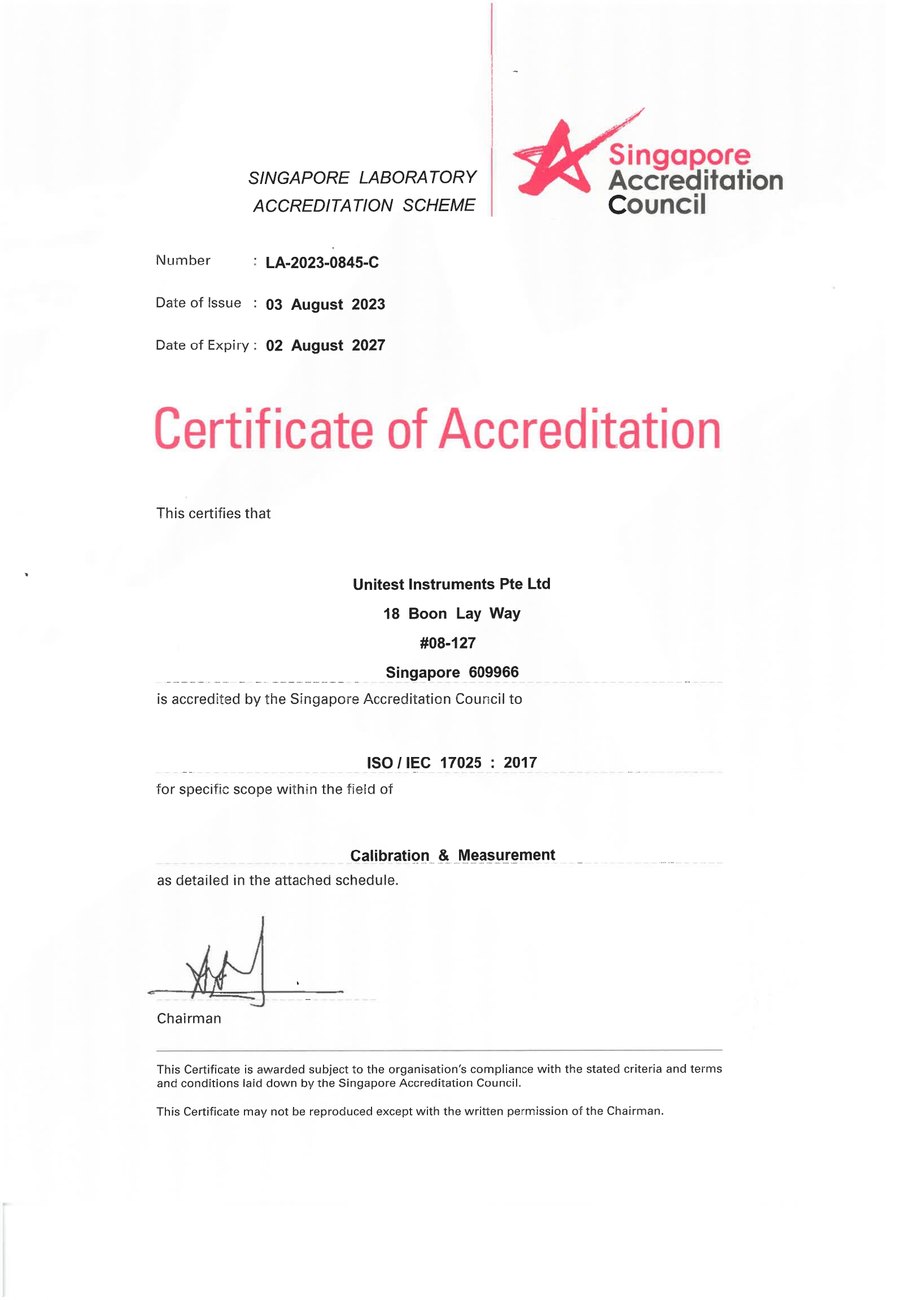
SAC-SINGLAS accredited calibration laboratory (Acc. No. LA-2023-0845-C) serving Singapore's industrial, pharmaceutical, and manufacturing sectors. All content reflects our ISO/IEC 17025 accredited scope and is reviewed by our technical calibration team.
Need electrical instrument calibration in Singapore?
Unitest Instruments is SAC-SINGLAS accredited (Acc. No. LA-2023-0845-C) to ISO/IEC 17025. Same-week turnaround, certificates accepted by ISO 9001 auditors.