
Key Takeaways
- Singapore's WSH (Confined Spaces) Regulations 2009 require testing for oxygen levels, flammable gases, and toxic gases. A 4-gas multi-detector covers all three in a single instrument.
- Single-gas detectors cost less, weigh less, and have simpler calibration needs. They are best for well-characterised, single-hazard environments.
- MSA, BW/Honeywell, and Dräger are the three dominant brands in Singapore; each has genuine strengths in different application segments.
- Sensor technology matters: catalytic bead LEL sensors can be poisoned by silicones and lead; electrochemical sensors drift with temperature and humidity, both need periodic accredited calibration.
- Bump-testing before each use is essential but does not replace full ISO/IEC 17025 calibration, which produces traceable certificates with stated measurement uncertainty.
Why the Choice Matters More Than It Seems
Gas detectors are life-safety instruments. In Singapore, confined space fatalities continue to occur despite regulatory requirements, and post-incident investigations frequently reveal one of two instrument failures: the wrong detector for the atmosphere (for example, a single H2S unit used in a space that also had an oxygen-deficient atmosphere), or a detector that had not been properly calibrated and gave a false "safe" reading. The choice between a single-gas and a multi-gas instrument is therefore not merely a procurement decision. It directly shapes your risk exposure.
The Singapore Workplace Safety and Health Act, together with the WSH (Confined Spaces) Regulations 2009, places legal responsibility on the permit-to-work issuer and the appointed competent person to ensure that the atmosphere is tested and declared safe before any worker enters. Choosing the wrong instrument category can invalidate that declaration even if the detector was technically functional at the time.
How Single-Gas Detectors Work, and Where They Excel
A single-gas detector contains one sensing element tuned to one target gas. The sensor converts the gas concentration into an electrical signal, which the instrument displays as a reading (typically in parts per million for toxic gases, or percentage of the lower explosive limit for flammable gases). When the reading crosses a pre-set alarm threshold, the instrument activates audible, visual, and vibratory alarms.
Because there is only one sensor to engineer around, single-gas instruments can be made extremely compact. Many clip-on H2S monitors weigh under 60 grams and are small enough to be worn on a lapel. They also tend to have longer battery life (some run for two years on a single coin cell), simpler user interfaces, and lower calibration costs because only one gas-sensor combination needs to be verified.
Best Use Cases for Single-Gas Detectors
- Fixed-station monitoring: CO detectors in car parks, boiler rooms, or generator enclosures where the only realistic hazard is combustion-derived CO.
- Specialist toxic gas monitoring: Chlorine (Cl2) sensors in water treatment or swimming pool facilities; ammonia (NH3) monitors in cold-storage or food-processing plants.
- Supplementary monitoring: Adding a dedicated SO2 or NO2 sensor to a team that already carries a 4-gas unit, for specific process hazards the multi-gas unit cannot cover.
- Personal dosimetry: Workers in petrochemical plants with a well-characterised H2S risk who need a lightweight wearable that does not interfere with PPE.
What single-gas detectors cannot do is detect unexpected secondary hazards. If a worker enters a confined space relying solely on an H2S monitor, but the space also has a flammable gas build-up or is oxygen-depleted, the instrument will remain silent. This is the core limitation, and in Singapore's diverse industrial environment (shipyards, wastewater infrastructure, marine terminals, pharmaceutical manufacturing), unexpected gas combinations are the norm rather than the exception.
How Multi-Gas Detectors Work, and What the Trade-offs Are
A multi-gas detector houses two to six sensing elements in a single housing, connected to a shared display and alarm system. The standard 4-gas configuration monitors oxygen (O2), lower explosive limit (LEL) for flammable gases, carbon monoxide (CO), and hydrogen sulphide (H2S). This combination was not arbitrary: these four gases represent the most common causes of confined space fatalities worldwide, and the four sensors together weigh only modestly more than a single-sensor unit.
Beyond the standard 4-gas pack, multi-gas units can be configured with additional sensors (SO2, NO2, NH3, CO2, phosphine (PH3), or infrared hydrocarbon sensors), making them adaptable to specialist industries. Some pumped models draw air from up to 30 metres away, enabling pre-entry testing without exposing the worker to the atmosphere.
Honest Trade-offs of Multi-Gas Units
- Cost: A quality 4-gas multi-detector costs S$800–S$2,500 versus S$150–S$400 for a comparable single-gas unit. The total cost of ownership also includes calibration gas mixtures (which must match all sensor types), sensor replacement (sensors age independently and may need staggered replacement), and a higher calibration fee because multiple sensors must be verified.
- Bulk and weight: Even compact 4-gas units typically weigh 150–300 grams. Not a problem in most applications, but relevant for workers who must also manage breathing apparatus, fall protection, and comms equipment in confined spaces.
- Calibration complexity: Each sensor has its own response curve, cross-sensitivity characteristics, and ageing behaviour. A calibration laboratory must verify each sensor independently. This is not a reason to avoid multi-gas units. It is a reason to use an ISO/IEC 17025 accredited laboratory that has the documented procedures and reference gas mixtures to do this correctly.
Need your gas detectors calibrated to an accredited standard?
Unitest Instruments calibrates single-gas and multi-gas detectors from MSA, BW/Honeywell, Dräger, and other brands. Our certificates are traceable to Singapore's NMC and accepted by MOM inspectors and ISO 9001 auditors.
Brand Comparison: MSA vs BW/Honeywell vs Dräger
These three brands dominate Singapore's industrial gas detection market. All three manufacture both single-gas and multi-gas instruments, and Unitest sells and calibrates all three. The comparison below reflects our technical team's honest assessment based on calibration volume, sensor replacement frequency, and customer feedback. It is not a sales pitch for any one brand.
| Feature | MSA Safety (Altair Series) | BW/Honeywell (GasAlert Series) | Dräger (X-am Series) |
|---|---|---|---|
| Typical product range | Altair (single), Altair 4X / 5X (multi) | GasAlertClip (single), GasAlertQuattro / MicroClip (multi) | X-am 2500 (single/dual), X-am 5600 (multi) |
| Build quality / IP rating | IP67 standard; known for housing durability in rough environments | IP66/67 depending on model; widespread in Singapore marine sector | IP67; German engineering heritage; slightly heavier but robust |
| Sensor options (multi-gas) | Up to 5 sensors; good O2/LEL/CO/H2S base; limited exotic sensors | Up to 5 sensors; broad sensor library including PH3, Cl2, NH3 | Up to 6 sensors; widest exotic sensor catalogue (>20 types) |
| Entry-level price (Singapore market) | Single: ~S$200–S$320; 4-gas: ~S$900–S$1,400 | Single: ~S$160–S$280; 4-gas: ~S$750–S$1,200 | Single: ~S$280–S$420; multi: ~S$1,200–S$2,500 |
| Battery life (typical) | Altair: 2-year lithium (single); 4X: ~18 hrs rechargeable | MicroClip: ~18 hrs; GasAlertClip Extreme: 2 years | X-am 2500: 26+ hrs; X-am 5600: 12–16 hrs |
| Datalogging | Yes (Altair 4X/5X via Galaxy automated test system) | Yes; BW Fleet Manager software; easy PC download | Yes; Dräger CC-Vision software; strong compliance reporting |
| Calibration frequency (manufacturer rec.) | Bump test: daily; Full calibration: 6 months (or per local regulation) | Bump test: before each use; Full calibration: 6 months | Bump test: before each use; Full calibration: 3–6 months |
| Sensor replacement cost | Moderate; O2/H2S sensors ~S$60–S$120 each | Moderate; competitive pricing; widely available in Singapore | Higher; proprietary sensor cartridges; S$90–S$200 each |
| Best for | Heavy industry, marine, construction. Durability priority | General confined space, cost-sensitive procurement, large fleets | Chemical, pharmaceutical, offshore. Widest sensor range needed |
| Weaknesses | Narrower exotic sensor range; Galaxy docking station adds cost | Softer housing compared to MSA/Dräger; some field durability complaints | Higher purchase and sensor cost; heavier units |
The honest summary: BW/Honeywell wins on total cost of ownership for standard confined space work when you are managing a fleet of 10 or more units. MSA wins on build durability for shipyard, construction, and heavy industrial environments where instruments take physical punishment. Dräger wins on sensor breadth for chemical processing, offshore, or pharmaceutical facilities where you need exotic gas types from a single manufacturer. There is no universally "best" brand. The right choice depends on your specific hazard profile and fleet size.
Calibration Requirements. Where Many Operators Fall Short
Purchasing the correct instrument is only half the equation. A gas detector that has not been properly calibrated is not a safety device. It is a false assurance device. This is where many Singapore operators, particularly SMEs managing their own maintenance, fall short.
The calibration of a gas detector involves two distinct activities. A bump test (or functional test) exposes each sensor to a challenge gas and confirms that the instrument alarms. It verifies function but not accuracy. A sensor that has drifted to read 15 ppm when the actual concentration is 25 ppm will pass a bump test if it still alarms. A full calibration, performed by a qualified laboratory, adjusts the instrument's output against a reference gas of known concentration and documents the measurement uncertainty. Only a full calibration tells you whether the reading you see is accurate.
Understanding what information should appear on a calibration certificate (including the reference gas concentrations, measurement uncertainty, and traceability chain), is important for procurement and compliance purposes. Our article on how to read a calibration certificate covers exactly what auditors and MOM inspectors expect to see.
For organisations subject to ISO 9001, ISO 45001, or OSHAS 18001 management systems, gas detector calibration must be performed by a laboratory whose calibration scope covers the relevant measurement parameters. A SAC-SINGLAS accredited laboratory operating to ISO/IEC 17025 (such as Unitest Instruments, Acc. No. LA-2023-0845-C), meets this requirement. A non-accredited service provider's certificate, regardless of how professional it looks, does not. Our article on accredited versus non-accredited calibration explains the legal and practical difference in detail.
Clear Winner Recommendations by Use Case
To make the decision concrete, here is our recommendation across the most common Singapore confined space scenarios:
| Scenario | Recommended Instrument | Reasoning |
|---|---|---|
| General confined space entry (manhole, vessel, tank) | 4-gas multi-detector (O2, LEL, CO, H2S) | Multiple simultaneous hazards are probable; single instrument satisfies all WSH testing requirements |
| Shipyard / marine confined space | 4-gas multi-detector + consider pumped sampling for large void spaces | Coating solvents (LEL), residual cargo gases, and oxygen depletion may all be present; MSA or Dräger for durability |
| Cold storage / food processing plant | Single-gas NH3 (or add NH3 sensor to multi-gas) | Ammonia refrigerant is the primary hazard; a dedicated low-ppm NH3 sensor outperforms a generic toxic channel |
| Wastewater / sewage infrastructure | 4-gas multi-detector; H2S sensor must be low-range (0–50 ppm or 0–100 ppm) | H2S, CO, low O2, and methane (LEL) are all credible hazards in sewage environments simultaneously |
| Fixed indoor station (car park, boiler room) | Single-gas CO detector (wall-mount) | Single, well-characterised combustion hazard; fixed installation with no confined space entry requirement |
| Pharmaceutical / chemical plant | Multi-gas (Dräger X-am preferred) with custom sensor configuration | Process chemistry may involve exotic gases (Cl2, SO2, NO2, PH3) that standard 4-gas units cannot detect; Dräger's sensor library is widest |
| Large fleet / budget-constrained procurement | BW/Honeywell GasAlert 4-gas | Best total cost of ownership for standard 4-gas configuration; replacement sensors widely available in Singapore |
One important point: the recommendations above assume you are conducting a proper pre-entry risk assessment. Under no circumstances should instrument choice substitute for a documented hazard identification process. The WSH (Confined Spaces) Regulations require a competent person to assess the space and select monitoring parameters accordingly. The instrument you carry must match the gases identified in that assessment, not the other way around.
Cross-Sensitivity: The Failure Mode Most Operators Never Learn About
A gas sensor's specification sheet lists a primary target gas, but electrochemical and catalytic sensors are rarely perfectly selective; many respond, to a lesser degree, to gases other than the one they are named for. This is called cross-sensitivity, and it is one of the least understood risks in confined space gas detection, because a cross-sensitive response can produce either a false alarm (wasting time and eroding worker trust in the instrument) or, more dangerously, a suppressed or offset reading that masks the true hazard concentration.
The most commonly documented example in Singapore's industrial settings is the interaction between H2S and SO2 sensors, both are sulphur-based reduced gases and many electrochemical H2S sensors show a measurable positive response to SO2 and vice versa, which matters in facilities running combustion processes or handling both gases, such as certain wastewater and chemical plants. Catalytic LEL (combustible gas) sensors carry a different, more serious risk: exposure to silicone vapours, certain sulphur compounds, or leaded fuel additives can permanently poison the catalytic bead, silently reducing its sensitivity without necessarily triggering an obvious fault indication, so a sensor that has been poisoned may continue reporting plausible-looking but understated LEL readings until it fails a bump test or full calibration. This is precisely why bump testing before every use, not just periodic full calibration, matters so much for catalytic LEL sensors specifically: a poisoned sensor can pass weeks of normal-looking readings while its actual sensitivity has degraded well below specification.
Facilities with a known cross-sensitivity risk profile (chemical plants, refineries, and certain pharmaceutical processes) should discuss their specific process gas inventory with their calibration laboratory before finalising a sensor configuration, since some manufacturers publish detailed cross-sensitivity tables for their sensor ranges and a competent calibration technician can advise whether a standard sensor will behave reliably in your actual atmosphere or whether a more selective (and typically more expensive) infrared or photoionisation sensor type is warranted instead.
Building a Practical Bump Test and Calibration Cadence
The regulatory and manufacturer guidance is consistent that gas detectors need daily or pre-use bump testing plus periodic full calibration, but translating that into an actual operational routine is where many Singapore SMEs struggle, particularly with smaller fleets that do not justify a dedicated automated test station. A workable manual routine for a fleet of five to fifteen units starts with a fixed bump test station, a small enclosed test cap connected to a cylinder of the appropriate challenge gas mixture, kept at the point of instrument issue (a guardhouse, tool store, or muster point) so that testing happens as a genuine pre-shift habit rather than an occasional afterthought. Each bump test result (pass or fail, date, tester's initials) should be logged, even though it is a quick 30–60 second procedure per instrument, because the log itself is what demonstrates to a MOM inspector that the process is actually being followed rather than existing only on paper.
Full calibration, by contrast, is not something to attempt in-house without the reference gas standards, regulator equipment, and traceability documentation an accredited laboratory maintains; Unitest schedules full calibration on a rolling basis so that a fleet's instruments are staggered through the lab rather than all falling due in the same month, which avoids the common failure pattern of an entire fleet going out of service simultaneously during a busy site period. For fleets larger than fifteen to twenty units, an automated docking-station system (such as MSA's Galaxy or the equivalent BW and Dräger platforms) that performs bump tests and logs results automatically each time a unit is docked overnight removes the reliance on manual discipline entirely and produces a defensible digital audit trail, which is worth the capital cost once a fleet reaches that size purely from the labour time it saves versus manual logging.
Frequently Asked Questions
A single-gas detector monitors one specific gas (for example, hydrogen sulphide (H2S) or carbon monoxide (CO)), and alarms when that gas exceeds a set threshold. A multi-gas detector simultaneously monitors two to six gases (typically O2, LEL combustibles, H2S, and CO as a minimum 4-gas combination) and provides a single instrument solution for complex or unknown atmospheres. Single-gas units are cheaper, lighter, and simpler to calibrate; multi-gas units cost more but remove the risk of missing a secondary hazard.
It depends on the atmosphere. Singapore's Workplace Safety and Health (Confined Spaces) Regulations 2009 require a competent person to test for oxygen deficiency/enrichment, flammable gases, and toxic gases before and during entry. If your risk assessment can rule out all hazards except one specific gas with high confidence, a single-gas detector may be acceptable. In practice, most confined spaces in Singapore (manholes, tanks, cargo holds), present multiple simultaneous hazards, making a 4-gas multi-gas detector the safer and more defensible choice.
There is no single legally mandated interval for gas detector calibration in Singapore, but manufacturers typically recommend bump-testing before each use and full calibration every 3 to 6 months. ISO/IEC 17025 accredited calibration is strongly recommended to produce traceable certificates accepted by MOM inspectors and ISO 9001 auditors. High-use instruments in aggressive environments (marine, chemical, offshore) should be calibrated at shorter intervals, often quarterly.
Unitest Instruments sells and provides SAC-SINGLAS accredited calibration for gas detectors from MSA Safety, BW Technologies (Honeywell), and Dräger, among other leading brands. Our ISO/IEC 17025 accredited scope covers a wide range of sensor types including electrochemical (O2, CO, H2S, SO2, NO2), catalytic bead (LEL), and infrared (CO2, hydrocarbons). Calibration certificates issued by Unitest are traceable to Singapore's National Metrology Centre (NMC).
The industry standard minimum for general confined space entry is the '4-gas combination': oxygen (O2, for deficiency below 19.5% and enrichment above 23.5%), lower explosive limit (LEL) for flammable gases, carbon monoxide (CO), and hydrogen sulphide (H2S). This covers the four most common life-threatening hazards in enclosed spaces. Additional sensors for gases such as ammonia (NH3), sulphur dioxide (SO2), or chlorine (Cl2) should be added when process chemistry or historical monitoring data suggest those hazards are plausible.
Yes, and this is sometimes the most cost-effective approach for specialist hazards. A team might carry a 4-gas multi-detector as the primary instrument and supplement it with a dedicated single-gas detector for a specific hazard (for example, a dedicated ammonia sensor in refrigeration plant rooms), where the target gas concentration range or alarm threshold differs from what the multi-gas unit is calibrated for. This layered approach is common in petrochemical and pharmaceutical facilities in Singapore.
A bump test (also called a functional test) exposes the detector to a known concentration of challenge gas to verify that each sensor responds and the alarm activates. It confirms the instrument is working but does not confirm the accuracy of the reading. Full calibration adjusts the instrument's output to match a known reference concentration and produces a traceable certificate with measurement uncertainty. Bump tests should be performed before each day's use; they do not replace periodic ISO/IEC 17025 accredited calibration.
Yes. Electrochemical sensors (used for O2, CO, H2S, and most toxic gases) are sensitive to temperature, humidity, and chemical cross-sensitivity, and typically need calibration every 3 to 6 months. Catalytic bead (pellistor) sensors for LEL measurements can be poisoned by silicones, lead compounds, and halogenated hydrocarbons. Contaminated sensors may pass a bump test but read low, giving false confidence. Infrared (IR) sensors are more stable and less prone to poisoning, but still require periodic verification against a reference gas. An accredited laboratory will note sensor type and condition on the calibration certificate.
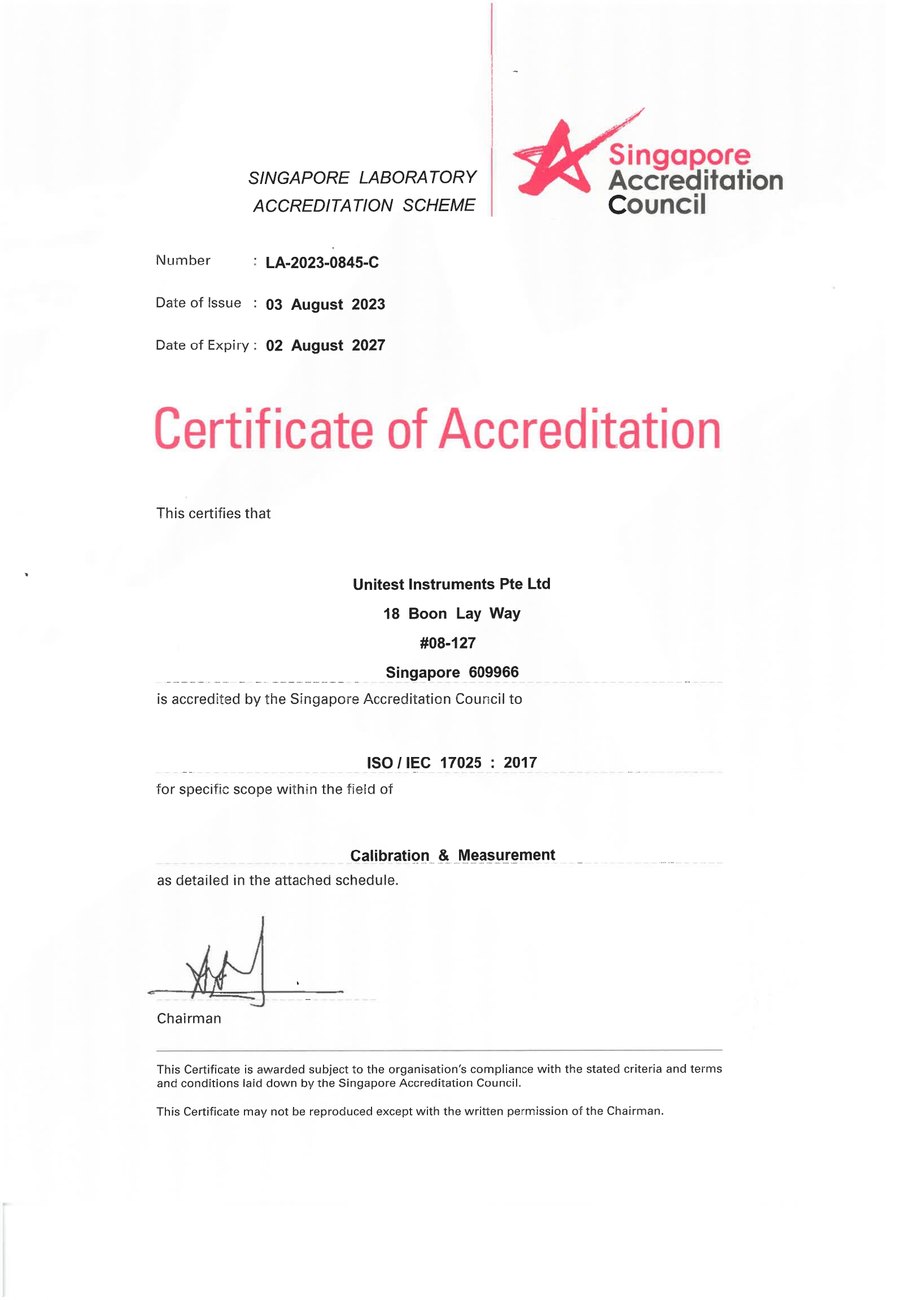
SAC-SINGLAS accredited calibration laboratory (Acc. No. LA-2023-0845-C) serving Singapore's industrial, pharmaceutical, and manufacturing sectors. All content reflects our ISO/IEC 17025 accredited scope and is reviewed by our technical calibration team.
Need gas detector calibration in Singapore?
Unitest Instruments is SAC-SINGLAS accredited (Acc. No. LA-2023-0845-C) to ISO/IEC 17025. We calibrate single-gas and multi-gas detectors from MSA, BW/Honeywell, Dräger, and other leading brands. Same-week turnaround, certificates accepted by ISO 9001 auditors and MOM inspectors.