
Key Takeaways
- The WSH (Confined Spaces) Regulations 2009 are the primary law. Any entry without a valid Entry Permit based on current atmospheric testing is a criminal offence.
- Three gas categories must be tested: oxygen (19.5–23.5% v/v), flammable gases (below 10% LEL), and space-specific toxic gases such as H2S, CO, or NH3.
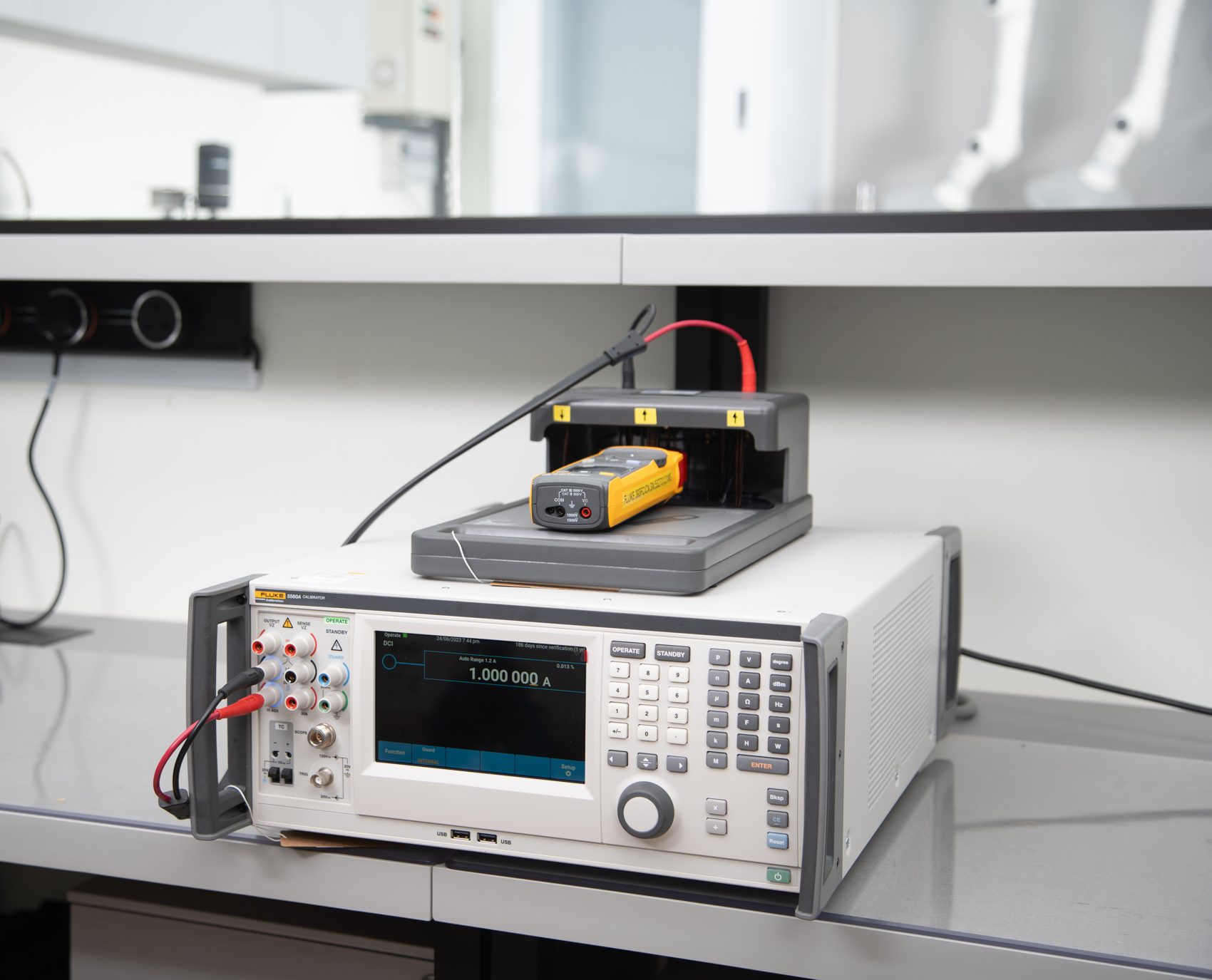
- Gas detectors must be calibrated at least every 6 months (many instruments require quarterly calibration) using traceable reference standards. Bump tests do not substitute for calibration.
- A Confined Space Assessor (CSA) must conduct or oversee all atmospheric testing and issue the Entry Permit; using uncalibrated instruments invalidates the permit.
- PUB, NEA, MPA, and LTA each impose sector-specific requirements that stack on top of MOM's baseline. Facilities managers must satisfy all applicable layers simultaneously.
- Calibration certificates from a SAC-SINGLAS accredited laboratory (Acc. No. LA-2023-0845-C) are accepted by MOM inspectors and ISO 9001 auditors without question.
Why Confined Space Safety Is a Priority Enforcement Area in Singapore
Confined spaces. Tanks, silos, manholes, tunnels, sewers, pits, vaults, and any other enclosed or partially enclosed structure with restricted entry and egress. Account for a disproportionate share of Singapore's workplace fatalities. A significant proportion of these deaths occur not to the initial casualty, but to would-be rescuers who enter without confirming the atmosphere is safe. This pattern of multiple fatalities from a single incident prompted MOM to establish the WSH (Confined Spaces) Regulations 2009 as a standalone regulatory instrument with criminal-level penalties, separate from the general WSH Act duties.
MOM's WSH Council identifies confined space incidents as a persistent high-consequence risk across the marine, construction, utilities, petrochemical, and food manufacturing sectors. Facilities managers in Singapore need to understand that this is not a bureaucratic checkbox exercise. The regulations are actively enforced, prosecutions are publicly reported, and the legal exposure for individuals (not just companies) is real.
The Legal Framework: WSH Act and the Confined Spaces Regulations
The Workplace Safety and Health Act (Cap. 354A) establishes overarching duties for employers, occupiers, principals, and contractors to ensure the safety of workers and others affected by their work. Beneath the Act, the WSH (Confined Spaces) Regulations 2009 provide the specific operational requirements for confined space work. These Regulations define what constitutes a confined space, who may enter, under what conditions, and what documentation must be maintained.
Key obligations under the Regulations include: conducting a risk assessment before any confined space work; appointing a competent Confined Space Assessor (CSA); testing the atmosphere before entry and continuously during occupancy; issuing a written Entry Permit (often called a Confined Space Entry Certificate) for each entry; establishing standby and rescue arrangements; and ensuring all equipment (including gas detection instruments), is in proper working order.
Sector-Specific Overlays
The WSH Regulations are the baseline, but several sector regulators impose additional requirements:
- PUB. The Code of Practice for Sewerage and Sanitary Works requires testing for hydrogen sulphide (H2S) and methane (CH4) in sewer manholes and pump chambers. PUB contractors must follow PUB's Safe Work Procedure for Confined Space Entry in its entirety.
- NEA. Toxic waste or hazardous substance environments may trigger additional atmospheric monitoring obligations under the Environmental Protection and Management Act.
- MPA. Confined space entry on vessels within Singapore port limits falls under the Port Marine Safety Code and MPA's marine safety regulations, which reference international maritime conventions alongside MOM's requirements.
- BCA / LTA. Construction and tunnelling projects involving confined spaces (e.g. MRT tunnels, underground utilities) must comply with BCA's approved codes of practice and LTA's specific safety directives for civil infrastructure works.
- CAAS. Airside facilities at Changi Airport with confined spaces (fuel pits, cable ducts) are subject to CAAS aviation safety oversight in addition to MOM's Regulations.
Mandatory Atmospheric Testing: What Must Be Measured
Before issuing an Entry Permit, the CSA must confirm that the atmosphere within the confined space meets all three of the following criteria:
| Gas / Parameter | Acceptable Range / Limit | Common Source in SG Workplaces | Sensor Technology |
|---|---|---|---|
| Oxygen (O₂) | 19.5% – 23.5% v/v | Biological decomposition, oxidising agents, purging with inert gas | Electrochemical cell |
| Flammable gases (LEL) | < 10% of LEL (entry); < 25% LEL (continuous) | LPG residue, sewer gas (CH4), solvent vapours | Catalytic bead (pellistor) or IR sensor |
| Hydrogen sulphide (H2S) | < 1 ppm TWA (MOM PEL: 1 ppm) | Sewers, marine bilges, food processing waste | Electrochemical cell |
| Carbon monoxide (CO) | < 25 ppm TWA (MOM PEL: 25 ppm) | Engine exhaust, combustion, smouldering materials | Electrochemical cell |
| Ammonia (NH3) | < 25 ppm TWA (MOM PEL: 25 ppm) | Cold storage facilities, fertiliser stores, waste treatment | Electrochemical cell |
| Chlorine (Cl₂) | < 0.5 ppm TWA (MOM PEL: 0.5 ppm) | Water treatment plants, swimming pool plant rooms | Electrochemical cell |
The specific toxic gases to test are determined by the prior use of the space, materials stored or processed within it, and the outcomes of the risk assessment. A manhole in a PUB sewer network will always require H2S and CH4 testing. A confined space in a cold storage warehouse may require NH3 testing. The CSA must make this determination and document the rationale.
Gas Detector Calibration Requirements Under WSH Regulations
The WSH (Confined Spaces) Regulations require that instruments used for atmospheric testing be in proper working order. MOM's guidance and industry codes of practice (including the SS 510 Code of Practice for Safety in Confined Spaces, referenced in the Regulations) specify that instruments must be calibrated and the calibration traceable to national standards. In Singapore, traceability runs through the National Metrology Centre (NMC) at A*STAR, and calibrations performed by SAC-SINGLAS accredited laboratories satisfy this requirement.
Calibration Frequency
There is no single fixed interval mandated in the Regulations, but industry practice (and the expectation of MOM inspectors), is that full calibration is performed at least every 6 months. Instruments used in demanding environments (frequent use, high humidity, exposure to extreme concentrations) should be calibrated quarterly. Each instrument manufacturer also specifies a maximum calibration interval in their documentation, and this must not be exceeded.
For further guidance on how calibration intervals are determined in practice, see our article on how often calibration should be performed and how to set the right interval for your instruments.
Bump Testing vs. Full Calibration
A bump test (functional test) briefly exposes the detector to a small quantity of test gas to confirm that sensors activate and alarms sound. It verifies that the instrument responds, not that it measures accurately. A bump test does not produce a calibration certificate and is not accepted as evidence of calibration by MOM inspectors or ISO 9001 auditors. Both practices are mandatory: bump test before each use, full calibration on the required periodic schedule with a traceable certificate.
Gas Detector Calibration with Traceable Certificates. Accepted by MOM Inspectors
Unitest Instruments calibrates multi-gas detectors, O2 analysers, and toxic gas sensors to traceable standards. Same-week turnaround. Certificates reference SAC-SINGLAS Acc. No. LA-2023-0845-C.
Step-by-Step Compliance Process for Facilities Managers
The following sequence reflects the requirements of the WSH (Confined Spaces) Regulations 2009 and MOM's approved codes of practice. Use this as a compliance checklist for your facilities management programme.
Step 1. Identify and Register All Confined Spaces
Conduct a site survey to identify every confined space on your premises. The WSH Regulations define a confined space as an enclosed or partially enclosed space not designed or intended primarily for human occupancy, with a restricted means of entry or exit, that is, or may become, hazardous. Register each space with a unique identifier, document its prior use, and assign it a risk category. High-risk spaces (those with known hazardous atmospheres or engulfment risk) require more stringent controls.
Step 2. Appoint a Confined Space Assessor (CSA)
Appoint one or more CSAs who hold recognised qualifications (e.g. completion of a MOM-approved Confined Space Assessor training programme). The CSA is legally responsible for assessing hazards, conducting or overseeing atmospheric testing, and issuing Entry Permits. Ensure the CSA's training and appointment are documented and that the appointment letter is retained on file.
Step 3. Procure and Maintain Calibrated Gas Detection Instruments
For most confined spaces in Singapore, a 4-gas multi-gas detector measuring O2, LEL, H2S, and CO is the minimum instrument. Sites with ammonia, chlorine, or other specific hazards require additional sensors. Maintain an instrument register recording: model, serial number, sensor types, last calibration date, next calibration due date, and the issuing laboratory's accreditation number. Never use an instrument past its calibration due date in a confined space entry.
Step 4. Perform Atmospheric Testing and Issue Entry Permit
Before each entry, the CSA must: (a) conduct pre-entry atmospheric testing at multiple levels within the confined space (top, middle, bottom. Gases stratify); (b) confirm that oxygen, LEL, and all relevant toxic gas readings are within acceptable limits; (c) issue a written Entry Permit valid only for the specific entry and work scope; and (d) brief all entrants on the hazards, emergency procedures, and alarm response. The Entry Permit must be displayed at the entry point during the work.
Step 5. Maintain Continuous Monitoring and Standby Arrangements
For confined spaces where atmospheric conditions may change, continuous monitoring using personal gas detectors worn by entrants is required. A trained standby person must remain outside the confined space at all times while workers are inside, maintaining communication and ready to initiate rescue without entering the space. Rescue arrangements (equipment, trained personnel, and emergency contacts), must be established before entry begins.
Step 6. Maintain Records and Conduct Periodic Reviews
Retain Entry Permits for at least 3 years. Maintain gas detector calibration certificates for the life of the instrument plus one audit cycle. Conduct an annual review of your confined space programme, including re-assessment of all registered confined spaces, review of incident and near-miss records, and verification that all instruments are within their calibration validity period. Update the risk assessment whenever there is a change in work activity, materials, or space configuration.
Penalties for Non-Compliance
MOM enforces the WSH (Confined Spaces) Regulations with both regulatory and criminal sanctions. The penalty structure under the WSH Act is among the most stringent in Singapore's industrial safety landscape.
| Offence Category | Individual Penalty (First Offence) | Corporate Penalty | Repeat Offence |
|---|---|---|---|
| Breach of WSH (Confined Spaces) Regulations | Fine up to S$200,000 and/or up to 2 years' imprisonment | Fine up to S$500,000 | Higher fines; possible director liability |
| Failure to conduct atmospheric testing | Prosecution under Regulations + WSH Act general duty | Stop-work order; public enforcement notice | Debarment from government contracts |
| Entry without valid Entry Permit | Fine and/or imprisonment | Corporate fine; increased insurance liability | Licence suspension (for contractors) |
| Fatality or serious injury in confined space | Prosecution under WSH Act s.15/16; potential manslaughter | Full statutory maximum; civil liability | N/A. Each incident treated separately |
MOM publishes enforcement actions on its website, and these can affect a company's ability to bid for government-linked contracts and obtain certain licences. Beyond legal penalties, a confined space fatality carries significant reputational, civil liability, and business continuity consequences. The cost of proper gas detector calibration (typically a few hundred dollars per instrument per year), is trivially small compared to the exposure from non-compliance.
Instrument Selection and Calibration Standards for Singapore Compliance
Not all gas detectors are equal in terms of regulatory acceptance. For WSH compliance in Singapore, instruments must be calibrated using certified reference gases whose concentrations are traceable to national measurement standards. In Singapore, traceability runs through the NMC at A*STAR. Calibration laboratories must be accredited by SAC under the SINGLAS scheme to ISO/IEC 17025 to demonstrate competence in this work.
Understanding what an ISO/IEC 17025 accreditation actually means for your calibration certificate (including what measurement uncertainty figures tell you about your instrument's reliability), is covered in our detailed guide to reading and interpreting a calibration certificate. For gas detection specifically, the calibration certificate should record: the sensor gas type and concentration range tested, the reference gas certificate number and concentration, the as-found and as-left readings, the expanded uncertainty at 95% confidence, and the calibration due date.
Sensor Cross-Sensitivity and Field Errors That Can Mask a Hazard
Electrochemical and catalytic sensors are highly effective, but they are not perfectly selective, and a facilities manager relying purely on a numeric readout without understanding sensor limitations can be lulled into a false sense of security. Cross-sensitivity is the most significant of these limitations: an H2S sensor, for instance, can show a partial response to sulphur dioxide or other reduced sulphur compounds, while a CO sensor can be affected by the presence of hydrogen in some industrial atmospheres. In most confined space applications this cross-sensitivity is a minor contributor to overall reading error, but in specific environments (chemical processing, certain marine tank environments, or spaces where an unusual gas mixture is plausible) it can matter enough that the CSA should understand the sensor's documented cross-sensitivity table, available from the manufacturer, before relying on a borderline reading.
A second and more common field problem is catalytic bead LEL sensor poisoning. Silicone vapours, leaded compounds, and certain sulphur compounds can permanently or temporarily deaden a catalytic bead sensor's response, causing it to under-read a genuinely dangerous flammable atmosphere while still appearing to function normally on a routine bump test with clean calibration gas. This is precisely why calibration alone is not sufficient protection. A sensor poisoned in the field between calibrations can pass a bump test with an inert test gas that does not reveal the poisoning, and the only reliable defence is a documented sensor replacement schedule combined with awareness of which confined space environments carry elevated poisoning risk, such as spaces where silicone sealants, degreasers, or leaded fuel residues are present.
Battery condition is a third, easily overlooked factor. Multi-gas detectors that alarm on low battery mid-entry force an emergency evacuation, and detectors whose battery has degraded without triggering a clear warning can display readings with reduced sensor response time, delaying an alarm just long enough to matter in a rapidly changing atmosphere. Pre-shift checks should always confirm full battery charge, not just a passed bump test.
Building a Confined Space Gas Detection Programme That Survives an Audit
Facilities teams that pass MOM inspections and ISO 9001 audits comfortably tend to share a common structural feature: their gas detection programme treats calibration, bump testing, and sensor lifecycle management as three distinct, separately documented disciplines rather than one blurred activity. A defensible instrument file for each detector should contain the full calibration certificate history (not just the most recent one, since inspectors and auditors sometimes want to see the trend of as-found readings over time to judge sensor drift), a daily or pre-shift bump test log with pass/fail results and the technician's initials, and a sensor replacement record noting installation date and expected end-of-life, since electrochemical sensors typically have a rated life of one to two years regardless of calibration performance and will eventually fail even when calibration continues to show them within tolerance up to the point of failure. Cross-referencing the bump test log against the calibration certificate dates is a simple check that catches the single most common documentation gap MOM inspectors report: instruments that were bump-tested faithfully every day but whose full calibration had quietly lapsed months earlier because the renewal reminder was missed. Building the calibration due date into the same equipment register used for planned maintenance, rather than a separate spreadsheet only the safety officer checks, removes the single point of failure that causes most confined space calibration lapses in practice.
Frequently Asked Questions
Confined space gas detection in Singapore is governed primarily by the Workplace Safety and Health (Confined Spaces) Regulations 2009, made under the Workplace Safety and Health Act (Cap. 354A). These regulations require that atmospheric testing for oxygen level, flammable gases, and toxic contaminants be conducted before any worker enters a confined space, and that continuous monitoring be maintained during work. The Factories (Safety Officers) Regulations and sector-specific codes from MOM's WSH Council provide additional guidance.
Under the WSH (Confined Spaces) Regulations 2009, atmospheric testing must cover three categories: (1) oxygen concentration (acceptable range is 19.5% to 23.5% v/v; (2) flammable gases and vapours), must be below 10% of the Lower Explosive Limit (LEL); and (3) toxic contaminants specific to the confined space, such as hydrogen sulphide (H2S), carbon monoxide (CO), or ammonia, evaluated against their respective Permissible Exposure Limits (PELs) set by MOM. The specific toxic gases to test depend on prior use of the space and materials present.
MOM's WSH (Confined Spaces) Regulations require that instruments used for atmospheric testing be in proper working order and calibrated. Industry best practice (and most manufacturers' specifications), mandate bump testing before each use and full calibration at least every 6 months, with some instruments requiring quarterly calibration depending on usage intensity and environmental exposure. For compliance audit purposes, calibration must be traceable to national standards. SAC-SINGLAS accredited laboratories like Unitest Instruments provide the traceable calibration certificates that satisfy MOM and ISO 9001 auditor requirements.
A Confined Space Assessor (CSA) is an individual appointed under the WSH (Confined Spaces) Regulations 2009 who has the relevant competency to assess hazards and certify that a confined space is safe for entry. The CSA must conduct or oversee the atmospheric testing, issue an Entry Permit (also called a Confined Space Entry Certificate), ensure that gas detection instruments are functional and calibrated, and establish rescue arrangements. The CSA must hold a recognised qualification such as the Confined Space Assessor course approved by the WSH Council.
Under the Workplace Safety and Health Act, penalties for confined space violations are substantial. An individual found guilty of breaching the WSH (Confined Spaces) Regulations 2009 can face fines of up to S$200,000 and/or up to 2 years' imprisonment for a first offence, with higher penalties for repeat offences. Corporate entities face fines of up to S$500,000. Where a fatality or serious injury occurs, MOM may also issue stop-work orders, pursue prosecution under the WSH Act's general duties, and publish enforcement actions. MOM publishes confirmed enforcement actions publicly, and these can affect business reputation and tendering eligibility.
Yes. While the WSH (Confined Spaces) Regulations 2009 under MOM form the baseline, sector regulators impose additional obligations. PUB's Code of Practice for Sewerage and Sanitary Works requires H2S and CH4 monitoring in sewer manholes. NEA requirements apply when toxic or hazardous substances are involved in environmental management contexts. MPA's Port Marine Safety Code and associated procedures govern confined space entry on vessels in Singapore waters. Contractors working in MRT tunnels or critical infrastructure must additionally comply with LTA's safety directives. Each layer of regulation must be satisfied simultaneously. MOM's Regulations are the floor, not the ceiling.
A bump test (or functional test) briefly exposes a gas detector to a known concentration of test gas to verify that the sensors and alarms respond correctly. It does not measure sensor accuracy or provide traceable measurement data. It only confirms the instrument "reacts." Calibration, on the other hand, uses certified reference gas of known concentration to adjust sensor output to a verified standard and generates a dated calibration certificate with measurement uncertainty data. A bump test is not a substitute for calibration and is not accepted as evidence of calibration by MOM inspectors or ISO 9001 auditors. Both are required: bump test before each confined space entry, full calibration on the required periodic schedule.
The WSH (Confined Spaces) Regulations 2009 require employers and occupiers to maintain Entry Permits (Confined Space Entry Certificates) for at least 3 years. Gas detector calibration certificates should be retained for the working life of the instrument plus one audit cycle, or at minimum 3 years. Records should include: the instrument model and serial number, the calibration date and due date, the laboratory's accreditation number (e.g. SAC-SINGLAS LA-2023-0845-C), the reference gas certificate details, and the technician's signature. MOM inspectors and ISO 9001 auditors routinely request these records during site inspections.
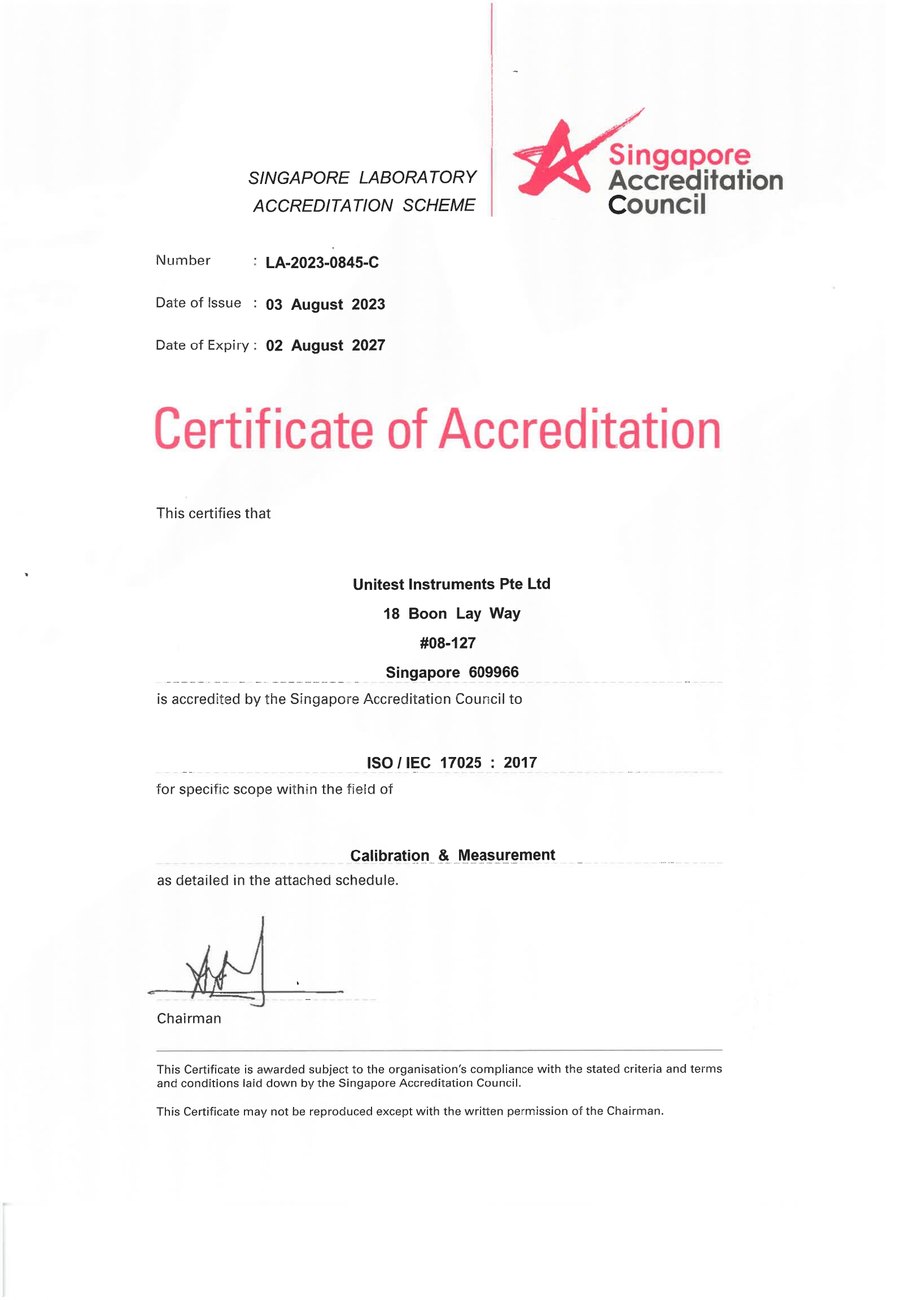
SAC-SINGLAS accredited calibration laboratory (Acc. No. LA-2023-0845-C) serving Singapore's industrial, pharmaceutical, and manufacturing sectors. All content reflects our ISO/IEC 17025 accredited scope and is reviewed by our technical calibration team.
Need gas detector calibration in Singapore?
Unitest Instruments is SAC-SINGLAS accredited (Acc. No. LA-2023-0845-C) to ISO/IEC 17025. Same-week turnaround, certificates accepted by MOM inspectors and ISO 9001 auditors.