
Key Takeaways
- Bump tests confirm sensor response; full calibration verifies measurement accuracy against a traceable reference. Both are legally required in confined space work.
- MOM-aligned Safe Work Procedures require full gas detector calibration at least every 12 months; manufacturers often specify 6-month intervals for harsh environments.
- Any gas detector that fails a bump test must be immediately removed from service and fully recalibrated before reuse.
- A valid calibration certificate must state measurement uncertainty, reference gas concentrations, and traceability to NMC Singapore. Certificates without these details may not satisfy ISO 9001 or MOM auditors.
- Using a SAC-SINGLAS accredited laboratory (Acc. No. LA-2023-0845-C) removes ambiguity during post-incident investigations and regulatory audits.
What Happens During Gas Detector Calibration?
A full laboratory calibration of a gas detector is a structured, multi-step procedure performed by trained metrologists using certified reference gas standards. At Unitest Instruments (SAC-SINGLAS Acc. No. LA-2023-0845-C), the process for a typical four-gas detector (O2, LEL, CO, H2S) proceeds as follows:
- Instrument intake and inspection. The detector is logged, its make, model, and serial number recorded, and its physical condition noted. Any visible sensor damage or contamination is flagged before calibration begins.
- Zero calibration. Each sensor channel is exposed to clean, dry air (or nitrogen for O2 sensors) and zeroed. This establishes the baseline against which gas concentration readings are measured.
- Span calibration. Each channel is exposed to a certified reference gas cylinder of known concentration traceable to NMC Singapore (or NIST/NPL via mutual recognition). The instrument's span is adjusted until its reading matches the certified value within the manufacturer's specified tolerance.
- Response time verification. The time taken for each sensor to reach 90% of the final reading (T90) is measured and compared against the manufacturer's specification.
- Alarm set-point confirmation. Low and high alarm thresholds are verified to activate at the correct concentrations. For H2S, for example, the low alarm is typically set at 5 ppm and the high alarm at 10 ppm per Singapore's WSH guidelines.
- Certificate issuance. A calibration certificate is issued recording pre- and post-adjustment readings, reference gas concentrations and their uncertainties, expanded measurement uncertainty for each channel, calibration date, due date, and the accreditation number LA-2023-0845-C.
The measurements made during calibration depend on the gases the detector is designed to monitor. For oxygen sensors, the measurement is percentage volume (% v/v). For combustible gases, it is percentage of the Lower Explosive Limit (% LEL). For toxic gases such as CO and H2S, it is parts per million (ppm). Each measurement channel requires its own reference standard, and measurement uncertainty is calculated and stated separately for each.
Bump Testing: What It Is and What It Is Not
A bump test (sometimes called a functional test or challenge test), is a rapid on-site procedure that confirms the gas detector's sensors are responsive and its alarms are functional. It does not verify measurement accuracy and does not produce a calibration certificate. Think of it as the difference between checking that a fire alarm beeps when you press the test button versus having a qualified engineer verify that the detector reliably triggers at the correct smoke density.
In practice, a bump test involves briefly exposing the detector to a challenge gas concentration above the alarm set-point (typically from a small cylinder of calibration gas), and confirming that the sensor reading rises and the alarm activates within the manufacturer's specified response time. The entire procedure typically takes under two minutes. Most modern multi-gas detectors support automatic bump testing via a docking station, which records the result electronically.
Under Singapore's WSH (Confined Spaces) Regulations 2009, gas detectors used for atmospheric testing must be tested before each use. In practice, this means a bump test before every confined space entry. The results (pass or fail, reference gas used, date and time), should be logged in the site's safety management records.
Singapore Regulatory Context: What MOM and WSH Require
The primary legislative instrument governing gas detection in confined spaces in Singapore is the Workplace Safety and Health (Confined Spaces) Regulations 2009, made under the Workplace Safety and Health Act (Cap. 354A). Regulation 11 requires that before any worker enters a confined space, a competent person must carry out atmospheric testing to determine whether the atmosphere is safe. The competent person must use instruments that are in good working order and appropriate for the purpose.
The WSH Council's Code of Practice for Working Safely in Confined Spaces provides additional guidance, specifying that gas detectors must be calibrated and maintained in accordance with the manufacturer's recommendations and that calibration records must be kept. The Code also references the requirement for traceability, that is, the calibration must be linked through an unbroken chain of comparisons to a national or international measurement standard.
Beyond confined spaces, gas detectors are also governed under the WSH (General Provisions) Regulations in any workplace where flammable or toxic atmospheres may be present. Including petrochemical plants, shipyards, pharmaceutical manufacturing facilities, and wastewater treatment works. The Fire Safety Act and SCDF requirements additionally mandate that gas detection systems in certain classes of premises be maintained under documented inspection and calibration programmes.
For industries operating under ISO 9001 quality management systems, the requirement is even more explicit: Clause 7.1.5 of ISO 9001:2015 requires that monitoring and measuring equipment be calibrated or verified at specified intervals, with calibration traceable to international or national measurement standards, and that calibration status be documented. A SAC-SINGLAS accredited certificate (Acc. No. LA-2023-0845-C) satisfies this requirement directly.
Book Gas Detector Calibration with Singapore's Accredited Lab
Unitest Instruments (Acc. No. LA-2023-0845-C) calibrates multi-gas detectors for O2, LEL, CO, H2S, and specialty toxic gases. Certificates are accepted by MOM auditors, ISO 9001 auditors, and major EPC contractors operating in Singapore.
Field Calibration vs. Laboratory Calibration: Which Do You Need?
Gas detector calibration can be performed either in the field (using portable calibration gas cylinders and a flow adaptor), or in an accredited laboratory under controlled conditions. Both have a legitimate role, but they are not equivalent, and the choice has significant implications for regulatory compliance and evidentiary weight.
| Factor | Field Calibration | Laboratory Calibration (SAC-SINGLAS Accredited) |
|---|---|---|
| Controlled environment | No. Temperature, humidity, and pressure vary on-site | Yes. Laboratory conditions are controlled and recorded |
| Measurement uncertainty stated | Rarely. Most field calibration reports do not include uncertainty budgets | Yes. Mandatory under ISO/IEC 17025 for accredited scope |
| Traceability to NMC Singapore | Conditional. Only if the field reference gas has a valid, traceable CoA | Yes. Direct traceability through the laboratory's reference standards |
| Certificate accepted by ISO 9001 auditors | Often not, iso 9001 Clause 7.1.5 typically requires accredited calibration | Yes. Accredited certificate satisfies ISO 9001 requirements |
| MOM/WSH audit defensibility | Lower. May be questioned on competence and traceability | Higher. Accreditation number (LA-2023-0845-C) provides clear evidence |
| Sensor fault detection | Limited. Technician may not have diagnostic equipment | Full. Lab technicians can identify degraded sensors, cross-sensitivity issues |
| Typical turnaround | Same day (but often undocumented) | 1–2 business days at Unitest Instruments |
| Best suited for | Routine span checks between scheduled lab calibrations | Scheduled periodic calibration, post-incident recalibration, ISO/MOM compliance |
The industry best practice in Singapore is to use laboratory calibration for all scheduled periodic calibrations and to supplement this with in-house bump tests before each use. This approach provides the highest level of regulatory defensibility while keeping day-to-day operational friction low. For a deeper discussion of when accredited calibration is mandatory versus recommended, see our article on accredited vs. non-accredited calibration in Singapore.
Reference Standards and Traceability in Gas Detector Calibration
The accuracy of any gas detector calibration is only as good as the reference gas standards used. At Unitest Instruments (SAC-SINGLAS Acc. No. LA-2023-0845-C), all reference gas mixtures are sourced from accredited gas suppliers holding primary or secondary standard cylinders traceable to NMC Singapore, NIST (USA), or NPL (UK). All signatories to the CIPM Mutual Recognition Arrangement (MRA). This unbroken chain of comparisons from the instrument under calibration back to a national metrology institute is what is meant by metrological traceability.
For gas detector calibration, traceability means the reference cylinder contains gas at a certified concentration (for example, 25 ppm H2S in nitrogen ± 2% relative), and this certificate was itself verified against a primary standard. When we calibrate your detector to this reference, your certificate inherits that traceability. If the gas in a confined space reads 8 ppm H2S on your calibrated instrument, you can be confident that value is defensible, not merely plausible.
Understanding traceability is essential for any organisation operating gas detectors under a documented safety management system. For a plain-English explanation of the concept and its practical implications, our article on what traceability means in calibration covers the topic in full detail.
Calibration Intervals: How Often Should Gas Detectors Be Calibrated?
The question of calibration frequency is one of the most common points of confusion in Singapore workplaces. There is no single regulatory prescription for gas detector calibration interval. Instead, the WSH framework refers to manufacturer recommendations and good engineering practice. In practice, the following conventions apply across Singapore's industrial sectors:
- Minimum annual calibration. Most MOM-aligned Safe Work Procedures and contractor quality plans specify a 12-month maximum interval between full laboratory calibrations for gas detectors in normal service.
- Six-monthly calibration for harsh environments. Instruments used in petrochemical plants, offshore, or environments with high humidity, temperature extremes, or chemical contamination are typically calibrated every six months, in line with manufacturer guidance from brands such as Industrial Scientific, Honeywell BW, Dräger, and MSA.
- After any incident or suspected exposure. Any detector that was exposed to gas concentrations above its measurement range, suffered a physical impact, or returned an unexplained reading must be fully recalibrated before returning to service.
- After sensor replacement. A new sensor must be calibrated before use; it cannot be assumed factory-accurate.
- After storage exceeding 30 days. Electrochemical sensors can drift during extended storage. Instruments taken out of long-term storage should be bump-tested and, if the sensor has been stored for more than 90 days, fully recalibrated.
For a detailed framework on setting calibration intervals for your entire instrument fleet (not just gas detectors), see our article on how to determine the right calibration interval.
What a Proper Gas Detector Calibration Certificate Must Show
A calibration certificate is a legal document. In the event of a workplace incident involving a gas detection failure, the calibration certificate will be one of the first documents MOM investigators request. A certificate that is incomplete, non-traceable, or issued by an unaccredited party may offer no protection, and may in fact demonstrate non-compliance.
Under ISO/IEC 17025:2017 (the international standard for calibration laboratory competence), and as required for SAC-SINGLAS accreditation, a calibration certificate must include all of the following:
- Laboratory name, address, and SAC-SINGLAS accreditation number (for Unitest Instruments: LA-2023-0845-C)
- Unique certificate identification number and date of issue
- Customer name and instrument identification (make, model, serial number, asset tag if applicable)
- Calibration date and the date by which the next calibration is due
- Description of the calibration method used and reference standards applied
- Calibration results. Pre-adjustment readings, post-adjustment readings, and the reference value for each gas channel
- Measurement uncertainty for each channel, expressed as expanded uncertainty with a stated coverage factor (typically k=2 for 95% confidence)
- A statement of traceability to national or international measurement standards
- Name and signature of the authorised signatory
- A statement that the certificate must not be reproduced without written approval from the laboratory
If a certificate you hold is missing measurement uncertainty values, has no accreditation number, or provides only a "pass/fail" result without numerical data, it does not meet the ISO/IEC 17025 standard. For a full guide on reading and evaluating calibration certificates, see our article on what a calibration certificate should contain and how to read it.
Purchasing Gas Detectors in Singapore
If your organisation is sourcing new gas detectors or replacement sensors, it is worth noting that the instrument you purchase will need to be compatible with standard calibration gas mixtures available in Singapore. Multi-gas detectors covering O2, LEL, CO, and H2S are the baseline standard for confined space work. Instruments with additional channels for NH3, SO2, Cl2, or process-specific gases require specialty calibration gases that should be confirmed available before purchase.
Unitest Instruments supplies a range of gas detection instruments through unitestshop.com, and our calibration laboratory is already familiar with the calibration requirements for all instruments we stock. Meaning you can purchase and calibrate from a single, SAC-SINGLAS accredited source. This simplifies documentation, reduces the risk of instrument-laboratory incompatibility, and ensures your new instrument enters service with a calibration certificate that is immediately compliant.
Frequently Asked Questions
A bump test (or functional test) is a quick check that confirms the gas detector's sensors respond to target gas and that the alarm triggers correctly. It typically takes less than two minutes and is performed before each use. A full calibration, by contrast, adjusts the detector's output to match a traceable reference gas standard, verifies accuracy across the measurement range, and produces a calibration certificate with measurement uncertainty. Bump tests confirm the instrument works; calibrations confirm how accurately it measures. Both are required under Singapore's WSH framework. Bump tests before each confined space entry, and full calibrations at intervals specified by the manufacturer or at least annually.
The Workplace Safety and Health (Confined Spaces) Regulations 2009 require that gas detectors used for atmospheric testing in confined spaces be maintained and tested in accordance with the manufacturer's recommendations and good engineering practice. In practice, MOM-aligned Safe Work Procedures set a minimum full calibration interval of 12 months, though many manufacturers specify 6-month intervals for instruments used in harsh environments. Instruments that fail a bump test must be removed from service and fully recalibrated before reuse, regardless of when the last scheduled calibration was performed.
While MOM's WSH framework does not mandate calibration exclusively by a SAC-SINGLAS accredited laboratory, it does require results to be traceable to national measurement standards and calibration to be performed by a competent party. In practice, ISO 9001, BIZSSAFE Level 3+, and many major project specifications require calibration certificates from SAC-SINGLAS ISO/IEC 17025 accredited laboratories. Using an accredited lab such as Unitest Instruments (Acc. No. LA-2023-0845-C) provides legally defensible evidence of traceability and removes ambiguity during MOM audits or post-incident investigations.
Under the WSH (Confined Spaces) Regulations 2009, before any worker enters a confined space, the atmosphere must be tested for: (1) oxygen content (safe range 19.5%–23.5% v/v), (2) flammable gases and vapours (must be below 10% of the Lower Explosive Limit), and (3) toxic gases relevant to the work environment. Commonly carbon monoxide (CO), hydrogen sulphide (H2S), and any process-specific hazards. Multi-gas detectors covering O2, LEL, CO, and H2S are standard for most confined space entries in Singapore's petrochemical, construction, and marine sectors.
A calibration certificate issued by a SAC-SINGLAS accredited laboratory (such as Unitest Instruments, Acc. No. LA-2023-0845-C) must include: the instrument make, model, and serial number; calibration date and due date; reference gas concentrations used; measured readings before and after adjustment; measurement uncertainty for each gas channel; a statement of traceability to NMC Singapore; the calibrating laboratory's accreditation number; and the authorised signatory's name and signature. A certificate missing any of these elements may not satisfy MOM auditor or ISO 9001 auditor requirements.
At Unitest Instruments, standard gas detector calibration (multi-gas, up to four channels) is typically completed within 1–2 business days, with same-day or next-day turnaround available for urgent requirements. The process includes sensor response time verification, zero and span calibration for each gas channel using certified reference gas standards, alarm set-point confirmation, and certificate issuance. Instruments requiring sensor replacement or fault investigation may take longer; our team will advise lead times before work commences.
Bump tests can be performed in-house by a trained and competent worker using manufacturer-approved calibration gas and a docking station or manual flow adapter. The key requirements are that the reference gas used has a valid certificate of analysis traceable to national standards, the test procedure follows the manufacturer's specification, and results are recorded in a logbook or electronic system. Full calibrations that generate an accredited certificate, however, must be performed by a laboratory with the appropriate competence. Ideally one accredited to ISO/IEC 17025 such as Unitest Instruments.
If a gas detector fails a bump test. Meaning a sensor does not respond within the manufacturer's response time threshold or the alarm does not trigger at the correct concentration. The instrument must be immediately withdrawn from service. Under Singapore's WSH framework, no confined space entry should proceed with an instrument of unknown or compromised reliability. The detector should be sent for full laboratory calibration and inspection. If sensors are found to be degraded, they must be replaced and the instrument recalibrated before returning to service. All failed bump tests and corrective actions should be documented as part of the site's safety management system.
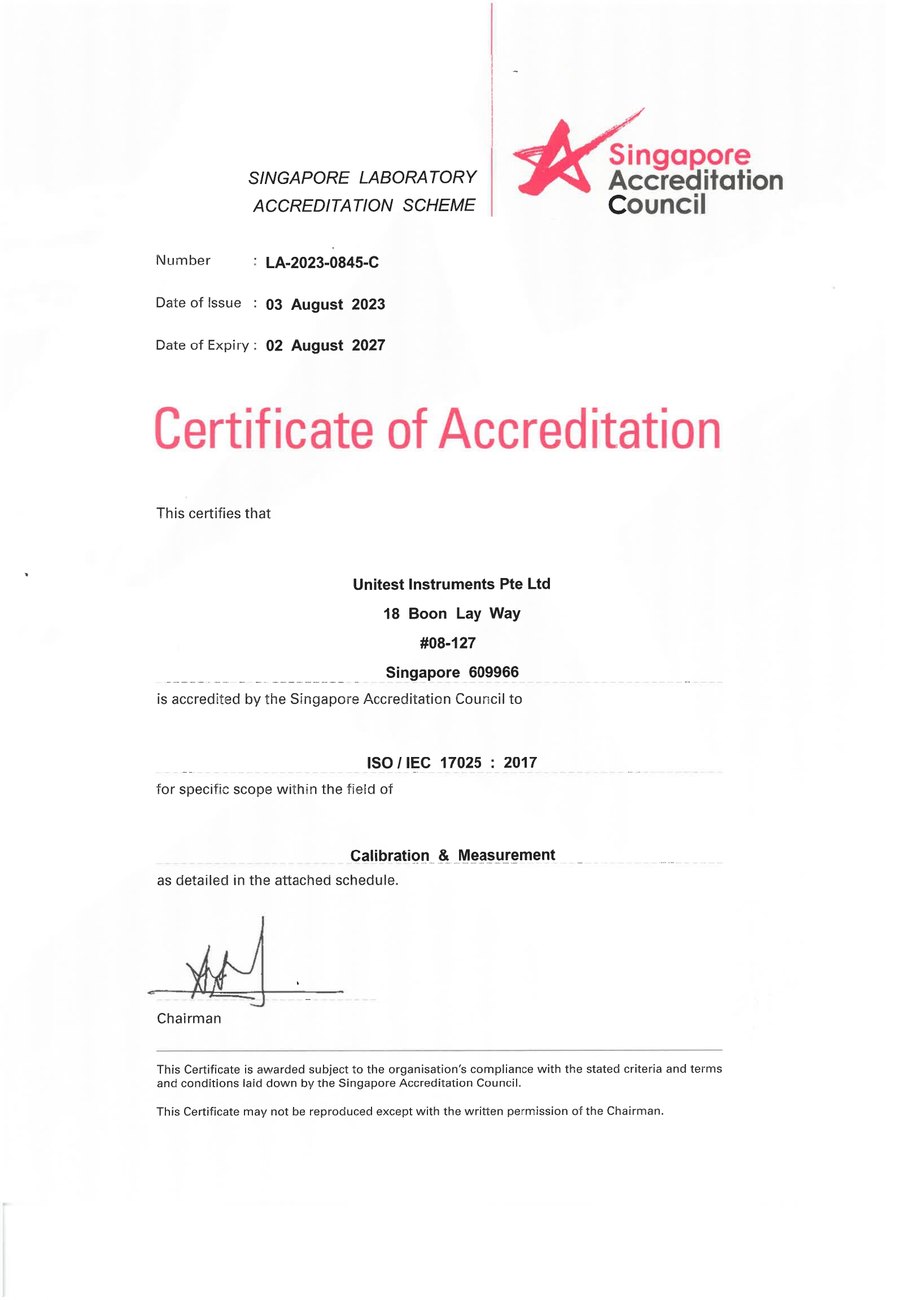
SAC-SINGLAS accredited calibration laboratory (Acc. No. LA-2023-0845-C) serving Singapore's industrial, pharmaceutical, and manufacturing sectors. All content reflects our ISO/IEC 17025 accredited scope and is reviewed by our technical calibration team.
Need gas detector calibration in Singapore?
Unitest Instruments is SAC-SINGLAS accredited (Acc. No. LA-2023-0845-C) to ISO/IEC 17025. Same-week turnaround, certificates accepted by ISO 9001 auditors and MOM inspectors.