
Key Takeaways
- Four main sensor types serve distinct applications: electrochemical (toxic gases), catalytic bead/NDIR (combustibles/LEL), and PID (VOCs). No single sensor covers all hazards.
- A bump test verifies sensor response and alarm activation; it does not replace a full calibration, which adjusts the instrument's output against a traceable reference gas.
- Singapore's WSH (Confined Spaces) Regulations 2009 require gas monitoring before and during confined-space entry. Non-compliance carries criminal liability for the responsible manager.
- Multi-gas detectors (4-gas: O₂, LEL, CO, H₂S) are the minimum standard for most Singapore industrial confined-space entry teams and offshore support vessels.
- ATEX/IECEx certification is mandatory for detectors used in classified hazardous zones (Zone 0, 1, or 2) across petrochemical, semiconductor, and specialty-gas facilities.
- Calibration by a SAC-SINGLAS accredited lab (Acc. No. LA-2023-0845-C) produces internationally traceable certificates aligned with ISO 45001 and MOM audit requirements.
Who Needs a Gas Detector, and Why It Matters in Singapore
Gas detectors are not optional equipment for most Singapore industrial operators. The Workplace Safety and Health Act (Cap. 354A) and its subsidiary Confined Spaces Regulations 2009 impose a positive duty on employers to monitor atmospheric hazards before workers enter any confined space. A category that covers tanks, pits, sewers, tunnels, hoppers, and any other enclosed work area with restricted entry and exit.
Beyond confined-space work, Singapore's petrochemical hub on Jurong Island, the city's extensive semiconductor and specialty-gas fabrication plants, wastewater treatment facilities, and cold-chain food processing sites all operate under continuous gas monitoring requirements driven by MOM regulations, insurance conditions, and international safety management standards such as ISO 45001 and OHSAS 18001.
The practical challenge is that gas detectors are not commodity items. An instrument bought for H₂S monitoring in a refinery will not reliably detect a methane leak from a gas pipeline, and a handheld PID survey meter cannot substitute for a fixed pellistor-based LEL detector in a Zone 1 classified area. Choosing the wrong sensor technology is not just a compliance failure. It is a genuine life-safety risk.
The Four Core Sensor Technologies Compared
Understanding sensor technology is the foundation of every gas detector purchase decision. Each sensing principle has distinct strengths, limitations, and maintenance requirements that directly affect running costs and reliability in Singapore's tropical operating environment.
Electrochemical (EC) Sensors
Electrochemical sensors generate a small electrical current proportional to gas concentration through an oxidation or reduction reaction at an electrode surface. They are the dominant technology for measuring toxic gases at low ppm levels. Hydrogen sulphide (H₂S), carbon monoxide (CO), nitrogen dioxide (NO₂), sulphur dioxide (SO₂), chlorine (Cl₂), and oxygen (O₂) deficiency/enrichment. EC sensors offer high sensitivity, reasonable selectivity, and a relatively fast T90 response (typically 15–40 seconds). Their main limitations are finite sensor life (typically 2–3 years), sensitivity to cross-interfering gases, and performance degradation in very high humidity or temperature extremes.
Catalytic Bead (Pellistor) Sensors
Catalytic bead sensors measure combustible gas by burning a small amount of gas on a platinum-wire catalyst bead and detecting the resulting temperature rise as a resistance change. They cover 0–100% LEL for a wide range of flammable gases and vapours, making them the workhorse of fixed and portable gas monitoring in petrochemical and general industrial settings. The critical weakness is catalyst poisoning: exposure to silicone vapours, lead compounds, halogenated solvents, or sulphur compounds permanently destroys sensor sensitivity. In Singapore's diverse industrial mix (where silicone sealants and halon-substitute fire suppressants are common), bump-testing before every confined-space entry is essential to catch poisoned sensors before they fail silently.
Non-Dispersive Infrared (NDIR) Sensors
NDIR sensors measure gas concentration by comparing the absorption of infrared light at a gas-specific wavelength to a reference channel. They are immune to catalyst poisoning, making them far more reliable for long-term fixed monitoring of methane, carbon dioxide, and other IR-active gases. NDIR sensors are the preferred choice for permanent installations in Singapore's LNG terminal support facilities, biogas plants, and refrigerant-gas monitor networks. They do not require oxygen to function (unlike catalytic beads), making them suitable for oxygen-depleted atmospheres. Trade-offs include higher unit cost and inability to detect gases with no IR absorption (such as hydrogen and noble gases).
Photoionisation Detectors (PID)
PID sensors use ultraviolet light to ionise gas molecules, measuring the resulting ion current as a proxy for concentration. They are exceptionally sensitive to volatile organic compounds (VOCs) (benzene, toluene, xylene, styrene, methylene chloride), at sub-ppm levels, making them indispensable for industrial hygiene surveys, tank cleaning inspections, and environmental remediation assessments. PIDs cannot detect methane, ethane, or other alkane hydrocarbons with ionisation energies above the lamp's photon energy. For VOC screening surveys in Singapore's electronics manufacturing, paint finishing, and chemical warehousing sectors, a PID-equipped multi-gas detector provides the most actionable data.
| Sensor Type | Best For | Cannot Detect | Typical Life | Poisoning Risk |
|---|---|---|---|---|
| Electrochemical | Toxic gases: H₂S, CO, NO₂, SO₂, O₂ | Most hydrocarbons at LEL | 2–3 years | Low–moderate |
| Catalytic Bead | Flammable gases 0–100% LEL | Oxygen-deficient atmospheres | 2–5 years | High (Si, Pb, halogens) |
| NDIR | CH₄, CO₂, hydrocarbons (fixed) | H₂, noble gases, many toxics | 5–10 years | Very low |
| PID | VOC survey: benzene, toluene, xylene | CH₄, ethane, H₂, O₂ deficiency | 1–2 years (lamp) | Low (humidity affects lamp) |
Top Gas Detector Models Available Through Unitest
Unitest distributes instruments from a portfolio of internationally recognised brands including Fluke, Comark, Amprobe, and specialist gas-measurement manufacturers. The following models represent the most commonly specified instruments for Singapore industrial applications, from basic confined-space entry kits to advanced multi-parameter survey meters.
| Model | Key Specifications | Price Range (SGD) | Best For | Shop |
|---|---|---|---|---|
| 4-Gas Multi Detector (Standard) | O₂, LEL (catalytic), CO, H₂S; ATEX/IECEx Zone 1; IP67; pump or diffusion | S$650–950 | Confined-space entry, general industrial | View on Unitest Shop |
| Single-Gas Clip (CO) | Electrochemical CO; 0–999 ppm; 2-year sealed unit; vibration + audible alarm | S$120–220 | Boiler rooms, underground car parks, maintenance teams | View on Unitest Shop |
| VOC/PID Survey Meter | 10.6 eV lamp; 0.1–4000 ppm isobutylene equivalent; data-logging; BLE | S$1,800–2,800 | Industrial hygiene, tank inspection, environmental remediation | View on Unitest Shop |
| Fixed NDIR Methane Detector | 0–100% LEL CH₄; 4–20 mA output; 316SS weatherproof housing; -40°C to +65°C | S$900–1,600 | Permanent installation: gas meters, LNG support, boiler plant | View on Unitest Shop |
| 5-Gas Detector with PID | O₂, LEL (NDIR), CO, H₂S + PID (10.6 eV); IP68; motorised pump; 12-hour battery | S$2,400–3,600 | Offshore, petrochemical, semiconductor maintenance | View on Unitest Shop |
Need your gas detectors calibrated with traceable certificates?
Unitest Instruments (Acc. No. LA-2023-0845-C) calibrates gas detection instruments against certified reference gases, issuing ISO/IEC 17025 traceable certificates accepted by MOM inspectors and ISO 45001 auditors. Same-week turnaround available.
Bump Testing: What It Is, What It Isn't, and How Often
A bump test (also called a functional test or challenge test) exposes the gas detector to a known concentration of target gas from a certified test-gas cylinder, verifying that the sensor responds above its alarm threshold and that all alarms (audible, visual, and vibration), activate correctly. It does not replace calibration, but it is the frontline defence against undetected sensor failure in service.
The recommended frequency for bump testing is before every use. This is the position of both the major detector manufacturers (including Industrial Scientific, MSA, Honeywell, and Dräger) and Singapore's MOM WSH guidelines for high-hazard confined-space entry. In practice, many Singapore facilities bump-test each instrument at the start of every shift, using pre-mixed certified test-gas cylinders stored at ambient temperature (typically 23°C ± 5°C) to avoid concentration drift from extreme storage temperatures.
Bump Test Pass Criteria
The instrument passes a bump test when its reading reaches at least 80% of the known gas cylinder concentration (some manufacturers specify ±10% or ±15% of span) and all alarm setpoints trigger within the manufacturer's specified response time. If the reading falls below the pass threshold, the sensor may be depleted, poisoned, or damaged, and the instrument must be taken out of service and submitted for full calibration and sensor replacement before re-use. As discussed in our guide on calibration intervals and how often instruments should be calibrated, the bump-test result is itself a leading indicator that can help you tune your calibration frequency to actual sensor degradation rate rather than a fixed calendar schedule.
Test Gas Cylinder Management
Certified test-gas cylinders have a shelf life (typically 12–24 months from fill date) and should be stored vertically in a well-ventilated, temperature-stable location away from direct sunlight. In Singapore's climate, avoid storing cylinders in outdoor equipment lockers that can reach 50°C+ during afternoon sun. High temperature increases cylinder pressure and can accelerate gas decomposition, especially for H₂S and reactive gas mixes. Record the cylinder certificate number, fill date, expiry date, and concentration on the bump-test log alongside each instrument's serial number and test result.
Calibration Requirements: What Singapore Regulations Actually Require
Singapore's WSH Act does not prescribe a specific calibration interval for gas detectors in the same explicit way that it does for, say, pressure vessels or lifting equipment. However, MOM's guidance documents and the code of practice for confined-space entry state that gas monitoring equipment must be "maintained in good working order," which in practice means documented calibration at intervals consistent with manufacturer recommendations and the instrument's service environment.
For instruments used as statutory evidence (in accident investigations, permit-to-work systems, or regulatory submissions), calibration by a SAC-SINGLAS accredited laboratory is the only defensible approach. The accreditation framework, governed by the Singapore Accreditation Council, requires laboratories to demonstrate measurement traceability to national measurement standards (NMC Singapore), maintain documented uncertainty budgets, and participate in proficiency testing. This is precisely what distinguishes an accredited certificate from a manufacturer's in-house service certificate. You can read more about the legal and practical distinctions in our article on accredited vs. non-accredited calibration.
Unitest Instruments (SAC-SINGLAS Acc. No. LA-2023-0845-C) calibrates gas detectors against certified reference gas mixtures traceable to national standards, covering electrochemical sensor response, LEL sensor linearity, and PID lamp calibration checks. Calibration certificates issued by our laboratory are accepted by MOM inspectors, ISO 9001 third-party auditors, and major oil-and-gas operator HSE management systems operating in Singapore.
Singapore-Specific Applications and Relevant Standards
Singapore's industrial mix creates a specific set of gas hazard scenarios that shape instrument selection. Understanding which standard governs your industry helps you choose an instrument with the right certification and documentation trail.
Confined-Space Entry (All Industries)
WSH (Confined Spaces) Regulations 2009 mandates atmospheric testing before entry and continuous monitoring during entry for oxygen, flammable gas (LEL), and toxic gases relevant to the space. A 4-gas multi-detector (O₂, LEL, CO, H₂S) is the universal minimum. For sewage, biogas, and wastewater confined spaces, add SO₂ and/or NH₃ channels depending on the specific process. Instruments must be bump-tested before each entry session and calibration records must be available on request.
Jurong Island Petrochemical and Chemical Plants
Operators on Jurong Island are typically subject to the MOM Major Hazard Installation (MHI) regulations, which require a documented Process Safety Management system. Gas detection is a critical control measure under process hazard analysis (PHA/HAZOP), and fixed detectors must be maintained under a documented inspection and testing regime. NDIR fixed detectors for hydrocarbon LEL and electrochemical fixed detectors for toxic gases (H₂S, SO₂, HF, Cl₂ depending on the process) are standard. Portable multi-gas instruments are required for maintenance entry into any classified zone.
Semiconductor and Electronics Manufacturing
Semiconductor fabs use a wide range of specialty gases including silane (SiH₄), phosphine (PH₃), arsine (AsH₃), ammonia (NH₃), and various fluorine compounds. These require electrochemical sensors specifically calibrated for the target gas. Cross-sensitivity between specialty gases can cause false readings on general-purpose instruments. Many fab operators specify semiconductor-grade calibration gas cylinders (±1% certified concentration) and quarterly calibration intervals aligned with their ISO 14001 environmental management system audits.
Marine and Offshore Support Vessels
Singapore's position as the world's second-largest bunkering port means a large fleet of bunker tankers, harbour craft, and offshore support vessels operate from local ports. MAS (Maritime and Port Authority) and class society (DNV, Lloyd's, BV) requirements typically mandate annual calibration of fixed gas detection panels and quarterly calibration of portable instruments used by safety officers. SAC-SINGLAS accredited calibration certificates are accepted by all major class societies operating in Singapore.
Diffusion Versus Pumped Sampling: A Selection Decision Buyers Often Skip
Beyond sensor technology, one of the most consequential specification decisions in gas detector selection is whether the instrument relies on passive diffusion (gas naturally reaching the sensor through vents in the housing) or an active pump that draws a sample through tubing from a remote point. Diffusion instruments are simpler, lighter, and have fewer moving parts to maintain, which makes them the right default for personal wearable monitors where the worker is physically present in the atmosphere being measured and the sensor sits close to the breathing zone. The moment your application requires testing an atmosphere before a worker enters it, remote pre-entry testing of a manhole, a tank, or a vessel from outside, a diffusion instrument cannot do the job at all, because there is no airflow mechanism to draw the sample from depth up to the sensor.
Pumped instruments solve this by actively drawing air through a length of sample tubing, commonly rated to sample from 15 to 30 metres depending on the model and pump strength, letting the operator test the atmosphere at the bottom of a deep confined space before anyone climbs in, which is precisely the pre-entry testing step the WSH (Confined Spaces) Regulations require and a diffusion-only instrument structurally cannot provide. The trade-off is real: pumped instruments cost more, require more battery capacity to run the pump continuously, need periodic tubing and filter replacement, and the pump mechanism itself is one more component that can fail and needs to be checked as part of your pre-use routine (most instruments will flag a blocked-line fault, but this depends on the pump having enough back-pressure sensing to detect it). For Singapore facilities doing regular confined-space entry, the pumped capability is not an optional upgrade, it is the feature that makes the instrument fit for the actual regulatory purpose of pre-entry testing, and buyers who select a diffusion-only unit purely on price for confined-space work are choosing an instrument that cannot legally satisfy the pre-entry testing step of their own permit-to-work system.
Budgeting the True Cost of Ownership, Not Just the Purchase Price
The sticker price of a gas detector is a small fraction of its real cost over a typical three-to-five-year service life, and buyers who compare instruments purely on upfront price frequently discover the gap once sensor replacement and consumables costs arrive. Electrochemical sensors have a finite chemical life regardless of how carefully they are used, typically two to three years, and replacement cost varies significantly by target gas: a standard CO or H₂S sensor is a relatively modest cost, while a specialty toxic gas sensor (chlorine, phosphine, or the exotic channels needed in semiconductor fabs) can cost several times as much and may need to be sourced with longer lead times from Singapore's limited specialty-gas distribution network. Catalytic bead LEL sensors carry a real, if less predictable, replacement cost driven by poisoning risk rather than a fixed calendar life, a facility with a genuine silicone or halogenated-solvent exposure risk should budget for more frequent unplanned sensor replacement than the manufacturer's nominal life figure would suggest, since a poisoned sensor is replaced on failure, not on schedule.
Beyond sensor replacement, the recurring costs worth budgeting explicitly are certified test-gas cylinders (consumed steadily by daily bump testing and needing replacement well before their stated shelf life if a facility runs high testing volumes), calibration itself (whether performed in-house against your own reference gas or outsourced to an accredited laboratory like Unitest), and the pump maintenance kit for pumped instruments (filters and tubing degrade with use and are inexpensive individually but add up across a large fleet). A facility evaluating two otherwise similar instruments on purchase price alone, without modelling these three recurring cost categories across the fleet size and expected usage intensity, is very likely to find the cheaper instrument was not actually the lower total-cost choice once the first full sensor replacement cycle arrives.
Frequently Asked Questions
A bump test (functional test) exposes the gas detector to a known concentration of target gas (typically from a certified test-gas cylinder), to verify that sensors respond and alarms activate correctly. It does not adjust sensor output. A full calibration, by contrast, compares the instrument reading against a certified reference gas concentration, then adjusts the instrument's response curve to match. Both are required under Singapore's WSH regulations and manufacturer guidelines. Most facilities bump-test before every shift and perform a full calibration every 3–6 months, or after any sensor replacement, sensor poisoning event, or significant reading anomaly.
Electrochemical sensors are the standard choice for H₂S and other toxic gases (CO, NO₂, SO₂) in refinery and wastewater applications. They offer high sensitivity at low ppm levels, fast response times (T90 typically under 30 seconds), and good selectivity. In Singapore's petrochemical clusters at Jurong Island, where confined-space entry requires gas monitoring under MOM's WSH (Confined Spaces) Regulations 2009, an electrochemical sensor with an explosion-proof housing (ATEX/IECEx rated) is the minimum standard. Pair with a catalytic bead sensor on the same multi-gas unit to simultaneously monitor for LEL hazards.
Singapore's WSH Act and subsidiary regulations do not mandate a fixed interval, but both MOM guidance and instrument manufacturers typically recommend full calibration every 3–6 months for instruments in continuous use. High-use environments (confined-space entry teams, offshore vessels, petrochemical plants), often calibrate quarterly. Bump tests should be performed before every use. For instruments subject to statutory inspection or used as evidence in compliance audits, calibration by a SAC-SINGLAS accredited laboratory (such as Unitest, Acc. No. LA-2023-0845-C) produces traceable certificates accepted by MOM inspectors and ISO 9001 auditors.
No. Photoionisation detector (PID) sensors cannot detect methane or other lower-alkane hydrocarbons because these gases have ionisation energies higher than the UV lamp energy used in standard PID instruments (typically 10.6 eV). PIDs excel at detecting volatile organic compounds (VOCs), benzene, toluene, xylenes, and many other hydrocarbons at sub-ppm concentrations. For combustible gas monitoring including methane, you need a catalytic bead (pellistor) or non-dispersive infrared (NDIR) sensor. Multi-gas detectors combining NDIR for CH₄ with a PID for VOCs give the broadest coverage for industrial hygiene surveys.
ATEX is the European certification framework for equipment used in potentially explosive atmospheres. IECEx is the International Electrotechnical Commission's equivalent global scheme. Both certifications confirm that the device's electrical components and enclosure design prevent ignition of surrounding flammable gases or dusts under specified conditions. In Singapore, MOM's WSH regulations and the Fire Safety Act require ATEX- or IECEx-rated equipment in classified hazardous zones (Zone 0, 1, or 2 for gases). Always verify the Zone, Gas Group, and Temperature Class on the instrument's nameplate match your site's area classification report.
Catalytic bead sensors degrade through catalyst poisoning. Exposure to silicon compounds, lead, sulphur compounds, or halogenated gases permanently damages the bead. Signs of degradation include: reduced response to bump-test gas (reading below 80% of expected value), sluggish response time, failure to alarm at the correct threshold, or a zero-drift that cannot be corrected by fresh air zeroing. Most manufacturers specify a sensor life of 2–5 years under normal conditions, shorter in harsh environments. Replace immediately if bump test results fall outside the ±10–15% tolerance window specified in the instrument's service manual.
MOM inspectors can and do request evidence of calibration for gas monitors used in confined-space entry and hazardous-area work under the WSH Act. While the regulations refer to 'proper maintenance and testing' rather than mandating SAC-SINGLAS accreditation specifically, using a SAC-SINGLAS accredited laboratory (such as Unitest, Acc. No. LA-2023-0845-C) produces internationally traceable certificates that are unambiguous to inspectors and align with ISO 45001 and ISO 9001 audit requirements. For government and statutory board sites, accredited calibration is increasingly specified as a contract requirement.
For LEL monitoring, most industrial fixed detectors measure from 0–100% LEL, with alarms typically set at 10% LEL (caution/warning) and 20–25% LEL (evacuate/action). In Singapore's petrochemical and specialty-gas storage facilities, the 10% LEL first alarm gives personnel adequate lead time to investigate without triggering unnecessary shutdowns. NDIR-based fixed sensors are preferred for long-term stability in Singapore's humid tropical climate, as catalytic bead sensors can lose sensitivity faster in high-humidity environments. Verify the sensor's operating humidity range covers Singapore's ambient 70–90% RH conditions before specifying a fixed installation.
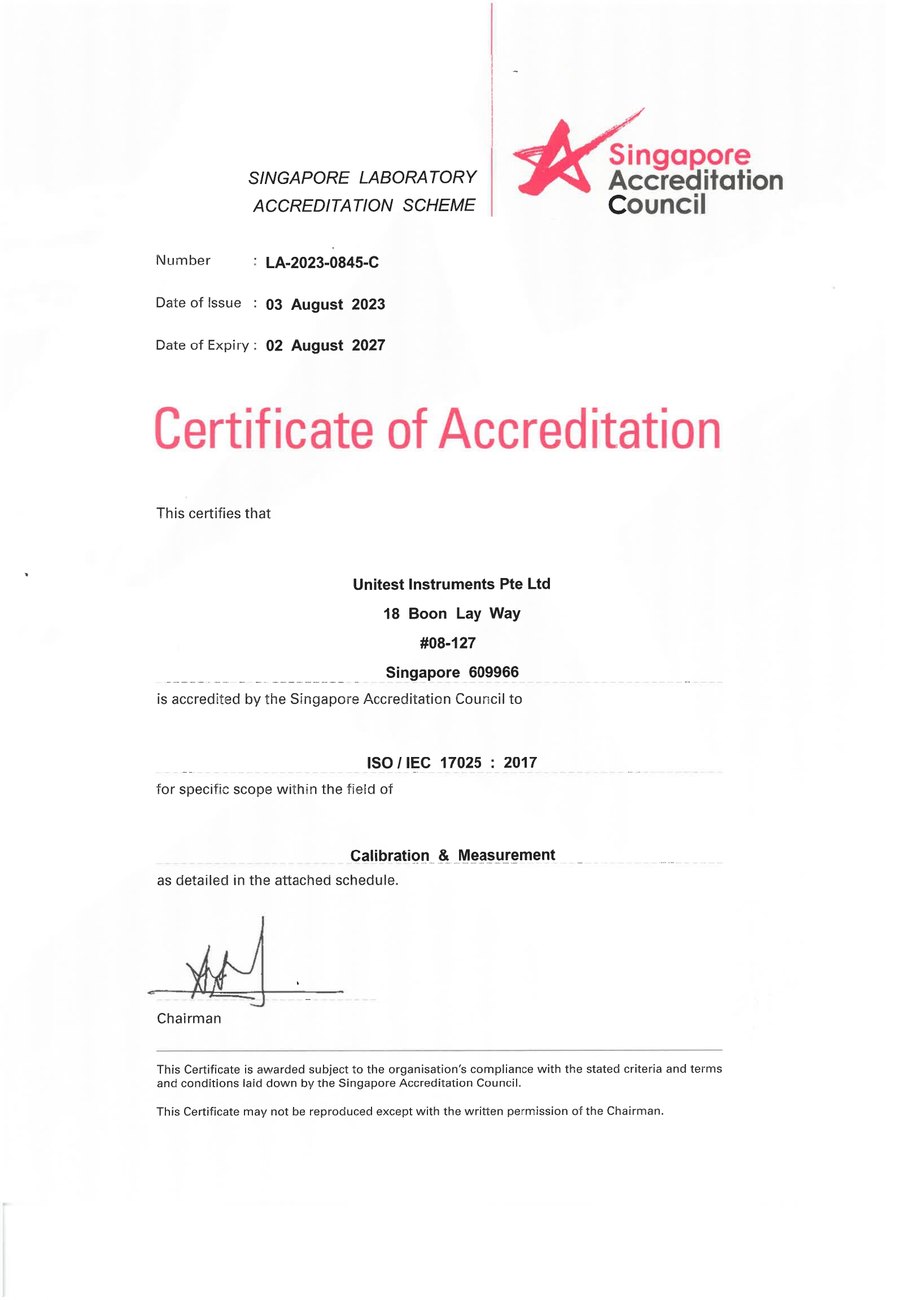
SAC-SINGLAS accredited calibration laboratory (Acc. No. LA-2023-0845-C) serving Singapore's industrial, pharmaceutical, and manufacturing sectors. All content reflects our ISO/IEC 17025 accredited scope and is reviewed by our technical calibration team.
Need gas detector calibration in Singapore?
Unitest Instruments is SAC-SINGLAS accredited (Acc. No. LA-2023-0845-C) to ISO/IEC 17025. Same-week turnaround, certificates accepted by MOM inspectors and ISO 45001 auditors.