
Key Takeaways
- Singapore's WSH (Confined Spaces) Regulations 2009 require atmospheric testing for O2, LEL, CO, and H2S before any entry. A 4-in-1 or 5-in-1 detector covers all four in one instrument.
- Bump test daily before use; full SAC-SINGLAS traceable calibration is required at least annually (or per manufacturer spec) to satisfy ISO 9001 audits and MOM inspections.
- For Singapore's high-humidity environment, prioritise IP67 or IP68-rated housings and sensors rated for continuous operation above 40°C and 90% RH.
- Factory calibration certificates are not equivalent to SAC-SINGLAS traceable certificates. They do not meet many government contract and regulatory requirements.
- Pump-style (active sampling) detectors are safer than diffusion-only units when pre-entry testing must be done without entering the space.
Who Needs a Portable Gas Detector in Singapore?
Confined space entry is more common in Singapore than many facility managers realise. A confined space is any enclosed or partially enclosed area not designed for continuous human occupancy, where hazardous atmospheric conditions may develop. Including manholes, drainage sumps, tanks, boiler interiors, cable tunnels, loading pits, and ship cargo holds. Singapore's urban density means that even routine building maintenance can involve confined space entry.
Under the Workplace Safety and Health (Confined Spaces) Regulations 2009, every employer whose workers enter confined spaces must appoint a Confined Space Assessor, conduct atmospheric testing before entry, and ensure that testing equipment is maintained in good working order. A portable gas detector is the primary instrument for satisfying the atmospheric testing requirement. Failure to comply carries fines up to S$500,000 and potential criminal liability under the WSH Act.
The main industries requiring portable gas detectors in Singapore include oil and gas facilities on Jurong Island, marine and shipyard operations (MPA-regulated confined space entry in cargo tanks and void spaces), construction (utility tunnels, underground drainage), water reclamation and utility maintenance, pharmaceutical manufacturing, and commercial facility management.
What to Look for Before You Buy
The market offers hundreds of portable gas detector models. In Singapore's context, five criteria determine whether a unit is fit for purpose:
1. Gas Coverage
The WSH (Confined Spaces) Regulations specify that atmospheric testing must check for oxygen deficiency or enrichment, flammable or explosive gas, and toxic gases or vapours. In practice, the four mandatory parameters for most Singapore worksites are O2 (19.5%–23.5% safe range), %LEL (flammable gas, evacuate at ≥10% LEL), CO (TWA 25 ppm, STEL 100 ppm under MOM exposure limits), and H2S (TWA 1 ppm, STEL 5 ppm). A 5-gas unit that adds CO2 or SO2 is useful for refineries and wastewater treatment.
2. Pump vs. Diffusion Sampling
Diffusion detectors rely on gas reaching the sensor by natural movement. They can only test the atmosphere at the worker's breathing zone. Pump-equipped (active sampling) detectors draw air from a remote probe, allowing you to test a tank or sump before anyone enters. For confined space pre-entry testing, a pump is not just convenient. It is safer and better practice.
3. Environmental Ratings
Singapore's outdoor and industrial environments routinely exceed 35°C and 85% relative humidity. Choose a unit rated at least IP67 (dust-tight, 30-minute water immersion) and confirm that the operating temperature range covers at least 0°C to 50°C. Units with polycarbonate or rubberised overmould housings hold up better in marine and petrochemical environments.
4. Alarm Modes and Display
Look for audible alarm ≥95 dB (essential in noisy industrial environments), vibration alarm for loud environments, LED visual alarm visible in bright sunlight, and a large backlit display readable in poorly lit confined spaces. Man-down (motion/tilt) and lone-worker alarm functions add a layer of protection for solo entries.
5. Battery Life and Calibration Interval
A full shift in Singapore may run 10–12 hours. Confirm rated battery life under continuous pump operation (not just diffusion mode). For calibration, check the manufacturer's recommended interval. Most electrochemical sensors require full calibration every 6 to 12 months and bump testing before every shift.
How the Sensors Actually Work, and Why It Affects Reliability
Understanding the sensing technology inside a gas detector helps explain why certain models fail in certain environments, and why calibration and maintenance discipline matters as much as the specification sheet. Oxygen sensors are almost universally electrochemical: a small fuel cell that generates a current proportional to oxygen concentration as it reacts with the electrolyte inside. These cells are consumed as they operate, meaning an O2 sensor has a finite service life (typically 1 to 2 years) regardless of how well it is maintained, and it will eventually need replacement rather than simply recalibration.
Toxic gas sensors for CO and H2S are also electrochemical, using a different catalyst and electrolyte formulation tuned to each target gas, and share the same finite-life characteristic. A critical detail often missed by buyers new to gas detection is cross-sensitivity: an electrochemical sensor calibrated and optimised for one gas can still respond, to a lesser degree, to other gases with similar chemical properties, producing a false or exaggerated reading in the presence of an interfering gas the sensor was never intended to detect. Manufacturer datasheets list known cross-sensitivities for each sensor model, and in a petrochemical or refinery environment where multiple gas species may be present simultaneously, understanding these cross-sensitivities is genuinely important for correctly interpreting an alarm rather than assuming every alarm indicates only the labelled target gas.
Flammable gas (%LEL) sensing typically uses either a catalytic bead (pellistor) sensor, which burns a small sample of the gas on a heated catalytic element and measures the resulting temperature change, or an infrared (NDIR) sensor, which measures gas concentration by its absorption of specific infrared wavelengths. Catalytic bead sensors are the traditional, lower-cost technology but are vulnerable to a phenomenon called sensor poisoning: exposure to silicone vapours, leaded compounds, or high concentrations of sulphur compounds (all present in various forms across Singapore's petrochemical and shipyard environments) can permanently coat and deactivate the catalytic element, silently reducing its sensitivity without necessarily triggering an obvious fault indication. NDIR sensors are inherently immune to catalytic poisoning and are increasingly specified for exactly this reason in environments with known poisoning risks, though they typically come at a higher purchase cost. This poisoning risk is precisely why bump testing before every shift matters so much for catalytic-bead-equipped detectors: a poisoned sensor can pass a casual visual inspection while having lost meaningful sensitivity to the gas it is meant to detect.
Warm-Up Time and Response Time: Why Rushing an Entry Decision Is Dangerous
Every gas sensor requires a warm-up period after power-on before its readings are reliable, typically ranging from 15 seconds for a well-designed electrochemical sensor to several minutes for some catalytic bead or PID sensors, and taking a reading before this warm-up period completes can produce an artificially low or unstable value that masks a genuine hazard. Most modern instruments display a countdown or lock out readings during warm-up specifically to prevent this, but older or lower-cost units may not, making it a genuine operational risk if a technician powers on a unit and immediately proceeds with pre-entry testing without confirming the warm-up period has elapsed.
Response time (how quickly the displayed reading catches up with an actual change in gas concentration, commonly specified as T90, the time to reach 90% of the final reading) is equally important and is frequently overlooked in purchasing decisions focused primarily on price and gas coverage. A detector with a slow response time, when used to sweep a probe through a confined space during pre-entry testing, can produce a reading that understates the true peak concentration if the probe is moved through the space faster than the sensor can respond, giving a false sense of safety at exactly the moment that safety assessment matters most. Confirming a detector's stated T90 response time against your actual pre-entry testing procedure, specifically how quickly the probe is moved and how long it dwells at each test point, is a worthwhile check that goes beyond simply comparing headline specifications between models.
Top Portable Gas Detectors Available Through Unitest
Unitest Instruments supplies and calibrates instruments from leading measurement brands including Fluke and associated lines. Below is a comparison of configurations commonly deployed on Singapore worksites, covering the range from essential entry-level units to advanced pump models used in petrochemical and shipyard settings.
| Configuration / Type | Gases Detected | Key Spec | Approx. Price Range (SGD) | Best For |
|---|---|---|---|---|
| 4-Gas Diffusion Monitor | O2, LEL, CO, H2S | IP67, ≥10 hr battery, audible/visual/vibration alarm | S$600 – S$900 | General construction, facility management, routine maintenance entry |
| 4-Gas Pump Monitor | O2, LEL, CO, H2S | Built-in pump, 3 m sampling hose, IP67, LCD backlit | S$1,100 – S$1,600 | Pre-entry tank/sump testing, shipyard void spaces, drainage manholes |
| 5-Gas Pump Monitor | O2, LEL, CO, H2S + CO2 or SO2 | Replaceable sensor cartridge, datalogging, PC download | S$1,800 – S$2,500 | Petrochemical and refinery applications, wastewater treatment, pharmaceutical |
| Single-Gas Personal Monitor (CO) | CO only | Compact clip-on, 2-yr sensor life, TWA/STEL display | S$180 – S$320 | Boiler rooms, vehicle workshops, supplementary personal monitoring |
| PID + 4-Gas Combination | O2, LEL, CO, H2S + VOC (PID) | 10.6 eV lamp, ppb-level VOC detection, IP65 | S$3,200 – S$4,800 | Chemical plants, lab environments, hazmat response teams |
Browse the full range of gas detection instruments available for purchase and immediate calibration at unitestshop.com. Unitest Instruments can calibrate any unit from the table above to SAC-SINGLAS traceable standards before delivery to your worksite.
Calibrate Your Gas Detector Before First Use
Unitest Instruments provides SAC-SINGLAS traceable calibration for portable gas detectors. Certificates accepted by MOM inspectors, ISO 9001 auditors, and government procurement teams. Typical turnaround 3–5 working days.
Singapore Standards and Regulatory Context
Beyond the WSH (Confined Spaces) Regulations, several Singapore standards and codes of practice govern gas detection equipment selection and maintenance:
- SS 510 (Code of Practice for Selection, Use, Care and Maintenance of Respiratory Protective Devices). References atmospheric monitoring as a prerequisite for selecting appropriate respiratory protection.
- CP 79 (Code of Practice for Confined Spaces). The primary operational reference for confined space entry in Singapore, published by Spring Singapore (now Enterprise Singapore). It specifies testing procedures, equipment requirements, and record-keeping obligations.
- MOM Chemical Hazards (Control of Toxic Substances) Regulations. Establishes occupational exposure limits (OELs) for CO, H2S, and other toxic gases. Your detector's alarm setpoints must be configured to these limits.
- ISO/IEC 17025. The international standard for calibration laboratory competence. A certificate bearing the SAC-SINGLAS accreditation mark confirms that the issuing laboratory (Unitest Instruments, Acc. No. LA-2023-0845-C) has been independently assessed against this standard.
Understanding why traceability matters (and what a calibration certificate actually certifies), is important when evaluating your legal exposure. Our article on what a calibration certificate means and what it must contain breaks this down in plain English, and our guide on accredited vs non-accredited calibration explains why the SAC-SINGLAS mark matters for MOM-regulated environments.
How to Set Up and Maintain Your Gas Detector
Buying the right instrument is only half the task. Proper setup and a disciplined maintenance routine determine whether the unit actually protects your workers.
Before First Use: SAC-SINGLAS Calibration
Factory calibration is performed at the point of manufacture, often months before delivery, and does not carry SAC-SINGLAS traceability to NMC Singapore. Before deploying a new unit on a Singapore worksite, send it for full calibration by an accredited laboratory. The calibration should cover all installed sensor channels at appropriate concentration points, with documented uncertainty. This establishes a traceable baseline reading for all future comparisons. Browse our shop at unitestshop.com. All units purchased through Unitest Instruments can be calibrated and certified before dispatch.
Daily Bump Testing
Before every shift, expose each sensor channel to a known concentration of reference gas (commonly a 4-gas mixture cylinder) and confirm that the instrument responds and alarms correctly. A bump test does not replace calibration. It confirms the instrument is responding. Most manufacturers require bump testing to be recorded in the instrument's maintenance log. If a sensor fails to respond to bump gas, the unit must be removed from service until recalibrated.
Calibration Intervals
Most electrochemical O2, CO, and H2S sensors have a service life of 2 to 3 years under normal conditions. Catalytic bead (pellistor) LEL sensors may last 3 to 5 years but can be poisoned by silicones, sulphur compounds, and heavy solvents, common in Singapore's petrochemical environment. Calibrate at least every 6 months for high-use applications (daily entry teams, shipyard operations) or every 12 months for lower-frequency use. See our article on how to determine the right calibration interval for a risk-based framework you can apply to your own programme.
In-Service Maintenance
After each confined space entry, wipe the sensor ports with a clean dry cloth to remove moisture and particulate. Check that the pump filter (on pump-equipped units) is clean. A blocked filter causes the pump to read low gas concentrations. Replace the filter every 3 to 6 months under Singapore conditions. Store units in a temperature-stable environment; avoid leaving instruments in direct sunlight in a vehicle, where enclosure temperatures can exceed 70°C and damage electrochemical sensors permanently.
Between entries, it is worth periodically verifying the sampling hose and probe on pump-equipped units for cracks, kinks, or degraded seals, since a compromised hose can draw in ambient air alongside the sample and produce a diluted, falsely reassuring reading during pre-entry testing. Singapore's UV exposure and heat accelerate rubber and plastic degradation faster than in temperate climates, so hoses that might last several years elsewhere may need replacement sooner here. A visual inspection before each significant deployment, checking specifically for hose damage in addition to the routine sensor and filter checks, closes a gap that a standard bump test does not directly verify.
Common Mistakes Singapore Safety Officers Should Avoid
Based on calibration records and service history at Unitest Instruments, the following errors appear repeatedly among Singapore customers who send in instruments that have failed in service or produced out-of-tolerance readings:
- Skipping pre-deployment calibration. The assumption that a new instrument is ready to use straight from the box leads to undetected sensor drift. Always calibrate before first use.
- Using expired reference gas cylinders. Bump test gas mixtures have a shelf life. Typically 12 to 24 months from the fill date. Expired cylinders may have drifted in concentration and will produce incorrect bump test results.
- Calibrating in a clean-air environment and deploying in a contaminated one. If your storage area has background CO or VOC from adjacent processes, calibrate in a separate clean-air zone.
- Ignoring low-battery warnings. In Singapore's heat, battery performance degrades faster than in temperate climates. A unit that shows 20% battery at the start of a long shift may exhaust before entry is complete.
- Not logging bump tests. MOM inspectors and ISO auditors may request maintenance records. A logbook or digital record of daily bump test results demonstrates due diligence.
- Ignoring sensor cross-sensitivity in mixed-gas environments. Treating every alarm as confirmation of the labelled gas, without considering that another chemical present on site may be cross-triggering the sensor, can lead to a mismanaged response or, worse, a dismissed alarm that was actually valid.
- Continuing to use a catalytic LEL sensor after suspected poisoning exposure. Following work involving silicone sealants, degreasers, or leaded compounds, a catalytic bead sensor should be bump tested before its next use rather than assumed to still be functioning at full sensitivity.
Frequently Asked Questions
Singapore's Workplace Safety and Health (Confined Spaces) Regulations 2009 require testing for at least four hazards before entry: oxygen level (O2, target 19.5%–23.5%), flammable gas or vapour (LEL), carbon monoxide (CO), and hydrogen sulphide (H2S). A 4-in-1 or 5-in-1 multi-gas detector covers all mandatory parameters in a single instrument, which is the most practical choice for most Singapore worksites.
MOM's WSH Act does not specify a fixed interval, but manufacturer recommendations typically call for bump testing before every use and full calibration every 6 to 12 months. Many Singapore customers align calibration with ISO 9001 audit cycles. For regulated industries such as pharmaceuticals, oil and gas, and government contracts, annual SAC-SINGLAS traceable calibration is the accepted standard. See our guide on calibration intervals for a deeper explanation.
A bump test (or functional test) briefly exposes the sensor to a known gas concentration to verify that it responds and alarms. It does not produce a traceable calibration certificate. A full calibration applies NIST- or NMC-traceable reference gas at multiple concentration points, records the sensor's response, adjusts the instrument if needed, and issues a calibration certificate with documented measurement uncertainty. Only full calibration satisfies ISO 9001 audit requirements and MOM enforcement checks.
Yes, if you hold traceable reference gas cylinders with current certificates and a documented calibration procedure. However, most Singapore companies send gas detectors to an accredited laboratory because in-house calibration requires maintaining your own gas supplies, traceable references, and quality system records. An SAC-SINGLAS accredited certificate from a third-party lab such as Unitest Instruments is typically required for government contracts and regulatory inspections.
LEL stands for Lower Explosive Limit. The minimum concentration of a flammable gas or vapour in air at which ignition can occur. Gas detectors display LEL as a percentage (e.g. 10% LEL for methane means 10% of the 5% v/v ignition threshold, or 0.5% v/v methane). Singapore regulations require workers to evacuate when LEL readings reach 10% or above in a confined space. A detector that reads in %LEL rather than %v/v gives workers an earlier, actionable warning.
The main sectors are oil and gas (Jurong Island refineries and petrochemical plants), marine and shipbuilding (tank entry in shipyards), construction (underground drainage and utility tunnels), water treatment and utilities (pump stations, manholes), pharmaceutical manufacturing (solvent vapour detection), and facility management (boiler rooms, basements). Singapore's dense urban infrastructure means confined space entry is common even in commercial building maintenance.
Yes. Sensors can drift during shipping and storage. Most manufacturers explicitly state in their user manuals that the instrument must be calibrated before first operational use. Additionally, a factory calibration certificate does not carry SAC-SINGLAS traceability to NMC Singapore, which is required for many local regulatory and contractual purposes. Unitest Instruments provides pre-use calibration with full traceable certificates, typically within 3 to 5 working days.
Singapore's average relative humidity exceeds 80% year-round, and temperatures in confined spaces can exceed 40°C. Key features to prioritise are an IP67 or IP68 ingress protection rating (dust-tight and water-submersible), an operating temperature range up to at least 50°C, electrochemical sensors rated for high-humidity environments, and a housing with anti-corrosion treatment. Units with large backlit displays are preferable, as condensation in poorly lit spaces can make small screens difficult to read.
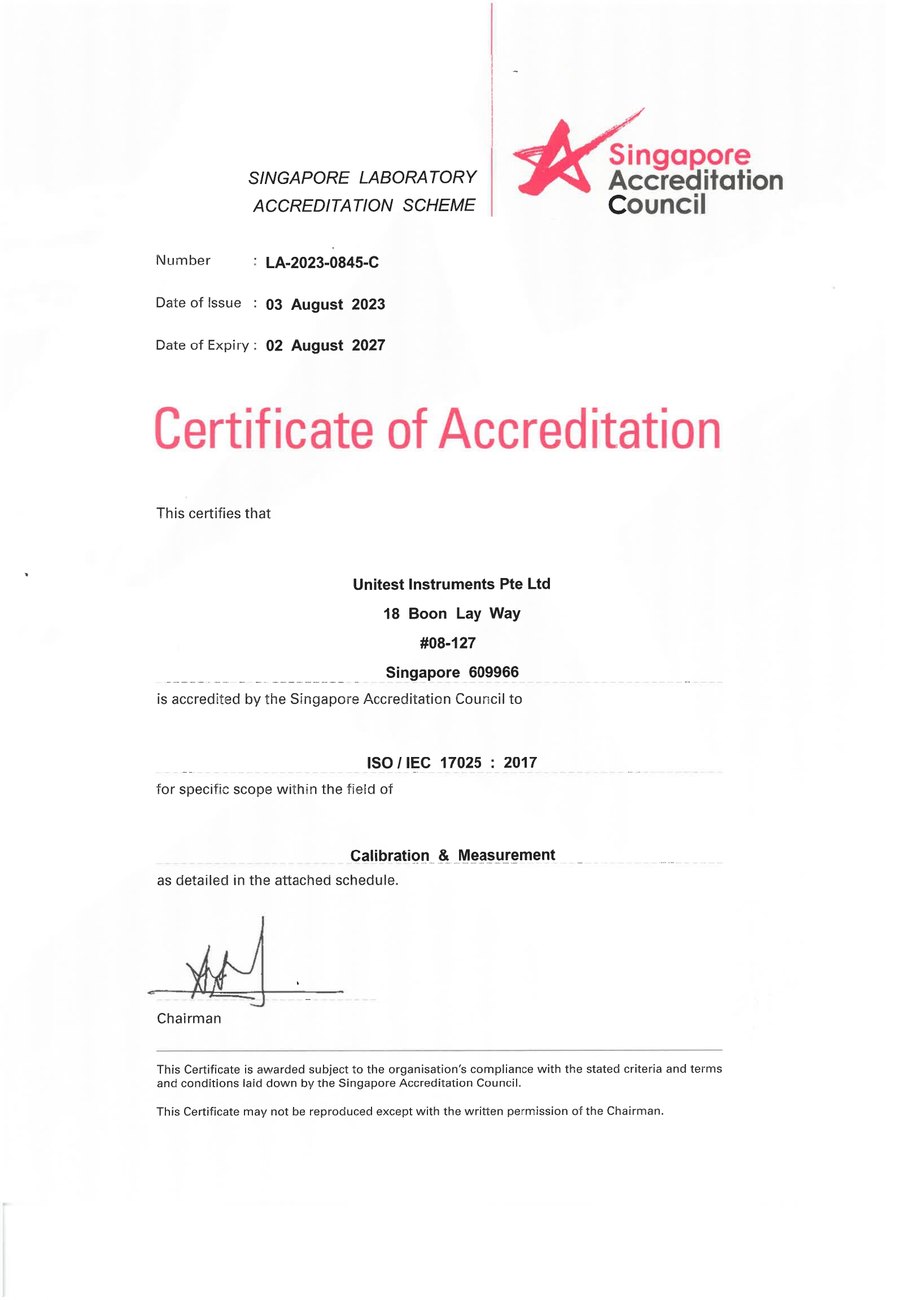
SAC-SINGLAS accredited calibration laboratory (Acc. No. LA-2023-0845-C) serving Singapore's industrial, pharmaceutical, and manufacturing sectors. All content reflects our ISO/IEC 17025 accredited scope and is reviewed by our technical calibration team.
Need gas detector calibration in Singapore?
Unitest Instruments is SAC-SINGLAS accredited (Acc. No. LA-2023-0845-C) to ISO/IEC 17025. Same-week turnaround, certificates accepted by ISO 9001 auditors and MOM inspectors.