
Key takeaways
- Revenue kWh meters (billing meters at premises' MSB) are SP Group's responsibility under the Electricity Act. They are calibrated and sealed by SP Group or their authorised agents; customers should not tamper with them.
- Sub-metering, energy management, and power quality meters (not used for billing) are the customer's responsibility. ISO 50001 and BCA Green Mark require these to be calibrated with traceable certificates.
- Power meter calibration verifies: voltage measurement accuracy, current measurement accuracy, active power (watts) accuracy, power factor accuracy, frequency accuracy, and energy integration accuracy (kWh).
- Harmonics measurement accuracy is a separate specification. A power meter claiming to measure THD must have its harmonic measurement capability calibrated at the relevant harmonic orders (5th, 7th, 11th, etc.).
- A power quality analyser calibrated to IEC 61000-4-30 Class A is the highest tier. Used for EN 50160 compliance reporting and grid code verification; Class S is adequate for most industrial energy management.
The Singapore power metering landscape
Metering in Singapore splits into two fundamentally different categories, and understanding which category your meters fall into determines who is responsible for calibration and what evidence you need to produce.
The first category is revenue metering. The smart meters (AMI system, Landis+Gyr and Itron equipment) installed by SP Group at each premises' Main Switch Board. These are SP Group's property, calibrated and sealed by SP Group or their authorised agents under the Electricity Act. Accuracy class is IEC 62053-21 Class 1 or Class 2. Customers should not tamper with them, and SP Group's calibration programme is not within the scope of this guide.
The second category is non-revenue metering. Sub-meters, energy management meters, power quality monitors, and ISO 50001 monitoring points installed by building owners, facility managers, and industrial operators to measure consumption within their premises, at individual equipment level, or at process boundaries. These instruments are the customer's property, and calibration is the customer's responsibility. This is the main market for industrial calibration services, and the focus of this article.
For ISO 9001 clause 7.1.5, ISO 50001 clause 6.6, and BCA Green Mark assessment, non-revenue meters used to generate energy performance data must be calibrated by a SAC-SINGLAS accredited laboratory with full traceability to Singapore's National Metrology Centre (NMC).
What a power meter measures
A three-phase power meter is not a single-parameter instrument. It performs multiple simultaneous measurements and derives calculated quantities from them. Understanding each parameter is necessary to specify what your calibration should cover.
The direct measurements are: voltage (V) on each phase, and current (A) on each phase. Measured either via internal current shunt resistors or, more commonly in industrial meters, via external current transformer (CT) inputs. From these, the meter calculates:
- Active power P = V × I × cos(φ) in watts. The real power consumed and converted to useful work
- Reactive power Q = V × I × sin(φ) in VARs. Associated with inductive or capacitive loads
- Apparent power S = V × I in VA. The vector sum of P and Q
- Power factor PF = P / S. The ratio of real power to apparent power
- Energy (kWh) = integral of P over time. Accumulated power consumption
Advanced power quality metres and analysers add: harmonic voltage and current (individual orders and THD), voltage unbalance, frequency, and flicker (Pst and Plt). Each of these has its own accuracy specification, and each must be separately calibrated. A meter's claimed accuracy for active power does not extend to its harmonic measurement capability unless that capability is explicitly within the calibration scope.
Revenue metering vs sub-metering calibration
The practical boundary between SP Group's responsibility and the customer's responsibility sits at the revenue meter. SP Group's AMI meters (installed at the MSB of each premises), are calibrated, sealed, and maintained by SP Group. Accuracy class is IEC 62053-21 Class 1 or Class 2. If you believe your billing is inaccurate, SP Group has a formal meter dispute procedure; the remedy is not to calibrate the meter yourself.
Everything downstream of the revenue meter (sub-meters monitoring individual floors, plant rooms, manufacturing lines, chillers, or data centres), is the customer's responsibility. Common instruments in this category include Schneider Electric PM series, Siemens SENTRON PAC series, ABB M2M, and Eastron SDM series meters. These instruments are accurate at installation; they drift over time as shunt resistors age, input impedance changes, and firmware-managed measurement algorithms interact with changing load profiles.
For ISO 50001 energy management systems, clause 6.6 specifically addresses the monitoring, measurement, analysis, and evaluation of energy performance. The monitoring and measurement plan must identify each significant meter, specify its calibration interval, and define how out-of-tolerance results are handled. Calibration certificates must be retained as documented evidence. An ISO 50001 auditor will check that the meters forming your energy performance indicator (EnPI) baseline have current, accredited calibration certificates. Not just a CALIBRATED sticker on the instrument.
Power meter calibration method
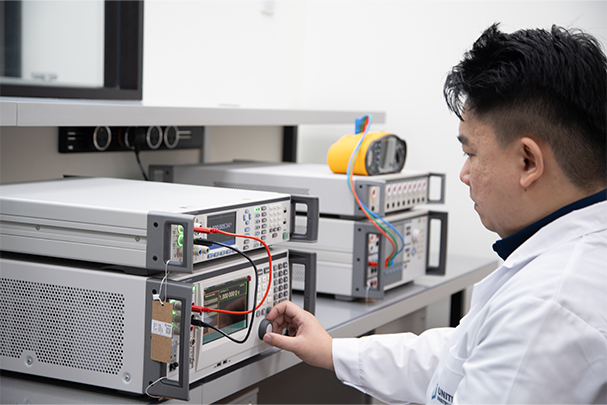
Power meter calibration uses a precision power source (typically a three-phase AC power standard), to apply known voltage, current, and phase angle to the meter under test. The meter's readings are compared to the reference values at multiple test points covering the meter's operating range.
A standard calibration sequence for an active energy meter typically covers:
- Active power at unity power factor (PF = 1.0), at 10%, 25%, 50%, 75%, and 100% of rated current
- Active power at 0.5 power factor lagging. This tests the meter's ability to correctly account for phase angle between voltage and current
- Reactive power at PF = 0 (purely inductive or capacitive load)
- Energy integration test: power is applied at a defined level for a measured time period; accumulated kWh is compared to the reference
- Frequency at rated values (50 Hz in Singapore)
The reference power standard's accuracy must be three to four times better than the meter's stated accuracy class. A requirement specified in IEC 62053-11 for the reference standard used in energy meter testing. For a Class 0.2S revenue-class meter, the reference must be better than Class 0.05S. Unitest's electrical calibration references are traceable to NMC Singapore, with traceability chains audited by SAC assessors as part of our accreditation under no. LA-2023-0845-C.
| Parameter | Typical specification | Standard reference | Application |
|---|---|---|---|
| AC voltage accuracy | ±0.1–0.5% | IEC 62053-22 class 0.2S | Revenue metering, energy management |
| AC current accuracy | ±0.1–0.5% | IEC 62053-22 class 0.2S | Revenue metering |
| Active power (W) accuracy | ±0.2–0.5% | IEC 62053-21/22 | Energy billing, ISO 50001 |
| Reactive power (VAR) | ±0.2–1% | IEC 62053-23 class 2 | Power factor monitoring |
| Energy integration (kWh) | ±0.2–1% | IEC 62053-21 class 1 | Sub-metering, energy audit |
| Power factor accuracy | ±0.005–0.02 PF | IEC 61000-4-30 | PFC, demand monitoring |
| Frequency accuracy | ±0.01–0.02 Hz | IEC 61000-4-30 | Grid compliance |
| Harmonic voltage (THD) | Per IEC 61000-4-7 | IEC 61000-4-30 Class A | Power quality analysis |
| Flicker (Pst, Plt) | Per IEC 61000-4-15 | IEC 61000-4-30 Class A | EN 50160 compliance |
ISO 50001 calibration requirements
ISO 50001:2018 clause 6.6 (Monitoring, measurement, analysis, and evaluation of energy performance and the EnMS), is the core calibration requirement for energy management systems. It requires that measuring equipment significant to energy performance be calibrated or verified on a specified schedule, against measurement standards traceable to international or national standards, and that the results of calibration be retained.
The EnMS must define four things for each significant meter: which meters are "significant" (those monitoring significant energy uses, SEUs, and energy performance indicator boundaries); the calibration interval (12 months is the most common adopted interval for industrial sub-meters); the calibration method (accredited lab calibration for precision meters; field verification against a calibrated reference for check purposes); and how out-of-tolerance meters are handled. Including whether previous measurements need to be reviewed.
BCA Green Mark Platinum schemes in Singapore increasingly require ISO 50001 EnMS certification as a prerequisite. An assessor conducting a Green Mark audit will expect to see calibration certificates for the sub-meters contributing to the energy performance data, and "I had it calibrated a few years ago" without a certificate is not a passing answer.
Calibrate your sub-meters and power quality analysers. ISO 50001 and BCA Green Mark audit-ready
Unitest calibrates AC power meters, energy meters, and power quality analysers against NMC-traceable power references. SAC-SINGLAS accredited for ISO 50001, BCA Green Mark, and industrial energy management.
Power quality analysers. Higher specification requirements
Standard energy sub-meters measure voltage, current, power, and kWh with accuracies in the range of Class 0.5 to Class 2. Power quality analysers. Instruments designed to measure harmonics, flicker, voltage unbalance, voltage dips and swells, and rapid voltage changes. Operate to a different and more demanding standard: IEC 61000-4-30.
IEC 61000-4-30 defines two performance classes for power quality measurement:
Class A is the highest tier, with defined uncertainty requirements for each parameter: voltage RMS uncertainty within ±0.1%, frequency uncertainty within ±10 mHz, flicker uncertainty within ±5% of reading, harmonic voltage within the limits of IEC 61000-4-7. Class A calibration is required when the instrument will be used for EN 50160 grid compliance reporting, demand monitoring for the Energy Market Authority, or harmonic distortion studies for large-load grid connections. For Singapore industrial customers reporting power quality issues to SP PowerGrid or verifying grid connection compliance for loads above 1 MVA, Class A instruments are expected.
Class S applies relaxed specifications and is adequate for most industrial energy surveys, monitoring campaigns, and general power quality assessment where the results are used for internal engineering decisions rather than regulatory reporting.
Calibrating a power quality analyser is more complex than calibrating a basic energy meter, because each harmonic order must be applied at the relevant frequency and the analyser's frequency response must be within specification. The calibration laboratory must have a reference capable of generating calibrated harmonic voltages and currents at the required orders and amplitudes.
Common power meter calibration failures
Understanding how power meters fail in service helps in deciding calibration intervals and in interpreting out-of-tolerance results. The most common failure modes in industrial sub-meters are:
Current channel drift is the most frequent finding. The meter's internal current shunt or the current input circuit (which converts the CT secondary current to a voltage for the ADC), drifts with age, temperature cycling, and high-current transient events. A current channel reading 2% high causes a systematic 2% overestimate of energy consumption at every load point.
Voltage divider aging affects the high-impedance voltage input resistors, particularly in high-temperature environments such as switchgear rooms or outdoor distribution boards in Singapore's climate. As resistor values drift, the voltage measurement error propagates directly into active power and energy readings.
Energy integration error manifests as a systematic offset in the kWh accumulator or pulse output. This is particularly important for meters used in tenant sub-metering or energy cost allocation, where even a 0.5% error accumulates to a significant sum over a year of operation at full load.
Power factor error at low PF is a specification boundary issue rather than a drift failure. Most industrial energy meters specify their accuracy at rated PF (unity or 0.5 lagging). At very low power factors (0.1 to 0.3, which can occur during large induction motor starting or in lightly loaded transformer banks), the meter's readings may be outside specification even when the instrument is technically "in calibration" at the tested points. For facilities with large variable-load motor drives, this is worth checking with the meter manufacturer's performance curves.
Calibration certificate requirements for power meters
A calibration certificate is the documentary evidence that calibration occurred, what was found, and whether the instrument is fit for purpose. For power meters used in ISO 50001 EnMS, BCA Green Mark programmes, or ISO 9001-controlled measurement processes, the certificate must contain specific information to satisfy an auditor. A "CALIBRATED" sticker on the instrument is not a certificate.
A compliant power meter calibration certificate must state:
- Instrument identification: make, model number, serial number, and firmware version
- Parameters calibrated and the measurement ranges covered at each test point
- Test conditions at each point: the voltage, current, power factor, and frequency applied
- The meter's reading at each test point
- The reference standard's value at each test point
- The error (meter reading minus reference value) and whether it is within the meter's stated accuracy specification
- The expanded measurement uncertainty for each result, at the stated coverage probability (typically k=2, 95% confidence)
- The calibration date and the next recommended calibration date (or the customer's chosen interval)
- The laboratory's SAC-SINGLAS accreditation number (LA-2023-0845-C for Unitest), and a clear statement that the results are covered by the accreditation
Certificates that list only "PASS" or "FAIL" without the numeric results and uncertainties do not satisfy ISO 50001 clause 6.6 or ISO 9001 clause 7.1.5. Both standards require that the calibration produce results with stated measurement uncertainties. Meaning the numerical evidence must be on the certificate, not just a conclusion.
Current transformers: the calibration step buildings often skip
Most industrial and commercial sub-meters do not measure current directly; they read a scaled-down secondary current from an external current transformer (CT) clamped or wound around the primary conductor, and this CT is itself a source of measurement error that is frequently overlooked when a calibration programme is scoped. A CT with a ratio error of even a fraction of a percent, or a phase displacement error that shifts the timing relationship between the current and voltage waveforms, introduces an error into every power and energy reading the downstream meter calculates, regardless of how accurately the meter itself has been calibrated against a reference power source. Because CTs are typically installed inside switchgear or panel enclosures at commissioning and rarely touched again, they are easy to omit from a calibration register that focuses on the more visible, more easily accessed meter display unit.
IEC 61869-2 governs CT accuracy classes and defines the ratio error and phase displacement limits for each class, and a rigorous ISO 50001 or BCA Green Mark energy monitoring programme should include CT verification as part of its significant meter scope, not just the meter reading the CT's output. In practice this means either sending the CT itself for accredited calibration where it can be removed without disrupting critical supply, or performing an in-situ verification using a calibrated reference CT and a known primary current injection, a service increasingly requested by Singapore facilities managers preparing for ISO 50001 recertification audits. A meter calibrated to a tight tolerance against a perfect reference power source but fed by an uncalibrated, drifted CT is still producing energy data with an unquantified systematic error, precisely the gap an auditor reviewing your EnMS documentation is trained to probe.
Building a Sub-Metering Calibration Programme for Multi-Tenant Buildings
Commercial buildings with tenant sub-metering face a particular calibration management challenge: dozens or hundreds of individual meters, often installed by different contractors over different fit-out cycles, feeding into a single tenant billing and cost allocation system where even a small systematic error compounds into a real financial dispute over a full lease term. The starting point for a defensible programme is a complete meter inventory tied to physical location and tenant account, cross-referenced against the building's single-line electrical diagram so that every meter's role (tenant billing, common area allocation, chiller plant sub-metering, EnPI monitoring) is documented alongside its calibration status. Building owners who have inherited an undocumented legacy metering installation, common in older Singapore commercial stock undergoing Green Mark retrofit, typically need to conduct this inventory exercise before a calibration schedule can even be meaningfully built, since calibrating meters in an arbitrary order without knowing which ones actually matter for tenant billing accuracy wastes budget on low-risk meters while leaving high-risk ones unchecked. Prioritising calibration spend toward meters with direct financial or regulatory consequence, tenant billing meters and EnPI-boundary meters first, informal engineering-reference meters last, is the practical risk-based approach that satisfies both ISO 50001's "significant meter" concept and a facilities budget that cannot calibrate every meter in the building every year.
Frequently asked questions
Revenue kWh meters at the Main Switch Board (MSB) of each premises are SP Group's property and responsibility. SP Group calibrates, seals, and maintains these meters under the Electricity Act; customers should not tamper with them. Sub-meters used for internal energy management, ISO 50001 monitoring, or BCA Green Mark compliance are the customer's property and the customer's calibration responsibility. These non-revenue meters must be calibrated by a SAC-SINGLAS accredited laboratory to satisfy ISO 9001, ISO 50001, and Green Mark audit requirements.
A full power meter calibration verifies AC voltage accuracy on each phase, AC current accuracy on each phase, active power (watts) at unity power factor and at 0.5 PF lagging, reactive power (VARs) at zero power factor, apparent power (VA), power factor accuracy, energy integration accuracy (kWh accumulated over a defined test period), and frequency. Advanced power quality analyser calibrations also cover harmonic voltage and current measurement at specific harmonic orders, voltage unbalance, flicker (Pst and Plt), and frequency deviation. Each parameter is tested at multiple load levels. Typically 10%, 25%, 50%, 75%, and 100% of rated current.
The calibration interval for industrial sub-meters is not fixed by a single regulation. It depends on the meter's application and the applicable compliance framework. For ISO 50001 energy management systems, the monitoring and measurement plan must specify a calibration interval for each significant meter; twelve months is the most common interval adopted for revenue-class and sub-metering-class instruments. BCA Green Mark assessors typically expect calibration evidence dated within twelve months of submission. For meters in less critical monitoring roles, a 24-month interval may be defensible if historical data shows the meter is stable. Document the rationale in your EnMS measurement plan.
IEC 61000-4-30 is the international standard for power quality measurement methods. Class A defines the highest accuracy tier: voltage RMS uncertainty within ±0.1%, frequency uncertainty within ±10 mHz, flicker uncertainty within ±5% of reading. Class S applies relaxed specifications suitable for surveys and general monitoring. Class A is required when you need to produce EN 50160 grid compliance reports, submit power quality evidence to SP PowerGrid for a large-load grid connection (typically above 1 MVA), or conduct formal harmonic distortion studies for regulatory purposes. Class S is adequate for most industrial energy management and routine monitoring applications.
ISO 50001:2018 clause 6.6 requires calibration or verification of measuring equipment that is significant to energy performance, not all meters unconditionally. The EnMS must identify which meters are significant (those monitoring significant energy uses, EnPI boundaries, and energy performance targets), specify the calibration interval, define the calibration or verification method, and document how out-of-tolerance meters are handled. Meters used only for general awareness or rough indication may be outside the significant scope. In practice, any meter whose reading feeds into an EnPI, a baseline, or an energy audit should be calibrated with a traceable, accredited certificate.
A compliant power meter calibration certificate must state the meter's make, model, serial number, and firmware version; the parameters and measurement ranges calibrated; the test conditions at each point (applied voltage, current, power factor, and frequency); the meter's reading at each test point; the reference standard's value at each point; the error and whether it is within specification; the expanded measurement uncertainty at each point; the calibration date; and the laboratory's SAC-SINGLAS accreditation number. A CALIBRATED sticker only, or a certificate omitting measurement uncertainty, is not sufficient for ISO 50001 or BCA Green Mark audits.
Yes. Unitest calibrates three-phase power meters, energy meters (kWh meters), and power quality analysers. Calibration covers AC voltage, AC current, active power, reactive power, apparent power, power factor, energy integration (kWh), and frequency. For instruments with power quality measurement capability, calibration can include harmonic measurement accuracy at the relevant harmonic orders. All calibrations are performed against NMC-traceable references and covered by our SAC-SINGLAS accreditation (no. LA-2023-0845-C). Contact us with your instrument model and the parameters required to confirm scope and turnaround time.

Unitest Instruments Pte. Ltd. is a SAC-SINGLAS accredited calibration laboratory (ISO/IEC 17025, no. LA-2023-0845-C) based in Singapore. We calibrate electrical, temperature, pressure, humidity, and related instruments for manufacturers, service providers, and regulated industries across Singapore and the region.
Power meter calibration (sub-meters, energy meters, power quality analysers), SAC-SINGLAS accredited
ISO 50001 and BCA Green Mark compliant calibration certificates. NMC-traceable. Accredited under no. LA-2023-0845-C.
Verifiable at sac.gov.sg · Acc. No. LA-2023-0845-C