Key Takeaways
- Green Mark 2021 (GM2021) requires measurement data for EUI calculation, water efficiency, and IEQ. All requiring calibrated instruments
- Energy submeters, chiller plant meters, air-handling unit sensors, and water flow meters are primary calibration targets
- CO2, PM2.5, temperature, and humidity sensors must be calibrated for IEQ evidence submitted under GM2021 Healthier Workplaces criteria
- SS 554:2016 sets IEQ limits (CO2 ≤1000 ppm, temperature 23–26°C, RH 55–70%). Instruments measuring these parameters should be calibrated annually
- Annual calibration of building energy and IEQ instruments, with certificates retained in the Green Mark documentation package
- SAC-SINGLAS calibration certificates provide internationally recognised traceability evidence accepted by BCA Green Mark assessors
The BCA Green Mark Framework
The Building and Construction Authority (BCA) Green Mark scheme was introduced in 2005 as Singapore's standard for measuring and recognising green buildings. It evaluates buildings across four key areas: energy efficiency, water efficiency, indoor environment quality (IEQ), and other green features and innovation. Since its introduction, the scheme has driven the transformation of Singapore's built environment, with thousands of buildings achieving Green Mark certification across commercial, residential, industrial, and institutional categories.
Green Mark 2021 (GM2021) is the current version, replacing GM2015. It uses a points-based system with four award tiers: Certified (50+ points), Gold (65+ points), GoldPLUS (75+ points), and Platinum (90+ points). Each tier unlocks access to different BCA incentive programmes and signals a progressively higher level of environmental performance to tenants, investors, and regulators.
GM2021 introduces a stronger emphasis on measurement and verification. Energy Use Intensity (EUI) (measured in kWh/m²/year), is the primary metric for energy performance. EUI cannot be calculated without accurate metering. Water efficiency is similarly metrics-based, requiring flow measurement data from building water systems. The shift toward measured performance, rather than design-intent compliance, means that instrument accuracy is no longer a secondary concern. It sits at the core of what Green Mark actually verifies.
From 2030, BCA requires all new buildings above 5,000 m² to achieve Green Mark Platinum under the Super Low Energy (SLE) programme. This raises the stakes for measurement accuracy: inaccurate metering produces inflated EUI figures, which can trigger non-compliance against increasingly stringent Platinum thresholds. A building designed to meet Platinum may fail at submission if its energy meters have drifted and are reporting higher consumption than is actually occurring. Or, conversely, may appear Platinum-compliant when it is not.
For building owners targeting Green Mark certification or renewal, the calibration state of measurement instruments is a documentation risk that is often underestimated. Facilities teams routinely invest heavily in the physical plant (efficient chillers, LED lighting, variable speed drives), but leave the instruments measuring those systems' performance uncalibrated for years. The result is that performance improvements are documented inaccurately, and Green Mark submissions rest on measurement data of unknown accuracy.
Instruments in Scope for Green Mark Measurement
Green Mark measurement spans multiple instrument types across energy, water, and environmental quality domains. The table below summarises the primary instrument categories, their application in Green Mark, and recommended calibration intervals.
| Measurement Category | Instrument Type | Green Mark Application | Recommended Calibration Interval |
|---|---|---|---|
| Energy metering | kWh submeters (tenant, system-level) | EUI calculation, utility benchmarking | Annual |
| Chiller plant efficiency | Chiller power meters, thermal energy meters | Chiller plant efficiency (kW/RT) | Annual |
| AHU / ACMV sensors | Temperature sensors, RH sensors, CO2 sensors | Demand-controlled ventilation, IEQ documentation | Annual |
| Water flow | Flow meters (chilled water, condenser water, domestic water) | Water efficiency documentation, Green Mark Water score | Annual |
| Illuminance | Lux meters | Lighting compliance verification | Annual (lux meter), per-project (field measurement) |
| Indoor air quality | CO2 meters, PM2.5 sensors, TVOC sensors | GM2021 Healthier Workplaces criteria | Annual |
| Thermal comfort | Temperature, humidity, air velocity meters | SS 554 compliance, thermal comfort surveys | Annual |
This is not an exhaustive list. Green Mark also touches on daylight metering, photovoltaic output monitoring, and refrigerant leak detection in some building configurations. However, the categories above cover the instruments most commonly requiring calibration evidence in a Green Mark submission or ongoing BCA Building Energy Submission (BES) filing.
Energy Metering and EUI Calculation
Energy Use Intensity (EUI) is calculated from actual energy consumption data measured by energy submeters. For Green Mark, EUI is typically calculated from 12 months of utility data. Either from SP Group billing records (for buildings on direct account) or from building-level submeters. Where submeters are used rather than utility billing data, the accuracy of those submeters directly determines the accuracy of the EUI figure submitted to BCA.
For EUI to be credible, the energy meters used must be accurate. Meter accuracy classes (Class 0.5, Class 1, Class 2 under IEC 62053) affect the measurement uncertainty in the EUI figure. A Class 1 meter has ±1% accuracy across its operating range under rated conditions, but only when properly calibrated and not drifted. In a building consuming 3,000,000 kWh/year, a ±1% error represents ±30,000 kWh. Enough to shift EUI figures meaningfully across Green Mark tier boundaries for large commercial buildings.
In practice, building energy submeters drift over time due to electrical environment factors: harmonics from variable frequency drives, low power factor loads, and load fluctuations can all cause meter error accumulation. Annual calibration verifies that the meter is still performing within its rated accuracy class at the power factors and current levels typical of the building's actual load profile.
Chiller Plant Efficiency Monitoring
For chiller plant efficiency monitoring (a key Green Mark and BCA BES requirement), the chiller power meter and the thermal energy meter (measuring cooling output in refrigeration tonnes, RT) must both be accurate. An error in either instrument leads to an inflated or deflated kW/RT figure, which directly affects the Green Mark chiller plant efficiency score.
Chiller thermal energy meters combine flow measurement (via a flow sensor in the chilled water pipe) with temperature differential measurement (supply and return chilled water temperatures). Errors in either the flow sensor or temperature sensors propagate directly into the thermal energy calculation. This means that a building reporting excellent chiller efficiency may actually be reporting a meter-error artefact rather than genuine plant performance.
ESCO (Energy Services Company) contracts often include guaranteed EUI improvement targets with financial penalties if targets are missed. Measurement accuracy directly affects whether the ESCO hits the target or triggers a performance shortfall. Making calibration a contractual and financial risk as well as a compliance issue. ESCOs that operate without calibrated metering systems expose both themselves and their clients to disputes based on measurement error rather than genuine performance variation.
Indoor Environmental Quality (IEQ) and SS 554
Green Mark 2021 includes criteria for Healthier Workplaces that award points for IEQ performance. These criteria require measured evidence of compliance with IEQ parameters. Meaning that sensor data from CO2 monitors, temperature sensors, humidity sensors, and particulate meters must support the submission. The evidence quality depends directly on whether those sensors have been calibrated.
Singapore Standard SS 554:2016 (Code of Practice for Indoor Air Quality for Air-Conditioned Buildings) sets the benchmark against which IEQ measurements are evaluated:
- Carbon dioxide (CO2): ≤1000 ppm (8-hour time-weighted average)
- Temperature: 23–26°C
- Relative Humidity: 55–70% RH
- PM10: ≤150 µg/m³
- PM2.5: ≤65 µg/m³ (recommended)
- TVOC: ≤3 mg/m³
- Formaldehyde: ≤0.1 ppm
Instruments measuring these parameters must be calibrated to produce data that satisfies a Green Mark assessor. An uncalibrated CO2 sensor may read 850 ppm when actual CO2 is 1100 ppm. Appearing compliant while the building is non-compliant. Conversely, a sensor with negative drift may show 1150 ppm when actual CO2 is only 920 ppm. Triggering unnecessary ventilation increases that raise energy costs without improving air quality.
Both error directions have consequences: false compliance is an occupant health risk, while false non-compliance wastes energy and may drive unnecessary HVAC modifications. Calibration eliminates both failure modes by confirming the sensor is reading within its specification.
CO2 Sensor Calibration Requirements
CO2 sensors require span gas calibration as well as zero calibration. Most electrochemical or NDIR (non-dispersive infrared) CO2 sensors drift at 10–50 ppm per year due to detector ageing, contamination, and reference gas depletion. Annual calibration using certified reference gas standards (traceable to primary gas standards), is the industry standard for building CO2 sensors.
For BMS-integrated CO2 sensors used to drive demand-controlled ventilation (DCV), drift in the CO2 sensor directly affects ventilation rates and therefore both IEQ and energy consumption. A high-reading CO2 sensor drives higher ventilation, increasing AHU energy use. A low-reading sensor under-ventilates occupied spaces, creating an IEQ compliance gap while appearing to save energy. Calibration of DCV CO2 sensors is therefore simultaneously an energy efficiency measure and an IEQ compliance measure. Both relevant to Green Mark scores.
Calibrate Your Building Measurement Instruments
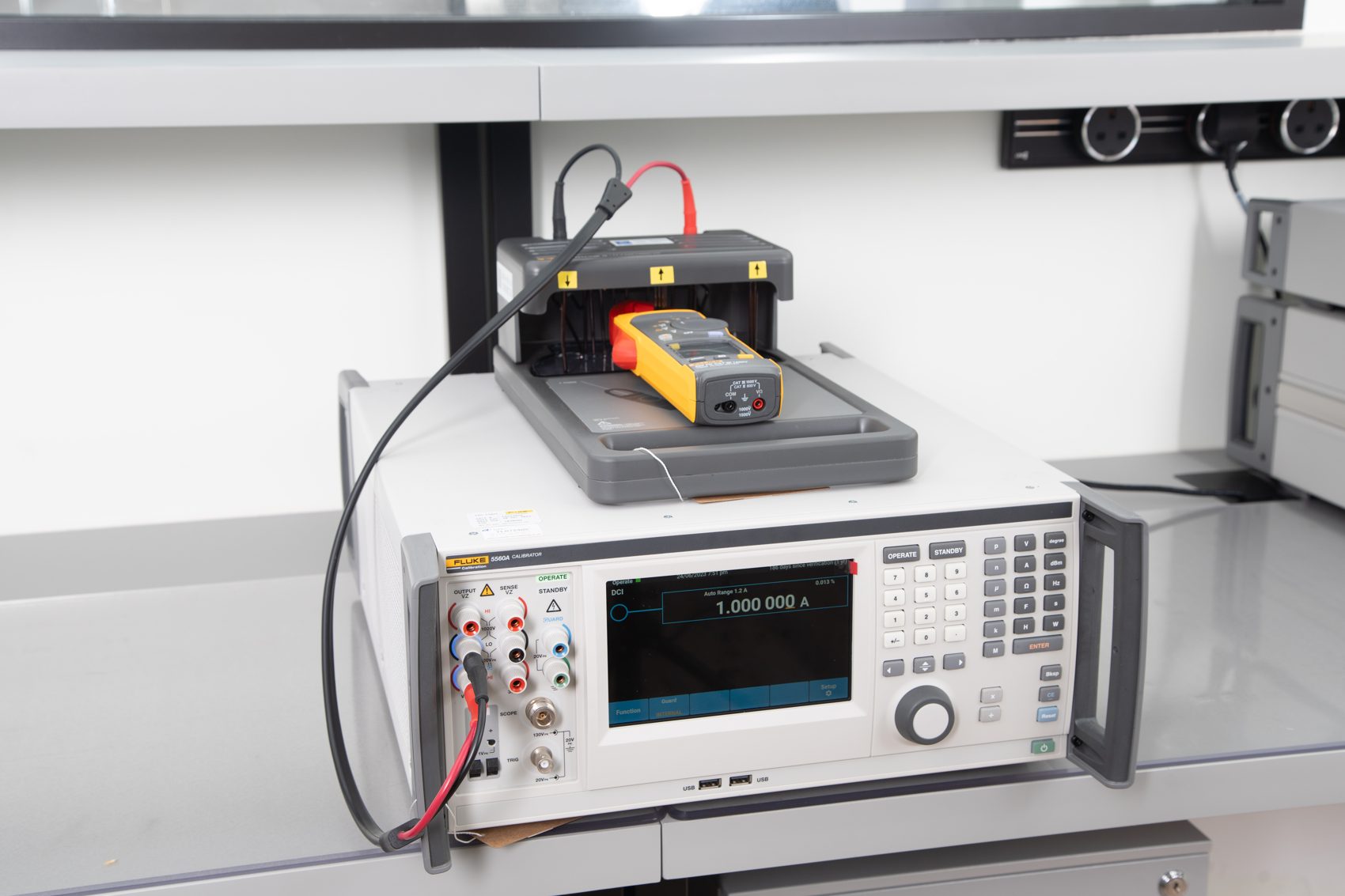
SAC-SINGLAS accredited calibration for energy meters, IAQ sensors, flow meters, and environmental monitoring instruments, with traceable certificates for Green Mark documentation packages.
Water Flow Metering
Water efficiency is a scored criterion in Green Mark. Building water metering data (including chilled water system consumption, domestic water consumption, and water recycling volumes), must be measured and documented. Green Mark's water efficiency scoring considers the building's water consumption per occupant or per floor area against benchmarks, and rewards installation of water-efficient fittings, recycling systems, and monitoring infrastructure.
Water flow meters (electromagnetic, ultrasonic, or differential pressure type) drift over time due to buildup on sensor elements, changes in pipe condition around the sensing point, and electronic component drift in the transmitter. Calibration verifies the meter's accuracy against traceable flow standards. For electromagnetic flow meters, calibration also confirms that the liner and electrodes are not fouled in ways that affect the magnetic field measurement. For ultrasonic meters, calibration confirms that the transducer coupling and signal path are producing accurate transit-time readings.
For Green Mark documentation, calibration certificates for water flow meters should be included in the Green Mark submission package. BCA assessors reviewing EUI and water efficiency data have the right to request evidence of meter accuracy, and in competitive Green Mark submissions for buildings targeting GoldPLUS or Platinum, where water efficiency scores can be the margin between tiers, the calibration evidence for flow meters can be submission-critical.
Temporary Flow Measurement Campaigns
Ultrasonic clamp-on flow meters, often used for temporary measurement campaigns during ESCO baseline studies or commissioning verification, should be calibrated before each measurement campaign. Particularly if they are used to provide data for ESCO baseline reports or Green Mark submissions. Clamp-on meters are sensitive to pipe condition, installation geometry, and coupling gel consistency. Without recent calibration, a clamp-on measurement campaign may produce data of unknown accuracy that cannot be defended in a submission or contract dispute.
For permanent installation flow meters that are difficult or costly to remove for laboratory calibration, in-situ calibration using a portable calibrated reference meter in series (or insertion probe calibration methods), provides a practical alternative. The calibration certificate should document the in-situ method, the reference standard used, and the uncertainty of the in-situ comparison.
Practical Calibration Programme for Green Buildings
For building managers and facility managers targeting Green Mark certification or renewal, a structured calibration programme ensures that measurement instruments are in a known, documented state when submission data is collected. The following framework covers the key instruments and timing considerations.
Annual Calibration Priorities
The core annual calibration targets for a Green Mark documentation programme are:
- All energy submeters used in EUI calculations. Verify accuracy class, commission new meters if found out of class
- Chiller thermal energy meters. Both the flow sensor and temperature differential sensors, calibrated as a system
- Domestic and process water flow meters. Laboratory calibration or in-situ verification against a calibrated reference
- CO2 sensors in occupied areas. Span gas calibration using certified reference gas, zero calibration in clean air
- Temperature and RH sensors in AHU ducts and occupied zones. Calibrated against traceable reference standards
- Lux meters used for lighting compliance surveys. Calibrated to traceable photometric standards
- PM2.5 and TVOC meters used for Healthier Workplaces IEQ surveys. Calibrated before each measurement campaign
Documentation Package Requirements
The calibration documentation package for Green Mark should be compiled as a standalone reference file that can be provided to BCA assessors on request. It should contain calibration certificates for every instrument whose output appears in the Green Mark submission, energy, water, and IEQ. Each certificate should show the instrument identifier (serial number, asset tag), the calibration date, the calibration results at each test point, the measured uncertainty, and the laboratory's accreditation reference.
Retain calibration certificates for at least the duration of the Green Mark certification period. Typically 3 years for new buildings at initial certification, with re-certification required every 3 years thereafter. For BCA Building Energy Submission (BES), retain energy meter calibration records for the submission year and the preceding 12 months. This aligns with BCA's right to audit submission data and request supporting evidence.
Calibration Timing
Calibrate instruments before the Green Mark submission period where possible. This means scheduling calibrations 2–4 months before the planned submission date. Allowing time to receive calibration certificates, identify any instruments that failed calibration, arrange repair or replacement, and re-calibrate before the measurement window opens. Attempting to calibrate instruments after the EUI measurement period has ended and then asserting that the meters were accurate during the period is a significantly weaker evidential position.
For buildings with building management systems (BMS) that integrate IEQ sensor data into dashboards and reports: the BMS sensor calibration records should be traceable to the same accredited laboratory standards used for standalone instruments, not just internal BMS verification or auto-calibration routines. BMS auto-calibration typically normalises sensor readings against other sensors in the network. Not against an external traceable standard. This is insufficient for Green Mark evidence purposes.
SAC-SINGLAS Accreditation and Green Mark Evidence
While BCA Green Mark does not explicitly name SAC-SINGLAS accreditation as a requirement, it does require that measurement data be credible and verifiable. SAC-SINGLAS (the Singapore Accreditation Council's calibration laboratory accreditation programme) is the strongest form of calibration evidence available in Singapore, and is the primary mechanism through which calibration laboratories demonstrate ISO/IEC 17025 compliance and NMC traceability.
A SAC-SINGLAS accredited calibration certificate carries several properties that distinguish it from a non-accredited certificate:
- Stated measurement uncertainty: The certificate quantifies the uncertainty of the calibration itself. Allowing assessors to calculate the total uncertainty budget in EUI or IEQ figures
- NMC traceability: Calibration results are traceable through an unbroken chain to Singapore's national measurement standards held at the National Metrology Centre
- ISO/IEC 17025 compliance: The laboratory's technical competence, measurement procedures, and quality system have been independently assessed and found compliant
- International mutual recognition: Singapore's accreditation system participates in the ILAC mutual recognition arrangement. Certificates are recognised by accreditation bodies in over 100 countries
For energy meters and flow meters specifically, calibration by an accredited laboratory provides measurement uncertainty statements that allow assessors to calculate the margin of error in EUI and water efficiency figures. This supports a defensible Green Mark submission even when assessors scrutinise the measurement basis.
In ESCO contracts, where measured performance data determines whether bonuses or penalties apply, accredited calibration certificates provide legally defensible evidence of meter accuracy. In disputes over whether an ESCO has met its guaranteed EUI target, the calibration certificates for the meters used to measure that target become key contractual evidence. Accredited certificates carry significantly more weight in dispute resolution than non-accredited alternatives.
Unitest Instruments holds SAC-SINGLAS accreditation scope LA-2023-0845-C, covering electrical, temperature, dimensional, and other parameters relevant to building instrumentation calibration. Our calibration scope covers energy measurement instruments, temperature and humidity sensors, flow measurement equipment, and photometric instruments. The primary instrument categories in scope for Green Mark measurement programmes.
Frequently Asked Questions
The primary instruments in scope are energy submeters used for EUI calculations, chiller thermal energy meters, water flow meters for water efficiency documentation, CO2 and IAQ sensors for Healthier Workplaces criteria, temperature and humidity sensors in air-handling units and occupied zones, and lux meters for lighting compliance. These instruments produce the measurement data that underpins Green Mark scores. Inaccurate measurements produce inaccurate Green Mark documentation.
BCA Green Mark requires that EUI be calculated from actual metered energy consumption data. For the data to be credible, energy meters must be within their rated accuracy class (typically Class 1 or Class 0.5 under IEC 62053). Annual calibration verifies that meters have not drifted outside their rated accuracy. For BCA Building Energy Submission (BES) and ESCO performance contracts, calibrated energy meter records provide the evidence base for measured energy performance.
Yes. GM2021 Healthier Workplaces criteria award points for IEQ performance measured against SS 554:2016 limits (CO2 ≤1000 ppm, temperature 23–26°C, RH 55–70%). CO2 sensors drift at 10–50 ppm per year without calibration. An uncalibrated CO2 sensor may show compliant readings when actual CO2 exceeds the limit. Annual calibration (including span gas calibration for CO2 sensors), ensures that IEQ evidence submitted for Green Mark is accurate and defensible.
Energy meters are typically calibrated to IEC 62053 (accuracy for active energy meters) or IEC 62054 (tariff and load control). Calibration is performed at defined test points (currents and power factors) to verify the meter is within its rated accuracy class. In Singapore, calibration traceable to the National Metrology Centre (NMC) via a SAC-SINGLAS accredited laboratory provides the highest-quality evidence. For utility meters under SP Group billing, mandatory accuracy requirements apply under the Electricity (Metering) Regulations.
Annual calibration is the standard practice for energy submeters, water flow meters, CO2 sensors, temperature and humidity sensors, and lux meters used in Green Mark documentation. For instruments used in critical ESCO performance measurement, some operators calibrate every 6 months. Calibration should be scheduled 2–4 months before planned Green Mark submissions or BES filings to allow time to repair or replace instruments that fail calibration.
BCA Green Mark does not explicitly name SAC-SINGLAS, but requires that measurement data used for EUI, water efficiency, and IEQ evidence be credible and verifiable. SAC-SINGLAS accredited calibration (under accreditation scope LA-2023-0845-C), provides ISO/IEC 17025 compliant calibration with NMC traceability and stated measurement uncertainty. This is the most robust calibration evidence available in Singapore and is accepted by Green Mark assessors, ESCO auditors, and BES reviewers.
Retain calibration certificates for all instruments used in Green Mark measurements. Energy submeters, flow meters, CO2 and IAQ sensors, temperature/humidity sensors, and lux meters. Keep records for at least the duration of the Green Mark certification period (typically 3 years) plus the preceding 12 months. For BES submissions, retain calibration records for the submission year. Include calibration certificate references in the Green Mark documentation package so assessors can verify instrument accuracy without additional requests.
Unitest Technical Team. Our engineers hold accreditation under SAC-SINGLAS scope LA-2023-0845-C, covering electrical, temperature, dimensional, and environmental measurement parameters. Calibration services are available for energy meters, IAQ sensors, flow meters, and building instrumentation across Singapore and the region.
Ready to calibrate your Green Mark instruments?
Get SAC-SINGLAS accredited calibration certificates for energy meters, IAQ sensors, flow meters, and environmental monitoring equipment, with NMC-traceable results accepted by BCA Green Mark assessors.