
Key Takeaways
- Calibration verifies both output test voltage accuracy and resistance measurement accuracy. A certificate that covers only one is incomplete.
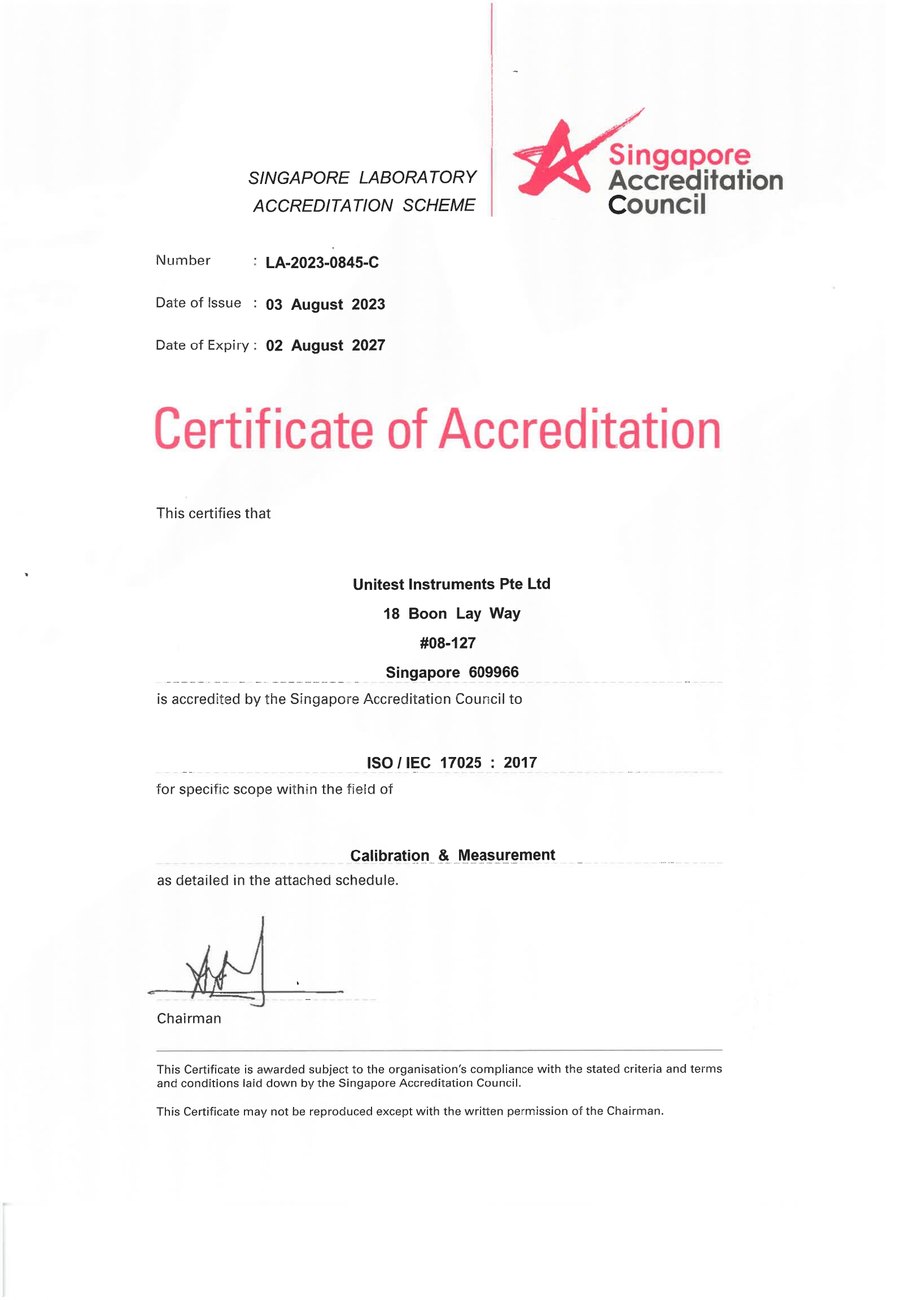
- SAC-SINGLAS accredited calibration (Acc. No. LA-2023-0845-C) is required for MOM statutory electrical inspections, BCA commissioning, and ISO 9001 clause 7.1.5 compliance.
- The standard calibration interval for insulation resistance testers is 12 months; heavy field use or mechanical shock warrants 6 months.
- A valid calibration certificate must state measurement uncertainty and traceability to NMC Singapore, not just pass/fail results.
- Field verification with a decade resistance box is useful for daily confidence checks but does not replace laboratory calibration for regulatory purposes.
What Happens During Insulation Resistance Tester Calibration?
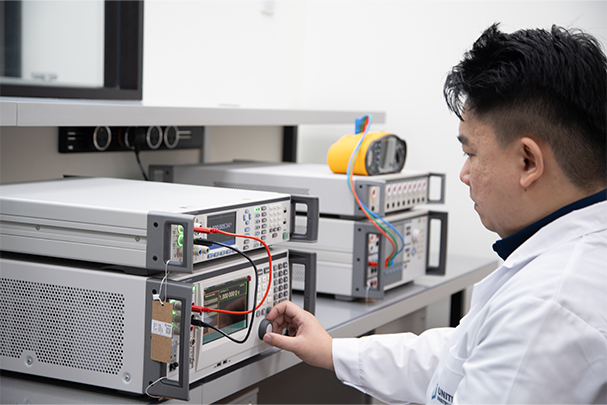
An insulation resistance tester (also called a megohmmeter or megger), applies a high DC voltage across an insulation barrier and measures the resulting leakage current to calculate resistance. Calibration at an accredited laboratory confirms two independent measurement parameters: the accuracy of the instrument's output test voltage, and the accuracy of the resistance values it displays.
The laboratory connects the instrument to a high-voltage precision voltmeter to measure the actual DC output at each rated voltage setting. Typically 250 V, 500 V, 1000 V, 2500 V, and 5000 V. The measured voltage must fall within the manufacturer's specification, which is typically ±2% to ±5% of the rated value. Even a 5% voltage error at 1000 V produces a 100 V discrepancy that can invalidate pass/fail decisions on motor windings, cable jackets, and switchgear insulation.
For resistance verification, the laboratory applies a series of traceable reference resistances (precision decade resistor standards ranging from 100 kΩ up to 10 TΩ), and records the instrument's displayed reading against the known value. The deviation at each test point, expressed as a percentage of reading or in absolute ohms, is reported alongside the expanded measurement uncertainty (typically at a 95% confidence level, k=2). This systematic approach is mandated by ISO/IEC 17025 and distinguishes accredited calibration from simple "plug and check" field verification.
Reference Standards and Traceability to NMC Singapore
Calibration is only as reliable as the reference standards used. At Unitest Instruments' SAC-SINGLAS accredited laboratory (Acc. No. LA-2023-0845-C), reference resistance standards are calibrated directly by (or in an unbroken chain back to), the National Metrology Centre (NMC) Singapore, which is Singapore's primary national measurement authority. This chain of traceability is a legal and technical requirement for certificates accepted by MOM and the Singapore Accreditation Council.
The reference standards used for insulation resistance calibration include precision high-value resistance standards housed in temperature-controlled enclosures, and high-voltage reference dividers for voltage verification. Each reference standard carries its own SAC-SINGLAS or BIPM-traceable calibration certificate with stated uncertainties. The laboratory's uncertainty budget, which combines the reference standard uncertainty, resolution of the instrument under test, repeatability of measurements, and environmental factors. Is formally documented and assessed during the SAC-SINGLAS accreditation audit.
For users, this traceability chain means that a measurement of 100 MΩ on your calibrated instrument is directly comparable to a measurement made anywhere in Singapore or internationally, within the stated uncertainty bounds. This comparability is the technical foundation of regulatory compliance. It is why MOM's Registered Inspectors and ISO 9001 auditors specifically request SAC-SINGLAS accredited certificates rather than generic "calibrated" labels.
As explained in our article on what calibration traceability means, the traceability chain from your instrument to the NMC is not an administrative formality. It is the technical guarantee that your measurement result is meaningful.
Calibration Interval Recommendations for Singapore Conditions
Singapore's equatorial climate (high humidity, temperatures consistently above 28°C, and frequent condensation in industrial environments), accelerates the drift of precision electronic components. The standard recommended calibration interval for insulation resistance testers is 12 months, consistent with most manufacturers' specifications and the IEC 61557-2 standard for insulation monitoring equipment.
However, several operating conditions in Singapore justify a shorter 6-month interval:
- High-frequency field use: instruments used daily on construction sites, in cable-testing routines, or for routine motor maintenance accumulate mechanical wear faster than laboratory-based instruments.
- Inductive load testing: testing motors, transformers, and long cable runs causes the instrument to dissipate stored energy on disconnection. Repeated inductive kickbacks stress internal protection circuits.
- Mechanical shock and vibration: instruments dropped or transported in vehicle toolboxes without adequate protection should be re-calibrated immediately after any significant impact, regardless of interval.
- High-voltage range use: instruments operated routinely at 2500 V or 5000 V experience greater internal stress than those used primarily at 500 V.
Our detailed article on how to determine the right calibration interval provides a systematic framework for setting intervals based on instrument criticality, use history, and drift data from previous calibrations.
A practical approach for Singapore facilities is to track drift data across successive calibrations. If an instrument consistently shows less than 20% of its allowable tolerance drift after 12 months, a 24-month interval may be justified with documented risk assessment. If drift approaches or exceeds tolerance limits, the interval should be shortened immediately.
Get Your Insulation Resistance Tester Calibrated with a Traceable Certificate
Unitest Instruments issues SAC-SINGLAS accredited calibration certificates (Acc. No. LA-2023-0845-C) accepted by MOM, BCA, and ISO 9001 auditors. Same-week turnaround available.
Field Calibration vs. Laboratory Calibration: What the Difference Means in Practice
The terms "field calibration" and "laboratory calibration" are sometimes used interchangeably in Singapore's electrical testing community, but they describe fundamentally different activities with different regulatory standing.
| Factor | Field Verification (On-Site) | Laboratory Calibration (Accredited) |
|---|---|---|
| Purpose | Spot-check for gross faults before a critical measurement session | Full parameter verification with traceable uncertainty |
| Reference standard | Portable decade resistance box (may not be traceable) | SAC-SINGLAS / NMC-traceable precision standards |
| Voltage verification | Rarely performed (requires HV reference meter) | All rated voltages verified with stated uncertainty |
| Uncertainty budget | Not calculated; results not comparable internationally | Fully documented per ISO/IEC 17025 |
| Certificate issued | None, or a non-accredited report | SAC-SINGLAS accredited certificate (LA-2023-0845-C) |
| Regulatory acceptance | Not accepted by MOM, BCA, or ISO 9001 auditors | Universally accepted across Singapore regulatory bodies |
| Frequency | Before each critical measurement session | Annually (or per defined interval) |
| Cost | Low (uses in-house reference box) | Moderate; typically S$80–S$200 per instrument |
Field verification is a valuable supplement, not a replacement. A well-run maintenance programme uses both: annual laboratory calibration to anchor the measurement to NMC traceability, and periodic field checks using a traceable portable reference to catch gross failures between formal calibrations.
What a Proper SAC-SINGLAS Calibration Certificate Must Show
Not all calibration certificates are equal. Singapore's MOM, BCA commissioning teams, and ISO 9001 auditors have become increasingly specific about what a valid calibration certificate must contain. A certificate that simply states "calibrated and found to be within specification" without supporting data is not compliant with ISO/IEC 17025 and should be rejected.
A proper SAC-SINGLAS calibration certificate for an insulation resistance tester must include all of the following elements:
- Instrument identification: make, model, serial number, and asset tag if applicable.
- Calibration date and due date: clearly stated, not ambiguous.
- Test voltage results: actual measured output voltage at each rated setting (250V, 500V, 1000V, 2500V, 5000V as applicable), with the allowable range and pass/fail status.
- Resistance measurement results: measured value, reference value, deviation, and measurement uncertainty for each test point across the instrument's range.
- Measurement uncertainty: expressed at 95% confidence level (k=2), separately for voltage and resistance measurements.
- Reference standards used: identification numbers, calibration certificates, and traceability statements for each reference standard.
- Environmental conditions: temperature and humidity at the time of calibration. Relevant because high-value resistance measurements are sensitive to ambient conditions.
- Laboratory accreditation number: LA-2023-0845-C for Unitest Instruments, prominently displayed with the SAC-SINGLAS mark.
- Authorised signatory: signature and name of the technically responsible person.
As we explain in our guide to reading a calibration certificate, each element serves a specific purpose. The uncertainty statement tells you how much to trust the result, and the traceability statement tells you where that trust comes from.
Singapore Regulatory Context: MOM, WSH, BCA, and ISO 9001
Singapore's regulatory framework creates multiple touchpoints where calibrated insulation resistance testers are either required or strongly implied. Understanding which regulation applies to your operation helps you scope your calibration programme correctly.
MOM Workplace Safety and Health (Electrical Safety) Regulations
The WSH (Electrical Safety) Regulations 2006, administered by the Ministry of Manpower, govern the safe installation, operation, and maintenance of electrical systems in workplaces. Registered Electrical Workers (REW) and Registered Inspectors (RI) appointed under the Electricity Act use insulation resistance testers as primary tools for verifying the integrity of new and existing electrical installations. While the regulations do not prescribe a specific calibration standard by name, MOM's enforcement practice (and the professional standards of the Singapore Contractors Association and the Institution of Engineers Singapore), treats SAC-SINGLAS accredited calibration as the expected baseline for instruments used in statutory inspections.
SS 638 and CP5 Code of Practice Requirements
Singapore Standard SS 638 (Code of Practice for Wiring of Electrical Equipment of Buildings) and CP5 (Code of Practice for Earthing) both require insulation resistance testing as part of installation verification and periodic inspection. The codes reference IEC 60364 and IEC 61557 for measurement procedures, which in turn require that instruments meet specified accuracy classes and that measurements be traceable. Facilities maintaining ISO 9001 certification under clause 7.1.5 (Monitoring and Measuring Resources) are explicitly required to calibrate measurement equipment against traceable standards at planned intervals. Insulation resistance testers fall squarely within this scope.
BCA Building Commissioning Requirements
The Building and Construction Authority's commissioning requirements for M&E systems (including LV switchboards, distribution boards, and cable systems), require insulation resistance test records as part of the commissioning package submitted to building owners and the Commissioner of Building Control. Commissioning engineers increasingly attach calibration certificates to their test records to demonstrate that the measurements were made with instruments of known accuracy. This practice, while not yet universally mandated by BCA regulations, is becoming standard expectation in quality-conscious project specifications.
Choosing the Right Insulation Resistance Tester for Your Application
Calibration is only effective if the instrument itself is suited to the measurement task. Selecting an appropriate megohmmeter before committing to a calibration programme avoids the frustration of calibrating an instrument that cannot reach the resistance ranges or test voltages your application demands.
For low-voltage distribution systems (230/400V), a 500V or 1000V insulation resistance tester covering 0 to 2 GΩ is typically sufficient. For medium-voltage cables (up to 11 kV), a 2500V or 5000V instrument with a range extending to 1 TΩ is required. Switchgear and rotating machinery testing for motors above 11 kW typically requires a 1000V instrument with PI (Polarisation Index) and DAR (Dielectric Absorption Ratio) functions. Features that should be verified during calibration alongside basic resistance accuracy.
You can browse and purchase insulation resistance testers suited to Singapore's electrical testing environment at unitestshop.com, where Unitest Instruments stocks a curated range of calibration-ready megohmmeters from leading manufacturers including Fluke, Megger, and Hioki.
Accredited vs. Non-Accredited Calibration: Making the Right Choice
Some calibration service providers in Singapore offer calibration at significantly lower cost than SAC-SINGLAS accredited laboratories. Understanding why the gap exists helps you make an informed decision about when non-accredited calibration is acceptable and when it is not.
Non-accredited calibration can be performed with calibrated equipment, but the laboratory's measurement competence, uncertainty budget methodology, and reference standard traceability have not been independently assessed. For internal quality control or general maintenance (where the goal is simply to confirm an instrument has not catastrophically failed), non-accredited calibration may be sufficient. However, for any instrument whose measurements underpin statutory compliance (MOM inspections, BCA commissioning), ISO 9001 clause 7.1.5 compliance, or third-party contractual obligations, only SAC-SINGLAS accredited calibration provides the independent assurance required.
For a detailed comparison across instrument types and use cases, see our article on accredited vs non-accredited calibration in Singapore, which outlines the specific scenarios where each is appropriate and the risks of choosing the cheaper option for the wrong application.
Two Field Practices That Matter as Much as Calibration: Guard Terminal Use and Temperature Correction
A perfectly calibrated insulation resistance tester can still produce a misleading reading in the field if two well-established measurement practices are skipped, and both are worth covering explicitly because they are frequently omitted by technicians under time pressure, even experienced ones. The first is use of the guard terminal, present on most quality megohmmeters but often left unconnected during routine testing. Surface leakage current, tracking across a contaminated or damp insulator surface rather than through the insulation bulk itself, adds directly to the measured leakage current and produces an artificially low resistance reading that has nothing to do with the actual insulation quality you are trying to assess. The guard terminal, connected to a conductive guard ring around the test point, diverts this surface leakage current away from the measurement circuit so the instrument reports only the current that has genuinely passed through the insulation. Testing cable terminations, bushings, or motor windings in Singapore's high-humidity environment without using the guard terminal is one of the most common reasons a technician sees a puzzlingly low reading on insulation that later tests fine, and the discrepancy has nothing to do with the instrument's calibration status.
The second practice is temperature correction of results for trend comparison. Insulation resistance is strongly temperature-dependent, as a rough rule of thumb, resistance roughly halves for every 10°C rise in winding or cable temperature, which means a reading taken on a motor at 45°C after several hours of operation is not directly comparable to a reading taken on the same motor at ambient temperature during a shutdown, even though both readings came from a correctly calibrated instrument. IEEE 43 and most insulation testing standards provide temperature correction factors (referenced to a standard 40°C base for rotating machinery) specifically to make trend data comparable across different test conditions, and a maintenance programme that tracks raw, uncorrected readings over successive tests risks either missing genuine insulation degradation (masked by a coincidentally cooler test condition) or flagging a false alarm (caused by a warmer test condition, not real deterioration). Building temperature recording and correction into your standard test procedure, alongside the guard terminal habit, closes the two most common gaps between "the instrument is calibrated" and "the reading is actually meaningful."
Reading PI and DAR Results Correctly
Polarisation Index (PI, the ratio of the 10-minute to 1-minute resistance reading) and Dielectric Absorption Ratio (DAR, the ratio of the 60-second to 30-second reading) are time-based tests that assess insulation condition beyond a simple spot resistance value, and interpreting them correctly requires understanding what they actually measure, not just comparing the resulting number against a table. Both tests exploit the fact that healthy, dry insulation continues to absorb charging current and shows a rising resistance trend over the test duration, while contaminated, moist, or degraded insulation reaches a stable (and lower) resistance value quickly and shows little further rise. A PI below roughly 1.0 to 1.5 (depending on the applicable standard and insulation class) suggests contamination or moisture ingress worth investigating, while a PI above 2.0 generally indicates good condition, but these are guideline ranges from IEEE 43, not universal pass/fail thresholds, and the correct interpretation depends on the specific machine's insulation class and its own historical trend rather than a single generic cut-off applied uniformly across every asset.
The practical value of PI and DAR testing is trend-based, not absolute, comparing a motor's PI reading against its own history over successive maintenance cycles reveals a developing insulation problem long before a simple spot resistance reading would show anything alarming, since a motor's spot resistance can remain comfortably above a minimum acceptable value even as its PI trend quietly deteriorates. This is why the calibration of the instrument's timing function (verifying that the 1-minute, 10-minute, 30-second, and 60-second intervals used in these ratio calculations are themselves accurate) matters for PI and DAR testing specifically, and it is worth confirming with your calibration provider that this timing accuracy is included in scope alongside the voltage and resistance calibration described earlier in this guide.
Frequently Asked Questions
During calibration, a laboratory verifies two primary parameters: (1) the output test voltage at each rated setting (e.g. 250V, 500V, 1000V, 2500V, 5000V), and (2) the resistance measurement accuracy across the instrument's full megohm range. The lab applies known, traceable reference resistances (typically from 100 kΩ up to 10 TΩ), and records the instrument's displayed value against the reference. Measurement uncertainty is calculated and reported on the certificate for every test point.
The recommended calibration interval for most insulation resistance testers used in Singapore is 12 months. Instruments subjected to frequent field use, mechanical shock, or high-voltage testing on inductive loads may warrant a 6-month interval. MOM's Workplace Safety and Health (Electrical Safety) Regulations and CP5 both require that test instruments used in statutory inspections be calibrated and traceable to national standards. A SAC-SINGLAS accredited laboratory such as Unitest Instruments (Acc. No. LA-2023-0845-C) can issue certificates accepted by MOM-appointed Electrical Workers and Registered Inspectors.
Accredited calibration (SAC-SINGLAS / ISO/IEC 17025) means the laboratory's measurement capability has been independently assessed and its uncertainty budget validated against NMC Singapore's primary references. The certificate includes stated measurement uncertainty and a traceable chain. Non-accredited calibration may use calibrated reference equipment but the laboratory's competence and uncertainty claims are not independently verified. For MOM, BCA, or ISO 9001 audit purposes, only accredited calibration certificates are universally accepted without question.
A proper SAC-SINGLAS calibration certificate must include: the instrument make, model, and serial number; calibration date and due date; all test voltages verified (e.g. 250V, 500V, 1000V, 2500V); resistance measurement results at multiple points across the full range; measurement uncertainty for each result; reference standards used and their traceability to NMC Singapore; the laboratory's SAC-SINGLAS accreditation number (LA-2023-0845-C for Unitest Instruments); and the signature of a technically responsible person. Certificates that omit measurement uncertainty or traceability statements are not compliant with ISO/IEC 17025.
The Workplace Safety and Health (Electrical Safety) Regulations 2006 under MOM require that instruments used by Electrical Workers and Registered Inspectors be fit for purpose and maintained. CP5:2009 (Code of Practice for Earthing) and SS 638 (Code of Practice for Wiring of Electrical Equipment) reference traceable measurement as best practice for insulation testing. BCA's requirements for building commissioning also implicitly require calibrated instruments. For ISO 9001-certified organisations, clause 7.1.5 mandates that monitoring and measuring equipment be calibrated against traceable standards at planned intervals.
Field verification (using a portable reference decade resistance box), can confirm that an instrument has not drifted significantly between formal calibrations, but it cannot replace laboratory calibration. A laboratory calibration provides full voltage verification, a traceable uncertainty statement, and an accredited certificate. Field checks are useful for daily confidence before critical measurements but do not satisfy MOM, BCA, or ISO 9001 requirements for traceable calibration.
Calibration covers every selectable test voltage on the instrument. Typically 250V, 500V, 1000V, 2500V, and 5000V for a full-range megohmmeter. The laboratory measures the actual output voltage under no-load and load conditions using a traceable high-voltage reference meter, and verifies it falls within the manufacturer's specification (commonly ±2% to ±5% of rated voltage). This is critical because an out-of-tolerance test voltage will produce incorrect resistance readings and may invalidate pass/fail decisions on insulation integrity tests.
You can request a calibration quote through the Unitest Instruments contact page at theuniteststandard.com/contact.html. Bring or courier your instrument to our SAC-SINGLAS accredited laboratory (Acc. No. LA-2023-0845-C). Standard turnaround is 3–5 working days; express same-week service is available on request. We issue ISO/IEC 17025-compliant certificates accepted by MOM-appointed inspectors, BCA, and ISO 9001 auditors across Singapore.
SAC-SINGLAS accredited calibration laboratory (Acc. No. LA-2023-0845-C) serving Singapore's industrial, pharmaceutical, and manufacturing sectors. All content reflects our ISO/IEC 17025 accredited scope and is reviewed by our technical calibration team.
Need insulation resistance tester calibration in Singapore?
Unitest Instruments is SAC-SINGLAS accredited (Acc. No. LA-2023-0845-C) to ISO/IEC 17025. Same-week turnaround, certificates accepted by ISO 9001 auditors.