
Key takeaways
- Singapore's WSH (Electrical Work) Regulations 2020 requires electrical installations to be tested and verified by a Licensed Electrical Worker (LEW) or Electrical Worker (EW). PAT testing of portable equipment is not explicitly mandated by statute but is required by many companies' safety management systems and insurance policies.
- The three core PAT tests: earth continuity (earthed equipment only (resistance of protective earth conductor must be <0.5Ω typically); insulation resistance (at 500V DC), must exceed 1MΩ for Class I, 2MΩ for Class II); earth leakage (protective earth current must not exceed 3.5mA for standard equipment, 0.75mA for sensitive equipment).
- The PAT tester itself must be calibrated. A tester that applies the wrong test voltage or measures resistance/leakage incorrectly produces unreliable test results, which is worse than no testing at all.
- Insulation resistance decreases with moisture, contamination, age, and damage. A reading of 2MΩ is marginal; 20MΩ or higher is typical for new equipment. Equipment that fails the insulation test must be withdrawn from service immediately.
- Class I equipment (earthed, metal casings (computers, power tools, most laboratory equipment) and Class II equipment (double-insulated, no earth), many domestic appliances, some power tools) require different test sequences.
PAT test types at a glance
The table below summarises the eight test types used in portable appliance and installation testing, what each checks, the pass/fail criterion, and the instrument required.
| Test | What it checks | Pass/fail criterion | Instrument required |
|---|---|---|---|
| Visual inspection | Physical damage, frayed cable, cracked plug, correct fuse | Pass if no visible defect | None. Trained visual check |
| Earth continuity | Low resistance of protective earth conductor from socket pin to exposed metal | <0.5Ω (includes test lead resistance) | PAT tester or low-resistance ohmmeter |
| Insulation resistance (500V DC) | Resistance between Live+Neutral and Earth (Class I) or between terminals and case (Class II) | >1MΩ (Class I), >2MΩ (Class II) | PAT tester or insulation resistance tester |
| Substitute/touch leakage | Current that would flow through a person touching exposed metalwork | <0.75mA (sensitive), <3.5mA (standard) | PAT tester |
| Protective conductor current | Current in the earth conductor under normal operation | <3.5mA | PAT tester (leakage clamp) |
| Functional check | Equipment operates correctly after all tests | Equipment must function | , |
| Flash test (4kV) | Dielectric strength. Only for equipment that withstands high voltage | Per product standard | Hipot/dielectric strength tester |
| Earth electrode resistance | Resistance of earth electrode to remote earth | <1Ω for TN-S systems | Earth electrode tester (4-terminal) |
1. The regulatory landscape in Singapore
Electrical safety in Singapore is governed by a framework of legislation, codes of practice, and workplace health and safety regulations that work together rather than as a single statute.
The Electricity Act (Cap. 89A) is the primary legislation. It regulates who may perform electrical work, how electrical installations must be constructed and maintained, and what constitutes an unsafe electrical installation. The Energy Market Authority (EMA) administers the Act and sets the licensing requirements for electrical workers and contractors.
The Workplace Safety and Health (Electrical Work) Regulations 2020 (WSH Electrical Work Regulations) specifically address the testing and certification of electrical installations in workplaces. Under these regulations, fixed electrical installations must be tested and verified by a Licensed Electrical Worker (LEW) with an appropriate licence class, or by an Electrical Worker (EW) working under LEW supervision, before initial energisation, after significant modifications, and on a periodic basis. The LEW issues a certificate of compliance.
SS 638 (the Singapore Standard Code of Practice for Electrical Installations), and CP5 (Code of Practice for Electrical Installations, the residential equivalent) set the technical requirements for how installations must be constructed and tested. SS 638 specifies the inspection and testing procedures that LEWs follow when certifying fixed installations.
For portable electrical equipment, there is no single statute that mandates PAT testing at a specific frequency. However, occupiers have a duty under both the Workplace Safety and Health Act and the Electricity Act to maintain electrical equipment in a safe condition. In practice, most companies' safety management systems, as well as many professional indemnity, product liability, and employer liability insurance policies, require evidence of regular portable appliance testing as part of workplace electrical safety management. Insurance assessors and MOM WSH inspectors may ask to see PAT test records at any time.
2. Class I vs Class II equipment. Why it matters for testing
Before testing any portable electrical appliance, the first step is identifying its protection class. The class determines which tests apply, and applying the wrong test sequence to the wrong class of equipment produces misleading results.
Class I (earthed equipment)
Class I equipment uses a single layer of insulation for primary protection, with a protective earth conductor as the safety backup. If the insulation fails (due to damage, moisture, aging, or contamination), the fault current flows to earth through the protective conductor, trips the circuit breaker, and prevents a lethal shock. The key safety requirement is that the earth path remains intact and has low resistance. Examples include desktop computers, microwave ovens, most power tools, laboratory bench equipment, kettles, and toasters. Tests required: earth continuity AND insulation resistance.
Class II (double-insulated equipment)
Class II equipment has two independent layers of insulation (functional insulation plus supplementary insulation), with no protective earth conductor. An insulation failure must penetrate both independent layers before a shock hazard exists, making a protective earth unnecessary. Class II equipment is identified by the double-square symbol (□□) moulded into the equipment or label. Examples include many hair dryers, some power tools, some laptop power adapters, and many portable power supplies. Tests required: insulation resistance only. There is no earth conductor to test, and applying an earth continuity test would falsely fail the appliance. Do not attempt earth continuity on Class II equipment.
Class III (extra-low voltage, SELV)
Class III equipment operates at Safety Extra-Low Voltage. Below 50V AC or 120V DC. The voltage is inherently below the threshold considered dangerous under normal dry conditions. Examples include some battery chargers, LED lighting systems, and low-voltage control equipment. Tests required: typically visual inspection and functional check only. Insulation resistance testing at 500V DC is not appropriate for Class III equipment and may damage it.
3. Earth continuity testing in detail
Earth continuity testing measures the electrical resistance of the protective earth conductor. The connection from the earth pin of the plug, through the appliance cable, cable gland, and internal wiring, to every exposed conductive part of the appliance. This test applies only to Class I (earthed) equipment.
The purpose is to confirm that if the live conductor inside the appliance touches an exposed metal part due to an insulation failure, the protective earth can conduct the resulting fault current safely to the earth of the supply system, at sufficient current to operate the overcurrent protection (circuit breaker or fuse) and disconnect the supply before a dangerous shock can occur. A high earth continuity resistance (even 2 or 3 ohms), significantly reduces the fault current and may prevent the protective device from operating fast enough.
The test is performed by the PAT tester passing a low test current (typically 200mA or 25A depending on the tester type) through the earth conductor while measuring the resulting voltage drop. The resistance is calculated and compared against the pass criterion. Pass criterion: less than 0.5Ω, inclusive of the test lead resistance.
Common failure modes: corroded or loose earth connection at the cable gland; poorly crimped earth terminal inside the appliance; damaged or broken earth conductor within a frayed cable; a plug wired with the earth terminal not connected. What to do on failure: remove the equipment from service immediately; do not allow continued use until the fault has been identified, repaired, and verified by retest. Record the failure, the fault found, the repair, and the retest result.
4. Insulation resistance testing. The 500V DC test
Insulation resistance testing checks the electrical integrity of the insulation that separates the live conductors of an appliance from any part that a person could touch. For Class I equipment, the test is applied between the live and neutral conductors (connected together) and the protective earth. For Class II equipment, the test is applied between the live and neutral conductors and the case or any accessible conductive part.
The test voltage is typically 500V DC for mains-connected equipment. The insulation resistance (in megohms) is measured after the voltage has been applied for a set time (typically 1 minute for a stable reading). The result reflects the combined resistance of all insulation in the circuit. Cable insulation, component insulation, and any contamination paths.
Pass criteria: greater than 1MΩ for Class I equipment; greater than 2MΩ for Class II equipment. These are the minimum acceptable values. New equipment in good condition typically measures 100MΩ or more, often into the gigaohm range. A reading between 1MΩ and 10MΩ is marginal: the equipment may remain in service, but the downward trend should be tracked and the test interval shortened. Any reading below 1MΩ for Class I, or below 2MΩ for Class II, means the equipment must be withdrawn from service immediately and must not be returned until the fault has been found, repaired, and the insulation resistance confirmed above the minimum threshold by retest.
Why insulation fails: moisture ingress through a damaged cable entry or worn gland; physical damage to cable insulation from pinching, cutting, or repeated flexing; aging and thermal cracking of PVC cable insulation; contamination (oil, water, cleaning chemicals), on exposed conductors or terminal blocks; overloading causing thermal degradation of insulation materials.
5. Earth leakage testing. Protective conductor current and touch current
Earth leakage testing measures the current that flows to earth through the insulation of an appliance while it is operating under load. Unlike insulation resistance testing, which applies a DC test voltage with the equipment de-energised, earth leakage testing is performed with the equipment energised and operating normally.
Protective conductor current
Protective conductor current is measured using a leakage clamp placed around the earth conductor of the appliance while it is running. It indicates the current flowing from live conductors through insulation imperfections and EMC filter capacitors to earth under normal operating conditions. Some earth leakage is normal and expected. Particularly in IT equipment, which contains EMC filter capacitors connected between live conductors and earth to suppress high-frequency interference. A single office computer may have an earth leakage current of 0.5–2.5mA. Pass criterion: less than 3.5mA for standard equipment.
Touch current (substitute leakage)
Touch current (also called substitute leakage current), simulates the current that would flow through a person touching an exposed conductive part of the appliance. The measurement method uses a network simulating the impedance of the human body, and is typically performed by the PAT tester in a specific test mode. Pass criterion: less than 3.5mA for standard equipment, less than 0.75mA for sensitive equipment (medical-adjacent or equipment used with vulnerable persons).
An important practical consideration in Singapore's data centres, trading floors, and server rooms: IT equipment with multiple units daisy-chained on a single circuit can have cumulative earth leakage that exceeds safe limits even if each individual unit passes its own leakage test. The individual unit tests pass because each unit's leakage is within limit. But when all units share a common earth path, the total leakage adds. In high-density IT installations, a whole-rack leakage measurement (rather than individual unit PAT tests alone), is needed to confirm the installation is safe.
6. PAT testing instruments. What they do and calibration requirements
The instruments used for electrical safety testing span a range of capability, from simple portable appliance testers to full multifunction installation testers used by LEWs on fixed installations.
Simple PAT testers
Instruments such as the Megger PAT150, Fluke 6500-2, and similar testers automate the earth continuity, insulation resistance, and leakage test sequence for portable appliances. They apply the test voltage, measure the result, compare it against a stored pass/fail threshold, and display the outcome. Typically with a numerical reading and a pass/fail indicator. Many modern PAT testers also generate and store test records in internal memory or export them via USB or Bluetooth to a PAT management database.
These instruments must themselves be calibrated. The test voltage applied (500V DC for insulation resistance) is generated internally, and its accuracy drifts over time with component aging. The resistance and leakage measurement circuits drift independently. An uncalibrated PAT tester may apply 450V instead of 500V. Undertesting equipment and missing a borderline insulation failure. It may read an earth continuity resistance of 0.3Ω when the true resistance is 0.8Ω, falsely passing a dangerous earth. The test results from an uncalibrated PAT tester provide no reliable safety evidence, and no defensible legal or insurance record. Recommended calibration interval: 12 months.
Multifunction installation testers
Instruments such as the Megger MFT1741, Fluke 1663, and similar devices are used by LEWs for the periodic inspection and testing of fixed electrical installations. They measure earth fault loop impedance, RCD trip time and current, prospective fault current, insulation resistance, continuity of protective conductors, and polarity. These instruments are more complex than simple PAT testers and require calibration of multiple independent measurement functions. Recommended calibration interval: 12 months.
Standalone insulation resistance testers
Instruments such as the Megger MIT400, Fluke 1587FC, and Hioki IR4056 are dedicated insulation testers covering multiple test voltages (250V, 500V, 1000V, and sometimes 2500V or 5000V DC). They are used for both portable appliance insulation testing and for fixed installation insulation checks on cables and motor windings. Calibration covers output voltage accuracy at each test voltage and resistance measurement accuracy at multiple values. Recommended calibration interval: 12 months.
PAT testers, insulation testers, and multifunction testers. Calibrated certificates
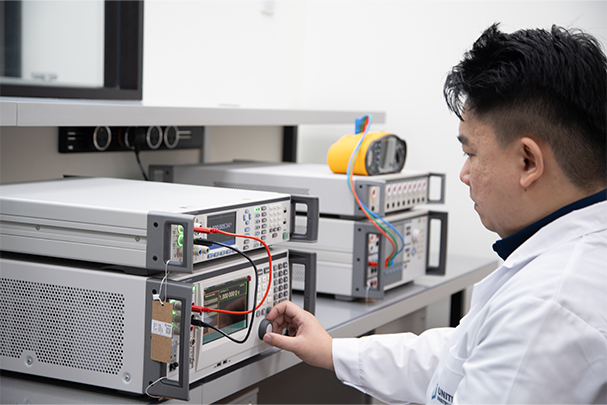
Unitest calibrates insulation resistance testers, PAT testers, and multifunction installation testers against NMC-traceable references. SAC-SINGLAS accredited. Your electrical safety records are defensible.
7. Fixed installation testing. Beyond portable appliances
Periodic Inspection and Testing (PITT) of fixed electrical installations is required under SS 638 and the WSH (Electrical Work) Regulations 2020. Unlike PAT testing, fixed installation testing must be performed by or under the direct supervision of a Licensed Electrical Worker (LEW) with the appropriate licence class.
What is tested in a PITT: earth fault loop impedance (confirming that the total impedance of the fault circuit is low enough to cause the overcurrent protection to operate within the required time); RCD response time and trip current (confirming that the residual current device trips within 300ms or 40ms as appropriate at its rated trip current); insulation resistance of fixed wiring (checking for degradation of cable insulation); continuity of protective conductors (ring final circuit continuity, CPC continuity); polarity (confirming live and neutral are correctly connected at all outlets).
Frequency of PITT in Singapore: commercial office and retail installations (typically every 5 years as a baseline; industrial installations and those with harsher environments), more frequently; installations in hazardous areas (flammable atmospheres) (annually or more frequently per the specific area classification; swimming pools and similar wet environments), annually. The LEW sets the recommended retest date based on the installation's condition, environment, and age.
The instruments used for PITT (multifunction installation testers), must be calibrated, and the calibration status of the instruments should be recorded on the test certificate issued by the LEW.
8. Calibration of electrical safety testing instruments. What is verified
Calibration of electrical safety test instruments verifies the accuracy of the measurement functions that the test result depends on. The specific parameters verified depend on the instrument type.
Insulation resistance testers
Calibration covers: output voltage accuracy at each test voltage (250V, 500V, 1000V. The tester must apply the correct voltage, not ±10% of it); resistance measurement accuracy at multiple resistance values across the range (typically 1MΩ, 10MΩ, 100MΩ, and 1GΩ. Checking linearity, not just one point); and where applicable, the timed measurement function (some testers display a polarisation index or dielectric absorption ratio based on measurements at 1 minute and 10 minutes).
Earth continuity / low-resistance ohmmeters
Calibration covers: the test current output (the tester must deliver the specified test current. Typically 200mA or 25A); resistance measurement accuracy at the relevant range (0.01Ω to 2Ω for PAT earth continuity; wider ranges for other applications); and resolution (the ability to distinguish small resistance differences that determine pass/fail at the 0.5Ω threshold).
PAT testers (combined instruments)
Calibration covers all of the above. Test voltage accuracy, resistance measurement, leakage current measurement accuracy (at values bracketing the 3.5mA and 0.75mA pass/fail thresholds). A PAT tester with a poorly calibrated leakage measurement circuit may pass equipment with 4mA of earth leakage (above the safe limit), because its leakage circuit reads 3.2mA when the true value is 4.1mA.
Multifunction installation testers
Calibration covers all insulation and continuity functions, plus: loop impedance measurement accuracy across the range (a critical measurement. Loop impedance determines whether the circuit breaker will operate in time under a fault condition); RCD test accuracy (trip time measurement and trip current measurement); prospective fault current measurement accuracy. These are complex multi-function instruments, and their calibration scope is broader than simple PAT testers. Recommended calibration interval for all electrical safety test equipment: 12 months.
9. Records. What you must keep
Whether or not PAT testing is explicitly required by a statute in a given situation, keeping clear, complete records is essential for demonstrating due diligence to auditors, insurers, and regulators. A record that cannot be found is a record that does not exist for the purposes of an inspection or a legal proceeding.
A complete PAT test record for each appliance should include: (a) Test date; (b) Appliance identification (asset tag number, description, model, serial number, and location; (c) Test results), earth continuity reading in Ω (where applicable), insulation resistance reading in MΩ, leakage current in mA, and pass/fail for each individual test; (d) Next test due date; (e) Tester ID and operator name; (f) Calibration certificate reference for the PAT tester used. Instrument model, serial number, calibration date, and certificate number.
The calibration certificate reference is important. If an auditor or inspector questions whether the test results are reliable, the calibration certificate reference allows them (and you), to verify that the instrument was in calibrated condition at the time of testing. A PAT test record that does not reference the instrument's calibration status is less defensible than one that does.
For large organisations in Singapore, dedicated PAT testing databases and asset management systems (such as PAT Manager and Asset Web Manager) are standard. They store test results against asset records, generate test labels with next-due dates, and produce audit-ready reports. For smaller operations, a spreadsheet capturing all the above fields is adequate. Whatever the format, records should be retained for at least the interval since the last test and ideally for the full service life of the equipment. The standard practice is to retain records for a minimum of 5 years or until the equipment is disposed of, whichever is longer.
10. Common questions and mistakes in Singapore workplaces
Our IT equipment all passed individually but the data centre earth current is very high
This is the cumulative earth leakage problem specific to IT-dense installations. Each unit contains EMC filter capacitors connected between live conductors and earth, which is why the equipment passes electromagnetic compatibility requirements. But those capacitors allow a small continuous current to flow to earth. When 20, 50, or 200 units share a common earth path in a server room or trading floor, the individual leakage currents add. The solution is not to retest individual units, they will still pass. The solution is to measure the total earth leakage of the entire rack, row, or installation as a system. If the total exceeds safe limits, reducing the number of units on a shared earth, adding isolated power distribution, or installing leakage monitoring equipment are the engineering options.
We do PAT testing in-house, do we need calibrated equipment?
Yes, and this is not optional. An uncalibrated PAT tester gives unreliable results. If the tester passes equipment that would fail if correctly tested, the organisation has gained false assurance, which is worse than having no record at all, because it creates a documented false trail. If an accident then occurs involving an appliance that passed an in-house test using an uncalibrated instrument, the record provides no defence and may be used as evidence of inadequate safety management. All PAT testing instruments used in-house should be calibrated on a 12-month cycle by an accredited laboratory, and the calibration certificate reference should appear in every test record.
How often should we PAT test in Singapore?
There is no single statutory frequency for portable appliance testing. The appropriate interval depends on the equipment type, the environment, how often the equipment is moved, and the risk assessment. Industry practice: office IT and desk equipment (every 3 years; equipment that is moved frequently or used in harder environments), annually; construction sites (every 3 months; equipment returned from repair), before return to service regardless of when last tested. Equipment showing deterioration (lower insulation resistance readings trending downward over successive tests) should be retested more frequently and withdrawn if the trend continues.
Can anyone do PAT testing?
For portable appliance testing, a trained person (not necessarily a Licensed Electrical Worker), can perform the tests. The person should understand how to use the PAT tester correctly, how to perform a competent visual inspection, how to interpret the results (including understanding borderline readings, not just pass/fail), and when to refer equipment for further investigation. For the testing and certification of fixed electrical installations (earth fault loop impedance, RCD testing, insulation resistance of fixed wiring), a Licensed Electrical Worker is required under the WSH (Electrical Work) Regulations 2020. Performing fixed installation testing without an LEW licence is an offence under the Electricity Act.
Frequently asked questions
PAT testing of portable electrical equipment is not explicitly mandated by a single statute in Singapore, but occupiers have a duty under the Workplace Safety and Health Act and the Electricity Act to maintain electrical equipment in a safe condition. Many companies' safety management systems, insurance policies, and industry codes of practice effectively require regular PAT testing as a standard of due diligence. Fixed electrical installations must be tested and certified by a Licensed Electrical Worker (LEW) under the WSH (Electrical Work) Regulations 2020.
There is no single statutory frequency for portable appliance testing in Singapore. Industry practice is: office IT and desk equipment (every 3 years; equipment moved frequently or used in harsher environments), annually; construction sites (every 3 months; equipment returned from repair), before return to service. The appropriate interval depends on equipment type, environment, and risk. Equipment showing a declining insulation resistance trend over successive tests should be retested more frequently and withdrawn if deterioration continues.
Class I equipment (earthed) relies on a protective earth conductor as a safety backup if insulation fails. Examples include desktop computers, microwave ovens, and most power tools. It requires both earth continuity and insulation resistance testing. Class II equipment (double-insulated) has two independent layers of insulation and no protective earth, marked with the double-square symbol. Examples include many hair dryers and some power tools. Class II requires insulation resistance testing only. There is no earth to test. Class III (extra-low voltage SELV) typically requires only visual and functional checks.
The minimum acceptable insulation resistance is 1MΩ for Class I equipment and 2MΩ for Class II equipment when tested at 500V DC. New equipment typically measures 100MΩ or higher. Readings between 1MΩ and 10MΩ are marginal. The equipment should remain in service but be monitored and retested more frequently. Any reading below 1MΩ for Class I or below 2MΩ for Class II means the equipment must be withdrawn from service immediately, inspected, repaired, and retested before use.
Yes. A PAT tester that applies the wrong test voltage (for example, 450V instead of 500V DC) will undertest equipment and miss borderline insulation failures. A tester with a drifted resistance circuit may read an earth continuity resistance of 0.3Ω when the true value is 0.8Ω, falsely passing a dangerous earth connection. The test results from an uncalibrated PAT tester are unreliable and provide no valid safety evidence, and no legal or insurance defence. Calibration interval is 12 months for all electrical safety test instruments.
For portable appliance testing, a trained person (not necessarily a Licensed Electrical Worker), can carry out PAT testing. The person should be trained in use of the PAT tester, interpretation of results, and visual inspection requirements. For testing and certification of fixed electrical installations (periodic inspection and testing, PITT), a Licensed Electrical Worker (LEW) with the appropriate licence class is required under the WSH (Electrical Work) Regulations 2020. Performing fixed installation testing without an LEW licence is an offence under the Electricity Act.
Yes. Unitest calibrates insulation resistance testers, PAT testers, and multifunction installation testers against NMC-traceable reference standards. Our calibration is SAC-SINGLAS accredited (accreditation no. LA-2023-0845-C), which means the certificate is independently verified, states measurement uncertainty, and is accepted by ISO 9001, WSH, and insurance auditors. Contact us via the quote page or visit our accreditation page for the full scope of what we cover.

Unitest Instruments Pte. Ltd. is a SAC-SINGLAS accredited calibration laboratory (ISO/IEC 17025, no. LA-2023-0845-C) based in Singapore. We calibrate electrical safety test equipment (including insulation resistance testers, PAT testers, and multifunction installation testers), for manufacturers, service providers, and regulated industries across Singapore and the region.
Calibrate your electrical safety test equipment. Traceable, accredited
Unitest calibrates PAT testers, insulation resistance testers, and multifunction installation testers. SAC-SINGLAS accredited. Reliable records for MOM WSH and ISO audits.
Verifiable at sac.gov.sg · Acc. No. LA-2023-0845-C