
Key Takeaways
- Test voltage selection matters: 500 V or 1000 V for standard LV wiring; 2500 V–10 kV for MV switchgear and large motors.
- The Fluke 1507 is the preferred field workhorse for Singapore LV electricians; the Fluke 1587 FC adds a full multimeter in one tool.
- Amprobe AMB-55 and Amprobe AMB-45 offer cost-effective alternatives with solid specs for smaller contractors.
- SS 638 and EMA licensing requirements mandate insulation testing for new and modified installations before energisation.
- A freshly purchased insulation tester should be calibrated by a SAC-SINGLAS accredited laboratory to establish a traceable baseline and satisfy ISO 9001 or customer audit requirements.
Who Needs an Insulation Tester, and Why
In Singapore, every licensed electrician working on low-voltage (LV) installations up to 1000 V must verify insulation integrity before energising new wiring, after any modification, and as part of periodic maintenance inspections mandated under SS 638 (the Singapore Standard for Electrical Installations, aligned to IEC 60364). This means insulation resistance testing is not optional. It is a statutory requirement that underpins safe commissioning sign-off by the Energy Market Authority (EMA).
Beyond compliance, insulation resistance testing catches degraded cable insulation, moisture ingress, contamination, and incipient faults before they cause equipment damage, production downtime, or (in the worst case), electrical fires. In Singapore's tropical climate, where high ambient humidity accelerates insulation ageing, regular testing is especially important for switchboards, motor circuits, and wiring in wet areas such as food processing facilities, pharmaceutical cleanrooms, and marine workshops.
The instrument you choose must match your typical test voltage range, your measurement range (how high a resistance you need to resolve), site conditions (dust, humidity, vibration), and (critically for regulated work), whether you need a calibration certificate accepted by inspectors and auditors.
Key Specifications to Compare
Before looking at specific models, understand the five specifications that matter most when selecting an insulation resistance tester for Singapore electrical work.
Test Voltage Range
The test voltage must be appropriate for the insulation class of the equipment. For standard 230 V/400 V LV wiring in Singapore, 500 V DC is the most common test voltage; 1000 V is used for higher-specification cables or when a more stressful acceptance test is required. For medium-voltage (MV) assets (6.6 kV or 22 kV switchgear, large transformer windings, or MV cable runs), test voltages of 2500 V, 5000 V, or 10 kV are appropriate. Using a voltage far above the equipment's rated insulation class can permanently damage cables, motor windings, or sensitive electronics.
Measurement Range
New cables in good condition can show insulation resistance in the gigohm (GΩ) range. A meter with an upper measurement limit of only 2 GΩ or 4 GΩ will report an off-scale reading on healthy cable and provide no useful diagnostic data. For field work, a range of at least 10 GΩ at 1000 V is recommended; for MV applications, 1 TΩ capability is useful.
Polarisation Index and Dielectric Absorption Ratio
For motor winding assessment, the Polarisation Index (PI (the ratio of the 10-minute reading to the 1-minute reading) and the Dielectric Absorption Ratio (DAR), the 60-second to 30-second ratio) are important diagnostic parameters. A tester that calculates these automatically saves considerable time in the field. PI above 2.0 generally indicates acceptable insulation; PI below 1.0 indicates a wet or seriously degraded winding.
CAT Rating and IP Protection
Singapore electrical sites range from clean commercial electrical rooms to outdoor construction sites and industrial plants. Look for a CAT III or CAT IV rating appropriate to where in the electrical system you are working, and IP40 or higher ingress protection for dusty or damp environments.
Connectivity and Data Logging
Modern megohmmeters increasingly offer Bluetooth or USB connectivity for downloading test records directly to a PC or mobile device. For contractors who need to produce traceable test reports for client handover or EMA submission, this feature significantly reduces transcription errors and paperwork time.
Top Insulation Testers Available Through Unitest Instruments
Unitest Instruments supplies and calibrates a range of insulation resistance testers from Fluke and Amprobe. Two of the most widely specified brands among Singapore electricians and electrical contractors. Below is a comparison of the top models suited to different applications and budgets.
| Model | Test Voltages | Max Measurement Range | Key Features | Price Range (SGD) | Best For |
|---|---|---|---|---|---|
| Fluke 1507 | 500 V, 1000 V | 10 GΩ @ 1000 V | PI & DAR, IP40, CAT III 1000 V, backlit display | S$650–780 | LV commercial & industrial electricians; general site use |
| Fluke 1587 FC | 500 V, 1000 V | 2 GΩ @ 1000 V | Full true-RMS multimeter, Bluetooth, CAT IV 600 V, PI & DAR | S$900–1,100 | Electricians who want insulation tester + multimeter in one tool |
| Fluke 1555 | 500 V, 1000 V, 2500 V, 5000 V, 10 kV | 200 GΩ @ 10 kV | High-voltage MV testing, PI & DAR, guard terminal, IP40, CAT III | S$3,200–3,800 | MV switchgear, large motors, cable testing at 6.6 kV / 22 kV |
| Amprobe AMB-55 | 250 V, 500 V, 1000 V | 4 GΩ @ 1000 V | PI & DAR, CAT III 1000 V, auto-discharge, compact form factor | S$350–430 | Smaller contractors and subcontractors; LV residential and light commercial |
| Amprobe AMB-45 | 250 V, 500 V, 1000 V, 2500 V | 30 GΩ @ 2500 V | PI & DAR, CAT III, 2500 V capability for LV motors, auto-discharge | S$480–570 | Motor maintenance engineers; LV motor winding assessment at higher stress |
Price ranges are indicative and subject to change. Contact unitestshop.com or Unitest Instruments directly for current pricing and availability.
Calibrate your insulation tester before the job matters
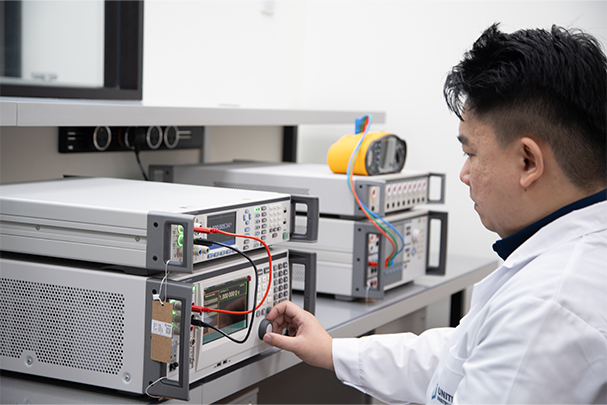
A newly purchased or long-unused megohmmeter may read outside its stated accuracy. Unitest Instruments issues SAC-SINGLAS accredited calibration certificates accepted by BCA, EMA inspectors, and ISO 9001 auditors, same-week turnaround available.
Singapore Standards and Regulatory Context
Insulation resistance testing in Singapore is governed primarily by SS 638: 2018 (Code of Practice for Electrical Installations), which adopts the framework of IEC 60364 and sets out minimum insulation resistance requirements for new and modified LV installations. Under SS 638, every circuit must pass an insulation resistance test (at 500 V DC for systems up to 500 V rated), before being energised, with the minimum acceptable reading of 1 MΩ per circuit. Periodic inspection intervals for existing installations are also defined, typically ranging from one to five years depending on installation type and risk classification.
Electricians holding EMA-issued electrical worker (EW) licences are responsible for ensuring that test instruments used in statutory testing are fit for purpose. While SS 638 does not mandate accredited calibration in every case, contractual frameworks (especially for building owners, government projects, and ISO 9001-certified contractors), increasingly require calibration certificates traceable to national standards. Understanding the difference between accredited and non-accredited calibration is essential for knowing when an SAC-SINGLAS certificate is required versus when an in-house check suffices.
For industrial applications involving motors and transformers, IEC 60034-27-1 (insulation resistance measurement on rotating machines) and IEC 60076-3 (transformer insulation) provide additional guidance on test voltages, acceptance criteria, and the interpretation of PI and DAR values. Electrical contractors working in pharmaceutical manufacturing, F&B, or data centre environments may also face customer-specific requirements that mandate calibrated instruments with documented traceability.
Why Calibration Matters for Your Insulation Tester
An insulation tester is a precision measurement instrument. Like any meter, its internal reference components (resistors, voltage regulators, analogue-to-digital converters), drift over time, particularly when the instrument is subjected to heat cycling, high humidity, and mechanical shock on construction sites. A tester that reads 2.0 MΩ when the true value is 1.2 MΩ will pass a circuit that should fail. A potentially dangerous outcome on a newly wired industrial panel.
For this reason, annual calibration by a SAC-SINGLAS accredited laboratory is the industry norm for insulation testers in regular use. Unitest Instruments (Acc. No. LA-2023-0845-C, ISO/IEC 17025) calibrates insulation resistance meters against standards traceable to Singapore's National Metrology Centre (NMC), covering test voltages from 100 V to 10 kV and resistance values from 100 kΩ to 1 TΩ. The calibration certificate we issue details the measured values, reference standards used, measurement uncertainty, and the technician sign-off. All the information an ISO 9001 auditor, BCA inspector, or project QA manager needs to close a non-conformance.
To understand what information appears on a calibration certificate and how to read it, see our guide on what a calibration certificate contains and means. For guidance on setting the right calibration interval for your instruments, read our article on how often calibration is needed.
Choosing the Right Model for Your Application
General LV Electrical Work. Fluke 1507
For the majority of Singapore electricians (those testing residential wiring, commercial switchboards, distribution boards, and standard motor circuits), the Fluke 1507 is the recommended choice. It covers the two most common test voltages (500 V and 1000 V), has a generous 10 GΩ measurement range that provides meaningful data on healthy new cables, automatically calculates PI and DAR for motor assessments, and is rated IP40 for dusty site conditions. The CAT III 1000 V rating is appropriate for work on distribution boards up to 1000 V. The backlit display is readable in Singapore's often harsh direct sunlight. Browse the Fluke 1507 and accessories at unitestshop.com.
Insulation Testing + Multimeter in One. Fluke 1587 FC
The Fluke 1587 FC combines a fully functional true-RMS multimeter with an insulation resistance tester, saving the cost and weight of carrying two instruments. It adds Bluetooth connectivity via the Fluke Connect app, enabling automatic logging and report generation from a smartphone. A real productivity advantage for contractors who need to produce handover documentation. The trade-off is a lower maximum insulation resistance range (2 GΩ at 1000 V) versus the dedicated 1507, which may show off-scale on excellent new cable. For electricians primarily interested in fault finding and motor checks, this is rarely a limitation.
Motor Maintenance. Amprobe AMB-45
The Amprobe AMB-45 extends test voltage to 2500 V, making it suitable for assessing motor windings rated above 1 kV without the cost of a full MV tester. Its 30 GΩ range at 2500 V provides headroom for assessing lightly loaded insulation. Auto-discharge after testing is a useful safety feature that prevents the hazard of accidentally touching charged test leads. At a significantly lower price point than the Fluke 1587 FC, the AMB-45 is a competitive option for contractors specialising in motor maintenance and mechanical engineering services.
MV Switchgear and High-Voltage Cables. Fluke 1555
For engineers and contractors working on Singapore's medium-voltage infrastructure , 6.6 kV distribution switchgear at industrial parks, 22 kV cable joints for SP Group subcontractors, or large transformer windings. The Fluke 1555 (10 kV model) is the appropriate tool. Its guard terminal eliminates surface leakage errors when testing contaminated or wet insulation surfaces, a critical feature for meaningful MV test results. The 200 GΩ maximum range provides useful data across the full spectrum of insulation conditions. This is a specialist instrument (most LV electricians will never need it), but for MV maintenance teams, it is indispensable.
Safe Testing Practice: The Discipline Behind the Instrument
An insulation tester applies a genuinely hazardous DC voltage, and safe practice around that voltage is as important to get right as selecting the correct instrument, particularly given how routine the task can start to feel after hundreds of repetitions on site.
The circuit under test must always be fully isolated and proven dead before connecting the tester, since applying a high DC test voltage to a live circuit risks serious equipment damage and, far more importantly, electric shock to anyone in contact with the circuit or nearby conductors. Capacitive elements in cables and equipment (particularly long cable runs, motor windings, and any circuit containing power factor correction capacitors) store a genuinely dangerous charge after the test voltage is removed, which is why every reputable insulation tester includes an auto-discharge function, and why technicians should never assume a circuit is safe to touch immediately after a high-voltage test completes, even with auto-discharge engaged, until the discharge cycle has visibly finished and been verified. Guard terminals, present on the higher-end MV-rated instruments like the Fluke 1555, should be connected to any surface or screen that could otherwise provide a leakage path around the actual insulation being tested, since omitting the guard connection on a contaminated or wet cable surface produces an artificially low, misleadingly pessimistic reading that can trigger unnecessary and costly cable replacement.
Interpreting Trended Readings Over Time
A single insulation resistance reading, taken in isolation, tells you whether a circuit passes today's acceptance criteria. It tells you far less about whether that circuit is degrading toward a future failure, which is why periodic re-testing of the same circuit over successive maintenance cycles, and comparing the trend rather than just each individual pass/fail result, is genuinely more valuable diagnostic information for critical assets like large motors and MV switchgear.
A motor winding that reads 500 MΩ this year, having read 2 GΩ two years ago and 1 GΩ last year, is showing a clear downward trend even though 500 MΩ comfortably passes most acceptance criteria in isolation; this trend is often the earliest available warning of developing insulation degradation, moisture ingress, or contamination, well before an outright failure occurs. For this reason, maintenance teams managing critical rotating machinery and MV switchgear in Singapore's industrial sector should record and retain every insulation resistance reading in a per-asset log, correlated with ambient temperature and humidity at the time of test (since, as noted above, both factors materially affect the raw reading), rather than treating each test as a standalone pass/fail event disconnected from the asset's measurement history.
Instrument Care in Singapore's Site Conditions
Insulation testers spend their working lives being carried between vans, tool bags, and construction sites, environments considerably harsher than a laboratory bench, and a few basic care practices meaningfully extend the interval between recalibrations actually finding a problem versus quietly running with degraded accuracy between scheduled checks.
Test leads are the most common failure point in daily use: a cracked or damaged insulation on a lead rated for 1000 V or higher is a genuine safety hazard, not just a cosmetic issue, and leads should be visually inspected before every use rather than only when a fault is suspected. Battery condition affects test voltage accuracy on battery-powered testers more than most technicians appreciate, since a tester operating on a partially depleted battery may still power on and appear to function normally while delivering a test voltage below its rated value, silently understating the stress applied during the test and potentially masking a marginal insulation fault. Storing the instrument in its protective case when not actively in use, rather than loose in a tool bag alongside sharp tools and abrasive materials, protects both the housing and the connector ports from the dust and moisture ingress that Singapore's site conditions make almost unavoidable over a working day, and is a small habit that measurably reduces the frequency of instrument faults discovered mid-project rather than during a planned calibration visit.
Frequently Asked Questions
The test voltage depends on the rated voltage of the equipment under test. For low-voltage systems up to 1 kV (the most common category in Singapore commercial and industrial installations), 500 V or 1000 V DC is standard per SS 638 and the Code of Practice for Electrical Installations (CP5). For medium-voltage switchgear (6.6 kV or 22 kV), 2500 V or 5000 V is appropriate. Motor windings are typically tested at twice the rated voltage plus 1000 V. Always confirm the rated insulation class of the equipment before selecting the test voltage.
A common rule of thumb under IEC 60364 and Singapore's CP5 is that insulation resistance should be at least 1 MΩ per kilovolt of rated voltage, with a practical minimum of 1 MΩ for any low-voltage system. In practice, a reading below 2 MΩ on a 230 V or 400 V system should prompt investigation, and above 100 MΩ is considered excellent for new wiring. Motor windings are often evaluated using the Polarisation Index (PI) (the ratio of the 10-minute to 1-minute reading), where PI above 2.0 indicates healthy insulation.
Yes. Insulation resistance meters are measurement instruments and their accuracy degrades over time due to component ageing, mechanical wear, and environmental exposure. For use in contractual, regulatory, or safety-critical testing in Singapore, calibration by a SAC-SINGLAS accredited laboratory (such as Unitest Instruments, Acc. No. LA-2023-0845-C) ensures traceability to Singapore's National Metrology Centre. Calibration certificates issued by accredited labs are accepted by BCA, SS 638 inspectors, and ISO 9001 auditors. Annual calibration is the industry norm for regularly used instruments.
A standard multimeter measures resistance using a low test voltage (typically under 9 V), which is far too low to stress electrical insulation and reveal leakage paths that only manifest at operating voltages. An insulation resistance tester (megohmmeter) applies a high DC test voltage (typically 500 V to 10 kV), and measures the resulting leakage current to calculate insulation resistance in the megohm or gigohm range. This high-voltage stress test is necessary for meaningful insulation integrity assessment per SS 638 and IEC standards.
For most Singapore electricians working on low-voltage commercial and residential installations, the Fluke 1507 is the best balance of features, durability, and cost. It offers 500 V and 1000 V test voltages, a measurement range up to 10 GΩ, and IP40 ingress protection for site conditions. Electricians working on motors or MV switchgear should consider the Fluke 1587 FC (which also functions as a full multimeter) or the Fluke 1555/1558 for test voltages up to 10 kV. All Fluke insulation testers supplied through Unitest Instruments can be calibrated to SAC-SINGLAS accredited standards.
Annual calibration is the standard interval recommended for insulation testers used regularly on-site. However, the appropriate interval depends on usage intensity, storage conditions, and any events such as accidental drops or exposure to high humidity. For instruments used in safety-critical or contractual testing (such as pre-commissioning, periodic inspections under SS 638, or ISO 9001 quality systems), annual SAC-SINGLAS accredited calibration is strongly recommended. Read our detailed guide on calibration intervals for more information on setting the right schedule for your instruments.
No. Applying a test voltage significantly above the rated insulation class of a cable or device can permanently damage the insulation, particularly in modern cables with thinner insulation walls or electronic components that cannot tolerate high DC voltages. For standard 230 V/400 V wiring in Singapore, use 500 V or 1000 V test voltage. Reserve 2500 V, 5000 V, or 10 kV test voltages for equipment specifically rated for those levels, such as medium-voltage cables, switchgear, or large motor windings.
The primary references are SS 638 (Code of Practice for Electrical Installations, aligned to IEC 60364), which mandates insulation resistance testing for new and modified low-voltage installations before energisation, and the Energy Market Authority (EMA) regulations for licensed electrical workers. For industrial machinery, IEC 60204-1 sets requirements for control panel and motor circuit insulation. Calibration of the test instrument itself should conform to IEC 61557-2 (insulation resistance measurement instruments) and be traceable to national standards via a SAC-SINGLAS accredited laboratory.
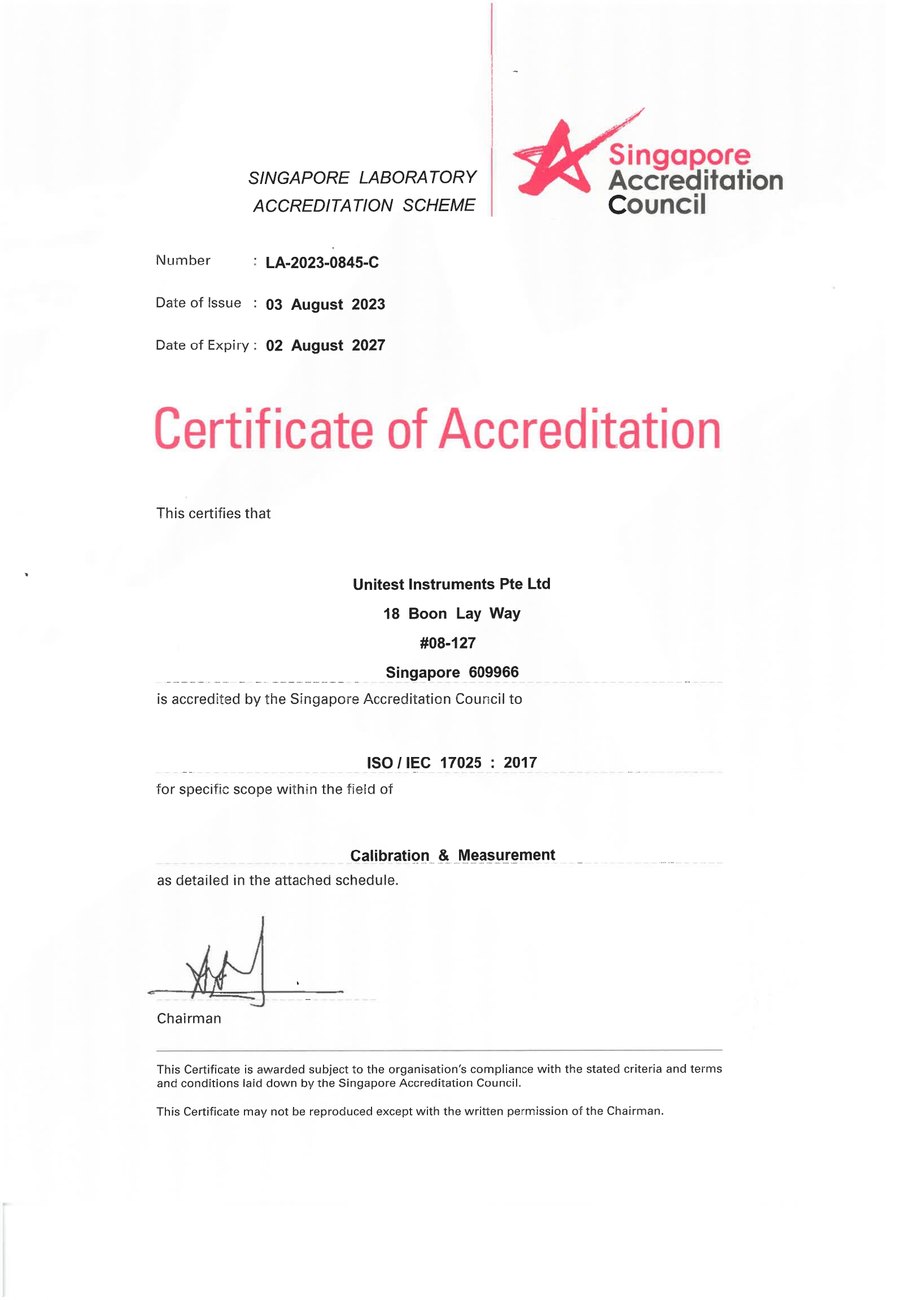
SAC-SINGLAS accredited calibration laboratory (Acc. No. LA-2023-0845-C) serving Singapore's industrial, pharmaceutical, and manufacturing sectors. All content reflects our ISO/IEC 17025 accredited scope and is reviewed by our technical calibration team.
Need insulation tester calibration in Singapore?
Unitest Instruments is SAC-SINGLAS accredited (Acc. No. LA-2023-0845-C) to ISO/IEC 17025. Same-week turnaround, certificates accepted by ISO 9001 auditors, BCA, and EMA inspectors.