
Key Takeaways
- Calibration compares your instrument against traceable reference resistance standards. Any deviation is recorded as measurement error with stated uncertainty.
- SAC-SINGLAS accredited calibration (Acc. No. LA-2023-0845-C) provides NMC-traceable certificates accepted by ISO 9001 auditors, MOM WSH inspectors, and BCA-regulated project teams without challenge.
- Annual calibration is the standard interval for most Singapore industrial and construction applications; instruments in harsh environments should be calibrated every 6 months.
- A valid certificate must include traceability statement, measurement uncertainty at k=2, and the laboratory's SAC-SINGLAS accreditation number, certificates without these are non-compliant.
- Singapore's WSH (Electrical Installations) Regulations 2011, CP5, and SS 638 all require verified earthing resistance measurements, making calibrated instruments a legal and safety necessity.
What Happens During Earth Resistance Tester Calibration?
Earth and ground resistance testers (also called earth testers, ground resistance meters, or earth meggers), measure the electrical resistance of an earthing system to the reference ground. A calibrated instrument confirms that when your tester displays "1.2 Ω," the actual resistance is indeed 1.2 Ω within a known tolerance. Without traceable calibration, that reading is an opinion, not a measurement.
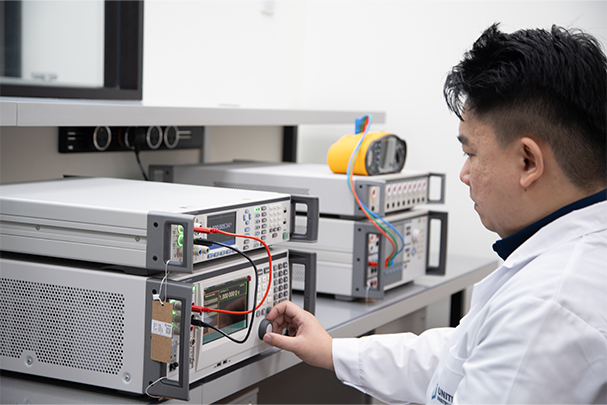
In the laboratory, calibration of an earth resistance tester follows a structured sequence. The technician first inspects the instrument for physical damage, confirms the battery or power supply is adequate, and allows the instrument to temperature-stabilise for at least 30 minutes under controlled conditions (typically 23 ± 2 °C, relative humidity 45–75%). A decade resistance box or purpose-built earth resistance simulator (itself calibrated and traceable to Singapore's NMC), is then connected to the instrument's measurement terminals.
Test points are selected to cover the instrument's full measurement range. For a typical earth tester used in Singapore construction and industrial settings, this means resistance values from as low as 0.10 Ω (for bonding and structural earthing checks) through mid-range values such as 1 Ω, 5 Ω, 10 Ω, 20 Ω, and up to the instrument's upper range limit (often 200 Ω or 2000 Ω depending on the model). At each test point, the technician records both the reference value and the instrument's displayed reading. The difference between these two values (plus the calculated measurement uncertainty), constitutes the calibration result for that point.
The calibration technician then evaluates whether each error falls within the manufacturer's specification limits. If the instrument passes, a calibration certificate is issued. If errors exceed specification at any point, the instrument is flagged as out-of-tolerance and should not be used for compliance measurements until it has been repaired and recalibrated.
Reference Standards and Traceability to NMC Singapore
The core requirement of ISO/IEC 17025 is that every measurement made in a calibration laboratory is traceable (through an unbroken documented chain of comparisons), to the International System of Units (SI). In Singapore, this chain terminates at the National Metrology Centre (NMC), which maintains Singapore's primary measurement standards for electrical resistance alongside mass, length, temperature, and other quantities.
At Unitest Instruments (SAC-SINGLAS Acc. No. LA-2023-0845-C), our reference resistance standards are calibrated directly by NMC or by another NMC-accredited national metrology institute. Each reference standard carries a current calibration certificate showing its certified value and measurement uncertainty. When we calibrate your earth tester, we formally document this traceability chain on your certificate, so that any auditor, inspector, or quality manager can follow the evidence from your instrument's reading back to the national SI standard.
The calibration procedure for earth resistance testers references IEC 61557-5 (Electrical safety in low voltage distribution systems. Earth impedance), which sets out measurement methods and performance requirements for earth resistance measuring equipment. We also follow each instrument manufacturer's published calibration procedure where available, which specifies the exact test points and acceptance tolerances for that model.
Field Calibration vs. Laboratory Calibration: Which Is Right for Your Situation?
Singapore's electrical testing industry uses both field and laboratory calibration approaches for earth resistance testers, and the choice affects your measurement uncertainty, certificate validity, and regulatory standing. The comparison below covers the key decision factors.
| Factor | Laboratory Calibration | Field Calibration (On-Site) |
|---|---|---|
| Measurement uncertainty | Lowest. Controlled environment, primary reference standards | Higher. Environmental variables (temp, humidity, EMI) increase uncertainty |
| Traceability | Full NMC-traceable chain documented on certificate | Depends on the portable standard used; verify the reference standard's own certificate |
| Certificate acceptance | Accepted universally by ISO 9001 auditors, WSH, BCA, EMA | May be questioned if uncertainty is not stated or standard is not independently calibrated |
| Instrument availability | Instrument must be sent to the lab (5–7 working days typical) | No downtime for transport; instrument remains on site |
| Typical use case | Routine periodic calibration for all compliance and QMS purposes | Emergency re-verification after a drop or suspect reading; remote sites |
| SAC-SINGLAS accreditation | Available from accredited labs including Unitest (LA-2023-0845-C) | Rarely available in true field conditions; most field service is not SAC-accredited |
| Recommended for Singapore compliance? | Yes. Preferred for all regulatory and audit purposes | Use as a supplement between scheduled lab calibrations only |
For most Singapore businesses (whether in construction, oil and gas, facilities management, or manufacturing), laboratory calibration by a SAC-SINGLAS accredited facility is the operationally correct choice. The certificate you receive satisfies all local and international audit requirements without additional justification.
Need Your Earth Resistance Tester Calibrated in Singapore?
Unitest Instruments (Acc. No. LA-2023-0845-C) provides NMC-traceable earth tester calibration with 5–7 day standard turnaround. Certificates accepted by ISO 9001 auditors and WSH inspectors, no questions asked.
Singapore Regulatory Context: WSH, BCA, and Electrical Compliance
Earth resistance testing occupies a central role in Singapore's electrical safety regulatory framework. Several pieces of legislation and technical codes require that earthing systems be measured and that the instruments used for those measurements are fit-for-purpose, which in practice means calibrated and traceable.
Workplace Safety and Health (Electrical Installations) Regulations 2011
Under the WSH (Electrical Installations) Regulations administered by the Ministry of Manpower (MOM), occupiers of workplaces with electrical installations above 1 kVA are required to maintain those installations in a safe condition and have them inspected periodically by a licensed electrical worker or contractor. Earth resistance measurement is a standard part of such inspections. While the regulations do not prescribe a specific calibration accreditation by name, MOM WSH inspectors expect measurement instruments to be calibrated and will request calibration certificates as part of their audit evidence. A SAC-SINGLAS certificate from Unitest (Acc. No. LA-2023-0845-C) satisfies this expectation directly.
Singapore Standard SS 638 and Code of Practice CP5
SS 638 (Code of Practice for Earthing) (the primary Singapore technical standard for electrical earthing system design and testing), specifies that earthing resistance shall be measured and verified at commissioning and during periodic maintenance inspections. CP5, the older Code of Practice for Electrical Installations, similarly mandates earth continuity and resistance verification. Both standards require that measurements be made with appropriate, verified test equipment. Verified, in the Singapore metrology context, means calibrated with traceability documentation.
BCA and SP Group Requirements
For building projects regulated by the Building and Construction Authority (BCA), and for connections to SP Group's (Singapore Power) distribution network, earthing resistance must meet defined thresholds (typically ≤1 Ω for TN-S systems and ≤10 Ω for general protective earth systems). Project acceptance test records (which include the earth tester readings), must be submitted as part of the electrical installation completion documentation. Calibrated instruments with traceable certificates are essential to avoid disputes over the validity of these readings.
Understanding the difference between accredited and non-accredited calibration is important when your project documentation will face regulatory scrutiny. An accredited certificate carries the weight of a third-party conformity assessment body's endorsement, non-accredited certificates do not.
What a Proper Calibration Certificate Must Show
Not all calibration certificates are equal. A certificate that lacks key fields can be rejected by auditors, or worse, can give false confidence in an instrument that is actually out of specification. ISO/IEC 17025:2017 Section 7.8 specifies mandatory content for calibration certificates. For earth resistance testers calibrated in Singapore, a compliant certificate must include all of the following:
- Laboratory identification. Name, address, and SAC-SINGLAS accreditation number (e.g. LA-2023-0845-C)
- Certificate number. Unique identifier for the calibration record
- Customer and instrument details. Instrument make, model, serial number, and asset/tag number if applicable
- Calibration date and the date the next calibration is due
- Calibration conditions. Ambient temperature and relative humidity at the time of calibration
- Measurement results. Nominal value, displayed value, and error at each test point across the full measurement range
- Measurement uncertainty. Expressed as expanded uncertainty U at a coverage factor k=2 (95% confidence level) for each measurement point
- Reference standards used. Identification and current calibration status of the reference resistance standards, including their own traceability to NMC Singapore
- Traceability statement. Explicitly stating that results are traceable to national measurement standards
- Authorised signatory. Name, signature, and position of the person approving the certificate on behalf of the accredited laboratory
For a detailed breakdown of every field on a calibration certificate and what each means for your quality records, see our guide: Calibration Certificate Explained, what Every Field Means. Understanding measurement uncertainty is equally important; our article on measurement uncertainty in calibration explains how the stated uncertainty value relates to the confidence you can place in your instrument's readings.
Calibration Interval Recommendations for Earth Resistance Testers
There is no single universal calibration interval mandated for earth resistance testers in Singapore. The correct interval depends on the instrument's use environment, the criticality of the measurements it makes, and any requirements specified in your quality or safety management system.
As a practical starting framework for Singapore conditions:
- Annual calibration (12 months). Appropriate for instruments used in typical industrial, construction, or facilities management environments with moderate use frequency and standard site conditions. This is the most common interval for ISO 9001 and ISO 45001 certified organisations.
- Semi-annual calibration (6 months). Recommended for instruments used daily in high-humidity or outdoor environments (Singapore's tropical climate is particularly demanding on electronic instruments), instruments transported frequently between sites, or instruments used for critical safety-related measurements where out-of-tolerance errors carry significant WSH risk.
- After any incident. An instrument that has been dropped, submerged, or exposed to a fault current should be returned for calibration before further use, regardless of when it was last calibrated.
- Before critical commissioning tests, for major electrical installation projects where earthing test results will be submitted to BCA or SP Group, calibrating the instrument within 3 months of the test provides the strongest evidence of measurement confidence.
Our dedicated guide on how often to calibrate your instruments covers the risk-based approach to setting calibration intervals, including how to use historical calibration data to justify extending or shortening your interval under ISO/IEC 17025 principles.
Choosing a Calibration Laboratory for Earth Resistance Testers in Singapore
When selecting a calibration laboratory for your earth resistance testers, the single most important criterion is SAC-SINGLAS accreditation for the specific measurement parameter (electrical resistance), in the range relevant to earth testing. Accreditation to ISO/IEC 17025 is not blanket; it is granted for specific measurement disciplines and ranges. Before sending your instrument, confirm that the laboratory's accredited scope covers resistance measurement in the 0.1 Ω to 2000 Ω range that earth testers operate in.
Unitest Instruments holds SAC-SINGLAS accreditation (Acc. No. LA-2023-0845-C) under ISO/IEC 17025 for electrical calibration, including earth and ground resistance testers. Our laboratory operates under strict quality management procedures, with all reference standards directly traceable to NMC Singapore. We calibrate a wide range of earth testing instruments from manufacturers including Fluke, Kyoritsu, Megger, AEMC, Chauvin Arnoux, and Hioki.
Beyond accreditation, consider practical factors: turnaround time (standard 5–7 working days at Unitest, with express options available), whether the laboratory offers collection and delivery for large instrument fleets, and whether the certificate format is compatible with your QMS software or audit requirements. Unitest certificates are issued in PDF with a unique certificate number and are available for re-issue if copies are needed for multiple project stakeholders.
If you are evaluating whether to purchase a new earth resistance tester or send an existing instrument for calibration, visit unitestshop.com to browse our range of earth and ground resistance testers from leading manufacturers. Our technical team can advise on model selection based on your measurement range requirements, site conditions, and whether the instrument is amenable to efficient laboratory calibration.
Frequently Asked Questions
During calibration, the technician applies a series of known resistance values (typically from a decade resistance box or purpose-built earth resistance simulator), to the tester's measurement terminals. The instrument's displayed reading at each point is compared against the reference standard's known value. Any deviation is recorded as an error, and the full results (with measurement uncertainty) are documented on a calibration certificate. The process covers the full measurement range, including low-resistance earth values (0.1 Ω to 20 Ω) commonly encountered in Singapore industrial installations.
Most earth and ground resistance testers used in Singapore industrial and construction environments should be calibrated annually (every 12 months). Instruments exposed to harsh site conditions (high humidity, vibration, or frequent transport), may warrant a 6-month interval. ISO 9001-certified facilities and WSH-regulated workplaces typically specify annual calibration in their quality or safety management system procedures. Always follow the manufacturer's recommendation and your own QMS policy; whichever interval is shorter takes precedence.
Calibration is performed using decade resistance standards traceable to Singapore's National Metrology Centre (NMC) and ultimately to the International System of Units (SI). The calibration procedure typically references IEC 61557-5 (earth resistance measurement) and the instrument manufacturer's calibration procedure. Reference resistance standards must themselves hold current calibration certificates with traceability documented through an unbroken chain to NMC Singapore, in accordance with ISO/IEC 17025 requirements.
While Singapore's Workplace Safety and Health Act does not mandate SAC-SINGLAS accreditation for every calibration activity by name, many WSH-regulated industries (construction, oil and gas, manufacturing) specify calibration by an accredited laboratory in their safety management systems or tender specifications. ISO 9001 and ISO 45001 auditors routinely request evidence of accredited calibration. Using a SAC-SINGLAS accredited laboratory such as Unitest Instruments (Acc. No. LA-2023-0845-C) ensures your certificates are accepted without challenge across all Singapore regulatory and audit contexts.
A compliant calibration certificate must include: the instrument identification (make, model, serial number), calibration date and due date, reference standard details with traceability to NMC Singapore, measurement results at each test point, stated measurement uncertainty (expressed as expanded uncertainty at k=2, 95% confidence), the accredited laboratory's name and SAC-SINGLAS accreditation number, a unique certificate number, and the authorised signatory's name and signature. Certificates lacking traceability statements or measurement uncertainty values do not meet ISO/IEC 17025 requirements.
Laboratory calibration is performed under controlled temperature (typically 23 ± 2 °C) and humidity conditions using primary reference standards, producing the lowest possible measurement uncertainty. It is the preferred method for quality records and regulatory compliance. Field calibration is conducted on-site using portable reference standards; it offers convenience but typically carries higher measurement uncertainty due to environmental variables. For instruments used in critical WSH or ISO-audited applications, laboratory calibration by a SAC-SINGLAS accredited facility is strongly recommended.
The Workplace Safety and Health (Electrical Installations) Regulations 2011 require that electrical installations, including earthing systems, are maintained safe and tested. Singapore CP5 and SS 638 specify earth resistance measurement as part of commissioning and periodic inspection. BCA-regulated building projects must comply with SP Group's technical requirements for verified earthing resistance values. The Energy Market Authority's (EMA) licensing requirements for electrical workers also reference instrument verification. Calibrated earth testers with SAC-SINGLAS traceable certificates are essential evidence of measurement confidence in all these contexts.
Unitest Instruments (SAC-SINGLAS Acc. No. LA-2023-0845-C) accepts earth and ground resistance testers for laboratory calibration. Standard turnaround is 5–7 working days; express 2–3 day service is available on request. You can arrange drop-off, courier collection, or on-site pick-up for larger instrument fleets. Upon completion you receive a full ISO/IEC 17025 calibration certificate with NMC-traceable results and stated measurement uncertainty. Contact us via the booking form at theuniteststandard.com/contact or call +65 6659 8878.
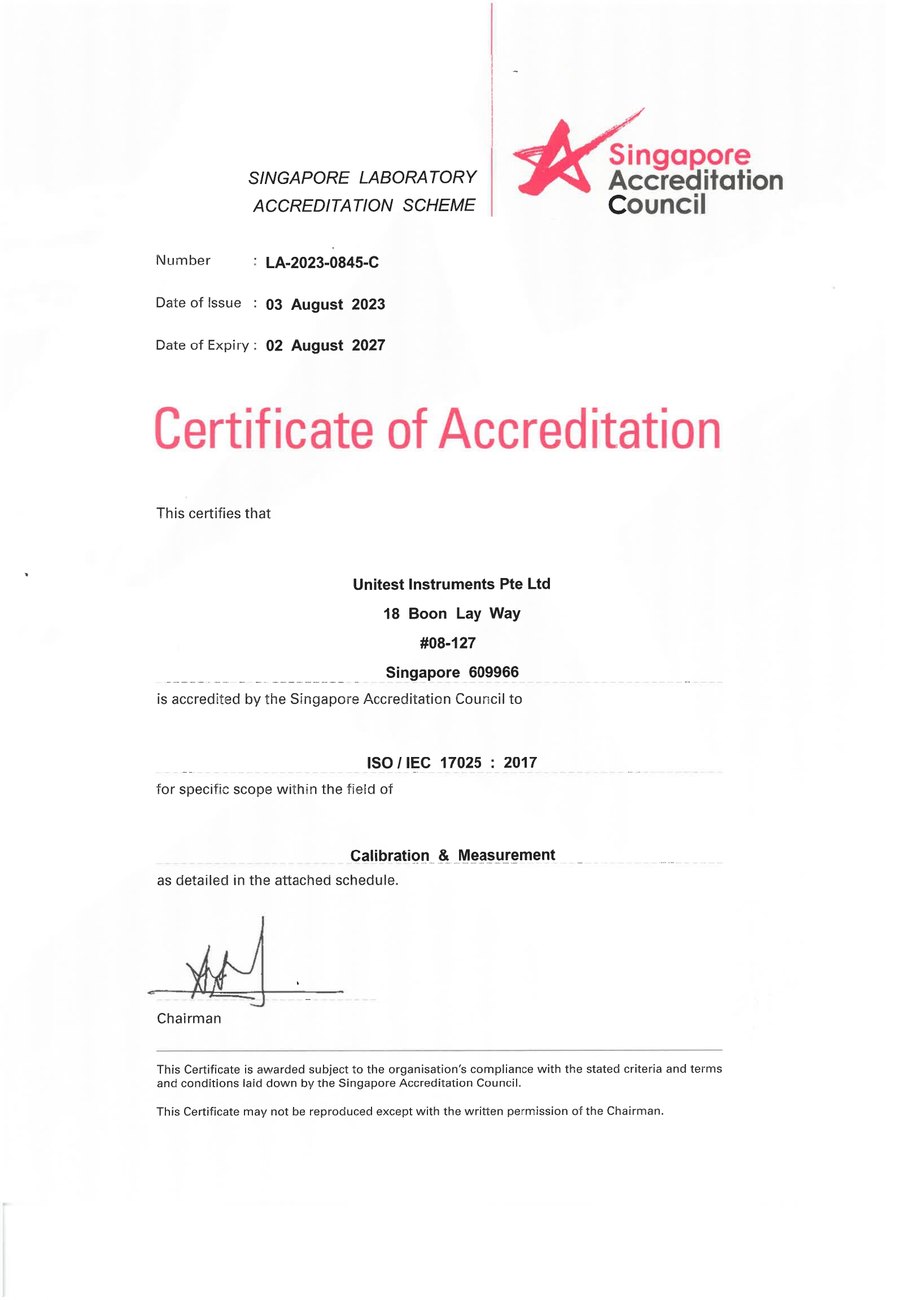
SAC-SINGLAS accredited calibration laboratory (Acc. No. LA-2023-0845-C) serving Singapore's industrial, pharmaceutical, and manufacturing sectors. All content reflects our ISO/IEC 17025 accredited scope and is reviewed by our technical calibration team.
Need earth resistance tester calibration in Singapore?
Unitest Instruments is SAC-SINGLAS accredited (Acc. No. LA-2023-0845-C) to ISO/IEC 17025. Same-week turnaround, certificates accepted by ISO 9001 auditors.