
Key Takeaways
- Three parameters are calibrated: output voltage (AC and/or DC), leakage current, and trip-current threshold. All must be within manufacturer specifications.
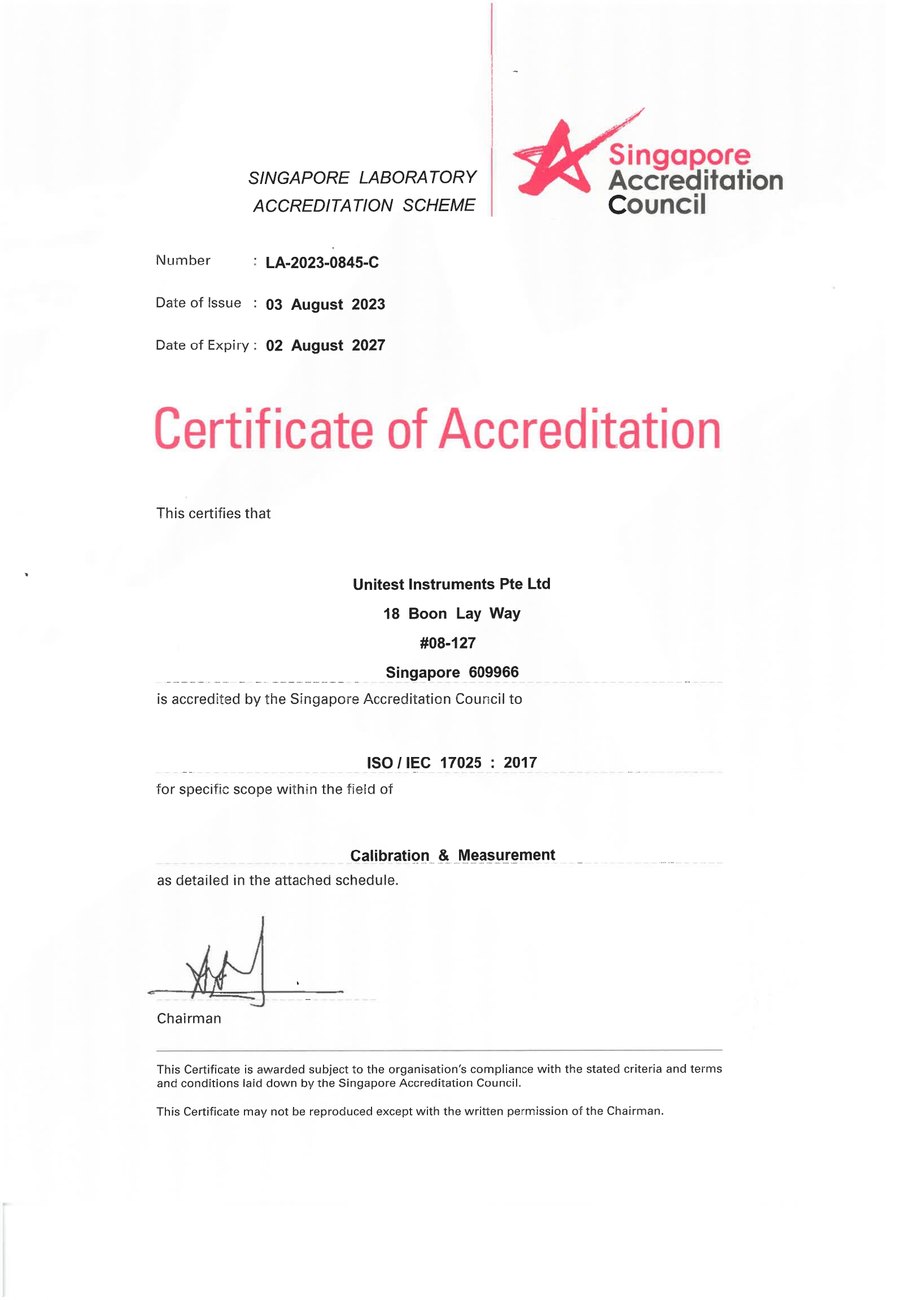
- Only a SAC-SINGLAS accredited laboratory (such as Unitest Instruments, Acc. No. LA-2023-0845-C) can issue certificates accepted for Singapore regulatory and ISO 9001 purposes.
- Reference standards must be traceable to NMC Singapore (or another BIPM-recognised national metrology institute). Traceability to a foreign distributor is not sufficient.
- The recommended calibration interval for hipot testers in Singapore is 12 months; high-use or harsh-environment instruments should be calibrated every 6 months.
- A valid calibration certificate must state expanded measurement uncertainty at k=2. Certificates without uncertainty values are not ISO/IEC 17025 compliant.
- Singapore's WSH Act and product-safety certification schemes (SAFETY mark) both require that dielectric withstand test equipment be maintained with demonstrable traceability.
What Is a Hipot Tester and Why Does Calibration Matter?
A hipot (high potential) tester (also called a dielectric withstand tester), applies a high voltage between a product's live conductors and its chassis or between isolated circuits, confirming that the insulation can survive the stress without breakdown. It is one of the most safety-critical instruments in any electrical product manufacturing or maintenance environment. The test is mandated by a wide range of international standards: IEC 60950-1 and IEC 62368-1 for IT equipment, IEC 60335 for household appliances, IEC 60601 for medical devices, and many others.
The problem with a mis-calibrated hipot tester is not that it gives a slightly wrong reading. It is that it silently passes products that should fail, or rejects products that are perfectly safe. An instrument that under-reads voltage by 10% will apply 4,500 V where 5,000 V is required; an instrument with a faulty trip circuit may not interrupt the test at the set leakage limit. Both scenarios carry serious legal, safety, and commercial consequences in Singapore, where products sold to consumers must meet mandatory safety requirements under the Consumer Protection (Safety Requirements) Regulations.
Calibration by a SAC-SINGLAS accredited laboratory provides an independent, metrologically traceable measurement of what the instrument actually does. Versus what it claims to do. It is not a repair, a service, or a self-test. It is a comparison against reference standards that are themselves traceable to the Singapore National Metrology Centre (NMC) or an equivalent national body.
What Happens During Hipot Tester Calibration. Step by Step
Understanding the calibration process helps quality managers write better calibration procedures and helps procurement teams ask the right questions when evaluating service providers. A rigorous SAC-SINGLAS accredited calibration of a hipot tester covers the following stages.
1. Pre-Calibration Inspection and Conditioning
The instrument is inspected for physical damage, contaminated test leads, and obvious faults. It is then powered on and allowed to warm up for the manufacturer-specified period (typically 15–30 minutes) to reach thermal equilibrium. This is not optional: high-voltage components exhibit significant temperature-dependent drift, and measurements taken before stabilisation can be misleading.
2. Output Voltage Calibration
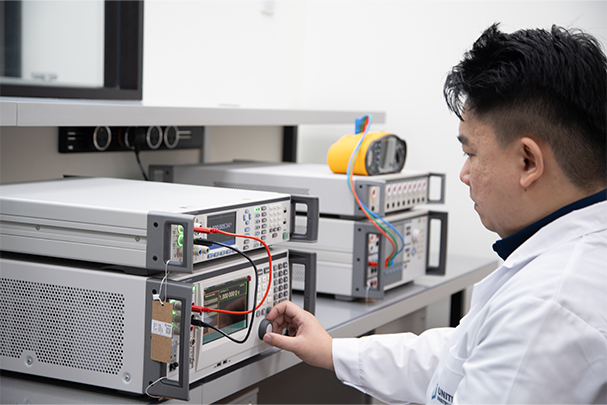
The voltage output is the most critical parameter. For AC hipot testers, the calibration engineer connects a calibrated high-voltage divider across the output terminals and measures the true RMS voltage with a precision voltmeter traceable to NMC Singapore. Measurements are taken at a minimum of five points across the instrument's rated range. Typically 500 V, 1 kV, 2 kV, 3 kV, and 5 kV for a standard 5 kV unit. For DC hipot testers, a calibrated high-voltage probe and precision DC voltmeter are used instead. The deviation between the instrument's displayed value and the reference measurement at each point is recorded, along with the associated measurement uncertainty.
3. Leakage Current Calibration
The leakage current measurement circuit is verified separately. A precision resistor of known value (calibrated and traceable) is connected as a load, and the current calculated from Ohm's Law (I = V/R) is compared to the instrument's displayed leakage current at multiple set points. Typical test points cover the full current range in at least five increments. This step confirms that the instrument's ammeter circuit is accurate. A critical safeguard, since leakage current thresholds in product safety standards (e.g. 1 mA for consumer appliances under IEC 60335) leave very little room for error.
4. Trip-Current Threshold Verification
The trip function is the hipot tester's safety interlock: when the leakage current exceeds the set limit, the test is supposed to terminate immediately and signal a failure. Calibration verifies that this threshold is accurate. The engineer incrementally increases the current through a precision resistor network until the instrument trips, recording the actual current at trip versus the set value. For production-line testing where the trip is set at, say, 3 mA, an error of ±0.5 mA can mean the difference between passing and failing a non-compliant product.
5. Documentation and Certificate Issuance
All measured values, reference standard identifiers, environmental conditions (temperature, relative humidity), and uncertainty calculations are compiled into a calibration certificate. Under ISO/IEC 17025, the certificate must state the laboratory's accreditation number, the measurement uncertainty for each parameter, the traceability chain, and the calibration date. Unitest Instruments issues certificates under SAC-SINGLAS Acc. No. LA-2023-0845-C. A number that can be independently verified on the SAC website.
Reference Standards Used in Hipot Calibration
The accuracy of a calibration is only as good as the reference standards used to perform it. For hipot tester calibration, two types of reference standards are essential.
High-voltage dividers and probes reduce the kilovolt-level output to a safe, measurable voltage. These dividers must themselves have calibrated ratio errors and phase errors (for AC), traceable to NMC Singapore or a BIPM-member national laboratory. The divider's own uncertainty contributes directly to the reported uncertainty of the voltage calibration result.
Precision current shunts and electrometers provide the reference for leakage current and trip-current calibration. Shunt resistors with low temperature coefficients and verified resistance values (again, traceable to NMC) are used at the microampere-to-milliampere level. For very low leakage measurements (sub-100 µA), precision electrometers with femtoampere-level resolution are employed.
All reference standards at Unitest Instruments are maintained in a temperature- and humidity-controlled laboratory environment and are recalibrated on schedules determined by their drift characteristics and uncertainty budgets, as required by ISO/IEC 17025 clause 6.4.
Need your hipot tester calibrated in Singapore?
Unitest Instruments (Acc. No. LA-2023-0845-C) calibrates AC and DC hipot testers from 0.5 kV to 10 kV. Certificates are accepted by ISO 9001 auditors and Singapore product-certification bodies. Same-week turnaround available.
Field Calibration vs Laboratory Calibration: Which Is Right for You?
Some service providers offer on-site (field) calibration of hipot testers to avoid the downtime of sending equipment to a laboratory. Understanding the trade-offs helps you make an informed decision for your quality system.
| Factor | Field Calibration (On-Site) | Laboratory Calibration (Accredited) |
|---|---|---|
| Environment control | Limited. Ambient temperature, humidity, and EMI at site | Controlled. ISO/IEC 17025 compliant lab conditions |
| Measurement uncertainty | Higher, due to environmental variability | Lower, with full uncertainty budget documented |
| Reference standard grade | Portable (lower grade) references | Bench-grade primary/secondary references |
| Instrument downtime | Minimal. Instrument stays on-site | Typically 2–5 business days (same-week option available) |
| ISO 9001 / auditor acceptance | May be challenged if provider is non-accredited | Fully accepted, sac-SINGLAS Acc. No. on certificate |
| Singapore product certification (SAFETY mark) | Not accepted for formal submissions | Accepted. Traceability to NMC Singapore confirmed |
| Best for | Interim checks, low-risk applications, tight schedules | Annual calibration, ISO 9001, product safety compliance |
For the annual calibration that feeds your ISO 9001 or quality management system records, laboratory calibration at a SAC-SINGLAS accredited facility is the correct choice. Field calibration can supplement (but should not replace), this. As explained in our article on accredited vs non-accredited calibration, the distinction matters significantly when certificates are reviewed by auditors or regulatory assessors.
Singapore Regulatory Context: WSH, SAFETY Mark, and ISO Requirements
Singapore's regulatory landscape for electrical product testing and calibration is shaped by three overlapping frameworks: workplace safety law, product safety regulations, and voluntary quality certifications.
Workplace Safety and Health (WSH) Act
The WSH Act (Cap. 354A) and its subsidiary regulations place a duty on employers to ensure that work equipment (including electrical test instruments), is maintained in a safe and serviceable condition. While the Act does not mandate specific calibration intervals by instrument type, MOM's enforcement guidance makes clear that equipment used to verify electrical safety (including hipot testers, insulation resistance testers, and PAT testers) must be demonstrably fit for purpose. In practice, this means maintaining calibration records with traceable certificates. An uncalibrated hipot tester that issues a pass result for a product that later causes an electrical incident creates significant liability exposure for the responsible officer under WSH Section 11.
Consumer Protection (Safety Requirements) Regulations and SAFETY Mark
Controlled goods under the Consumer Protection (Safety Requirements) Regulations, which include most household electrical appliances, information technology equipment, and audio/video products sold in Singapore. Must be registered with Enterprise Singapore and bear the SAFETY mark. The testing laboratories that generate the technical files for SAFETY mark registration must demonstrate traceability of their test equipment, including hipot testers. A calibration certificate from Unitest Instruments (SAC-SINGLAS Acc. No. LA-2023-0845-C) directly satisfies this traceability requirement.
ISO 9001 and Quality Management Systems
Clause 7.1.5 of ISO 9001:2015 requires that monitoring and measuring equipment be calibrated at specified intervals against measurement standards traceable to international or national measurement standards. It further requires that calibration status be preserved and records maintained. During ISO 9001 surveillance audits in Singapore, auditors routinely request calibration certificates for hipot testers and reject certificates from non-accredited providers or those missing uncertainty statements. Our guide on ISO 17025 calibration requirements explains what auditors look for in detail.
Calibration Interval Recommendations for Hipot Testers
There is no single universal calibration interval prescribed by regulation for hipot testers in Singapore. Calibration frequency should be determined by the instrument manufacturer's recommendation, the usage intensity, and the risk profile of the application. The following guidelines reflect industry practice for Singapore's manufacturing and testing environment.
- Standard production testing (annual): For instruments used in routine end-of-line production testing, a 12-month calibration interval is the most common choice and satisfies most ISO 9001 audit requirements.
- High-volume or multi-shift production (6 months): Instruments used continuously across multiple shifts accumulate more wear and thermal cycling. A 6-month interval reduces the risk of undetected drift affecting production batches.
- After any physical incident: If the instrument has been dropped, has tripped on an unusually high overcurrent, or shows erratic readings, an out-of-cycle calibration is required before the instrument is returned to use. Do not rely on self-diagnostics alone.
- After repair or component replacement: Any repair affecting the voltage generation, measurement, or trip circuitry requires a full calibration before the instrument is returned to service.
- New instruments before first use: It is good practice (and required by some quality systems), to verify a new instrument's performance before relying on it in production, as manufacturer calibrations may have been performed months before delivery.
Purchasing a Hipot Tester in Singapore
Selecting the right hipot tester for your application is as important as keeping it calibrated. Key specifications to evaluate include the maximum output voltage (AC and/or DC), leakage current measurement range and resolution, trip-current accuracy, ramp rate control, and the availability of ground continuity testing in a combined unit. For Singapore's electronics manufacturing sector, instruments with both AC and DC hipot capability and a ground bond test function cover the majority of IEC and EN product safety standard requirements.
Unitest Instruments supplies a curated range of hipot testers and dielectric withstand testers at unitestshop.com. Including models from leading manufacturers calibrated and verified before dispatch. Purchasing your instrument from a SAC-SINGLAS accredited calibration provider means you can establish an integrated supply-and-calibration relationship from day one, with traceability built in.
When evaluating a hipot tester purchase, consider the total cost of ownership including annual calibration, not only the unit price. An instrument with tighter inherent accuracy will typically have a smaller calibration uncertainty, meaning a larger portion of its specification remains valid even at the end of the calibration interval.
Ramp Rate and Dwell Time: The Parameters Buyers Often Overlook
Discussions of hipot tester calibration tend to focus almost entirely on voltage accuracy and trip-current threshold, because those are the parameters most directly tied to pass/fail decisions, but two timing-related parameters, ramp rate and dwell time, deserve equal attention in your calibration scope and are frequently the source of test result disputes even on a correctly calibrated instrument. Ramp rate is the speed at which the output voltage rises from zero to the test voltage, specified in most product safety standards (IEC 60950-1, IEC 62368-1) because a test voltage applied too abruptly can cause a nuisance trip on a genuinely safe product due to capacitive inrush current, while a ramp that is too slow extends test time unnecessarily across a production line and can, in some insulation systems, allow partial self-healing effects that mask a marginal insulation defect. Confirming that your calibration scope actually verifies ramp rate accuracy, not just the final steady-state voltage, matters specifically for production environments running high test volumes where ramp-related nuisance trips translate directly into throughput loss.
Dwell time (the duration the test voltage is held at its set point before the pass/fail decision is made) is the second commonly overlooked parameter, and getting it wrong in either direction has real consequences: too short a dwell time can pass a product whose insulation would have broken down under sustained stress, which is precisely the failure mode the test exists to catch, while an unnecessarily long dwell time on a high-volume production line is a throughput cost with no corresponding safety benefit once the standard's minimum requirement is met. Both parameters are timer-circuit functions rather than voltage-measurement functions, and a technically complete hipot calibration should verify the instrument's internal timing against a traceable reference alongside the voltage and current parameters. When requesting a quotation from any calibration provider, ask explicitly whether ramp rate and dwell time verification are included in the standard scope or offered only as an add-on, since a certificate that covers voltage and leakage current alone, while compliant on those specific parameters, leaves a real gap in your instrument's overall verified performance if your product safety standard specifies ramp and dwell tolerances.
Operator Safety Considerations Around Calibration and Routine Use
A hipot tester is, by design, an instrument that deliberately generates a lethal voltage under controlled conditions, and the calibration process itself, connecting reference dividers and shunts to a live high-voltage output, carries genuine risk that only trained personnel using appropriate interlocks and protective equipment should perform. This is worth stating plainly for facilities managers who may be tempted to treat hipot calibration scheduling the same way they treat a routine multimeter calibration drop-off: the instrument must be fully discharged and isolated before any connection or disconnection of test leads, reference standards, or output terminals, and Unitest's technicians follow documented isolation and discharge procedures specifically because a residual charge on a capacitive load under test is a genuine hazard even after the instrument itself has been switched off.
This same discipline should extend to your own production floor's operating procedure, independent of calibration: operators should never bypass a hipot tester's safety interlocks (door interlocks on test fixtures, dual-button start requirements, or automatic discharge circuits) to speed up a test cycle, and any interlock found defective during routine use should be treated as an immediate stop-work condition rather than a scheduling inconvenience to be worked around until the next planned maintenance window. Building this expectation into new operator training, alongside the calibration and interval discipline covered above, is what actually prevents the rare but serious injury incidents that hipot testing, uniquely among the instrument categories covered on this site, carries a real risk of causing when procedure is not followed.
Frequently Asked Questions
During hipot tester calibration, three key parameters are verified: (1) AC or DC output voltage accuracy across the instrument's full range (typically 0.5 kV to 5 kV or higher), (2) leakage current measurement accuracy, and (3) trip-current threshold accuracy. Confirming the unit interrupts the test at the set current limit. Each parameter is measured against reference standards traceable to Singapore's NMC, and results are reported with expanded measurement uncertainty at k=2.
The standard calibration interval for hipot testers in Singapore is 12 months for most production environments. Instruments used in high-frequency production testing, harsh environments, or those subject to physical shock should be calibrated every 6 months. If the instrument has been repaired, dropped, or gives suspect readings, an immediate out-of-cycle calibration is required before further use. Your ISO 9001 quality system or a risk-based assessment should ultimately define the interval for your specific application.
The WSH Act requires that test equipment used to verify electrical safety is maintained in good working order with demonstrable traceability. For equipment used in formal product safety compliance testing (such as for the SAFETY mark), a calibration certificate traceable to national standards from a SAC-SINGLAS accredited laboratory is expected by Enterprise Singapore's product testing regime. Many ISO 9001-certified manufacturers also mandate accredited calibration under clause 7.1.5 of the standard.
A SAC-SINGLAS accredited laboratory uses calibrated high-voltage dividers and precision current measurement standards traceable to NMC Singapore. For voltage calibration, a calibrated high-voltage divider with a known ratio is used alongside a precision voltmeter. For current calibration, precision shunt resistors and calibrated electrometers provide reference values. All reference standards are maintained under ISO/IEC 17025 conditions and recalibrated on defined schedules to ensure ongoing traceability.
A valid calibration certificate for a hipot tester must include: the instrument identification (make, model, serial number), calibration date and next-due date, the laboratory's SAC-SINGLAS accreditation number (e.g. LA-2023-0845-C), a statement of traceability to NMC Singapore or a recognised national metrology institute, measured results for each test point (voltage and current), expanded measurement uncertainty at a stated coverage factor (typically k=2, 95% confidence), and the authorised signatory's details. Certificates lacking uncertainty statements are not ISO/IEC 17025 compliant and should not be accepted for quality system records.
Field calibration uses portable reference standards brought to the instrument's location. It is faster and avoids transport, but uncontrolled environmental conditions (temperature, humidity, EMI) typically result in higher measurement uncertainty. Laboratory calibration is performed in a controlled environment using bench-grade reference standards, yielding lower uncertainty and full ISO/IEC 17025 compliance. For formal product certification and ISO 9001 audits in Singapore, laboratory calibration from a SAC-SINGLAS accredited provider is strongly preferred and in many contexts required.
Non-accredited calibration is generally not accepted for formal product safety submissions under Singapore's SAFETY mark scheme, and ISO 9001 auditors increasingly challenge certificates from non-accredited providers. A calibration certificate is only considered metrologically traceable if issued by a laboratory accredited under ISO/IEC 17025 by a recognised body such as SAC (Singapore Accreditation Council). Unitest Instruments holds SAC-SINGLAS accreditation Acc. No. LA-2023-0845-C, covering electrical calibration including high-voltage sources and current measurement.
Common indicators that a hipot tester may be out of calibration include: displayed voltage or current readings that differ noticeably from an external reference measurement, the trip circuit activating at an inconsistent or unexpected threshold, physical damage or a high-current event since the last calibration, or a calibration due date that has passed. Do not rely solely on self-diagnostics. Only comparison against a traceable reference standard confirms calibration status. Schedule an immediate laboratory calibration if any of these conditions are present.
SAC-SINGLAS accredited calibration laboratory (Acc. No. LA-2023-0845-C) serving Singapore's industrial, pharmaceutical, and manufacturing sectors. All content reflects our ISO/IEC 17025 accredited scope and is reviewed by our technical calibration team.
Need hipot tester calibration in Singapore?
Unitest Instruments is SAC-SINGLAS accredited (Acc. No. LA-2023-0845-C) to ISO/IEC 17025. Same-week turnaround, certificates accepted by ISO 9001 auditors and Singapore product-certification bodies.