
Key Takeaways
- Production-line hipot testers must deliver consistent, repeatable results across thousands of test cycles per day. Accuracy and throughput speed are equally critical.
- Singapore's SS 638 (IEC 62368-1), SS IEC 60335-1, and IMDA safety registration requirements all mandate dielectric withstand testing with traceable calibration.
- AC hipot is the standard method for most products; DC hipot is preferred for capacitive loads such as switch-mode power supplies and long cables.
- Automation bus (Handler, RS-232, USB, Ethernet) integration is essential for high-volume lines. It eliminates operator error and creates a digital test record trail.
- All hipot testers used in compliance testing must be calibrated by a SAC-SINGLAS accredited laboratory (ISO/IEC 17025) to satisfy IMDA and ISO 9001 auditors in Singapore.
Who Needs a Production-Line Hipot Tester?
Any manufacturer or contract electronics assembler whose finished products connect to mains power (or whose output voltage exceeds Safety Extra Low Voltage (SELV, defined as 60 V DC / 42.4 V AC peak in IEC 62368-1)), is legally required to perform dielectric strength testing before shipment. In Singapore, this obligation flows from the Consumer Protection (Safety Requirements) Act and its associated technical references, which specify that controlled goods must pass defined safety tests before being placed on the market.
Beyond the regulatory floor, ISO 9001 quality management systems require that measurement equipment used in product verification be calibrated and maintained. For hipot testers, this means a documented calibration record from an accredited laboratory, traceable to national measurement standards. A unit that leaves your line without a valid hipot test record (or tested by an out-of-calibration instrument), creates a product liability exposure that no manufacturer in Singapore can afford.
Industries with the highest demand for production-line hipot testers in Singapore include electronics contract manufacturing (EMS), power supply and UPS assembly, medical device manufacturing, industrial motor and drive manufacturing, and EV charging equipment assembly. Each sector has slightly different test voltage requirements, but the selection criteria for the instrument itself remain largely the same.
Key Specifications to Evaluate
Before comparing models, it helps to understand the five specification dimensions that actually determine whether a hipot tester fits a production line. Voltage range and mode (AC/DC/IR), current measurement resolution and trip accuracy, test cycle speed, automation interface, and safety features are the axes on which every buying decision should be made.
Voltage Range and Test Mode
Most product safety standards for mains-connected equipment specify AC hipot at 1.0–3.0 kV or DC hipot at 1.4–4.2 kV. A tester with a maximum output of 5 kV AC / 6 kV DC covers virtually every consumer and light-industrial application and leaves headroom for future product categories. If your line also produces medical devices, verify that the instrument can reach the higher potentials specified in IEC 60601-1 (up to 4 kV AC between mains parts and applied parts).
Trip Current Resolution
The leakage current trip threshold (typically settable from 0.1 mA to 30 mA), is the parameter that determines whether you catch a marginal insulation defect or produce a nuisance fail. A resolution of 0.01 mA or better is important for medical and class II (double-insulated) products where allowable leakage is very low. For industrial equipment with large EMI filter capacitors, you may need to set the threshold higher and rely on the instrument's reactive current compensation to avoid false trips.
Test Cycle Speed
Production-line testers are rated by their minimum dwell time (often 1 second) and ramp time. A tester that takes 3 seconds to ramp, 2 seconds to dwell, and 1 second to discharge adds 6 seconds per unit. At 500 units per shift, that is nearly an hour of dedicated test time. Instruments with programmable ramp control and fast discharge circuits can cut this to under 3 seconds per unit without compromising measurement integrity.
Automation Interface
High-volume lines require handler interfaces (dry-contact I/O) for fixture interlock, pass/fail signal outputs, and barcode scanner inputs for unit serialisation. Mid-to-high-end testers also offer RS-232, USB, or Ethernet for data logging to a manufacturing execution system (MES). This data trail is not optional. It is the evidence an ISO 9001 auditor will request when reviewing your product verification records.
Top Hipot Testers Available from Unitest
Unitest supplies and calibrates hipot testing instruments from several brands in its portfolio. The comparison below covers four models that represent the practical range from entry-level benchtop to full production automation. All are available through unitestshop.com with Singapore-local support and SAC-SINGLAS calibration included or available as an add-on service.
| Model | Max Voltage | Test Modes | Automation Interface | Price Range (SGD) | Best For |
|---|---|---|---|---|---|
| Vitrek 964i | 5 kV AC / 6 kV DC | AC, DC, IR, Continuity | Handler I/O, RS-232, USB, Ethernet | S$4,800 – S$6,200 | High-volume production lines, multi-standard compliance, MES integration |
| Vitrek 961i | 5 kV AC / 6 kV DC | AC, DC, IR, Continuity | Handler I/O, RS-232, USB | S$3,800 – S$4,800 | Mid-volume lines, contract manufacturers requiring full IEC compliance |
| Amprobe TES-1800 | 5 kV AC / 5 kV DC | AC, DC, IR | RS-232, USB | S$1,800 – S$2,600 | Smaller production lines, R&D, EMS companies doing periodic batch testing |
| Fluke 1550C | 5 kV DC | DC, IR (Megohmmeter) | USB, Bluetooth (FC series) | S$2,200 – S$3,200 | Insulation resistance trending, cable and motor winding inspection, IR-only workflows |
Price ranges are indicative and subject to exchange rate fluctuation; contact unitestshop.com for current Singapore pricing and availability. All models listed are calibratable by Unitest Instruments under our SAC-SINGLAS accredited scope.
Calibrate Your Hipot Tester with Full NMC Traceability
Unitest Instruments (Acc. No. LA-2023-0845-C) calibrates hipot testers, megohmmeters, and electrical safety analysers. Certificates accepted by ISO 9001 auditors and IMDA product registration submissions, same-week turnaround available.
Model Deep-Dives: What the Specs Mean in Practice
Vitrek 964i. The Production Automation Standard
The Vitrek 964i is the instrument most frequently specified by Singapore EMS companies and OEMs running three-shift production. Its Handler interface provides dry-contact I/O for fixture interlocking, automatic unit loading signals, and pass/fail outputs that connect directly to conveyor or robotic handling systems. The Ethernet port enables real-time data streaming to MES platforms. Every test result, timestamp, and serial number is recorded without operator intervention.
The 964i supports up to 50 stored test sequences, making changeovers between product families fast and error-proof. Its 0.01 mA current resolution and ±2% accuracy on leakage current measurement is sufficient for IEC 60601-1 medical device testing. A growing market in Singapore's Jurong and Tuas industrial clusters. The instrument's reactive current compensation mode is particularly valuable for switch-mode power supplies with large X and Y capacitors, where displacement current through filter capacitors would otherwise cause nuisance trips.
Amprobe TES-1800. The Practical Entry Point
The Amprobe TES-1800 covers the 0.1–5 kV AC / DC range with 0.1 mA trip resolution. Sufficient for the vast majority of SS 638 and IEC 60335 compliant products. Its USB interface supports data logging to a PC spreadsheet without requiring a purpose-built MES, which makes it practical for smaller contract manufacturers who do not yet have full production automation. The instrument's compact form factor and clear pass/fail indicators make it well-suited to bench-level testing stations where operators handle multiple product types per shift.
The TES-1800 does not support Handler I/O, so it cannot integrate into a fully automated test fixture. This is the key limitation relative to the Vitrek series. For lines producing fewer than 200 units per shift, this is rarely a constraint. For higher-volume lines, plan to upgrade to the 961i or 964i within 12–18 months as throughput grows.
Vitrek 961i. The Mid-Volume Sweet Spot
The 961i sits between the TES-1800 and the 964i in capability and price. It includes Handler I/O and RS-232/USB but lacks the Ethernet port of the 964i. For production lines that use a local PC for data logging rather than a networked MES, this is not a limitation. The 961i runs the same test sequences and has the same measurement accuracy as the 964i, making it a natural upgrade path for lines currently using the TES-1800 that need fixture automation without the full MES integration cost.
Singapore Regulatory Context: What Standards Apply?
Singapore's product safety framework is administered by the Infocomm Media Development Authority (IMDA) through the Consumer Protection (Safety Requirements) Regulations. Controlled goods (which include household electrical appliances, IT equipment, audio-visual equipment, and luminaires), must be registered before supply. Registration requires a test report from an accredited laboratory demonstrating compliance with the applicable Singapore Standard.
The most commonly referenced standards in hipot testing contexts are SS 638 (the Singapore adoption of IEC 62368-1, covering audio/video, IT, and communications equipment), SS IEC 60335-1 (household and similar electrical appliances), and SS IEC 60601-1 (medical electrical equipment). Each standard specifies the dielectric withstand test voltage as a function of the product's working voltage and insulation class.
For a 230 V mains-connected product with basic insulation (single fault tolerance), IEC 62368-1 typically requires a 1.5 kV AC or 2.1 kV DC hipot test for 1 minute at type-test level, or 1.0 kV AC for 1 second at production-test level. The production test voltage is lower than the type test voltage precisely because every unit is tested. The shorter, lower-stress test catches manufacturing defects without overstressing the insulation of a sound unit.
Understanding the difference between accredited and non-accredited calibration is essential here: only a SAC-SINGLAS accredited calibration certificate provides the traceability chain that IMDA and your ISO 9001 registrar will accept as proof that your hipot tester was operating within its specification at the time of testing. A certificate issued by the equipment vendor at the point of sale (while useful as a starting point), does not constitute accredited calibration and should be renewed by an accredited laboratory before the instrument is used in compliance testing.
Calibration Requirements for Hipot Testers
Hipot testers are multi-parameter instruments: they measure output voltage, leakage current, test time, and (on IR mode) insulation resistance. Each of these parameters drifts independently over time. The high-voltage output of a capacitively-loaded tester is particularly susceptible to drift in the voltage divider circuit, and the current sense resistor degrades with thermal cycling. An annual calibration interval is the industry norm; high-throughput lines running continuous duty may benefit from a 6-month interval.
When Unitest calibrates a hipot tester, we verify output voltage accuracy across the full range (typically ±2–5% depending on model and manufacturer specification), leakage current measurement accuracy at multiple setpoints, timer accuracy, and (for instruments with IR mode), insulation resistance accuracy across decades. Each parameter is compared against reference standards traceable to Singapore's National Metrology Centre (NMC) at A*STAR. The resulting certificate maps directly to the traceability hierarchy described in our article on what calibration traceability means and why it matters.
For newly purchased instruments, we recommend scheduling calibration within 30 days of receipt. The factory calibration performed at the point of manufacture uses reference standards traceable to the manufacturer's national standards laboratory, which may or may not be directly equivalent to Singapore's NMC chain. Establishing a local calibration baseline early also gives you a clean data point for the next annual interval.
Making the Final Decision: A Practical Checklist
Before issuing a purchase order for a production-line hipot tester, work through this checklist to confirm the instrument fits your specific application. It takes 15 minutes and prevents a common outcome. Purchasing a capable instrument that cannot integrate with your production system without expensive additional hardware.
- Test voltage required: Identify the highest dielectric withstand test voltage in your product standards. Add 10% headroom. Confirm the tester's maximum rated output meets or exceeds this figure.
- Test mode required: Confirm whether your standards specify AC or DC hipot (or both). If you produce capacitive loads (power supplies, VFDs), confirm DC hipot mode is available.
- Throughput target: Calculate maximum units per shift. Divide by available test minutes. Confirm the tester's minimum cycle time (ramp + dwell + discharge) meets the required throughput.
- Automation level: If you use a test fixture or automated handler, confirm Handler I/O is available. If you log to an MES, confirm Ethernet or compatible bus interface is available.
- Calibration access: Confirm a SAC-SINGLAS accredited laboratory (such as Unitest Instruments) can calibrate the model you are purchasing, within Singapore, with acceptable turnaround time.
- Safety interlock: Confirm the instrument has a physical interlock for HV-on indication and remote-start lockout, required under SS 510 and workplace safety guidelines for high-voltage test equipment.
If all six points are satisfied, the instrument is fit for purpose. For calibration scheduling, contact Unitest Instruments before or immediately after purchase. We can often turn around an initial calibration within 5–7 business days for most hipot tester models.
Frequently Asked Questions
A hipot (high-potential) tester applies a high AC or DC voltage between a product's live conductors and its chassis or earth to verify that the insulation can withstand the stress without breaking down. On a production line, every unit is tested (typically for 1–5 seconds), before it ships. This catches insulation defects that resistance measurements alone cannot detect and is required by IEC 60950-1, IEC 62368-1, and SS 638 for electrical equipment sold in Singapore.
For most mains-connected consumer and industrial electronics (rated up to 300 V), a tester capable of 1.5–3 kV AC or 2–4.2 kV DC with a trip current threshold settable from 0.5 mA to 30 mA covers the majority of IEC and SS standards. High-power industrial equipment and medical devices may need up to 5 kV AC. Always derive the test voltage from the applicable product standard, not a rule of thumb.
AC hipot stresses the insulation uniformly and matches real-world operating conditions; it is the default method in most product safety standards. DC hipot uses approximately 1.414× the AC test voltage and is preferred for capacitive loads (long cables, switch-mode power supplies) because it does not charge the capacitance repeatedly and avoids nuisance trips. DC testing also reveals surface tracking defects more reliably. Many modern testers support both modes from the same instrument.
Most quality management systems and product safety standards require annual calibration as a minimum. High-throughput production lines running three shifts may benefit from a 6-month interval because the high-voltage generator and current measurement circuits degrade faster under continuous use. After any repair, drop, or unusual reading, the instrument must be recalibrated before returning to service. See our full guide on calibration interval selection for a risk-based framework.
Yes, for product safety submissions to IMDA or the Singapore Civil Defence Force, calibration certificates must be traceable to national or international measurement standards. SAC-SINGLAS accreditation (ISO/IEC 17025) is Singapore's mechanism for demonstrating this traceability. Certificates from non-accredited labs are routinely rejected during audits. Unitest Instruments holds SAC-SINGLAS accreditation no. LA-2023-0845-C and can calibrate hipot testers with full traceability to Singapore's NMC.
Yes, but the priorities differ. R&D labs need flexible ramp rates, wide measurement ranges, and detailed waveform data. Production lines need fast throughput (sub-5-second test cycles), PLC/SCSI integration, barcode scanning, and minimal operator interaction. Mid-range instruments like the Vitrek 964i and Amprobe TES-1800 series bridge both needs reasonably well. Purpose-built production testers like the Vitrek 961i offer full automation bus interfaces that R&D benches rarely need.
The primary standards are SS 638 (Singapore Standard for safety of information technology equipment, harmonised with IEC 62368-1), SS IEC 60335-1 (household appliances), and the IMDA Technical Reference for electrical products requiring registration under the Consumer Protection (Safety Requirements) Act. Industrial switchgear and control panels follow SS IEC 61439 and SS IEC 60439. Medical electrical equipment must meet SS IEC 60601-1, which specifies significantly higher dielectric strength tests.
First, verify that your trip current threshold is set correctly, an overly sensitive setting (e.g. 0.5 mA on a capacitive DUT) will cause false failures. Next, check that earth return leads are short and well-connected; long leads add impedance and can cause erratic readings. On AC hipot, consider switching to DC mode for highly capacitive units. If nuisance trips persist, inspect the unit's Y-capacitors and EMI filters. Their leakage adds to the measured current. Finally, confirm the tester itself is within calibration; a drifted current sense circuit produces systematic errors.
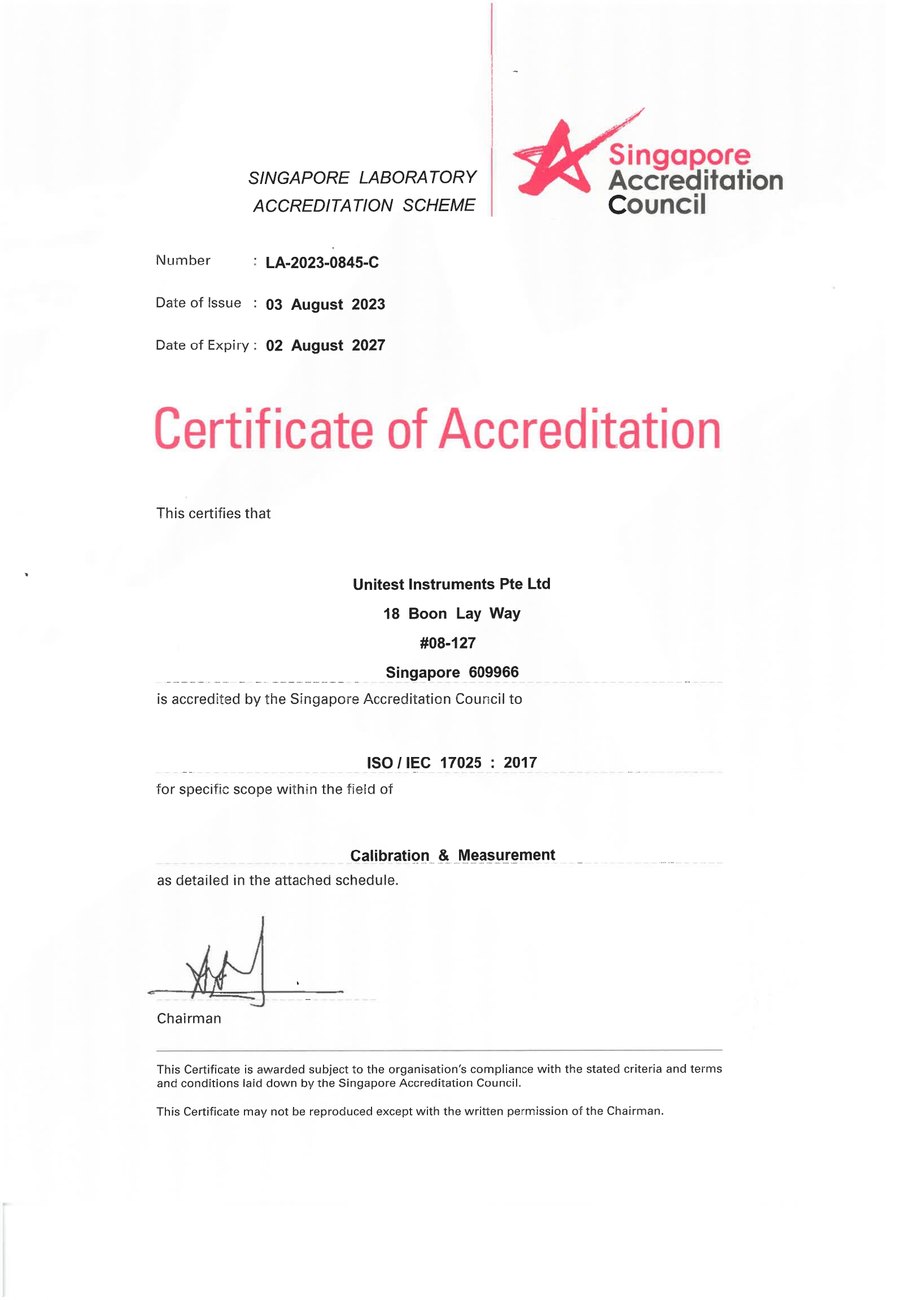
SAC-SINGLAS accredited calibration laboratory (Acc. No. LA-2023-0845-C) serving Singapore's industrial, pharmaceutical, and manufacturing sectors. All content reflects our ISO/IEC 17025 accredited scope and is reviewed by our technical calibration team.
Need electrical safety instrument calibration in Singapore?
Unitest Instruments is SAC-SINGLAS accredited (Acc. No. LA-2023-0845-C) to ISO/IEC 17025. Same-week turnaround, certificates accepted by ISO 9001 auditors and IMDA product registration submissions.