
Key Takeaways
- Vitrek reaches up to 20 kVAC output; Chroma's mainstream safety testers cap at 5 kVAC. A decisive difference for HV transformer and cable testing.
- Chroma's software ecosystem (Softpanel, LabVIEW, ATS platform) is more mature for high-throughput production-line deployments.
- Both brands offer combination units covering AC hipot, DC hipot, insulation resistance, and ground bond in one chassis.
- Chroma has stronger Asia-Pacific regional service infrastructure; Vitrek relies more heavily on local distributor support.
- Unitest Instruments sells and calibrates both brands in Singapore under SAC-SINGLAS accreditation (Acc. No. LA-2023-0845-C).
Why This Comparison Matters for Singapore Engineers
Electrical safety testing is not optional. Whether you are manufacturing power supplies, medical devices, industrial machinery, or consumer appliances, regulatory frameworks including IEC 60335, IEC 62368-1, IEC 60601, and various UL standards mandate dielectric withstand (hipot) testing before a product can ship. A wrong instrument choice costs you in re-testing, failed audits, or (worse), undetected insulation failures reaching end users.
Singapore's manufacturing sector faces additional considerations: MOM workplace safety requirements, SAC-accredited calibration obligations for ISO 9001 and ISO 13485 quality management systems, and the practical reality that instrument servicing and calibration must be obtainable locally without weeks of downtime. This comparison is written from the perspective of a SAC-SINGLAS accredited calibration laboratory that works with both Vitrek and Chroma instruments regularly.
We have no commercial incentive to favour either brand, unitest sells and calibrates both. Our goal is to give you an honest view of where each instrument family genuinely outperforms the other.
Brand Backgrounds: Vitrek and Chroma at a Glance
Vitrek
Vitrek is a US-based manufacturer founded in 1991, specialising exclusively in high-voltage safety compliance test instruments. Their product range is narrow and deep: hipot testers, ground bond testers, and combination units, with a particular emphasis on precision and high-voltage capability. The 900-series instruments, including the 964i and 965i, are popular in aerospace, transformer, and high-power electronics sectors. Vitrek instruments are known for accurate current measurement at low leakage levels and for their ability to reach test voltages that most competitors cannot match.
Chroma
Chroma ATE is a Taiwanese test and measurement company with a much broader product portfolio: power supplies, electronic loads, battery test systems, ATE platforms, and electrical safety testers. The 19051/19052 series are their flagship safety testers, widely adopted in Asian electronics manufacturing. Chroma's scale gives it advantages in software integration, regional service infrastructure, and pricing competitiveness. Their instruments are a common sight on production lines throughout Taiwan, China, and Southeast Asia.
What a Hipot Test Actually Verifies, and Why AC and DC Are Not Interchangeable
A dielectric withstand (hipot) test applies a high voltage between a product's live conductors and its accessible or protectively earthed parts, then monitors the leakage current flowing through the insulation for a defined dwell time, typically 60 seconds for production testing or longer for type-approval testing. If the leakage current stays below a defined threshold throughout the test, the insulation is considered to have withstood the applied stress; if it exceeds the threshold (indicating breakdown, tracking, or an unacceptably weak insulation path), the tester trips and the unit fails. This is fundamentally different from an insulation resistance (IR) test, which applies a much lower DC voltage and simply measures resistance; a hipot test is specifically designed to stress the insulation enough to reveal marginal defects (a nick in wire insulation, a contaminated creepage path, a manufacturing defect in a transformer winding) that would pass an IR test cleanly but could fail catastrophically in service.
AC and DC hipot testing are not interchangeable substitutes for each other, despite testing broadly the same insulation. AC hipot testing stresses both the resistive and capacitive components of the insulation simultaneously and is the form specified by most consumer and IT equipment safety standards (IEC 60335, IEC 62368-1), because it represents the insulation's behaviour under the AC mains conditions the product will actually experience in service. DC hipot testing avoids the capacitive charging current that complicates AC leakage measurement on products with significant capacitance (such as those with EMI filter capacitors across the mains input), making DC testing the practical choice for products where a large capacitive charging current would otherwise swamp a meaningful AC leakage reading, but it stresses the insulation differently and is not automatically an acceptable substitute for a standard that specifically calls for AC testing. Choosing correctly between the two, and understanding why a standard specifies one over the other for a given product category, is a genuine engineering judgement, not simply a matter of whichever mode is more convenient to run on the available instrument.
Ramp Rate, Dwell Time, and Arc Detection: The Settings That Actually Determine Test Validity
Beyond the instrument's maximum voltage and current measurement resolution, three configurable test parameters determine whether a hipot test is actually valid evidence of a product's insulation integrity: ramp rate (how quickly the voltage rises from zero to the test level), dwell time (how long the full test voltage is held once reached), and arc detection sensitivity (how the instrument distinguishes a genuine, momentary arc event, which should fail the test, from normal capacitive charging transients that should not). A test voltage ramped up too quickly can produce a misleading, transient leakage current spike unrelated to the insulation's true steady-state behaviour, while a ramp that is too slow adds unnecessary test time on a production line without improving the test's validity, which is why most safety standards specify an acceptable ramp rate range rather than leaving it to the operator's discretion.
Arc detection sensitivity is a particularly consequential setting to get right, and one that varies more between products than test engineers sometimes expect. Set too sensitively, the instrument false-trips on normal capacitive charging noise or on genuinely benign corona discharge from sharp conductor edges, generating false failures that waste production time investigating "faults" that do not actually exist. Set too loosely, the instrument may fail to catch a genuine, brief arc event indicating a real insulation breakdown, passing a defective unit. Both Vitrek and Chroma instruments offer adjustable arc detection sensitivity for exactly this reason, and getting the setting right for a specific product typically requires empirical tuning against known-good and known-defective samples during test development, not simply accepting the instrument's default setting.
Head-to-Head Feature Comparison
The table below compares the most decision-relevant specifications across the two brands' primary hipot tester product lines. Note that both manufacturers offer multiple models; figures reflect typical mainstream models (Vitrek 964i/965i vs Chroma 19051/19052).
| Feature / Specification | Vitrek 964i / 965i | Chroma 19051 / 19052 |
|---|---|---|
| Max AC Hipot Output | Up to 20 kVAC (model dependent) | Up to 5 kVAC |
| Max DC Hipot Output | Up to 32 kVDC | Up to 6 kVDC |
| Leakage Current Measurement | 0.001 mA resolution; true RMS measurement | 0.001 mA resolution; true RMS measurement |
| Ground Bond Test | Yes (combination models) | Yes (combination models) |
| Insulation Resistance (IR) | Yes (combination models) | Yes (combination models) |
| Arc Detection | Yes. Adjustable sensitivity | Yes. Adjustable sensitivity |
| Ramp Rate Control | Yes. Programmable | Yes. Programmable |
| PC / Software Interface | SCPI via RS-232, USB, LAN; basic companion software | SCPI + Softpanel GUI; LabVIEW driver; ATS platform integration |
| Multi-channel / Scanner | Optional (external scanner) | Optional (internal card or external scanner) |
| Voltage Accuracy | ±(1% + 3 V) typical | ±(1% + 5 V) typical |
| Current Accuracy | ±(1% + 0.5 mA) typical | ±(1% + 0.5 mA) typical |
| Display | Colour touchscreen (newer models) | Colour touchscreen (19052 series) |
| Typical Price Range (SGD) | S$4,500 – S$18,000+ (model dependent) | S$3,500 – S$12,000 (model dependent) |
| Regional Service Centre | Via Singapore distributor | Taiwan HQ + SE Asia partners |
| Standards Compliance | IEC 60950, IEC 62368, IEC 60335, IEC 60601, UL, EN | IEC 60950, IEC 62368, IEC 60335, IEC 60601, UL, EN, GB standards |
Need your Vitrek or Chroma hipot tester calibrated in Singapore?
Unitest Instruments issues fully traceable calibration certificates for electrical safety testers. Accepted by ISO 9001, ISO 13485, and MOM auditors. Same-week turnaround available.
Where Vitrek Wins: High-Voltage and Precision Applications
Vitrek's most significant competitive advantage is voltage range. The 965i series reaches 20 kVAC and 32 kVDC. Voltage levels that Chroma's mainstream safety tester line simply does not offer. This matters in specific sectors:
- Power transformer manufacturers testing primary-to-secondary insulation at several times rated voltage.
- High-voltage cable and connector manufacturers performing dielectric withstand at 10 kV and above.
- Switchgear and distribution panel builders complying with IEC 62271 or similar HV equipment standards.
- Aerospace and defence subcontractors where custom test voltages are specified in the procurement contract.
Vitrek also earns respect for its true RMS leakage current measurement at very low current levels. For applications where distinguishing 0.010 mA from 0.015 mA matters (such as medical device testing under IEC 60601-1 where patient leakage current limits are extremely tight), Vitrek's measurement architecture is a genuine technical strength.
The instruments have a reputation among calibration engineers for long-term stability. In our laboratory's experience calibrating both brands, Vitrek units tend to drift less between calibration intervals, which can support a case for extending calibration intervals under a risk-based interval review. This is discussed further in our article on how often calibration should be performed.
Where Chroma Wins: Production Lines and Software Integration
Chroma's 19051/19052 series was designed with volume manufacturing in mind. The Softpanel PC software provides a graphical interface for test sequence programming, data logging, and pass/fail record keeping. All critical for a production quality management system. The LabVIEW instrument driver is well-documented and actively maintained, making integration with National Instruments-based ATE systems straightforward.
Chroma also fits naturally into its own ATS (Automated Test System) platform, which allows a single PC to orchestrate multiple test instruments (power supplies, electronic loads, and safety testers), in a co-ordinated test sequence. For a manufacturer running 500 units per shift through a compliance test station, this integration capability is worth more than a few extra kilovolts of output range that will never be used.
Pricing is another practical consideration. Chroma's 19051/19052 series is generally 15–25% less expensive than comparable Vitrek models at standard test voltages (up to 5 kVAC). For procurement teams managing capital equipment budgets, and for facilities that need to deploy multiple test stations, this cost difference accumulates quickly.
Understanding whether your calibration certificate for these instruments meets Singapore's requirements is important context, our guide to accredited vs non-accredited calibration explains what auditors actually look for.
Use-Case Recommendations: Which Brand for Which Application?
| Application / Sector | Recommended Brand | Reason |
|---|---|---|
| Consumer appliance compliance (IEC 60335) | Either. Chroma slightly preferred | 5 kVAC is sufficient; Chroma's production software adds value |
| IT / AV equipment (IEC 62368-1) | Either. Chroma slightly preferred | Standard voltage ranges; Chroma's ATS integration suits production |
| Medical devices (IEC 60601-1) | Vitrek | Superior low-current accuracy for patient leakage current measurement |
| Power transformers / HV cables | Vitrek | Higher voltage output (up to 20 kVAC / 32 kVDC) required |
| High-throughput production line | Chroma | Softpanel, LabVIEW, ATS platform; lower cost per station |
| Aerospace / defence (custom voltages) | Vitrek | Wider voltage range and precision at high voltage |
| General R&D / compliance lab | Either. Evaluate based on max voltage needed | Both provide accurate measurement and good arc detection |
| EMS / contract manufacturer (multi-client) | Chroma | Cost-effective multi-station deployment; broad standards coverage |
Singapore Procurement Considerations
Singapore-based procurement has a few practical dimensions that differ from a purely technical evaluation. First, import lead times: Vitrek instruments are manufactured in the US, and lead times for non-stock models can extend to 8–14 weeks. Chroma's proximity to Taiwan and its regional warehousing typically means shorter delivery times for standard models.
Second, calibration continuity matters. When you acquire a hipot tester, you are committing to a calibration relationship for the life of the instrument. Typically 10 to 15 years of annual or biannual calibration. Choosing a brand that is calibrated by a SAC-SINGLAS accredited laboratory in Singapore removes the risk of having to ship instruments overseas for calibration. Unitest Instruments calibrates both Vitrek and Chroma hipot testers locally.
This local calibration availability matters more for a high-voltage instrument than it might for a general-purpose meter, because shipping a hipot tester capable of tens of kilovolts output overseas for calibration carries its own logistics complications, insurance considerations, and typically a materially longer turnaround than a domestic calibration cycle. For a production line where the hipot tester is a genuine bottleneck instrument (every unit shipped must pass through it before release), a multi-week overseas calibration turnaround can directly translate into lost production capacity, which is a real, quantifiable cost worth factoring into the total cost of instrument ownership alongside the purchase price itself.
Third, consider instrument qualification costs under your quality management system. If you operate an ISO 9001 or ISO 13485 QMS, each new instrument typically requires an Installation Qualification (IQ) and Operational Qualification (OQ) exercise. Having a local accredited laboratory to support that process (including providing baseline calibration data), significantly reduces the burden. Our article explaining ISO/IEC 17025 calibration requirements covers what accredited calibration documentation must include.
Finally, consider your after-sales service strategy. Both brands require professional service when a fault develops. Chroma has authorised repair infrastructure in Asia; Vitrek depends more on the local distributor's technical capability. Before purchasing, confirm whether the distributor can perform in-warranty and out-of-warranty repairs locally, and what the typical turnaround time is for a faulty instrument.
Calibration Requirements for Hipot Testers
Regardless of brand, a hipot tester is classified as safety-critical test equipment. Errors in output voltage or leakage current measurement translate directly into incorrect pass/fail decisions on products that will eventually be used by people. This is why calibration of hipot testers must be taken seriously, and why accredited calibration is the appropriate standard.
A full hipot tester calibration covers output voltage accuracy across the full voltage range (AC and DC), leakage current measurement accuracy at multiple current levels, timing accuracy (test duration), ramp rate verification, and arc detection function check. The calibration certificate should reference the measurement uncertainty of each parameter. This is required under ISO/IEC 17025 and is explained in detail in our guide to measurement uncertainty in calibration.
Most Singapore manufacturers calibrate hipot testers annually. Instruments used in high-throughput production, or in environments with temperature extremes or vibration, may warrant a 6-month interval. When in doubt, the conservative position is annual calibration. The cost is modest relative to the risk of a calibration-induced test error.
An important practical detail specific to hipot tester calibration is verifying the instrument's safety interlock and discharge functions, not just its measurement accuracy. A properly functioning hipot tester automatically discharges the device under test's residual capacitive charge after a test completes, and its safety interlock should prevent test initiation unless the test enclosure or fixture is properly closed. Neither of these functions shows up in a standard voltage or current accuracy check, but both are genuinely safety-critical, since a hipot tester that fails to discharge a tested unit can leave dangerous residual voltage on a product's terminals after testing appears complete. A thorough accredited calibration should verify these safety functions alongside the core measurement accuracy, and it is worth confirming with your calibration provider that this is explicitly included in their standard scope rather than assumed.
Frequently Asked Questions
For high-voltage AC hipot testing above 5 kVAC, Vitrek generally has the edge. The Vitrek 960 series reaches up to 20 kVAC, making it the preferred choice for transformer manufacturers, switchgear makers, and HV cable testing. Chroma's 19051/19052 series tops out at 5 kVAC, which covers the vast majority of IEC/UL consumer and industrial appliance standards but falls short for specialised HV work.
Chroma has a stronger software ecosystem for production-line automation. Its Softpanel and LabVIEW driver support are mature, and the 19051/19052 series integrates neatly with Chroma's ATS (Automated Test System) platform. Vitrek's instruments offer SCPI over RS-232/USB/LAN, but the companion PC software is less polished for high-throughput production environments. If you need deep MES or ERP integration on a manufacturing line, Chroma is easier to deploy out of the box.
Yes. Unitest Instruments stocks, services, and calibrates both Vitrek and Chroma hipot testers in Singapore. We are a SAC-SINGLAS accredited laboratory (Acc. No. LA-2023-0845-C) and can issue ISO/IEC 17025 traceable calibration certificates for either brand, accepted by ISO 9001, IEC 17025, and MOM safety auditors.
Most manufacturers and standards bodies recommend calibration every 12 months under normal use. If the instrument is used in a high-throughput production environment, or if it has been dropped, repaired, or shows drift on the output voltage or leakage current display, calibrate immediately. Some ISO 9001 quality management systems require more frequent calibration (every 6 months) for safety-critical test equipment. See our article on calibration intervals for a full breakdown of how to set the right interval for your application.
A hipot (high potential) test applies a voltage much higher than the normal operating voltage across the insulation barrier to confirm that no breakdown or excessive leakage current occurs. A ground bond test checks the resistance and current-carrying ability of the protective earth connection. Both Vitrek and Chroma offer combination units that perform AC hipot, DC hipot, insulation resistance (IR), and ground bond testing in a single chassis. Reducing bench space and calibration costs.
Yes. Both brands' mainstream models are suitable for dielectric withstand testing per IEC 60950-1, IEC 62368-1, IEC 60335, and UL standards. The key parameters to verify are maximum output voltage, maximum leakage current detection limit, ramp rate control, and arc detection sensitivity. Chroma's 19051/19052 and Vitrek's 964i/965i all meet these requirements for typical IT and consumer appliance compliance testing.
For ISO 9001, ISO 13485 (medical), and MOM-regulated safety testing, calibration by a SAC-SINGLAS accredited laboratory is strongly recommended and often contractually required by auditors. Non-accredited calibration certificates may not satisfy third-party auditors. Unitest Instruments holds SAC-SINGLAS accreditation (Acc. No. LA-2023-0845-C) under ISO/IEC 17025 and can issue fully traceable certificates for hipot tester calibration.
Chroma has a wider regional service network in Asia, with repair centres in Taiwan and service partners across Southeast Asia including Singapore. Vitrek is a smaller US manufacturer; local support depends on the authorised distributor. Unitest Instruments provides local calibration, minor repair co-ordination, and loaner instruments for both brands, minimising downtime for Singapore-based customers regardless of which brand they choose.
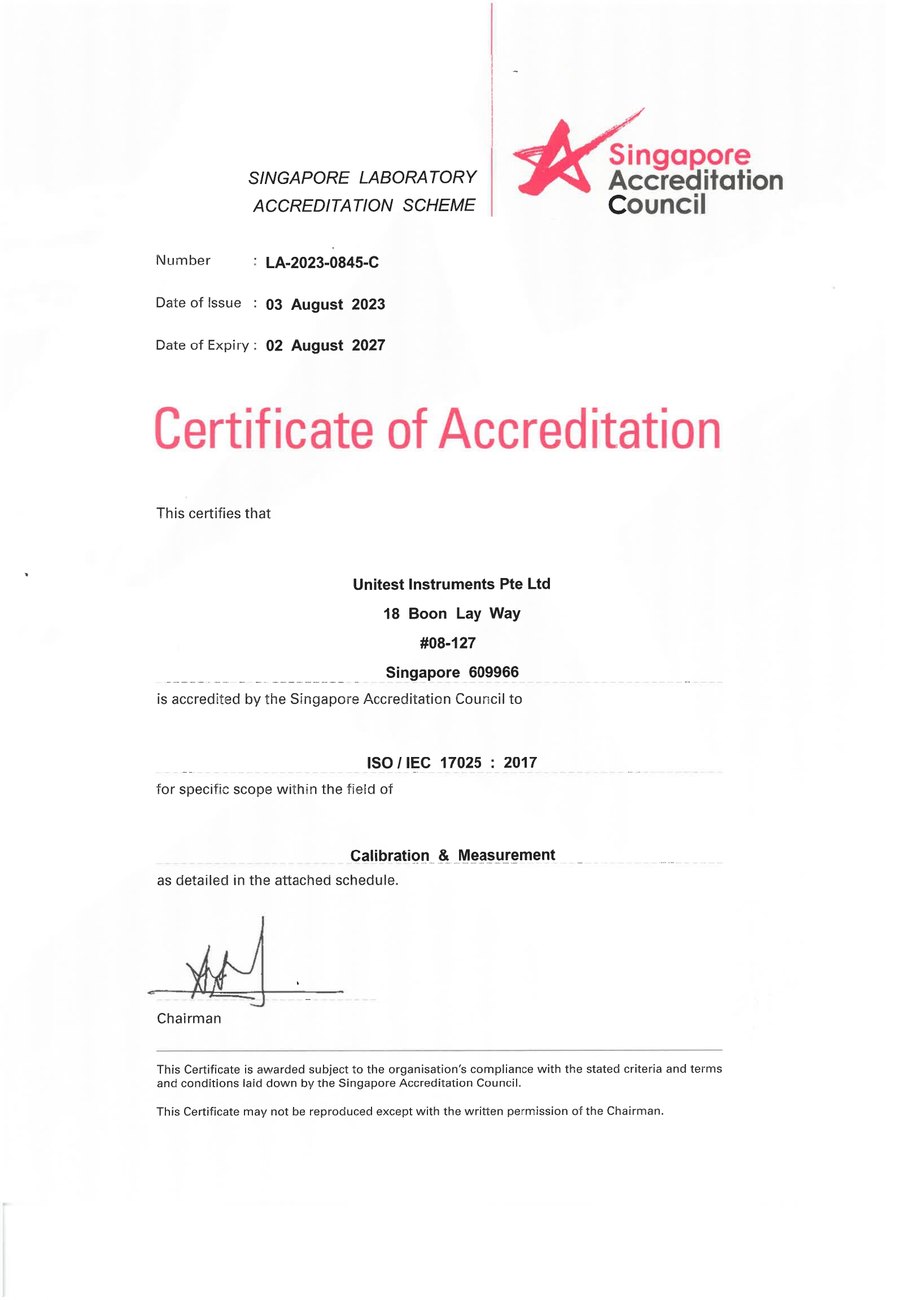
SAC-SINGLAS accredited calibration laboratory (Acc. No. LA-2023-0845-C) serving Singapore's industrial, pharmaceutical, and manufacturing sectors. All content reflects our ISO/IEC 17025 accredited scope and is reviewed by our technical calibration team.
Need hipot tester calibration in Singapore?
Unitest Instruments is SAC-SINGLAS accredited (Acc. No. LA-2023-0845-C) to ISO/IEC 17025. Same-week turnaround, certificates accepted by ISO 9001 auditors.