
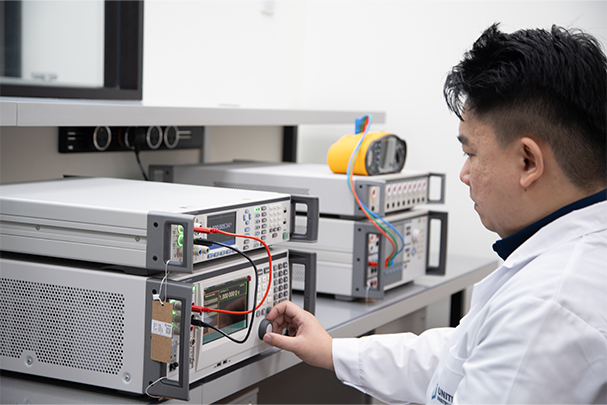
Key Takeaways
- Hipot (dielectric withstand) testing applies AC or DC high voltage (typically 500 V to 5 kV), between live conductors and chassis to detect insulation defects invisible to the naked eye.
- The test voltage and leakage current limit are set by the applicable product standard (IEC 62368-1, IEC 60601-1, IEC 61010-1, UL 60950, etc.), not by the tester manufacturer.
- An uncalibrated hipot tester can apply voltages up to 20% off-setpoint, causing genuine defects to go undetected or good products to be incorrectly scrapped.
- Singapore's CPSR SAFETY Mark scheme requires hipot testing for 43 categories of Controlled Goods; the Workplace Safety and Health Act also mandates safe electrical equipment in workplaces.
- Hipot tester calibration must be traceable to national measurement standards (NMC Singapore or a BIPM-member NMI) and performed at a defined interval, typically 6–12 months.
Definition and Purpose: What Hipot Testing Actually Tests
The word hipot is a contraction of "high potential," and the test is also formally called the dielectric withstand test or electric strength test. Its purpose is singular: to verify that the insulation separating live electrical conductors from touchable surfaces (and from conductors of different circuits), can survive a voltage stress that is significantly higher than the equipment's normal operating voltage, for a prescribed duration, without breaking down.
This matters because insulation defects that are harmless at 230 V can become catastrophic at elevated voltage. A pinhole in a cable jacket, a microscopic void in a potting compound, a conductive contaminant bridge across a PCB creepage gap. All may carry negligible leakage current at rated voltage but collapse catastrophically under test voltage, producing an arc or through-current that would, in service, cause electrocution or fire. By stressing the insulation before the product reaches the customer, hipot testing acts as a 100% screen for manufacturing defects that visual inspection cannot detect.
Hipot testing is distinct from insulation resistance (IR) testing, which measures the megohm or gigohm resistance of insulation at a lower DC voltage (typically 500 V or 1,000 V) and is better suited to detecting gradual degradation in aged equipment. Hipot is a pass/fail catastrophic-defect screen; IR testing is a trending tool. Both have their place, and both require a calibrated instrument.
The Physics of Dielectric Breakdown
To understand why hipot testing is effective, it helps to understand what happens inside an insulator under high electric field stress. Every solid, liquid, or gaseous dielectric has a characteristic dielectric strength. The maximum electric field (in V/m or kV/mm) it can sustain before conduction begins. For common solid insulators:
| Insulating Material | Dielectric Strength (kV/mm) | Typical Application |
|---|---|---|
| Air (1 atm, uniform field) | ~3.0 | Clearance gaps, open-frame assemblies |
| PVC cable insulation | 10–20 | Mains wiring, appliance cords |
| Polyimide film (Kapton) | 150–300 | Transformer interlayer insulation, flex PCBs |
| Epoxy (cast/laminated) | 15–25 | PCB substrate (FR4), potting compounds |
| Silicone rubber | 20–30 | Medical-grade enclosures, cable overmoulds |
| Mica (sheet) | 60–170 | High-temperature motor slot liners |
When a defect is present (a void, a contaminant particle, a crack), the local electric field at that defect is amplified by a factor that can reach 3× to 10× the macroscopic average field. A void with relative permittivity lower than the surrounding solid sees an even higher field concentration (governed by the boundary condition that the normal component of displacement current D must be continuous across the interface). This amplified local field initiates partial discharge (micro-arcs within the void), which erode the insulation progressively until full breakdown occurs. Hipot testing applies sufficient voltage that a defect severe enough to cause in-service failure will produce detectable partial discharge or full breakdown during the test.
The detection mechanism in a hipot tester is the leakage current measurement circuit. Under a pure capacitive load (a good insulator), the current is 90° out of phase with the voltage, purely reactive and harmless. When resistive breakdown begins, an in-phase (resistive) current component appears. Modern hipot testers can be set to measure only the resistive component (sometimes called "real leakage current"), eliminating false trips caused by capacitive charging current in high-capacitance products such as motor windings, large EMI filter capacitors, or shielded cables.
Test Types: AC Hipot vs. DC Hipot vs. Insulation Resistance
Three test modalities are in common use, each with distinct advantages and limitations. Understanding which is applicable to your product and standard is essential to running a valid test.
AC Dielectric Withstand Test
The AC hipot test applies a sinusoidal voltage at mains frequency (50 Hz in Singapore and most of Asia; 60 Hz in North America and parts of Japan). Because AC voltage stresses the insulation in both polarities on every cycle, it is generally considered the most rigorous test and is the default method in IEC product-safety standards. The test voltage is expressed as rms; the peak voltage seen by the insulation is 1.414× higher. For a 1,500 V rms test, the insulation sees ±2,121 V peak on every cycle.
DC Dielectric Withstand Test
The DC hipot test applies a steady direct voltage. DC is favoured in several situations: where the product under test has large capacitance (reducing reactive charging current that can trip protection on AC testers), where EMC filter capacitors would otherwise draw excessive current, and in some telecommunications and power electronics standards. The DC test voltage is typically set at 1.414× the AC equivalent to produce the same peak field stress in the insulation. DC testing does not exercise the insulation under both polarities, so it may miss certain defect types. A trade-off to be understood, not ignored.
Insulation Resistance (IR) Test
IR testing at 500 V or 1,000 V DC measures the steady-state resistance of the insulation after the initial charging transient has decayed. A good insulation system typically reads >100 MΩ; degraded or moisture-contaminated insulation may read 1–10 MΩ. IR testing is mandatory under IEC 60364 (electrical installations), is used for in-service condition monitoring under IEC 60364-6, and is the standard method for periodic maintenance testing in Singapore's electrical installation inspection regime. It is not a substitute for hipot testing; they measure different things and complement each other.
Need Your Hipot Tester Calibrated in Singapore?
Unitest Instruments calibrates AC and DC hipot testers, insulation resistance testers, and high-voltage measurement equipment with full traceability to NMC Singapore. Calibration certificates accepted by ISO 9001, ISO 13485, and CE mark auditors.
Applicable Standards and Test Voltages
The test voltage, test duration, and leakage current limit are always prescribed by the applicable product standard. Not by the hipot tester manufacturer or by the laboratory. Applying the wrong voltage invalidates the test. The table below summarises the most commonly referenced standards in Singapore's manufacturing and export context.
| Standard | Scope | AC Test Voltage (230 V rated equipment) | Duration | Leakage Limit (typical) |
|---|---|---|---|---|
| IEC 62368-1 (replaces IEC 60950-1 & IEC 60065) | Audio/video, IT & communications equipment | 1,500 V rms (Basic Insulation); 3,000 V rms (Reinforced) | 1 s (production); 60 s (type test) | 10 mA AC |
| IEC 60601-1 Ed. 3.1 | Medical electrical equipment | 1,500 V (Basic); 4,000 V (Reinforced/Double) | 60 s (type test) | 5 mA (earth leakage); 100 µA (BF/CF patient parts) |
| IEC 61010-1 Ed. 3 | Measurement, control, laboratory equipment | 2× Vrating + 1,000 V (min 1,500 V) | 5 s (routine); 60 s (type) | Per standard; typically 10 mA |
| IEC 60335-1 | Household and similar electrical appliances | 1,250 V (Basic); 3,750 V (Reinforced) | 60 s (type); 1 s (production) | Breakdown = fail |
| UL 60950-1 / UL 62368-1 | US/North American IT & AV equipment | 1,500 V rms (Basic); 3,000 V rms (Reinforced) | 60 s (type); 1 s (production) | 10 mA |
Understanding creepage and clearance requirements is inseparable from hipot testing. Clearance is the shortest distance through air between two conductive parts; creepage is the shortest path along the surface of insulating material. IEC 62368-1 and IEC 60601-1 specify minimum clearance and creepage values based on working voltage, pollution degree, and insulation class. A product that meets these dimensional requirements will typically pass the hipot test, but dimensional compliance alone does not guarantee a dielectric withstand pass if manufacturing defects are present. Both checks are required.
Calibration of Hipot Testers: Why It Matters and What Is Verified
The calibration of a hipot tester is not optional bureaucracy. It is the technical foundation on which every test result rests. A hipot tester that outputs 1,350 V when set to 1,500 V is conducting a test that no applicable standard recognises. Any "pass" result is meaningless, and any product certified on the basis of that test carries an unquantified safety risk.
As detailed in our article on accredited vs. non-accredited calibration, a calibration certificate from an ISO/IEC 17025 accredited laboratory provides legally defensible measurement traceability. The chain of comparisons linking your instrument's reading back to the SI unit of voltage maintained at a national metrology institute (NMC Singapore, in the local context). Non-accredited calibration provides no such assurance.
Parameters Verified During Hipot Tester Calibration
A complete calibration of an AC or DC hipot tester verifies the following parameters against reference standards whose uncertainty is stated in the calibration certificate:
- Output voltage accuracy: Verified at multiple test voltage setpoints (e.g. 500 V, 1,000 V, 1,500 V, 3,000 V, 5,000 V) against a calibrated high-voltage divider or precision voltmeter. Typical manufacturer specification: ±(1–3)% of setpoint.
- Leakage current measurement accuracy: Verified by injecting a known current (via a precision resistor at the rated test voltage) and confirming the displayed reading. Typical specification: ±(2–5)% of reading + floor current.
- Timer accuracy: Verified for the test duration setpoint. Critical for production-line testing where 1-second tests are used; a 20% timer error can make a 1-second test only 0.8 seconds. Potentially insufficient for thermal defects to manifest.
- Trip threshold accuracy: Verified by confirming the instrument trips (fails the test) at or below its set leakage current trip point. A tester that trips at 12 mA when set to 10 mA will pass products that should fail.
- Arc detection sensitivity (where equipped): Verified that the instrument correctly detects a simulated partial discharge or arc event.
The calibration certificate for a hipot tester should include measurement uncertainty for each parameter. As explained in our guide to measurement uncertainty, the uncertainty of the calibration must be small relative to the instrument's specification (typically by a factor of 4:1 or better), for the calibration to be meaningful. A calibration laboratory that reports only pass/fail without uncertainty values does not comply with ISO/IEC 17025 requirements.
Singapore Regulatory Context: SAFETY Mark, WSH, and Export Compliance
Singapore's regulatory landscape for electrical product safety intersects with hipot testing in three primary ways.
Consumer Protection (Safety Requirements) Regulations. SAFETY Mark
Enterprise Singapore administers the SAFETY Mark scheme under the Consumer Protection (Safety Requirements) Regulations 2011. The scheme covers 43 categories of Controlled Goods, including household appliances, power tools, cables, luminaires, and consumer electronics. Before a Controlled Good can be supplied in Singapore, it must carry a SAFETY Mark, which requires type-test results from a recognised Conformity Assessment Body (CAB), typically an accredited test laboratory. The referenced product standards for most Controlled Goods categories are IEC standards that include dielectric withstand (hipot) testing as a mandatory test. The test must be conducted on a calibrated, traceable hipot tester; calibration certificates are reviewed by CABs during technical file assessment.
Workplace Safety and Health Act (WSH Act)
The WSH Act and its subsidiary legislation require that machinery and equipment used in Singapore workplaces (including electrical equipment), is safe. For electrical equipment manufactured or imported for workplace use, this practically means the equipment must have been tested to the applicable IEC product-safety standard, which for most categories includes a hipot test. Manufacturers and importers bear the legal duty to demonstrate due diligence, of which a calibrated-tester test record forms a key part.
Export and CE Mark
Singaporean manufacturers exporting to the European Union under the Low Voltage Directive (LVD, 2014/35/EU) must demonstrate conformity to harmonised standards such as IEC 62368-1, IEC 60601-1, or IEC 61010-1. These standards require hipot testing as part of type testing and often as a routine production-line test. EU market surveillance authorities can require technical files including calibration certificates for the test equipment used. An expired or non-traceable calibration is grounds for market withdrawal.
Common Mistakes in Hipot Testing
Even when the correct standard is identified and the correct test voltage is programmed, several procedural errors can invalidate results or cause genuine hazards.
1. Testing Without Voltage Ramp-Up
Applying the full test voltage instantaneously to a capacitive load (such as a motor winding, a shielded cable, or a product with large EMI filter capacitors), produces a high current transient that can falsely trip the leakage current detector or damage the product. The correct procedure is to ramp the voltage from zero to the test level over 1–10 seconds, hold for the prescribed duration, then ramp down. Most modern hipot testers have a programmable ramp; operators must enable it.
2. Grounding the Wrong Point
The test must be conducted between the correct conductor pair. For a double-insulated Class II appliance, the test is between live conductors and accessible metal parts, not between live and neutral. For a Class I (earthed) appliance, live+neutral bonded together are tested against PE. Testing the wrong conductor pair may miss the insulation that actually protects the user.
3. Testing on Energised Equipment
Hipot testing must be performed on de-energised equipment with mains supply disconnected. Applying test voltage to equipment that remains connected to the mains creates a parallel path and is a severe safety hazard to the operator and to the equipment.
4. Using a Non-Calibrated Tester for Acceptance Testing
This is the most commercially consequential mistake. ISO 9001 clause 7.1.5.2 explicitly requires that monitoring and measuring equipment be calibrated or verified at specified intervals, with calibration traceable to international or national measurement standards, and calibration records retained. Using a non-calibrated hipot tester for product acceptance testing is a non-conformance that audit bodies (and courts), treat seriously.
5. Ignoring the Difference Between Type Testing and Routine Testing
Type testing (performed on design samples to verify the design meets the standard) typically requires a 60-second test duration. Routine (production-line) testing on every unit is often permitted to use a 1-second test at the same or slightly higher voltage. The two are not interchangeable: a 1-second type test is not compliant, and a 60-second routine test on every unit is unusually conservative, and slows production. The standard specifies which duration applies to which test category.
Frequently Asked Questions
Hipot testing (short for "high potential" testing), is an electrical safety test that applies a voltage significantly higher than the product's normal operating voltage between its live conductors and its accessible conductive parts or chassis. The purpose is to verify that the insulation separating those conductors is free from defects such as pinholes, contamination, or inadequate creepage distances. A passing test confirms the insulation can withstand the required dielectric stress without breaking down, protecting end users from electric shock.
Hipot (dielectric withstand) testing applies a high voltage (typically 500 V to 5 kV), for a short period (1–60 seconds) and measures whether the leakage current exceeds a pass/fail threshold, indicating insulation breakdown. Insulation resistance (IR) testing applies a lower DC voltage (typically 500 V or 1,000 V) and measures the resistance of the insulation in megohms or gigohms. Both tests assess insulation quality, but hipot is a pass/fail stress test designed to catch catastrophic manufacturing defects, while IR testing detects gradual degradation and is better suited for trending over time in maintenance programs.
The test voltage depends on the applicable product safety standard and the rated working voltage of the equipment. IEC 62368-1 (IT and AV equipment) requires 1,500 V rms AC for Basic Insulation and 3,000 V rms for Reinforced Insulation on 230 V-rated products. IEC 60601-1 (medical equipment) requires 1,500 V for Basic Insulation and 4,000 V for Reinforced/Double Insulation. IEC 61010-1 (lab and measurement equipment) requires 2× working voltage + 1,000 V (minimum 1,500 V). The test duration is typically 1 second for production-line testing and 60 seconds for type testing. Never choose a test voltage without consulting the applicable standard.
Leakage current limits vary by standard and insulation class. Under IEC 62368-1 for consumer electronics and IT equipment, the production-line limit for Basic Insulation is typically 10 mA AC or 2 mA DC. IEC 60601-1 for medical equipment sets stricter limits: 5 mA for earth leakage and as low as 100 µA for patient-applied parts in BF and CF classifications. Any current spike indicating resistive breakdown (as opposed to capacitive charging current), is an immediate fail regardless of absolute magnitude. Modern hipot testers can be configured to measure only the resistive (in-phase) component of leakage current, avoiding false trips from capacitive loads.
Yes. The accuracy of the output voltage and the leakage current measurement circuit of a hipot tester directly determine whether a product genuinely passes or fails. An uncalibrated tester may apply a voltage 10–20% lower than required (causing a genuinely defective product to appear safe), or measure leakage current inaccurately, leading to false passes or false failures. ISO 9001 clause 7.1.5.2 requires calibration of all monitoring and measuring equipment used in product acceptance testing, traceable to national measurement standards. Medical device manufacturers under ISO 13485 and CE mark exporters under the EU LVD face the same requirement, with technical files subject to audit.
The calibration interval for a hipot tester must be determined by the user based on drift history, frequency of use, environmental conditions, and the consequence of an out-of-tolerance result, not assigned arbitrarily. In practice, most manufacturers calibrate annually or semi-annually. ISO 9001 and IEC 62368-1 both require calibration intervals to be reviewed against historical data. If previous calibration records show the instrument drifts close to its tolerance limits within 12 months, a 6-month interval is warranted. After any impact, overload event, or significant repair, the instrument should be recalibrated before further use, regardless of schedule.
Yes, for many product categories. Singapore's Consumer Protection (Safety Requirements) Regulations (CPSR) require that 43 categories of Controlled Goods carry a SAFETY Mark before they can be sold, and the referenced IEC standards for most categories include hipot testing as a mandatory type test. The Workplace Safety and Health Act additionally requires that electrical equipment used in workplaces is safe to the relevant IEC standard. For CE mark exports to the EU, hipot testing is required under the Low Voltage Directive 2014/35/EU via harmonised standards including IEC 62368-1 and IEC 60601-1.
Dielectric breakdown occurs when the electric field strength applied across an insulating material exceeds its dielectric strength. The material's intrinsic ability to resist electron avalanche. When a defect such as a void, pinhole, or conductive contaminant is present, the local electric field at that defect is concentrated by a factor of 3×–10× compared to the surrounding bulk insulation. At the elevated voltage used in a hipot test, this concentrated field initiates partial discharge (micro-arcs within the void), which erode the insulation and quickly lead to full breakdown. This manifests as a rapid rise in resistive (in-phase) leakage current, which the hipot tester detects and registers as a fail.
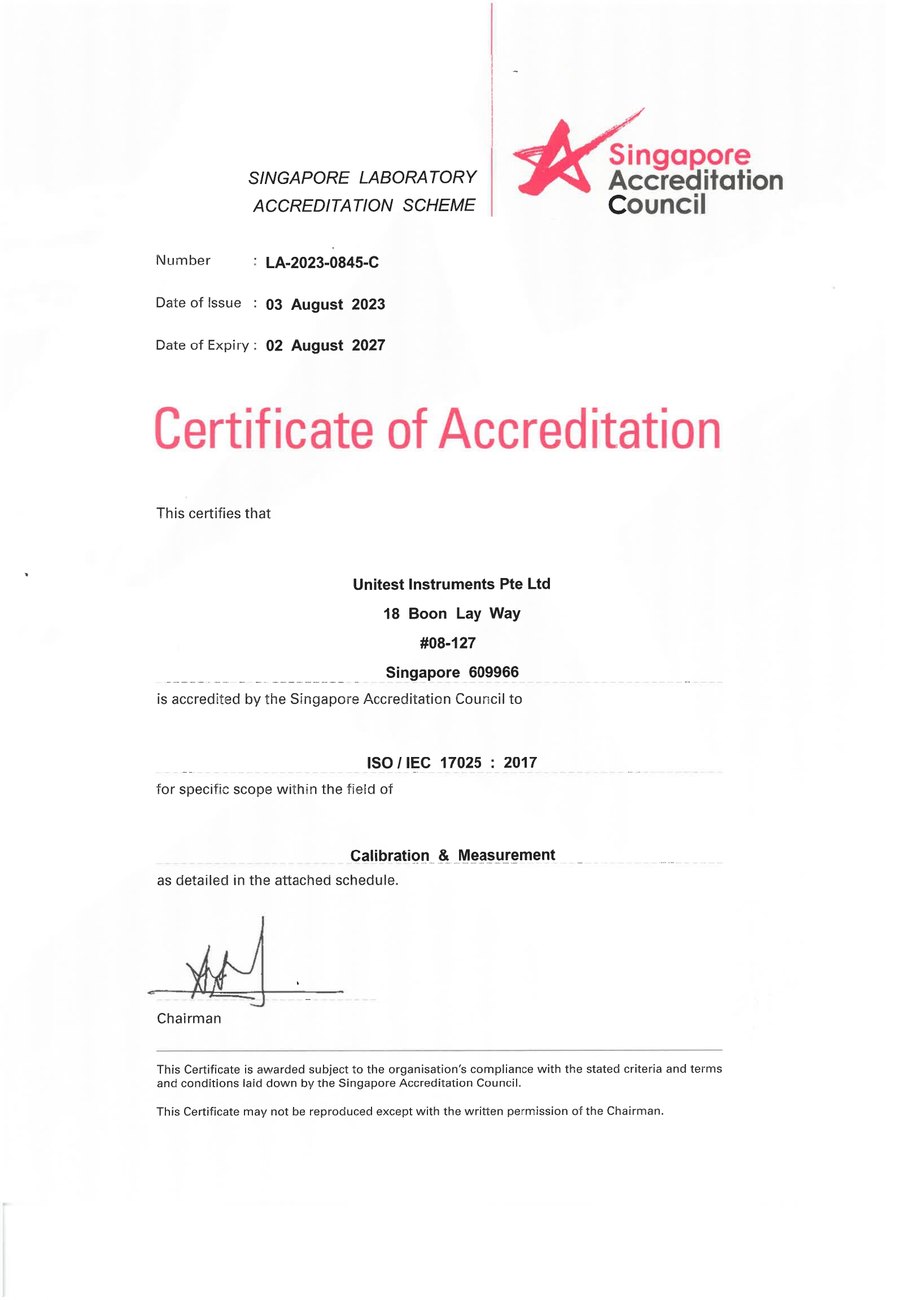
SAC-SINGLAS accredited calibration laboratory (Acc. No. LA-2023-0845-C) serving Singapore's industrial, pharmaceutical, and manufacturing sectors. All content reflects our ISO/IEC 17025 accredited scope and is reviewed by our technical calibration team.
Need electrical safety instrument calibration in Singapore?
Unitest Instruments is SAC-SINGLAS accredited (Acc. No. LA-2023-0845-C) to ISO/IEC 17025. We calibrate hipot testers, insulation resistance testers, and high-voltage measurement equipment. Same-week turnaround, certificates accepted by ISO 9001 auditors.