Key Takeaways
- Both Hach and YSI use optical (luminescent) DO sensor technology; neither has a meaningful accuracy advantage when properly calibrated.
- Hach leads for WWTP process control and SCADA integration. Their sc controller ecosystem is the de facto standard in Singapore's water utilities.
- YSI leads for multi-parameter field sondes and unattended environmental monitoring. The EXO platform handles biofouling and long-duration deployments better.
- Sensor caps (Hach LDO cap, YSI ODO cap) are the main consumable for both brands. Budget S$150–300 per replacement at 6–12 month intervals under heavy use.
- Annual SAC-SINGLAS accredited calibration is required for both brands in regulated Singapore applications; Unitest calibrates and supplies both.
Why This Comparison Matters in Singapore
Dissolved oxygen (DO) measurement is central to water quality management, aquaculture, environmental compliance, pharmaceutical process water, and wastewater treatment across Singapore. PUB, NEA, and ISO 9001 auditors all expect instruments to be calibrated against traceable references, which means the choice of meter is not just a performance question but also a procurement and compliance question.
Hach and YSI (now part of Xylem) together account for the majority of professional DO meters deployed in Singapore's industrial and environmental sectors. They are not equivalent products, however. Choosing the wrong brand for your application leads to higher consumable costs, unnecessary calibration complexity, or instruments that simply do not fit your workflow. This guide draws on our experience as a SAC-SINGLAS accredited calibration laboratory that services both brands daily.
Sensor Technology: LDO vs ODO. The Same Physics, Different Implementation
Both Hach and YSI have moved their flagship DO product lines from older polarographic (Clark cell) electrochemical sensors to optical luminescent sensors. Hach calls theirs LDO (Luminescent Dissolved Oxygen); YSI calls theirs ODO (Optical Dissolved Oxygen). The underlying physics is identical: a blue LED excites a luminophore dye coated on a cap or foil, and the meter measures the phase shift in the emitted red light. Higher oxygen concentration quenches the luminescence faster, producing a shorter phase delay. The meter converts phase delay to a DO concentration using the Stern-Volmer equation corrected for temperature and salinity.
Where the brands differ is in cap design and anti-fouling. YSI's EXO series caps include a wiper mechanism that automatically brushes the optical face to prevent algal and biofilm fouling during long-term deployments. Hach's LDO sensors designed for online process monitoring rely on the turbulent flow conditions inside a WWTP aeration tank or recirculation pipe to self-clean. For static or slow-moving field deployments without a wiper, Hach LDO caps can foul faster than YSI EXO caps. A practical difference that matters when you are dropping a sonde into a tidal channel for a week.
Full Feature Comparison Table
| Feature | Hach (HQ40d / LDO sc) | YSI (ProDSS / EXO2) |
|---|---|---|
| Sensor technology | Luminescent DO (LDO) optical | Optical DO (ODO) luminescent |
| Measurement range | 0–20 mg/L (HQ40d); 0–50 mg/L (LDO sc) | 0–50 mg/L (ProDSS); 0–50 mg/L (EXO) |
| Accuracy (specification) | ±0.1 mg/L or ±1% reading | ±0.1 mg/L or ±1% reading |
| Temperature compensation | Automatic (built-in thermistor) | Automatic (built-in thermistor) |
| Salinity compensation | Manual entry (HQ); automatic with conductivity module (sc) | Automatic with integrated conductivity sensor (ProDSS/EXO) |
| Multi-parameter capability | Yes. HQ40d accepts 2 probes; sc series modular | Yes. ProDSS up to 4 sensors; EXO up to 6 sensors |
| Field/portable form factor | HQ40d portable meter + probe | ProDSS handheld; EXO sonde (unattended) |
| Online/process sensor | LDO sc / LDO101 for SCADA | EXO with telemetry; less common for SCADA |
| SCADA / 4–20 mA output | Native via sc1000/sc200 controller | Available but requires additional hardware |
| Data logging | Internal memory + USB (HQ); sc controller logs to SD | Internal memory + Bluetooth + KorDSS software |
| Anti-fouling (unattended) | No wiper (HQ/LDO sc); turbulent-flow dependent | Central wiper on EXO series. Field-proven |
| Sensor cap / consumable cost | LDO cap ~S$180–260 (6–12 month life) | ODO cap ~S$160–280 (6–12 month life) |
| IP rating | IP67 (HQ40d) | IP67 (ProDSS); EXO depth rated to 100 m |
| Calibration complexity | One-point air-saturation or water-saturated air | One-point air-saturation or water-saturated air |
| Typical street price (Singapore) | S$1,800–3,500 (HQ40d + LDO probe) | S$2,200–4,800 (ProDSS + ODO sensor) |
| Best for | WWTP process control, lab spot-checks, SCADA | Environmental surveys, estuary/river monitoring, unattended deployment |
Use Case Deep Dives: Where Each Brand Wins
Wastewater Treatment and Process Control. Hach Wins
In Singapore's wastewater treatment plants (whether NEWater reclamation facilities, industrial trade effluent plants, or conventional activated sludge systems), Hach dominates for a reason. The Hach sc controller ecosystem (sc200, sc1000) accepts LDO sensors, turbidity sensors, and nutrient analysers under a single controller, outputting to SCADA via Modbus, PROFIBUS, or 4–20 mA without a separate signal conditioner. Operators familiar with Hach's menu structure can configure DO set-points for blower control in minutes.
YSI does not have an equivalent unified process controller ecosystem. Their EXO sondes can output via SDI-12 or RS-232, which works well with environmental data loggers but requires an I/O translator to interface cleanly with a Siemens or Rockwell PLC. For new WWTP builds or expansions in Singapore where the control room is already Hach-based, staying with Hach is the pragmatic choice.
Environmental Monitoring and Field Surveys. YSI Wins
For Singapore's environmental agencies, reservoir monitoring, marina surveys, coastal ecology studies, and stream-health assessments, YSI's platform has significant advantages. The YSI EXO2 sonde can carry up to six sensors simultaneously (DO, pH, conductivity, turbidity, chlorophyll-a, and fDOM), all in a single deployment, reducing boat time and data complexity. The integrated central wiper keeps optical faces clean over 30+ day deployments without operator intervention.
The ProDSS handheld is equally capable for grab-sample field work, with Bluetooth connectivity to the KorDSS app that logs GPS coordinates alongside measurements. A practical advantage when producing NEA-formatted data reports. Hach's HQ40d is a competent portable meter but does not offer equivalent GPS logging or the sonde-deployment architecture that makes multi-week environmental surveys practical.
Laboratory Bench-Top and Pharmaceutical Applications. Broadly Even, Slight Hach Edge
For bench-top lab use (BOD testing, pharmaceutical process water, aquaculture hatchery monitoring, or food processing QC), both brands perform equivalently. Hach's HQ series is perhaps marginally better documented for GLP (Good Laboratory Practice) workflows, with audit trail features and password-protected calibration records that satisfy USP and EP requirements. YSI's ProDSS offers similar data integrity features but is physically designed for field handling rather than a bench stand. If your lab already uses Hach multiparameter meters for pH and conductivity, keeping DO on the same platform simplifies operator training and calibration scheduling.
Need your Hach or YSI DO meter calibrated in Singapore?
Unitest Instruments issues SAC-SINGLAS accredited calibration certificates for both Hach and YSI dissolved oxygen meters. Traceable to NMC Singapore and accepted by ISO 9001 auditors. Same-week turnaround available.
Calibration Requirements: What Singapore Labs and Auditors Expect
Regardless of which brand you choose, the calibration obligations under Singapore's regulatory environment are the same. ISO 9001:2015 clause 7.1.5 requires that monitoring and measurement equipment be calibrated or verified against traceable standards. For NEA-licensed environmental testing laboratories, SAC-SINGLAS accredited calibration certificates are the accepted standard. PUB-regulated water quality programmes require certificates traceable to national measurement standards.
Both Hach and YSI optical DO meters can be calibrated using the water-saturated air method (placing the sensor in a sealed headspace of water-saturated air) or directly in air at known barometric pressure and temperature. The calibration uncertainty achievable for DO at Unitest's accredited laboratory is typically ±0.10–0.15 mg/L at 95% confidence, well within the ±0.5 mg/L tolerance most process control applications require.
Understanding what your calibration certificate should contain is important before accepting any certificate from a calibration provider. Read our guide to what a calibration certificate should include to verify that your current supplier meets the ISO/IEC 17025 documentation standard.
Total Cost of Ownership: A 3-Year Model
The list price of an instrument is rarely the largest cost over its service life. For DO meters, the main ongoing costs are sensor caps, calibration, and operator time. The table below models a single portable DO meter deployed for a typical Singapore industrial or environmental application.
| Cost Element (3 Years) | Hach HQ40d + LDO Probe | YSI ProDSS + ODO Sensor |
|---|---|---|
| Initial purchase (meter + sensor) | ~S$2,200 | ~S$2,800 |
| Sensor caps (3 years, 1 per year) | ~S$600 | ~S$600 |
| SAC-SINGLAS calibration (annual) | ~S$450 (3 × S$150) | ~S$450 (3 × S$150) |
| Operator time (calibration, maintenance) | ~8 hrs/year | ~7 hrs/year |
| Estimated 3-year total cost | ~S$3,250 | ~S$3,850 |
The gap narrows significantly when comparing a fleet of four or more instruments, or when factoring in the cost of a Hach sc process sensor versus a YSI EXO sonde. Process sensors (online, SCADA-connected) from Hach typically cost S$4,000–8,000 installed, while YSI EXO sondes with telemetry start at S$6,000 but serve dual duty as both an online and portable device. For multi-use flexibility, the YSI EXO architecture can offer better value in environmental monitoring programmes.
Procurement Considerations for Singapore Buyers
Singapore's government and quasi-government procurement processes often require calibration certificates from SAC-SINGLAS accredited laboratories as a condition of equipment acceptance. This applies to PUB suppliers, NEA contractors, A*STAR-funded research projects, and many larger manufacturing clients. When specifying either Hach or YSI in a tender, include a line item for annual accredited calibration (not just the instrument purchase), to avoid compliance gaps at audit time.
Both brands are represented by authorised distributors in Singapore. Unitest Instruments supplies and calibrates both Hach and YSI dissolved oxygen meters, giving procurement teams a single vendor for both the instrument and its traceable calibration certificate. This simplifies the vendor management and audit trail, particularly for ISO 9001-certified facilities where calibration records must be linked to specific instrument serial numbers. It is also worth understanding the distinction between accredited and non-accredited calibration when evaluating quotes. Read our guide on accredited vs non-accredited calibration to understand what the difference means for your audit exposure.
Our Honest Recommendation
There is no universally better brand. The honest recommendation depends entirely on your primary application:
- WWTP operators and process engineers: Hach LDO sc with sc200/sc1000 controller. The SCADA integration is unmatched and the ecosystem is the Singapore utility standard.
- Environmental consultants and field monitoring teams: YSI ProDSS for handheld work; YSI EXO2 for unattended sonde deployments. The multi-parameter flexibility and wiper anti-fouling justify the premium.
- Lab managers and QC analysts: Either brand works. Hach HQ40d is marginally better for GLP audit trails; YSI ProDSS is better if the meter also needs to leave the lab.
- Aquaculture and fish farm operators: YSI ProDSS. The ability to log GPS, multi-parameter data on a single handheld, and connect to a smartphone app is practically valuable for farm-based monitoring programmes.
Whatever brand you select, the most important step is to establish a regular calibration programme with an SAC-SINGLAS accredited laboratory. Instrument accuracy degrades over time, sensor caps age, and calibration records are the only evidence that protects your organisation during regulatory audits. Unitest Instruments calibrates and supplies both Hach and YSI dissolved oxygen meters. Contact us to discuss your application and get a calibration quote.
Software and Data Management: Claros vs KorDSS
The software layer around each platform matters more than most buyers expect, particularly for facilities that need to defend calibration records during an audit. Hach's ecosystem centres on Claros, a cloud-connected water intelligence platform that pulls calibration logs and process data from sc-series controllers automatically, timestamps every calibration event, and flags sensors approaching their scheduled maintenance date. For a WWTP running dozens of instruments, this centralised view is genuinely useful for scheduling calibration campaigns with Unitest well ahead of an ISO 9001 surveillance audit, rather than discovering a lapsed certificate during the auditor's site walk.
YSI's equivalent is KorDSS, a desktop and mobile application built primarily for field data collection rather than fleet management. It excels at what environmental teams actually need in the field: GPS-tagged readings, site metadata, calibration logs stored against each sonde's serial number, and direct export to formats compatible with NEA reporting templates. What it does not offer is Claros-style centralised fleet monitoring across a large multi-sensor installation, because YSI's instruments are more commonly deployed as individual field units than as a networked plant-wide system. For a five-person environmental consultancy running a handful of EXO2 sondes, KorDSS is more than sufficient. For a utility managing forty DO sensors across multiple treatment trains, Claros' fleet-level visibility is the more practical tool, and this software gap is often a bigger deciding factor for procurement teams than the sensor specification itself.
Common Failure Modes and What to Check Before Calling It a Calibration Problem
Both brands' optical DO sensors fail in recognisable, brand-specific ways, and knowing the pattern saves a wasted calibration trip when the real issue is maintenance, not measurement accuracy. On Hach LDO sensors, the most common field complaint is a slow-drifting low reading in process applications, which is almost always cap fouling from biofilm or grease in an aeration basin rather than sensor failure; Hach specifies a cap replacement interval of roughly 12 months in clean applications but recommends inspection every 3 months in high-fouling environments typical of Singapore's warmer wastewater streams. A genuine LDO sensor fault more often shows up as an erratic or non-responsive reading rather than a gradual drift, and that pattern does warrant a service call rather than a cap change.
On YSI ODO sensors, the characteristic failure mode is a reading that responds correctly to changes but reports a fixed offset from a reference method, which typically traces to the sensor's internal calibration coefficients degrading with cap age or to the wiper mechanism failing to fully clear the optical face between readings on EXO sondes; a visual check of the wiper's parked position and a manual cap inspection resolves the majority of these cases without needing to send the sonde in. Where either brand shows a reading that will not stabilise at all, even after a fresh cap and a successful air-calibration, that is the point to stop troubleshooting in the field and send the instrument for full accredited calibration and inspection, since it usually indicates a failed thermistor, a cracked cap seal admitting ambient air, or in older polarographic-legacy units still in service, membrane damage. Unitest's technicians log the specific failure signature on the calibration report so your team can distinguish a true out-of-tolerance reading from a maintenance issue the next time it recurs.
Cross-Brand Fleets: A Common Reality in Singapore
Many Singapore facilities operating for more than a decade end up running both brands simultaneously, typically a legacy Hach installation on the process side inherited from an earlier plant design, alongside newer YSI sondes brought in for a specific environmental monitoring contract or research collaboration. This is not a problem worth re-engineering around purely for the sake of standardisation, provided your calibration provider can service both. Where it does matter is in the calibration schedule itself: because the two platforms have different sensor cap lifespans and slightly different acceptance-limit conventions in their own calibration software, treating a mixed fleet as one undifferentiated pool of "DO meters" on a single blanket calibration date tends to produce avoidable gaps, where a YSI sonde due for a mid-cycle cap change gets calibrated against a schedule built around Hach's longer LDO cap interval. Unitest maintains separate calibration due-date tracking by instrument serial number and brand for exactly this reason, so a mixed fleet does not silently drift out of compliance between audits.
Frequently Asked Questions
YSI generally has the edge for rugged field deployments, particularly the YSI ProDSS and EXO series, which are purpose-built for environmental monitoring, stream surveys, and unattended sonde deployments. Their optical (ODO) sensors include a central wiper mechanism on the EXO platform to handle biofouling over long deployments. Hach's HQ series is also field-capable but is more commonly found in portable lab-style work near a bench or truck. If your team spends days at remote sampling sites, lean toward YSI.
Hach is widely regarded as the preferred brand for WWTP process control. Their LDO101 and LDO sc sensors integrate directly into Hach's sc1000 controller ecosystem, enabling SCADA connectivity, 4–20 mA output, and Modbus communication out of the box. Most Singapore PUB-regulated WWTPs running Hach instrumentation benefit from a unified vendor relationship and single-vendor calibration service. YSI does offer online sensors with telemetry, but the SCADA integration ecosystem is less mature for process control versus environmental monitoring.
Calibration frequency depends on the application and regulatory requirements rather than brand alone. For ISO 9001 and regulatory compliance in Singapore, most labs calibrate portable DO meters every 6–12 months, with in-field one-point air-saturation checks before each use. Both Hach and YSI optical sensors drift less than older electrochemical (Clark cell) sensors, but calibration by an accredited laboratory remains mandatory for audit trails. Unitest recommends annual SAC-SINGLAS accredited calibration for both brands used in regulated applications.
Both brands offer optical luminescent dissolved oxygen sensors as their flagship technology, replacing older polarographic Clark cell sensors. Hach calls theirs LDO (Luminescent Dissolved Oxygen) and YSI calls theirs ODO (Optical Dissolved Oxygen). Both sensors excite a luminophore dye with blue LED light and measure the phase shift in returned red light, which correlates to oxygen partial pressure. The underlying physics is identical; differences lie in cap and foil design, anti-fouling features, and integration with each brand's data logging ecosystem.
Yes. Unitest Instruments sells and calibrates dissolved oxygen meters from both Hach and YSI. Our SAC-SINGLAS accredited calibration (Acc. No. LA-2023-0845-C) covers dissolved oxygen measurement and produces certificates traceable to Singapore's National Metrology Centre (NMC). Our certificates are accepted by ISO 9001 auditors, NEA-licensed laboratories, and PUB-regulated facilities across Singapore. Contact us for a quote.
Over a 3-year period, total cost of ownership is comparable, but the cost drivers differ. Hach meters typically have a lower initial purchase price for portable instruments, while YSI's multi-parameter sonde architecture costs more upfront but reduces per-deployment labour in environmental monitoring programmes. For a single-instrument lab application, Hach's HQ series tends to offer better value. For a fleet of instruments deployed in environmental monitoring, YSI's sonde architecture often wins on total cost per data-point collected.
Both brands publish specification accuracy of ±0.1 mg/L or ±1% of reading (whichever is greater) for their optical DO sensors under controlled conditions. In practice, real-world accuracy in Singapore's high-humidity, high-temperature environment depends heavily on proper calibration, cap condition, and temperature compensation. After SAC-SINGLAS accredited calibration, both brands typically achieve measurement uncertainty within ±0.15 mg/L at the 95% confidence level under field conditions. Neither brand has a statistically meaningful accuracy advantage when both instruments are properly calibrated and maintained.
For SCADA integration, Hach is the stronger choice. Their sc series controllers support Modbus RTU, PROFIBUS, 4–20 mA, and digital outputs natively, and are used extensively in Singapore's water and wastewater utilities. YSI's EXO sondes output via SDI-12 and RS-232, which suits environmental data loggers but requires additional translation hardware for industrial PLC/SCADA systems. If your facility already runs a Hach controller ecosystem, staying within Hach keeps configuration and calibration simpler and reduces total system integration cost.
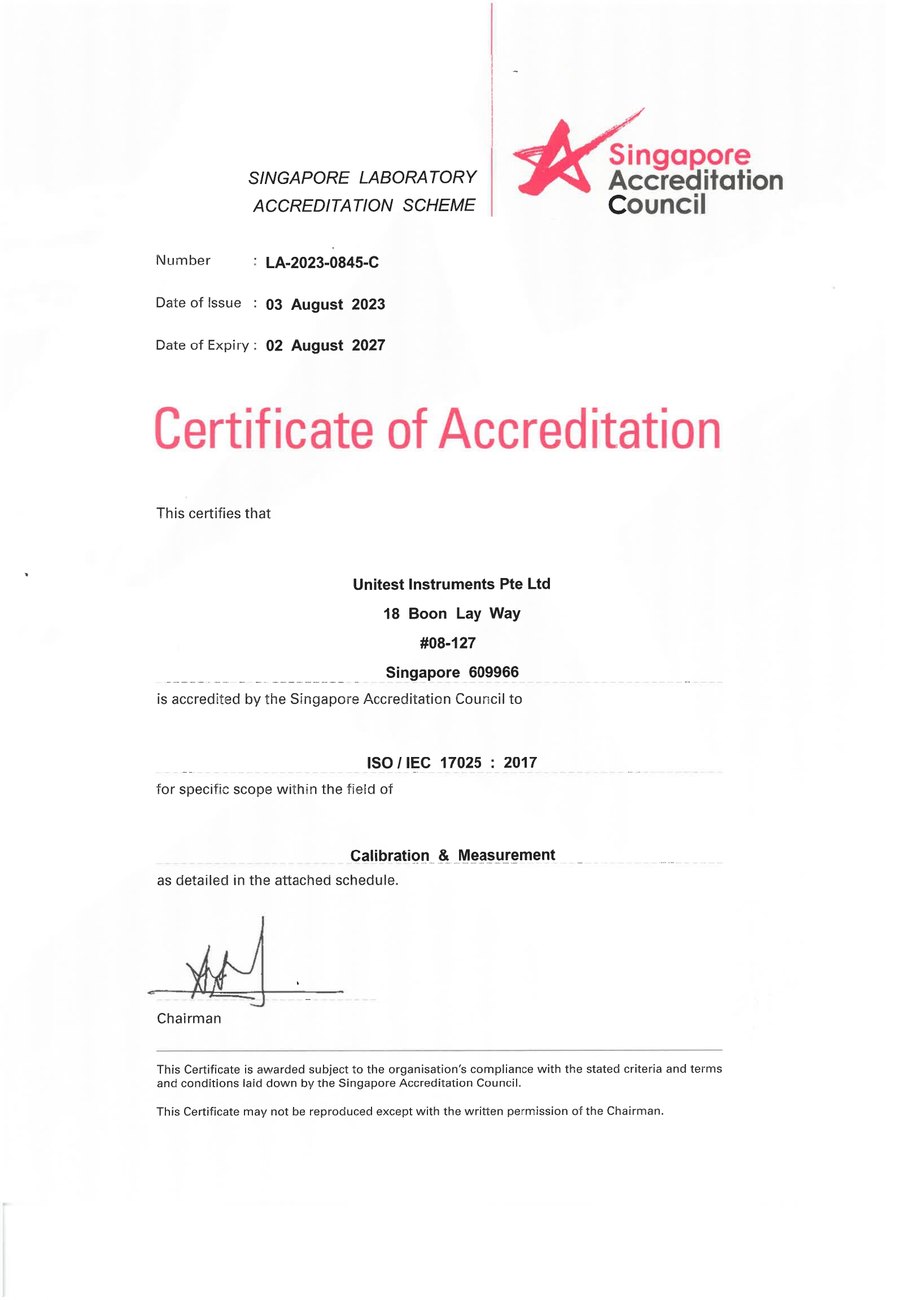
SAC-SINGLAS accredited calibration laboratory (Acc. No. LA-2023-0845-C) serving Singapore's industrial, pharmaceutical, and manufacturing sectors. All content reflects our ISO/IEC 17025 accredited scope and is reviewed by our technical calibration team.
Need dissolved oxygen meter calibration in Singapore?
Unitest Instruments is SAC-SINGLAS accredited (Acc. No. LA-2023-0845-C) to ISO/IEC 17025. We calibrate both Hach and YSI DO meters with same-week turnaround. Certificates accepted by ISO 9001 auditors and NEA.