
Key Takeaways
- Oxygen is paramagnetic due to two unpaired electrons in its outer shell. A property unique among common atmospheric gases that paramagnetic analysers exploit directly.
- Zirconia sensors follow the Nernst equation and must operate above 600 °C; they are not suitable for ambient-temperature or low-concentration (<0.1%) measurements without special modifications.
- Electrochemical cells consume oxygen in their reaction and have a finite lifespan of 1–3 years; sensor replacement, not just recalibration, is required periodically.
- Under Singapore's NEA Continuous Emissions Monitoring System (CEMS) requirements, oxygen analysers in licensed industrial premises must be calibrated with NMC-traceable certified reference gas mixtures.
- Cross-gas interference is the most common source of systematic error: NO₂ affects paramagnetic; combustibles affect zirconia; SO₂ and H₂S affect electrochemical cells.
Why Oxygen Measurement Technology Matters
Oxygen concentration measurement underpins safety, process efficiency, and regulatory compliance across Singapore's pharmaceutical, semiconductor, food processing, petrochemical, and power generation industries. A ±1% vol error in an inert-atmosphere glove box can compromise a batch of active pharmaceutical ingredients. A miscalibrated zirconia probe on a natural gas burner can cost 3–5% additional fuel per year. Or, in a worst case, create a dangerously fuel-rich furnace atmosphere. Yet the three dominant analyser technologies differ profoundly in their physics, accuracy, cost, and maintenance demands.
Selecting correctly begins with understanding what each technology actually measures, because all three ultimately report "oxygen concentration" while sensing entirely different physical phenomena. The reported number is only as reliable as the calibration process that converts the raw physical signal into a concentration value, which is why ISO/IEC 17025 accredited calibration using traceable reference gases is the regulatory baseline, not an optional upgrade.
Paramagnetic Oxygen Analysers: Magnetic Susceptibility as a Measurement Principle
Oxygen (O₂) is one of the few stable molecules that is strongly paramagnetic. Its paramagnetism arises from two unpaired electrons in its outer molecular orbital (the triplet ground state, ³Σg⁻), giving it a molar magnetic susceptibility of approximately +3,449 × 10⁻⁹ SI units at 20 °C. By comparison, nitrogen (N₂) has a susceptibility of −12 × 10⁻⁹ SI units (nearly diamagnetic. Carbon dioxide (CO₂) registers −21 × 10⁻⁹ SI units. This enormous contrast), O₂ is roughly 286 times more paramagnetic than N₂. Is what makes selective oxygen measurement possible without a separation step.
How the Sensor Works
In the classic Pauling-type paramagnetic analyser, a dumbbell-shaped glass test body filled with a diamagnetic gas (typically nitrogen) is suspended by a fine quartz fibre in a non-uniform magnetic field. When oxygen-containing sample gas enters the cell, the paramagnetic O₂ molecules are drawn into the region of highest field strength, displacing the test body. The angular displacement is detected optically, and a restoring current is applied to return the body to null position. This restoring current is linearly proportional to the partial pressure of O₂ in the sample gas.
Modern thermomagnetic variants use the temperature dependence of oxygen's paramagnetic susceptibility (Curie's law: χ ∝ 1/T) to drive a convective flow across a heated element in a reference-arm bridge circuit. A design with no moving parts. Both designs achieve measurement uncertainties in the range of ±0.01–0.05% vol O₂ across the 0–25% atmospheric range. Key standards governing paramagnetic analyser performance include IEC 60880 (nuclear instrumentation requirements citing paramagnetic analysis) and ASTM E1613 for gas analyser specifications in petrochemical applications.
Calibration Requirements for Paramagnetic Analysers
Paramagnetic analysers require two-point (zero and span) calibration using certified reference gas mixtures. Zero gas is typically oxygen-free nitrogen (OFN, <1 ppm O₂). Span gas is a certified mixture of O₂ in N₂, with the O₂ concentration chosen to bracket the expected measurement range, commonly 20.9% vol (ambient air equivalent) or a process-specific concentration. Certified gas mixtures under ISO 6141 must carry a certificate stating the mole fraction, uncertainty, and traceability chain. In Singapore, this means traceability to A*STAR's National Metrology Centre (NMC), which maintains primary gas standards.
One calibration pitfall specific to paramagnetic analysers is pressure sensitivity. The signal is proportional to the partial pressure of O₂, not mole fraction alone. If sample gas pressure deviates from calibration gas pressure by more than ±5 kPa without pressure compensation, the reported concentration will be systematically in error by a proportional amount. Pressure-regulated sample conditioning systems are therefore standard practice in laboratory installations.
Zirconia Oxygen Sensors: The Nernst Cell at High Temperature
Zirconia (yttria-stabilised zirconium dioxide, YSZ) oxygen sensors are solid-state electrochemical cells that operate at elevated temperatures. Typically between 600 °C and 850 °C. At these temperatures, the crystal lattice of ZrO₂, stabilised by approximately 8–10 mol% Y₂O₃, develops oxygen ion vacancies that allow O²⁻ ions to migrate under concentration gradients. The sensor is, in essence, a solid oxygen ion conductor sandwiched between two platinum electrodes.
The Nernst Equation and What It Means in Practice
The open-circuit voltage (EMF) generated across a zirconia cell follows the Nernst equation:
E = (RT / 4F) × ln(pO₂(reference) / pO₂(sample))
where R is the universal gas constant (8.314 J mol⁻¹ K⁻¹), T is absolute temperature in Kelvin, F is Faraday's constant (96,485 C mol⁻¹), and pO₂ are the oxygen partial pressures on each side of the cell. At 700 °C (973 K), the theoretical sensitivity is approximately 50 mV per decade of O₂ partial pressure ratio. This logarithmic response means zirconia sensors have inherently wide dynamic range (from sub-ppm levels to near-100% O₂), but they are less precise than paramagnetic analysers at the narrow ranges typical of air-quality or pharmaceutical atmosphere control.
The operating temperature must be known and controlled accurately. A ±5 °C temperature error introduces approximately ±0.5% relative error in the EMF calculation. Significant enough to cause systematic bias in CEMS reporting. This is why in-situ zirconia probes in industrial stacks include integral heating elements and temperature sensors, and why the temperature reading itself must be included in calibration records.
Cross-Sensitivity to Combustible Gases
A frequently overlooked failure mode of zirconia sensors in combustion monitoring is cross-sensitivity to combustible gases. When unburned hydrocarbons, hydrogen, or carbon monoxide reach the sensing electrode, they are oxidised electrochemically, consuming oxygen and artificially depressing the measured pO₂. The effect can falsely indicate leaner combustion conditions than actually exist. A potentially dangerous systematic error in fuel-control applications. Modern dual-function lambda probes used in automotive and industrial combustion systems address this with a diffusion barrier and a pump cell, but process-grade zirconia analysers in flue-gas duty must still account for this effect when combustion is incomplete.
Need Calibration for Your Oxygen Analyser?
Unitest Instruments calibrates paramagnetic, zirconia, and electrochemical oxygen analysers using NMC-traceable certified reference gas mixtures. Same-week turnaround. Certificates accepted by NEA, MOM, and ISO 9001 auditors.
Electrochemical Oxygen Sensors: Galvanic and Polarographic Cells
Electrochemical oxygen sensors are the most widely deployed technology by unit volume, primarily because they are compact, inexpensive, and require no external power for the sensing reaction itself (galvanic type). They are the O₂ sensor in virtually every personal gas monitor, confined-space entry kit, and portable environmental meter in Singapore's industrial sector.
Galvanic vs Polarographic Cells
Galvanic (also called fuel-cell type) sensors use a spontaneous electrochemical reaction. Oxygen is reduced at a gold or silver cathode in an aqueous electrolyte (typically potassium hydroxide or potassium acetate), while a base metal anode (lead or zinc) is oxidised. The reaction generates a current proportional to the oxygen concentration at the cathode. No external voltage source is required. The trade-off is that the anode is consumed in the reaction. The cell has a finite lifetime, typically 1–3 years depending on average oxygen exposure.
Polarographic sensors (Clark cells) are similar in electrochemistry but apply an external polarising voltage (typically −0.7 V) to the cathode, allowing the use of more stable electrode materials and electrolytes. They offer better long-term stability but require continuous power. Medical pulse oximeters and dissolved oxygen sensors in water quality instruments are based on this principle.
Accuracy and Limitations
Electrochemical cells typically achieve ±1–2% of full scale (FS) accuracy in the 0–25% vol range, compared to ±0.01–0.05% vol for paramagnetic and ±0.1–0.5% vol for zirconia in their respective ranges. This is adequate for personnel safety alarms (which must trigger at 19.5% and 23.5% O₂ under Singapore's WSH Act and SS 510 requirements) but is insufficient for process control requiring better than 0.5% resolution, or for calibration gas verification work.
Temperature sensitivity is a significant limitation: most electrochemical sensors have a temperature coefficient of approximately 0.5–1.5% FS per 10 °C. In Singapore's variable ambient conditions (20–36 °C), an uncompensated sensor can drift by up to 2–3% FS between an air-conditioned control room and a hot outdoor confined space. Better-quality instruments include on-board temperature compensation, but this must be verified at calibration against the actual working temperature range.
As described in our article on measurement uncertainty, electrochemical sensors also exhibit drift (both short-term noise and long-term baseline shift), that contributes significantly to expanded uncertainty. Regular calibration intervals are therefore shorter for electrochemical technology than for paramagnetic systems.
Technology Comparison: A Decision Framework
The table below summarises the key performance and application parameters for all three technologies. Use it as a starting point for technology selection, then validate against your specific sample conditions, regulatory requirements, and calibration programme.
| Parameter | Paramagnetic | Zirconia (YSZ) | Electrochemical |
|---|---|---|---|
| Operating principle | Magnetic susceptibility (χ of O₂) | Nernst ionic conductivity at high T | Electrochemical reduction (galvanic/polarographic) |
| Typical range | 0–25% vol O₂ (lab); 0–100% (specialty) | 0.001–100% vol O₂ (log scale) | 0–25% vol O₂ (safety); 0–100% (specialty) |
| Accuracy | ±0.01–0.05% vol | ±0.1–0.5% vol or ±2% of reading | ±1–2% FS |
| Response time (T90) | 5–30 s (extractive) | <1 s (in-situ); 10–60 s (extractive) | 10–30 s |
| Operating temperature | Ambient (with sample conditioning) | 600–850 °C sensor; suitable for hot gas up to 1600 °C | 0–50 °C (electrolyte dependent) |
| Primary interference | NO, NO₂ (paramagnetic gases) | Combustibles (H₂, CO, CH₄) | Cl₂, SO₂, H₂S, CO |
| Sensor lifetime | >10 years (no consumable parts) | 3–7 years (thermal cycling dependent) | 1–3 years (anode consumed) |
| Typical calibration interval | 6–12 months | Quarterly (CEMS); 6 months (process) | 3–6 months + bump test before each use |
| Best application | Laboratory, pharma, inert atmosphere, calibration reference | Combustion control, flue gas, CEMS, high-temperature process | Confined space safety, portable monitoring, environmental |
| Relative capital cost | High (S$8,000–50,000+) | Medium–High (S$3,000–30,000) | Low (S$200–3,000) |
Calibration Implications and Common Mistakes
Understanding the physics of each technology reveals the specific calibration mistakes that cause systematic error. As we explain in detail in our guide on how to read a calibration certificate, the certificate must explicitly state the reference standard used, the uncertainty of that standard, and the measurement conditions at the time of calibration, not just a pass/fail result.
Mistake 1: Calibrating at a Different Pressure Than Use
All three technologies are fundamentally measuring the partial pressure of oxygen (pO₂ = mole fraction × total pressure), not mole fraction directly. If a paramagnetic analyser is calibrated at 101.3 kPa and then used at 98 kPa (typical variation in Singapore due to weather and elevation), the reported concentration will be high by approximately 3.3% relatively, about 0.7% vol at ambient air concentration. This is typically within the uncertainty budget for safety monitors but is significant for process control and laboratory applications. Always specify and control sample pressure, or use pressure-compensated analysers.
Mistake 2: Using Non-Traceable Calibration Gases
Calibration gas cylinders sold without a certificate traceable to a national metrology institute are a common source of hidden systematic error. ISO 6141 requires that the certificate state: the certified mole fraction of each component, the expanded uncertainty at a stated coverage factor (typically k=2, 95% confidence), the traceability chain, and the cylinder validity date. In Singapore, gases must trace to A*STAR NMC or to a foreign NMI through a recognised BIPM mutual recognition agreement (CIPM MRA). Gas mixtures more than 12 months old should be reverified, as reactive components like O₂ in hydrocarbon backgrounds can shift with time.
Mistake 3: Ignoring Flow Rate Effects
Both paramagnetic and electrochemical analysers have specified optimal sample flow rates, typically 0.5–1 L/min for extractive systems. Too low a flow rate extends response time and may allow ambient air back-diffusion into the sample line. Too high a flow rate can create pressure differentials across the sensor that bias the reading. Calibration gas must be delivered at the same flow rate as the sample gas in normal operation. Flow rate should be recorded on the calibration certificate and checked at each calibration event.
Mistake 4: Neglecting Moisture Effects
Water vapour dilutes the sample and reduces the partial pressure of O₂. At Singapore's typical relative humidity of 80–85%, ambient air contains approximately 2.8–3.2% vol water vapour. A dry-basis measurement (after sample drying) will read approximately 3% higher in O₂ mole fraction than a wet-basis measurement on the same gas. This distinction is critical in CEMS reporting: Singapore NEA's Technical Reference for CEMS specifies whether measurements are to be reported on a dry or wet basis, and the calibration gas certification must match the reporting basis.
Choosing the Right Technology for Your Application
Three questions determine the technology selection: (1) What is the required measurement accuracy and resolution? (2) What is the temperature and chemical composition of the sample gas? (3) What are the regulatory calibration and reporting requirements?
For pharmaceutical nitrogen purging, semiconductor fab inert atmospheres, and any application where oxygen concentrations below 1% vol must be measured accurately, paramagnetic is the correct choice. Its lack of consumable parts and long sensor life make the higher capital cost economically rational over a ten-year horizon.
For boiler combustion optimisation, industrial kiln control, or NEA CEMS duty on hot flue gas stacks, zirconia probes are the engineering standard. Their ability to survive directly in the gas stream at temperatures up to 1,600 °C, with sub-second response, is unmatched by any extractive technology. The calibration programme must account for temperature, combustibles cross-sensitivity, and quarterly drift checks.
For confined-space entry under SS 510, portable ambient air monitoring, and occupational safety applications governed by MOM's WSH Regulations, electrochemical sensors provide adequate accuracy at a cost and size that enables widespread deployment. The key discipline is the pre-entry bump test (a functional check at a known concentration, distinct from formal calibration), combined with a formal six-monthly calibration using traceable span gas. Understanding the difference between a bump test and a calibration is as important as understanding the sensor technology itself, as covered in our article on accredited vs non-accredited calibration.
No single technology is universally superior. The correct answer depends on the physics of your measurement challenge and the regulatory framework that governs your operation. What is non-negotiable across all three technologies is that the calibration must be performed with NMC-traceable reference standards, documented to ISO/IEC 17025 requirements, and repeated at intervals matched to the sensor's demonstrated drift behaviour.
Frequently Asked Questions
Paramagnetic analysers are generally the most accurate for laboratory and high-precision process applications, achieving uncertainties of ±0.01% vol O₂ or better across the 0–25% range. Zirconia sensors can match this in high-temperature in-situ applications but require careful temperature stabilisation. Electrochemical cells are accurate enough for safety and environmental monitoring but typically carry ±1–2% of full scale uncertainty.
Paramagnetic oxygen analysers exploit oxygen's uniquely strong paramagnetic susceptibility (approximately 3,449 × 10⁻⁹ SI units at 20 °C), which is far higher than most other gases. A dumbbell-shaped test body suspended in a non-uniform magnetic field is displaced by incoming oxygen-rich gas. The angular displacement is proportional to the partial pressure of O₂, giving a highly specific, interference-resistant measurement.
Zirconia (yttria-stabilised zirconium dioxide, YSZ) sensors operate as solid-state electrochemical cells at elevated temperatures, typically 600–850 °C. At these temperatures, oxygen ions become mobile within the crystal lattice. The sensor measures the Nernst potential generated by the oxygen partial pressure difference between the sample gas and a reference air side. The output follows the Nernst equation: E = (RT/4F) × ln(pO₂(ref)/pO₂(sample)), making them ideal for high-temperature stack and combustion monitoring.
Yes. Electrochemical sensors are the dominant technology for portable confined-space and personal O₂ monitors because they are compact, low-power, and inexpensive. Under Singapore's Workplace Safety and Health (WSH) Act and SS 510 confined-space entry requirements, O₂ monitors must alarm below 19.5% vol and above 23.5% vol. Electrochemical cells handle this 0–25% range well, but require bump testing before each confined-space entry and calibration every six months under most risk management frameworks.
Calibration frequency depends on technology and application. Paramagnetic laboratory analysers used in ISO 9001 or pharmaceutical environments are typically calibrated every 6–12 months with traceable certified reference gas mixtures (ASTM E617 or ISO 6141). Zirconia sensors in continuous emissions monitoring systems (CEMS) under Singapore NEA guidelines are calibrated quarterly with span and zero checks daily. Electrochemical cells degrade electrochemically and should be calibrated every 3–6 months; the sensor itself is typically replaced every 1–2 years.
Paramagnetic analysers have the fewest interferences. Only nitric oxide (NO) and nitrogen dioxide (NO₂) have measurable paramagnetism. Zirconia sensors are cross-sensitive to combustible gases (H₂, CO, hydrocarbons) which oxidise at the sensing electrode and falsely depress the reading. Electrochemical cells are most susceptible to cross-gas interferences: chlorine, SO₂, H₂S, and CO can react at the electrode. Always check the analyser's cross-sensitivity table against your sample matrix before selecting a technology.
In Singapore, calibration gases for O₂ analysers should be traceable to the National Metrology Centre (NMC) at A*STAR. Applicable standards include ISO 6141 (gas analysis. Requirements for certificates for calibration gases), ISO 6143 (comparison methods for gas mixtures), and ASTM E617 for laboratory gas standards. For continuous emissions monitoring under NEA licence conditions, calibration gases must carry a certified uncertainty statement and be from a NMC-traceable source.
Zirconia in-situ probes are the industry standard for combustion control in furnaces, boilers, and kilns operating above 400 °C. They respond in under one second, tolerate dust and condensation better than extractive systems, and directly measure flue gas O₂ without sample conditioning. For lower-temperature combustion systems or where precise excess-air control is critical, a heated paramagnetic extractive system provides better accuracy and avoids zirconia's sensitivity to combustible gas cross-interference.
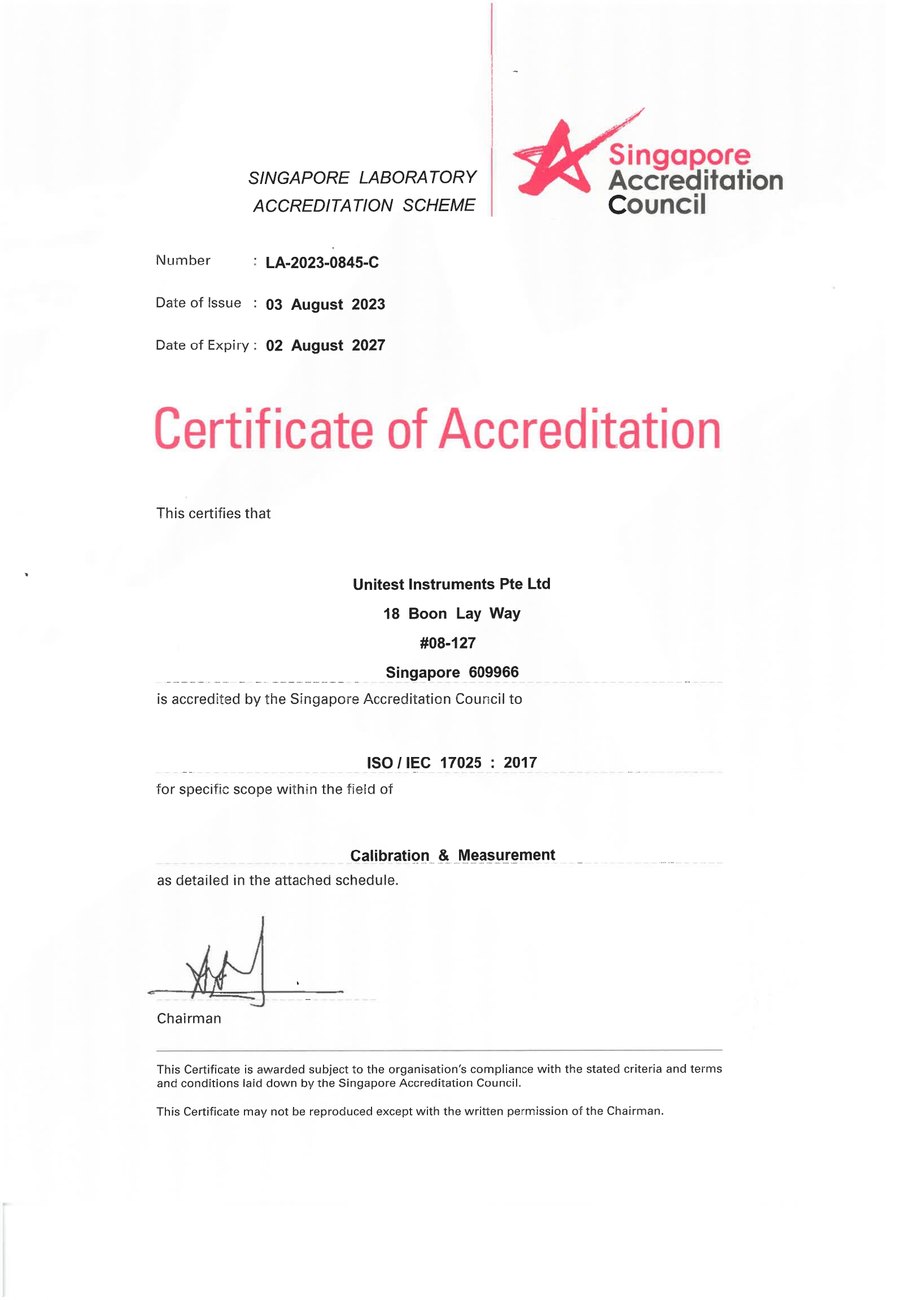
SAC-SINGLAS accredited calibration laboratory (Acc. No. LA-2023-0845-C) serving Singapore's industrial, pharmaceutical, and manufacturing sectors. All content reflects our ISO/IEC 17025 accredited scope and is reviewed by our technical calibration team.
Need oxygen analyser calibration in Singapore?
Unitest Instruments is SAC-SINGLAS accredited (Acc. No. LA-2023-0845-C) to ISO/IEC 17025. Same-week turnaround, certificates accepted by ISO 9001 auditors, NEA, and MOM.