
Key Takeaways
- Hach's IntelliCAL electrode system automates calibration logging. A significant advantage for GLP/GMP or audit-heavy laboratories.
- Hanna Instruments offer comparable measurement accuracy at 20–40% lower cost, making them excellent for routine QC and field applications.
- For Singapore field work (NEA, PUB, environmental sampling), Hanna portable meters are lighter and better suited to tropical humidity conditions.
- Both brands' pH meters drift over time and must be calibrated at defined intervals. An uncalibrated instrument from either brand carries measurement risk.
- Unitest Instruments is SAC-SINGLAS accredited (Acc. No. LA-2023-0845-C) to calibrate pH meters from both Hach and Hanna with NMC-traceable certificates.
Why This Comparison Matters in Singapore
Singapore's industrial and environmental testing landscape is unusually demanding. Facilities operating under PUB, NEA, HSA, or SAC-accredited scopes must demonstrate measurement traceability for every critical instrument, and pH meters are among the most common. Choosing the wrong brand is rarely catastrophic, but choosing without understanding the trade-offs leads to real costs: mismatched electrodes, poor data management, failed audits, or unnecessary spend on features you will never use.
Hach and Hanna Instruments are the two brands we see most frequently at Unitest's calibration bench. Both are established, both are accurate, and both have a legitimate place in a Singapore lab or field kit. This article gives you an honest breakdown so you can make a decision based on your actual use case, not marketing literature.
One thing to note upfront: brand choice does not replace the need for proper calibration. Regardless of which instrument you select, a valid calibration certificate from an accredited laboratory is what makes the measurement legally and technically defensible in Singapore.
Brand Overview: Hach and Hanna Instruments
Hach
Hach (a Danaher company) is an American instrumentation brand with roots in water quality analysis. Their pH meters (particularly the HQ series benchtop and HQ40d portable), are built around the IntelliCAL electrode platform, which uses RFID chips embedded in each electrode to automatically log calibration data, electrode history, and slope information directly to the meter. This makes them the natural choice for laboratories that need a complete, self-documenting measurement record for GLP, GMP, or ISO/IEC 17025 compliance.
Hach's strength is its ecosystem depth: electrodes, reagents, software (WIMS, Claros), and service are all tightly integrated. The trade-off is cost. Hach instruments command a premium, and consumables (electrodes, buffers) are priced to match. Local service support in Singapore is available through authorised distributors.
Hanna Instruments
Hanna Instruments is an Italian-American company that has built its reputation on broad product range and value. From the sub-SGD 100 pocket testers used in aquaculture and food service, through to the HI5000 series research-grade benchtop meters with 0.001 pH resolution, Hanna covers a wider price band than almost any competitor. Their portables (particularly the HI98103 and the multiparameter HI9829), are well-regarded in environmental and industrial field applications.
Hanna's weakness relative to Hach is software and LIMS integration. Their PC connectivity and data logging software is functional but less polished, and the electrode ecosystem is less automated. However, for most Singapore SME laboratories, contract labs, and field teams not operating under stringent GLP requirements, these limitations are immaterial.
Side-by-Side Comparison
The table below compares key features across the most commonly purchased tiers in each brand, laboratory benchtop and field portable. Prices are indicative SGD figures for Singapore procurement and will vary by configuration and distributor.
| Feature | Hach (HQ series benchtop / HQ40d portable) | Hanna Instruments (HI5000 benchtop / HI98103 portable) |
|---|---|---|
| pH resolution | 0.001 pH (benchtop); 0.01 pH (portable) | 0.001 pH (benchtop); 0.01 pH (portable) |
| Accuracy (typical) | ±0.002 pH (benchtop); ±0.05 pH (portable) | ±0.002 pH (benchtop); ±0.05 pH (portable) |
| Electrode system | IntelliCAL (RFID auto-logging); proprietary connector | Standard BNC connector; broad third-party compatibility |
| Calibration data logging | Automatic via RFID; no manual entry required | Manual entry or PC software; no auto-RFID |
| GLP / audit trail | Built-in; compliant with 21 CFR Part 11 workflows | Basic; adequate for ISO 9001 but not 21 CFR |
| LIMS / software integration | Claros cloud platform; USB/Ethernet data export | HI92000 PC software; USB data export |
| Benchtop price (indicative SGD) | SGD 1,500 – 3,500 (with electrode) | SGD 600 – 1,800 (with electrode) |
| Portable price (indicative SGD) | SGD 800 – 2,200 (with electrode) | SGD 400 – 900 (with electrode) |
| IP rating (portable) | IP67 (HQ40d) | IP65–IP67 depending on model |
| Battery life (portable) | 500–800 hours (AA cells) | 1,000+ hours (AA cells, select models) |
| Buffer auto-recognition | USA/NIST/DIN standard sets; recognises Hach RFID buffers | USA/NIST/DIN/custom; accepts any NIST-traceable buffer |
| Temperature compensation | Automatic (ATC) with compatible electrode | Automatic (ATC) with ATC probe |
| Local Singapore service | Via authorised distributor; lead times can vary | Via authorised distributor; broad regional network |
| Best for | Regulated labs, pharmaceutical, GLP, statutory bodies | Field work, routine QC, environmental monitoring, SME labs |
Alkaline Error and Acid Error: A Detail Both Brands' Datasheets Understate
A limitation of glass pH electrodes that applies equally to Hach and Hanna instruments, and one that catches out laboratories testing samples at the extremes of the pH scale, is that no glass electrode measures perfectly linearly across the full 0 to 14 range. At high pH (above roughly 12), the presence of high sodium ion concentration produces what is known as alkaline (or sodium) error, causing the electrode to under-read the true pH because the glass membrane responds partially to sodium ions in addition to hydrogen ions. At the opposite extreme, very low pH (below roughly 1 to 2) combined with high ionic strength can produce acid error, typically causing an over-reading. Both errors are well-documented electrode behaviours, not manufacturing defects, and both brands offer specialised high-pH or low-ionic-strength electrode formulations specifically engineered to minimise these errors for laboratories that routinely work at the extremes of the scale.
For most Singapore laboratory and field applications, working in the broadly neutral 4 to 10 pH range typical of water quality, food, and general industrial testing, alkaline and acid error are not a practical concern with a standard general-purpose electrode. But for a laboratory specifically testing strongly caustic process streams, concentrated acid baths, or cement and lime slurries at the high end of the scale, specifying an electrode formulated for that range, rather than assuming any standard combination electrode will perform equally well everywhere on the pH scale, is a genuine technical requirement worth raising with your supplier at procurement time.
ORP and Multiparameter Capability: A Feature Worth Comparing Beyond pH Alone
Many laboratories purchasing a pH meter also have an ongoing or future need for oxidation-reduction potential (ORP, sometimes called redox) measurement, used in water treatment disinfection monitoring, wastewater process control, and various industrial applications where the oxidising or reducing capacity of a solution matters alongside its pH. Both Hach and Hanna offer meters capable of accepting an ORP probe in addition to a standard pH electrode, typically using the same meter body with an interchangeable input, but the depth of this capability varies meaningfully between models and is worth checking explicitly rather than assuming any benchtop meter automatically supports it.
Hanna's HI5000 series and multiparameter portables like the HI9829 generally offer straightforward ORP measurement alongside pH as a standard, well-integrated feature at a relatively accessible price point, making the brand a practical choice for a laboratory or field team that needs both parameters without a large incremental cost. Hach's ecosystem also supports ORP measurement, typically through a compatible IntelliCAL probe, maintaining the same RFID-based auto-logging convenience as its pH electrodes, which is a genuine advantage for a GLP-regulated laboratory that wants both parameters captured with the same automated audit trail. If ORP measurement is a genuine current or near-term requirement rather than a hypothetical one, confirming the specific probe compatibility and any additional cost for your shortlisted meter model, rather than discovering the gap after purchase, is worth the extra five minutes during procurement.
Laboratory Use: Where Hach Wins
If your laboratory operates under pharmaceutical Good Laboratory Practice (GLP), Good Manufacturing Practice (GMP), or any regulatory framework that requires electronic audit trails and data integrity controls, Hach is the more defensible choice. The IntelliCAL system creates an automatic, tamper-evident record of every calibration event (electrode serial number, buffer lot, slope, offset, and timestamp), without any manual transcription. This is the kind of evidence an HSA or PIC/S auditor expects to see.
Hach's Claros cloud platform also allows multi-site instrument management, meaning a facility manager in Singapore can monitor the calibration status of pH meters across multiple labs or production lines without physically inspecting each instrument. For larger organisations, this is a genuine operational advantage that justifies the cost premium.
That said, the Hach system creates a form of vendor lock-in. IntelliCAL electrodes use a proprietary connector; third-party electrodes will not work with the RFID auto-logging feature. When it is time to replace an electrode (which should happen every 12–18 months under normal use), you are buying from Hach's catalogue. Budget for this in your total cost of ownership calculation, not just the upfront meter price.
Need your Hach or Hanna pH meter calibrated in Singapore?
Unitest Instruments calibrates both brands with NMC-traceable certificates accepted by ISO 9001 auditors, NEA, PUB, and statutory boards. Same-week turnaround available.
Field Use: Where Hanna Wins
Step outside the controlled lab environment and the calculus shifts. In Singapore's outdoor conditions , 30°C+ temperatures, 80–90% relative humidity, construction sites, reservoirs, drainage channels, and industrial discharge points. The practical advantages of a portable instrument matter as much as its specification sheet.
Hanna's portable line covers a wider range at lower price points. The HI98103 is a rugged, waterproof, single-parameter pH meter that field technicians use across aquaculture, hydroponics, and light environmental work. The HI9829 multiparameter logger adds GPS, turbidity, dissolved oxygen, and conductivity. Making it particularly useful for PUB drainage monitoring or NEA surface water sampling programmes where multiple parameters need to be recorded simultaneously in the field.
Battery life is another practical consideration. Singapore field teams conducting full-day monitoring runs need instruments that will last a shift without recharging. Several Hanna portables achieve 1,000 or more hours on standard AA cells. This is a real operational advantage over some Hach portables that consume more power due to their larger displays and more complex software layers.
Hanna's use of a standard BNC electrode connector is also worth noting for field procurement. If an electrode is damaged in the field, a compatible replacement from any major supplier can be used. You are not waiting for a specific proprietary part. For teams managing instruments in remote or time-critical situations, this matters.
Calibration: What Both Brands Share
Here is where we need to be direct: no matter how advanced a pH meter's self-calibration or electrode management features are, they are not a substitute for periodic calibration by an accredited external laboratory. Internal buffer calibration adjusts the meter to known reference points. It does not verify whether the meter's measurement chain is accurate and traceable to national measurement standards.
Under Singapore's quality assurance frameworks (including ISO 9001, ISO/IEC 17025, and regulatory requirements from PUB, NEA, and HSA), instruments used for quality-critical measurements must be calibrated at defined intervals against standards traceable to the Singapore National Metrology Centre (NMC) or an equivalent national body. This requirement applies to Hach and Hanna equally.
Understanding the difference between accredited and non-accredited calibration is essential before choosing a calibration provider. An accredited calibration certificate from Unitest (SAC-SINGLAS Acc. No. LA-2023-0845-C) provides the traceability chain that a non-accredited "calibration service" cannot. This distinction becomes critical during audits.
Unitest calibrates pH meters from both Hach and Hanna across our accredited scope, including benchtop, portable, and multiparameter instruments. Calibration certificates are issued with full uncertainty statements and are accepted by ISO 9001 third-party auditors, NEA, PUB, and statutory board procurement processes.
Procurement Considerations for Singapore Buyers
Several factors specific to Singapore procurement are worth weighing when choosing between these two brands.
GeBIZ and statutory board tenders: Some tender specifications cite method standards (for example, APHA Standard Methods for water quality) that may preference specific equipment classes or accuracy tiers. Read the specification carefully before committing to a brand. In most cases, both Hach and Hanna meet the accuracy requirements. The differentiator is the accompanying calibration documentation.
PSG and EDG grant eligibility: If you are purchasing through a government grant programme, check whether the specific model is on the approved equipment list. Hach instruments appear more frequently on enterprise-facing approved lists due to their positioning in regulated sectors. Hanna instruments are common in SME procurement. Either way, grant compliance requires a valid calibration certificate from an accredited laboratory. Budget for this alongside the instrument cost.
Electrode lifespan and consumable cost: This is where buyers often underestimate the total cost of ownership. A pH electrode used in aggressive sample matrices (high-ionic-strength solutions, extremes of pH, or elevated temperatures), may need replacement every 6–12 months rather than the typical 12–18 months. Hach electrodes cost more per unit. For a lab running high electrode turnover, this is a real budget consideration.
Local service and support: Both brands have authorised distributors in Singapore. Response times and parts availability vary. Before committing to a brand for a large deployment, ask your distributor specifically about electrode and spare parts lead times, and whether on-site service is available under warranty.
Electrode Storage and Conditioning: The Habit That Matters More Than Brand
Regardless of whether a laboratory settles on Hach or Hanna, how the pH electrode is stored between uses has a larger effect on day-to-day measurement reliability than almost any other single factor, and it is a habit that transcends brand choice entirely. A glass combination electrode's reference junction must remain hydrated to function correctly; allowing an electrode to dry out, even briefly, between measurements can cause the junction to partially clog with dried electrolyte crystals, producing sluggish response, unstable readings, or a persistent calibration offset that no amount of buffer recalibration will fully correct until the electrode is properly rehydrated (or, if the damage is severe, replaced entirely).
Both manufacturers specify a storage solution, typically a saturated KCl-based storage buffer, not plain water and never a pH 7 calibration buffer, for exactly this reason, and both explicitly warn against long-term dry storage in their user manuals. In practice, the laboratories and field teams that get the most reliable, longest service life from either brand's electrodes are the ones with a genuinely disciplined storage habit: capping the electrode in fresh storage solution immediately after use, checking that the storage cap has not dried out between uses, and replacing storage solution on a defined schedule rather than reusing the same cap of solution for months. This single habit, more than the brand printed on the meter's housing, is usually the difference between an electrode that delivers stable, defensible readings for its full rated service life and one that requires premature replacement after a few months of neglect.
Frequently Asked Questions
For a regulated laboratory environment (particularly pharmaceutical, water testing, or ISO 9001-audited settings), Hach's benchtop meters (the HQ series) generally offer the edge. Their IntelliCAL electrode ecosystem logs calibration data automatically, the software integrates with LIMS, and the audit trail features are designed for GLP/GMP compliance. Hanna's HI5000 series is a strong alternative and costs less, but its data management ecosystem is less mature. If your lab is budget-constrained and does not operate under strict regulatory data-integrity rules, Hanna provides excellent accuracy at a lower price.
Hanna Instruments wins clearly for field work. Their portable meters (HI98103, HI9813-6, HI9829 multiparameter) are lighter, have longer battery life, and carry solid IP ratings for Singapore's humid tropical conditions. Hach's portables are excellent but often heavier and more expensive. For NEA-regulated environmental sampling or PUB drainage compliance work in the field, the Hanna HI9829 with GPS logging is particularly practical.
Yes. Both brands' pH meters are measuring instruments that drift over time, and any ISO 9001, NEA, or PUB-related quality system will require documented calibration at defined intervals. Typically every 6 to 12 months for instruments in regular use. For regulated laboratories, calibration must be traceable to national measurement standards. Unitest Instruments is SAC-SINGLAS accredited (Acc. No. LA-2023-0845-C) to calibrate pH meters from both Hach and Hanna against standards traceable to Singapore's NMC.
Yes. Hanna's benchtop meters such as the HI5522 and HI5000 series achieve resolution of 0.001 pH and accuracy of ±0.002 pH. Well within the requirements of most ISO/IEC 17025 scope activities. The key consideration is not the meter's rated accuracy but whether you can demonstrate metrological traceability through a valid calibration certificate issued by an accredited laboratory. An uncalibrated instrument, regardless of brand, cannot be used in an accredited scope.
Hanna Instruments are generally 20–40% less expensive than comparable Hach models. A Hanna benchtop meter for laboratory use typically costs SGD 600–1,800 depending on configuration, while an equivalent Hach HQ meter with IntelliCAL electrode may cost SGD 1,500–3,500. Field portables from Hanna run approximately SGD 400–900; Hach portables SGD 800–2,200. Total cost of ownership also depends on electrode replacement cost and local service availability. Both factors to verify with your Singapore supplier.
Generally yes. PH buffer solutions follow universal standards (pH 4.00, 7.00, 10.01 at 25°C) and are not proprietary. However, some Hach meters with IntelliCAL electrodes are designed to recognise Hach-branded buffer data via RFID tags for automated logging. Using third-party buffers on those meters requires manual entry and breaks the auto-log chain. Hanna meters accept any NIST-traceable buffer solution without restriction. For calibration purposes, Unitest uses certified reference buffers traceable to national measurement standards regardless of meter brand.
Unitest Instruments provides SAC-SINGLAS accredited pH meter calibration (Acc. No. LA-2023-0845-C) for both Hach and Hanna instruments. Calibration certificates are traceable to Singapore's National Metrology Centre (NMC) and are accepted by ISO 9001 auditors, NEA, and PUB. We offer same-week turnaround for most pH meters. You can drop off instruments at our facility or enquire about on-site calibration for larger deployments.
For GeBIZ or statutory board procurement, the decision usually hinges on three factors: (1) the method or specification cited in the tender. Some PUB or NEA methods reference specific equipment classes; (2) the requirement for LIMS integration or digital audit trails, where Hach has an advantage; and (3) budget, where Hanna offers better value. In both cases, the instrument must be accompanied by a valid calibration certificate from an SAC-accredited laboratory to satisfy the measurement traceability requirement. Unitest can supply calibration documentation that meets GeBIZ and statutory board standards for both brands.
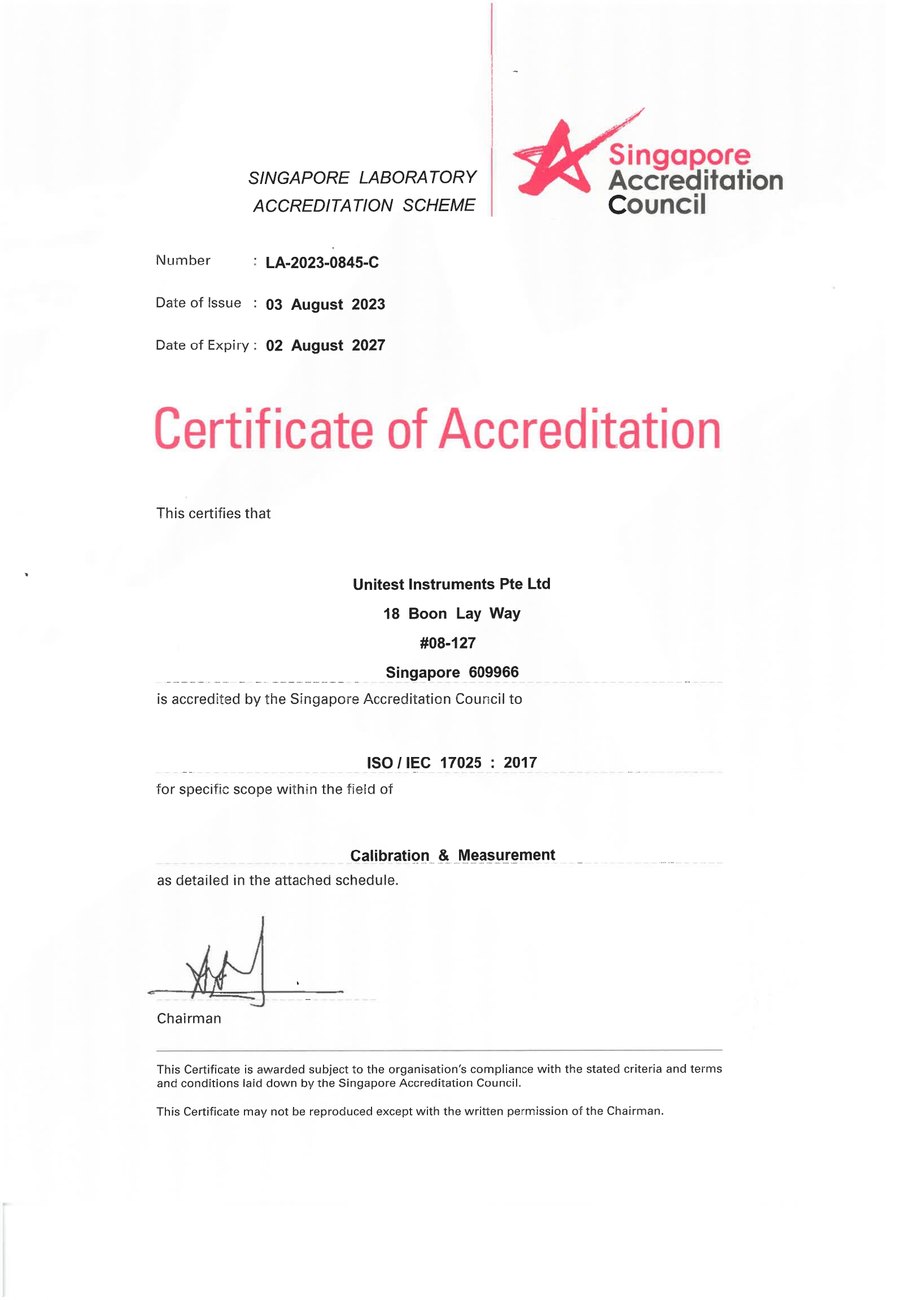
SAC-SINGLAS accredited calibration laboratory (Acc. No. LA-2023-0845-C) serving Singapore's industrial, pharmaceutical, and manufacturing sectors. All content reflects our ISO/IEC 17025 accredited scope and is reviewed by our technical calibration team.
Need pH meter calibration in Singapore?
Unitest Instruments is SAC-SINGLAS accredited (Acc. No. LA-2023-0845-C) to ISO/IEC 17025. Same-week turnaround, certificates accepted by ISO 9001 auditors, NEA, and PUB.