
Key Takeaways
- Two calibration points define the full DO measurement range: 100% air-saturation and 0 mg/L zero-oxygen. Both required for a complete, compliant calibration.
- Temperature and barometric pressure must be measured with traceable instruments during calibration because DO solubility changes with both variables.
- Only a SAC-SINGLAS accredited certificate (Acc. No. LA-2023-0845-C) provides the traceability statement and measurement uncertainty required by ISO 9001 auditors and MOM/WSH regulations.
- Annual laboratory calibration is the standard interval for most applications; pharmaceutical, wastewater, and confined-space monitoring instruments should be calibrated every 6 months.
- Field air-saturation checks before each use are best practice but do not replace laboratory calibration, they are verification, not calibration.
What Happens During a Dissolved Oxygen Meter Calibration?
A dissolved oxygen (DO) meter calibration is a controlled comparison between the instrument's reading and a known, traceable reference value under defined conditions. The process is governed by the sensor technology (most modern DO instruments use either a polarographic (Clark cell) or optical (luminescent) sensor), but both require the same two-point calibration framework.
At Unitest Instruments' SAC-SINGLAS accredited laboratory (Acc. No. LA-2023-0845-C), the calibration process begins with a conditioning period for the probe. Polarographic sensors require a polarisation time of at least 15–30 minutes to stabilise the electrochemical reaction. Optical sensors are generally faster to stabilise but must be inspected for membrane or cap fouling, which degrades luminescence quenching accuracy.
The laboratory technician records ambient temperature using a certified reference thermometer traceable to NMC Singapore, and barometric pressure using a calibrated barometer. These two values are used to calculate the theoretical dissolved oxygen saturation concentration from the Benson-Krause equation, the internationally accepted solubility model. This calculated value becomes the reference against which the instrument's air-saturation reading is assessed.
The probe is then exposed to water-saturated air (typically achieved by suspending the sensor above a wet cloth or in a saturated air chamber) until the reading stabilises. The displayed value is compared to the theoretical saturation value. Any offset is recorded and, where the instrument permits, an adjustment (calibration) is applied. The zero point is then verified using a freshly prepared sodium sulphite solution, which chemically removes all dissolved oxygen from the water sample, driving the theoretical DO concentration to 0.00 mg/L.
The Two Calibration Methods Explained
Air-Saturation (Water-Saturated Air) Method
The air-saturation method is the most widely used single-point calibration for dissolved oxygen meters and is the recommended approach in standards such as ASTM D888 and ISO 5814. The principle is straightforward: at a given temperature and atmospheric pressure, air in equilibrium with water has a precisely calculable oxygen partial pressure, and water in equilibrium with that air will hold a predictable concentration of dissolved oxygen.
In practice, the probe is placed in a moist, sealed environment. Not submerged in water, but surrounded by water-saturated air. This avoids the film resistance of an aqueous phase while ensuring the membrane is humidified. The meter is then adjusted to read the theoretical saturation value derived from the temperature and pressure measurements. In Singapore's tropical climate, calibrations at 25–30°C are common, and the corresponding saturation values (approximately 7.8–8.2 mg/L at sea-level pressure) differ substantially from temperate-climate reference tables, underscoring why on-site accredited calibration with local temperature measurement matters.
Zero-Oxygen (Sodium Sulphite) Method
The zero method establishes the 0 mg/L reference point. A sodium sulphite (Na₂SO₃) solution (typically 2% by weight), is used as an oxygen scavenger. The sulphite reacts rapidly with dissolved oxygen: 2Na₂SO₃ + O₂ → 2Na₂SO₄. When freshly prepared in sufficient concentration, the solution reduces the dissolved oxygen level below the detection threshold of virtually all commercial DO sensors.
The zero method is particularly important for polarographic sensors, which can exhibit non-zero residual currents even in the absence of oxygen (the so-called residual current). Quantifying this offset allows the laboratory to characterise the full linearity of the sensor across its measurement range. Optical sensors are generally less susceptible to residual current errors but still benefit from zero verification to confirm the quenching baseline is stable.
| Parameter | Air-Saturation Method | Zero-Oxygen (Na₂SO₃) Method |
|---|---|---|
| Calibration point | 100% saturation (approx. 7.8–9.1 mg/L depending on temp/pressure) | 0% saturation / 0.00 mg/L |
| Reference standard | Calculated from Benson-Krause equation; requires traceable thermometer + barometer | Chemical scavenging; confirmed by certified zero-oxygen standard or reference gas |
| Sensor types | Polarographic and optical | Polarographic (essential); optical (recommended) |
| Field applicability | Yes. Can be performed in the field with care | Limited. Na₂SO₃ is consumed; requires fresh preparation |
| Applicable standard | ASTM D888, ISO 5814 | ASTM D888, ISO 5814 |
| Traceability source | NMC Singapore (temperature, pressure) | NMC Singapore (temperature); certified reagent purity |
Reference Standards and Traceability to NMC Singapore
Traceability is the unbroken chain of comparisons linking your instrument's reading back to a national or international measurement standard. For dissolved oxygen calibration, this chain runs through temperature and pressure. Both of which directly determine the theoretical saturation value used as the calibration reference.
At Unitest Instruments (SAC-SINGLAS Acc. No. LA-2023-0845-C), our calibration thermometers and barometers are periodically calibrated against NMC Singapore's primary standards, which are in turn linked to the International System of Units (SI) via BIPM mutual recognition arrangements. This chain is documented on every calibration certificate we issue, giving your quality system auditors (whether ISO 9001, ISO 14001, or pharmaceutical GMP), an unambiguous paper trail.
For a deeper understanding of why traceability matters and what the chain of custody looks like in practice, see our article on what calibration traceability means and how it applies to your instruments. Understanding how this connects to measurement uncertainty is also essential, our guide to measurement uncertainty in calibration explains how the ±x mg/L figure on your certificate is calculated.
Dissolved oxygen calibration uncertainty at Unitest's laboratory is typically expressed at the 95% confidence level (coverage factor k=2) and accounts for contributions from temperature measurement uncertainty, barometric pressure uncertainty, probe stabilisation variability, and reference solution preparation.
Need a traceable dissolved oxygen meter calibration certificate?
Unitest Instruments (Acc. No. LA-2023-0845-C) calibrates polarographic and optical DO sensors with full two-point air-saturation and zero verification. Certificates accepted by ISO auditors and Singapore regulatory bodies.
Field Calibration vs. Laboratory Calibration: Which Do You Need?
A common source of confusion is the distinction between the daily air-saturation check a field operator performs before deployment and a formal laboratory calibration. Both involve exposing the sensor to water-saturated air and adjusting the meter, but they are fundamentally different activities with different outputs and different regulatory standing.
| Criteria | Field Calibration (User-Performed) | Laboratory Calibration (SAC-SINGLAS Accredited) |
|---|---|---|
| Reference traceability | None. Ambient conditions, unverified thermometer | Full traceability to NMC Singapore |
| Measurement uncertainty | Not calculated or stated | Calculated and stated at 95% confidence level |
| Certificate issued | No accredited certificate | ISO/IEC 17025 accredited certificate with SAC-SINGLAS mark |
| Zero-oxygen verification | Rarely performed in the field | Performed as standard at Unitest |
| Accepted for ISO 9001 audit | No | Yes |
| Accepted for MOM/WSH compliance | Verification only. Not for formal compliance records | Yes. Formal compliance record |
| Typical frequency | Before each use / daily | Annually (or 6-monthly for critical applications) |
| Cost | Low (operator time + consumables) | Laboratory fee. Contact Unitest for quote |
For organisations operating under ISO 9001, the requirement under Clause 7.1.5.2 is clear: measuring equipment must be calibrated or verified against measurement standards traceable to international or national measurement standards. A user-performed field calibration without traceability documentation does not satisfy this requirement. See our article on accredited vs. non-accredited calibration for a detailed breakdown of the compliance implications.
Singapore Regulatory Context for DO Meter Calibration
Dissolved oxygen measurements appear in several regulatory frameworks in Singapore, each with implications for how instruments must be maintained and what calibration records must be kept.
Workplace Safety and Health (MOM/WSH)
The Workplace Safety and Health Act (Cap. 354A) and its subsidiary legislation, particularly the WSH (Confined Spaces) Regulations, mandate that instruments used to assess oxygen levels in confined spaces are fit for purpose. While the regulations do not explicitly require SAC-SINGLAS accredited calibration, the burden of proof in a WSH investigation falls on the employer to demonstrate that the instrument was accurate and properly maintained. An accredited calibration certificate from Unitest Instruments (Acc. No. LA-2023-0845-C) provides the strongest evidence of due diligence.
Environmental Protection and Management Act (NEA)
Facilities discharging effluent under NEA licence conditions are often required to monitor dissolved oxygen as part of their trade effluent compliance programme. Calibration records for monitoring instruments are subject to inspection, and certificates from accredited laboratories are the accepted form of evidence during NEA audits.
Singapore Food Agency (SFA). Aquaculture and Food Processing
Aquaculture licensees and food processing facilities that monitor dissolved oxygen for product quality or animal welfare purposes are expected to maintain calibrated instrumentation. SFA's licensing framework does not prescribe calibration intervals by statute, but ISO 22000 and HACCP-aligned audits (increasingly required of SFA licensees), demand traceability-backed calibration records.
What a Proper Dissolved Oxygen Calibration Certificate Must Show
Not all calibration certificates are equal. A certificate that does not include the right information is useless to an ISO auditor and potentially inadequate for a regulatory inspector. For a comprehensive guide to reading and evaluating calibration certificates, see our article on what a calibration certificate must contain.
For a dissolved oxygen meter specifically, the certificate must document all of the following:
- Instrument identification: make, model, serial number, and asset/tag number
- Calibration date and location
- Next recommended calibration date (based on the laboratory's assessment and the recommended interval)
- Calibration method: reference to ASTM D888, ISO 5814, or the laboratory's internal procedure
- Reference conditions: temperature (in °C, with uncertainty), barometric pressure (in hPa or mmHg, with uncertainty), salinity correction applied (if any)
- Calibration points: the reference value and the instrument's measured value at both the air-saturation point and the zero point
- Measurement uncertainty at each calibration point, stated at a defined confidence level (typically 95%, k=2)
- Traceability statement: explicit reference to NMC Singapore or equivalent national metrology body
- SAC-SINGLAS accreditation mark and the laboratory's accreditation number (LA-2023-0845-C for Unitest Instruments)
- Authorised signatory of the issuing laboratory
A certificate missing the measurement uncertainty statement or the traceability reference is non-compliant with ISO/IEC 17025:2017 Clause 7.8, and will not satisfy ISO 9001 Clause 7.1.5.2. If you have received a calibration certificate that lacks these elements, contact Unitest Instruments to arrange a compliant recalibration.
Calibration Interval Recommendations for Dissolved Oxygen Meters
The calibration interval for a DO meter is not one-size-fits-all. It depends on sensor technology, operating environment, measurement criticality, and regulatory requirements. Our comprehensive guide on how often to calibrate your instruments provides a general framework, and the following table gives dissolved-oxygen-specific guidance.
| Application / Environment | Recommended Lab Calibration Interval | Field Verification Frequency |
|---|---|---|
| General laboratory / R&D | Annually | Before each use |
| ISO 9001 / ISO 14001 quality system | Annually (minimum) | Daily or before each measurement batch |
| Pharmaceutical / GMP manufacturing | Every 6 months | Daily; after membrane replacement |
| Wastewater / effluent monitoring (NEA) | Every 6–12 months | Daily; after probe cleaning |
| Confined space oxygen monitoring (MOM/WSH) | Every 6 months or per manufacturer | Before every confined space entry |
| Aquaculture / SFA-regulated | Annually | Daily |
| Continuous immersion / high-fouling environments | Every 3–6 months | Weekly or after cleaning events |
Intervals should be reviewed whenever a meter is subjected to mechanical shock, extreme temperatures, membrane replacement, or any event that could affect sensor performance. An out-of-tolerance finding on any calibration should trigger an impact assessment of measurements taken since the last known-good calibration.
Purchasing a Dissolved Oxygen Meter for Calibration-Ready Operation
The ease and accuracy of calibration depends in part on the instrument you select. Optical DO sensors (also called luminescent or fluorescent quenching sensors) have become the preferred choice in Singapore's laboratory and process environments because they require no electrolyte replenishment, are less sensitive to flow rate, and maintain calibration stability longer than polarographic sensors in high-temperature or high-humidity conditions. Both common in Singapore's tropical climate.
When choosing a DO meter for environments where regulatory compliance or ISO audits apply, look for instruments that store calibration records internally, support barometric pressure compensation (either automatically or via manual entry), and have a documented calibration procedure in the user manual that aligns with ISO 5814 or ASTM D888. Unitest Instruments supplies a range of dissolved oxygen meters through unitestshop.com, where you can find instruments already used and trusted by our calibration laboratory team. Purchasing through Unitest also simplifies the calibration loop. Your meter, its service history, and its calibration certificates are all managed in one place.
Frequently Asked Questions
The two primary calibration methods are the air-saturation (water-saturated air) method and the zero-oxygen (sodium sulphite) method. Air-saturation calibration sets the meter's 100% saturation reading by exposing the probe to humid air at a known temperature and barometric pressure. Zero calibration sets the 0 mg/L or 0% reference point using a sodium sulphite solution that scavenges all dissolved oxygen. Both points together define the full measurement range of the sensor.
For most laboratory and process applications in Singapore, dissolved oxygen meters should be calibrated at least annually by an accredited laboratory, with user verification checks (air-saturation spot checks) performed before each use or daily. In pharmaceutical, wastewater treatment, and aquaculture environments where readings are used for compliance decisions, a 6-month laboratory calibration interval is recommended. High-fouling or continuous immersion deployments may require even more frequent checks.
An accredited laboratory calibrates dissolved oxygen meters against certified reference standards traceable to national standards. At Unitest Instruments (SAC-SINGLAS Acc. No. LA-2023-0845-C), calibration is traceable to the National Metrology Centre (NMC) Singapore. Reference points include a barometric pressure reference traceable to SI units, a certified thermometer for temperature correction, and high-purity sodium sulphite or a certified zero-oxygen gas for the zero point. The air-saturation reference value is calculated from established solubility equations (Benson-Krause) at the measured temperature and pressure.
A compliant ISO/IEC 17025 calibration certificate must include: the instrument make, model, and serial number; the calibration date and next recommended date; the method used; the reference conditions (temperature, barometric pressure, salinity if applicable); the measured value at each calibration point versus the reference value; the measurement uncertainty at a stated confidence level (typically 95%); and a statement of traceability to NMC Singapore or equivalent. The certificate must carry the SAC-SINGLAS accreditation mark if issued by an accredited laboratory such as Unitest Instruments (Acc. No. LA-2023-0845-C).
Yes. Under the Workplace Safety and Health Act (WSHA) administered by MOM, instruments used for confined space oxygen monitoring must be calibrated and maintained per recognised standards. NEA-licensed wastewater treatment facilities must maintain calibrated instruments for effluent monitoring. SFA-regulated aquaculture and food processing operations are expected to hold calibration records for water quality instruments. ISO 9001-certified organisations must demonstrate measurement traceability, which requires calibration by a SAC-SINGLAS accredited laboratory such as Unitest Instruments (Acc. No. LA-2023-0845-C).
Field calibration (user-performed air-saturation check) is a quick verification that the sensor reads correctly at ambient conditions. It does not involve reference standards, measurement uncertainty statements, or traceability documentation. Laboratory calibration by a SAC-SINGLAS accredited lab like Unitest Instruments (Acc. No. LA-2023-0845-C) provides a full two-point calibration with certified reference conditions, a traceable certificate with uncertainty values, and independent verification. Field calibration is suitable for daily checks; laboratory calibration is required for regulatory compliance, ISO audits, and formal quality records.
User-level air-saturation and zero calibration can be performed in the field to adjust the meter's reading. However, this does not produce an ISO/IEC 17025 accredited certificate with measurement uncertainty and traceability. For regulatory compliance, ISO 9001 audits, or any application where instrument accuracy must be independently verified, the meter must be calibrated by a SAC-SINGLAS accredited laboratory. Unitest Instruments (Acc. No. LA-2023-0845-C) provides laboratory calibration with full documentation and can be reached via the contact page.
Dissolved oxygen solubility decreases as temperature and salinity increase, so both parameters must be accurately measured and corrected during calibration. A 1°C error in temperature measurement can introduce approximately 1–2% error in the DO reading. Salinity compensation is critical for estuarine or marine applications. A calibration performed in freshwater conditions will over-read in saltwater if salinity correction is not applied. During accredited laboratory calibration at Unitest Instruments, temperature is measured with a traceable reference thermometer and salinity is set to match the intended measurement medium.
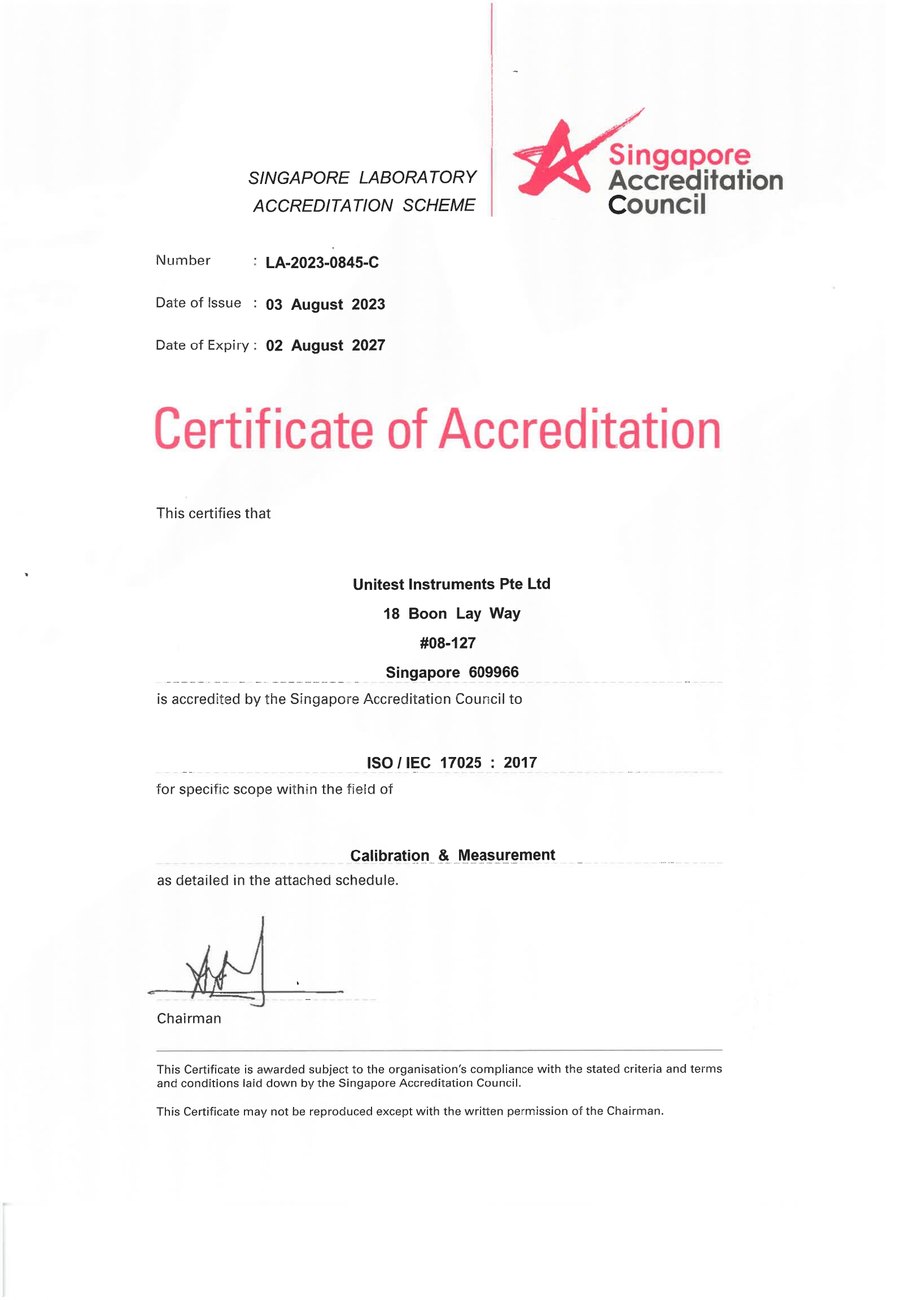
SAC-SINGLAS accredited calibration laboratory (Acc. No. LA-2023-0845-C) serving Singapore's industrial, pharmaceutical, and manufacturing sectors. All content reflects our ISO/IEC 17025 accredited scope and is reviewed by our technical calibration team.
Need dissolved oxygen meter calibration in Singapore?
Unitest Instruments is SAC-SINGLAS accredited (Acc. No. LA-2023-0845-C) to ISO/IEC 17025. Same-week turnaround, certificates accepted by ISO 9001 auditors and Singapore regulators including MOM and NEA.