
Key Takeaways
- Oxygen analyzer calibration uses two reference points: a zero gas (0% O2, typically pure nitrogen) and a span gas at a known O2 concentration traceable to NMC Singapore.
- Span gas selection depends on the application , 20.9% O2 for confined space / ambient air monitoring; higher concentrations for medical or enriched-oxygen environments.
- Under WSH (Confined Spaces) Regulations, atmospheric testing instruments must be calibrated at least every 6 months; electrochemical sensors may require shorter intervals due to sensor ageing.
- Only an ISO/IEC 17025 accredited laboratory (such as Unitest Instruments, SAC-SINGLAS Acc. No. LA-2023-0845-C), issues certificates with the traceability and uncertainty statements required by WSH inspectors and ISO 9001 auditors.
- A bump test is not a calibration: it confirms alarm function but does not produce a traceable measurement record.
What Happens During Oxygen Analyzer Calibration?
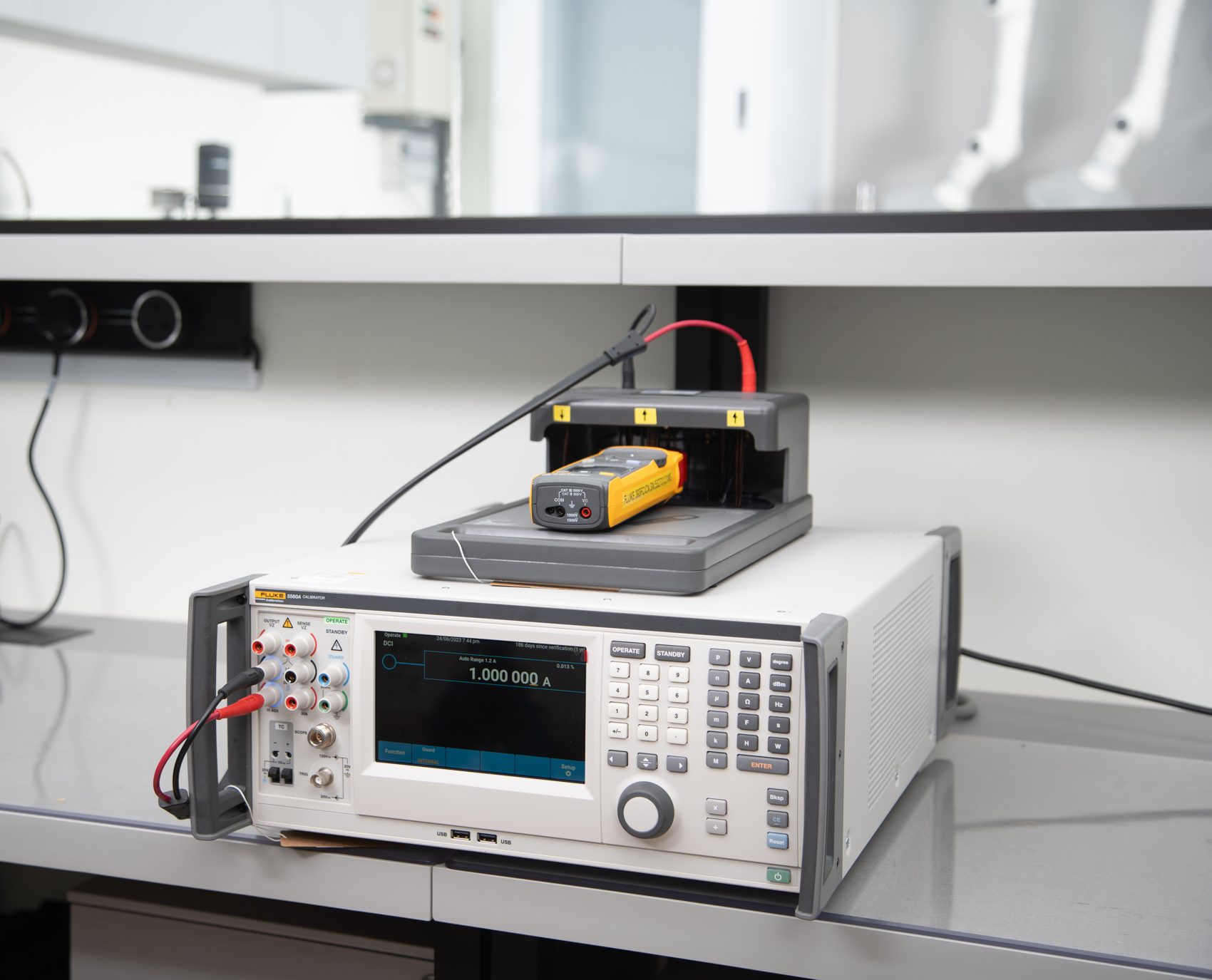
Oxygen analyzers (whether electrochemical, paramagnetic, zirconia-based, or optical), all share a common calibration logic: the instrument's output must be verified against at least two known reference points across its measurement range. In practice, this means applying a zero gas and a span gas, recording the instrument's response at each point, calculating the deviation, and documenting everything in a traceable calibration record.
The zero gas establishes the baseline. For most oxygen analyzers, pure nitrogen (99.999% N2, also called "instrument-grade nitrogen") is used as the zero reference because it contains no measurable oxygen. The instrument is purged with this gas until the reading stabilises, and the displayed value is compared against 0.00% O2. Any non-zero reading at this stage indicates sensor offset or contamination.
The span gas sets the measurement scale. A certified gas mixture (for example, 20.9% O2 balance nitrogen, traceable to NMC Singapore), is then applied. The instrument's reading is compared against the certified concentration on the gas cylinder's certificate of analysis. The difference between the displayed reading and the certified value, expressed as a percentage of the certified value or in absolute O2 percentage points, is the span error. If the error exceeds the manufacturer's specification or the laboratory's acceptance criteria, the instrument is adjusted and re-tested.
After adjustments, the as-left readings are recorded alongside the original as-found readings. The calibration certificate documents both states, giving your quality auditor a complete picture of the instrument's condition before and after the laboratory's intervention. Expanded measurement uncertainty (calculated at a 95% confidence level in accordance with ISO/IEC 17025), is also reported on every Unitest certificate.
Selecting the Right Span Gas for Your Application
Span gas selection is not one-size-fits-all, and using the wrong concentration is a common source of calibration error in the field. The span gas must be representative of the concentration range the analyzer will actually measure in service, and it must fall within the instrument's calibrated operating range.
For confined space entry monitoring under Singapore's WSH (Confined Spaces) Regulations 2009, the most widely used span gas is 20.9% O2 balance nitrogen. Equivalent to the nominal oxygen content of dry air at sea level. This calibrates the instrument's primary reference point (normal atmosphere) and is the correct choice when the analyzer is used to detect oxygen deficiency (below 19.5%) or oxygen enrichment (above 23.5%) in enclosed spaces.
For low-range or trace oxygen measurement (common in semiconductor cleanrooms, inert gas blanketing systems, or food packaging atmospheres), span gases at much lower concentrations (e.g. 100 ppm O2, 1,000 ppm O2, or 1% O2) are required. These speciality gas mixtures must carry their own traceable certificate of analysis, and the laboratory must confirm that the analyzer's measurement principle (typically electrochemical or zirconia) is suited to the concentration range in question.
For medical oxygen or enriched-atmosphere applications, span gases at 50% or 100% O2 (oxygen-in-nitrogen or pure oxygen) are appropriate. These applications are also governed by the Health Sciences Authority (HSA) for medical device contexts and may require additional documentation of the calibration procedure.
| Application | Typical Span Gas | Relevant Regulation / Standard | Calibration Interval |
|---|---|---|---|
| Confined space entry (WSH) | 20.9% O2 balance N2 | WSH (Confined Spaces) Regulations | 6 months (formal); bump test before each entry |
| Semiconductor / inert atmosphere | 100 ppm – 1% O2 in N2 | SEMI standards, ISO 14644 | 3–6 months or per process SOP |
| Food packaging (MAP) | 0.5–5% O2 in CO2/N2 blend | AVA / SFA GMP, ISO 22000 | 6–12 months |
| Medical oxygen supply | 50% or 100% O2 | HSA Medical Devices Act | 12 months or as per device registration |
| Flue gas / combustion O2 | Application-specific (5–21%) | NEA / SS 530 / ISO 11042 | 6–12 months |
| ISO 9001 QMS (general industry) | Application-specific | ISO 9001:2015 Clause 7.1.5 | 12 months or per risk assessment |
Traceability to NMC Singapore: What It Means and Why It Matters
Traceability is the property that makes a calibration result meaningful beyond the four walls of the laboratory. When Unitest Instruments calibrates your oxygen analyzer, every measurement we make can be traced through an unbroken chain of documented comparisons, from your instrument, through our reference standards, up to the National Metrology Centre (NMC) of Singapore at A*STAR, and ultimately to the SI unit of amount of substance (the mole) and the definition of the pascal for pressure-referenced measurements.
In practical terms, this means our reference gas mixtures are certified by a primary standards laboratory with NMC-recognised traceability, and our own laboratory reference standards are regularly recalibrated against NMC-traceable national standards. The result is that your calibration certificate carries the weight of Singapore's national measurement infrastructure. Not just the word of the calibration technician.
For an ISO/IEC 17025 accredited laboratory, traceability is not optional: it is a core requirement of the standard. As explained in our guide to what traceability means in calibration, an unbroken traceability chain is the only credible way to demonstrate that your measurement results are comparable to those of your customers, regulators, and trading partners worldwide. When a WSH inspector or an ISO 9001 auditor reviews your oxygen analyzer's calibration certificate, they are specifically looking for evidence of NMC or equivalent national metrology body traceability. Without it, the certificate may be rejected.
Need a traceable oxygen analyzer calibration certificate in Singapore?
Unitest Instruments (Acc. No. LA-2023-0845-C) calibrates all types of oxygen analyzers with full NMC traceability, measurement uncertainty reporting, and same-week turnaround. Certificates accepted by WSH inspectors and ISO 9001 auditors.
Field Calibration vs. Laboratory Calibration: Which Do You Need?
A persistent source of confusion among Singapore facilities managers is the difference between field calibration (bump testing with portable gas cylinders) and formal laboratory calibration by an accredited body. Both have their place, but they are not interchangeable for compliance purposes.
| Factor | Field Calibration / Bump Test | SAC-SINGLAS Lab Calibration (Unitest) |
|---|---|---|
| Purpose | Functional check. Confirms sensor responds and alarm activates | Measurement verification. Quantifies accuracy, error, and uncertainty |
| Certificate issued? | No. Pass/fail log only | Yes. ISO/IEC 17025 accredited certificate with NMC traceability |
| Measurement uncertainty reported? | No | Yes. Expanded uncertainty at 95% confidence |
| Accepted by WSH inspectors? | Acceptable for pre-entry functional check only | Yes. Fully acceptable for regulatory compliance |
| Accepted by ISO 9001 auditors? | No, clause 7.1.5 requires traceable calibration | Yes |
| Sensor condition assessed? | Partially. Anomalous response may be flagged | Yes. Full as-found condition documented |
| Frequency | Before each confined space entry (WSH requirement) | Every 3–12 months depending on application |
The practical recommendation for WSH-regulated confined space programs is to combine both: bump test before every entry (as required by the regulations) and send the instrument for full SAC-SINGLAS laboratory calibration at least every six months. This gives you both the day-to-day operational assurance and the documentary evidence required during inspections or incident investigations.
Singapore Regulatory Context: WSH, AVA, and HSA Requirements
Singapore's regulatory landscape for oxygen measurement spans several agencies depending on the industry and application. Understanding which regulations apply to your oxygen analyzer is the first step to ensuring your calibration program is fit for purpose.
Workplace Safety and Health (Confined Spaces) Regulations
The WSH (Confined Spaces) Regulations 2009, administered by the Ministry of Manpower (MOM), are the most directly relevant framework for portable oxygen analyzers used in industrial settings. These regulations require that any person entering a confined space must first have the atmosphere tested for oxygen content (deficiency and enrichment), flammable gases, and toxic substances. The testing equipment must be in good working order and calibrated. While the regulations do not explicitly prescribe ISO/IEC 17025 accreditation, MOM's advisory guidance and industry practice strongly favour calibration certificates from SAC-SINGLAS accredited laboratories, particularly following workplace incidents where instrument reliability is scrutinised.
Food Safety (AVA / SFA) and Modified Atmosphere Packaging
Facilities producing modified atmosphere packaged (MAP) food products (where controlled oxygen levels preserve shelf life), must demonstrate that their oxygen measurement instruments are calibrated and fit for purpose under Singapore Food Agency (SFA) good manufacturing practice requirements. For FSSC 22000 or BRC-certified facilities, the food safety management system's calibration clause (mirroring ISO 9001 Clause 7.1.5) requires traceable calibration certificates for all monitoring instruments, including headspace oxygen analyzers.
Health Sciences Authority (HSA) and Medical Oxygen
Medical oxygen supply systems in Singapore hospitals and clinics are regulated under the Health Products Act. Oxygen analyzers used to verify the purity of medical gas supplies must be calibrated to a documented procedure, and the traceability of reference standards is a key element of the audit trail. HSA-regulated facilities typically align with the calibration requirements of the relevant pharmacopoeia (e.g. British Pharmacopoeia) and ISO 11135 or EN standards for medical device sterilisation, which specify calibration intervals and traceability requirements for oxygen measurement.
What Your Oxygen Analyzer Calibration Certificate Must Show
A calibration certificate is only as useful as the information it contains. Many facilities in Singapore receive certificates from non-accredited service providers that are missing critical elements, and discover the gap only when an auditor or WSH inspector rejects the document. Understanding what a compliant certificate must contain protects you from this risk.
As detailed in our guide to reading a calibration certificate, a complete ISO/IEC 17025 compliant oxygen analyzer calibration certificate must include all of the following elements:
- Instrument identification: Make, model, serial number, and asset tag (if applicable).
- Calibration date and recommended recalibration date: The date the work was performed, and the laboratory's recommended interval for the next calibration.
- Reference gas details: The certified O2 concentration of each span gas used, the gas supplier's certificate number, and the traceability statement linking those gases to NMC Singapore or equivalent.
- As-found readings: The instrument's readings before any adjustment, at each calibration point. This documents the instrument's condition upon receipt.
- As-left readings: The instrument's readings after adjustment (if any), confirming it was returned to within specification.
- Expanded measurement uncertainty: Expressed as a ± value in % O2 or % of reading, at a stated coverage factor (typically k=2, 95% confidence level). A certificate without uncertainty is not ISO/IEC 17025 compliant. See our article on measurement uncertainty in calibration for a full explanation.
- Laboratory accreditation details: The issuing laboratory's SAC-SINGLAS accreditation number (for Unitest Instruments, this is LA-2023-0845-C), and the scope of accreditation covering the measurement.
- Authorised signatory: The name and signature (or electronic equivalent) of the technically responsible person at the accredited laboratory.
If any of these elements are absent, the certificate does not meet ISO/IEC 17025 requirements and may not be accepted by external auditors. When in doubt, ask the issuing laboratory to confirm their accreditation scope covers oxygen concentration measurement in the relevant range.
Calibration Intervals: How Often Should You Calibrate?
The question of how frequently to calibrate an oxygen analyzer does not have a single universal answer. The correct interval is determined by a combination of regulatory requirements, manufacturer recommendations, sensor technology, and the risk consequences of an out-of-tolerance reading.
Electrochemical oxygen sensors (the most common type in portable gas detectors), contain a chemical electrolyte that is consumed over time. This means they drift not only due to physical shocks or exposure to interferents, but simply due to age and use. Most manufacturers quote a sensor lifetime of 1–3 years, with formal calibration recommended every 3–6 months. In Singapore's humid environment, electrochemical sensors can degrade faster than in temperate climates, making shorter intervals prudent.
Paramagnetic and zirconia-based analyzers used in fixed process monitoring applications are generally more stable over time, but they are susceptible to contamination from process gases. For these instruments, annual calibration by an accredited laboratory is the minimum, with more frequent in-situ span checks using certified gas cylinders between formal calibrations.
Our dedicated article on how to determine the right calibration interval provides a risk-based framework for setting and justifying calibration frequencies in your quality management system, including how to use as-found data from successive calibrations to optimise the interval over time.
For instruments subject to WSH Confined Spaces Regulations, the practical minimum is:
- Bump test: Before every confined space entry (mandatory).
- Full accredited calibration: Every 6 months as a baseline, or more frequently if bump tests reveal unexpected drift.
- Immediate calibration: After any impact, exposure to high concentrations of interferent gases, or any indication of sensor failure.
Frequently Asked Questions
During oxygen analyzer calibration, a technician exposes the sensor to two known reference gas concentrations: a zero gas (typically pure nitrogen at 0% O2) and a span gas (a certified gas mixture at a known O2 concentration, commonly 20.9% for ambient air applications). The instrument's output is compared against these reference values, any deviation is recorded, and the sensor or display may be adjusted. The procedure is fully documented with measurement uncertainty, reference gas certificate numbers, and traceability to NMC Singapore. All required elements of an ISO/IEC 17025 compliant certificate.
The correct span gas concentration depends on the application. For confined space entry monitoring under WSH regulations, 20.9% O2 (equivalent to ambient air) is the most common choice. For deficiency alarm testing, some laboratories also apply a low-concentration span gas (e.g. 17% or 18% O2) to verify the alarm threshold. For enriched-oxygen or medical applications, higher concentration span gases (up to 100% O2) may be required. All span gases must be certified and traceable to NMC Singapore or an equivalent national metrology body.
For confined space use under WSH regulations, formal calibration by an accredited laboratory is required at a minimum of every 6 months, combined with a bump test before each entry. Electrochemical sensors degrade over time and may need shorter intervals in humid or demanding environments. For ISO 9001 or food safety applications, annual calibration is the typical minimum. Always follow the manufacturer's recommended interval and shorten it if bump tests show unexpected drift or if the sensor has been exposed to harsh conditions.
A bump test is a quick functional check that confirms the sensor responds to a challenge gas and triggers its alarms. It does not produce a traceable measurement record or report uncertainty. A full calibration by an SAC-SINGLAS accredited laboratory applies certified reference gases, measures the instrument's response, records deviations with calculated measurement uncertainty, and issues an ISO/IEC 17025 compliant certificate. Only full accredited calibration satisfies ISO 9001 Clause 7.1.5 and is accepted by WSH inspectors as documentary evidence.
A compliant certificate must include: instrument make, model, and serial number; calibration date and recommended next calibration date; reference gas concentrations and their own certificate numbers with NMC traceability; as-found and as-left readings at each calibration point; expanded measurement uncertainty at 95% confidence; the laboratory's SAC-SINGLAS accreditation number (Unitest: LA-2023-0845-C); and the authorised signatory. Certificates missing uncertainty values or traceability statements do not meet ISO/IEC 17025 requirements and may be rejected by auditors.
The WSH (Confined Spaces) Regulations 2009 require atmospheric oxygen testing using calibrated instruments before and during confined space entry. The WSH (General Provisions) Regulations broadly require that safety measurement equipment is maintained and fit for use. Food facilities certified to FSSC 22000 or BRC must have traceable calibration for all monitoring instruments under their food safety management systems. Medical oxygen supply systems regulated by HSA require calibrated oxygen analyzers with documented traceability. Flue gas monitoring for NEA compliance may also mandate calibrated O2 measurement.
Both approaches are possible, but they serve different purposes. Field calibration with portable certified gas cylinders is suitable for routine bump testing and minor zero/span adjustments between formal calibrations. It does not produce an accredited certificate. Laboratory calibration by Unitest Instruments (SAC-SINGLAS Acc. No. LA-2023-0845-C) produces an ISO/IEC 17025 compliant certificate required for WSH, ISO 9001, and customer quality audits. It also allows a full multi-point characterisation and sensor condition assessment not possible in the field.
Traceability to the National Metrology Centre (NMC) Singapore means every measurement in your calibration can be linked through an unbroken chain of documented comparisons to Singapore's national measurement standards, which in turn link to SI units recognised internationally. This matters because it gives your certificate legal and scientific credibility: auditors, WSH inspectors, and ISO 9001 assessors can verify that the reference gases and equipment used to calibrate your instrument were themselves accurate. Without NMC traceability, a calibration certificate is an unverifiable claim. Not accepted under ISO/IEC 17025 or ILAC mutual recognition.
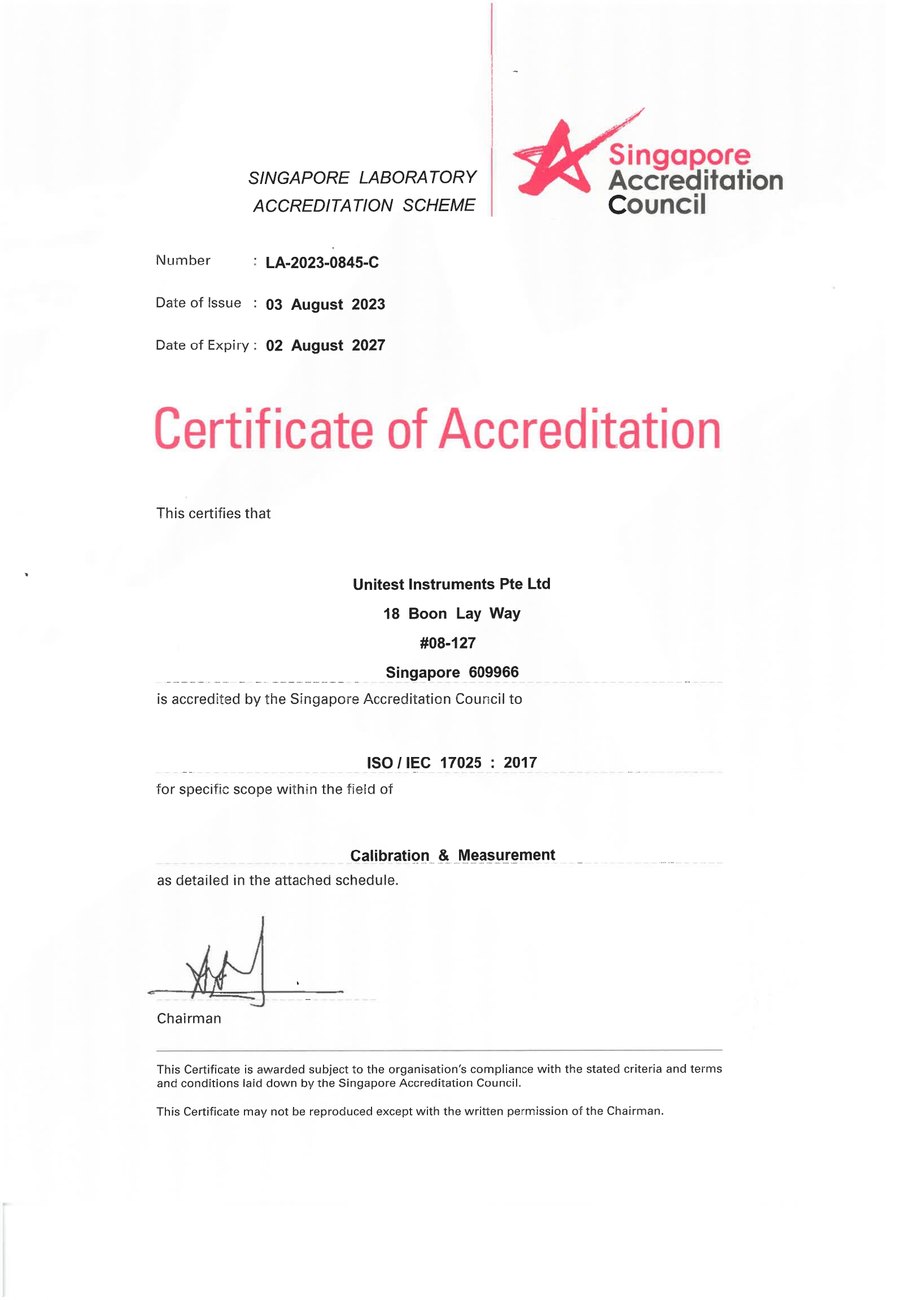
SAC-SINGLAS accredited calibration laboratory (Acc. No. LA-2023-0845-C) serving Singapore's industrial, pharmaceutical, and manufacturing sectors. All content reflects our ISO/IEC 17025 accredited scope and is reviewed by our technical calibration team.
Need oxygen analyzer calibration in Singapore?
Unitest Instruments is SAC-SINGLAS accredited (Acc. No. LA-2023-0845-C) to ISO/IEC 17025. Same-week turnaround, certificates accepted by ISO 9001 auditors and WSH inspectors.