
Key takeaways
- True RMS AC current measurement is non-negotiable for industrial use. Motors on VFDs, welding equipment, and UPS systems produce non-sinusoidal current; an average-responding clamp meter can read 20–30% low on these loads.
- AC/DC capability matters for solar PV installations, EV charger circuits, battery systems, and DC bus measurement on VFDs. If you work in any of these, a DC-capable clamp is worth the premium.
- Jaw size determines the largest cable you can measure , 50mm jaw is adequate for most LV cables; 100mm or 120mm jaws are needed for large power cables and bus bars in MV/LV switchgear.
- A clamp meter is not a substitute for a full multimeter. It measures current and may have voltage measurement functions, but its voltage accuracy and safety are typically not as good as a dedicated True RMS multimeter. Carry both.
- Clamp meter calibration is an annual requirement for ISO 9001 and IATF 16949 compliance. The calibration must cover both AC current (at rated clamp ratio) and any DC current function separately.
Clamp meter comparison: Fluke, Hioki, Kyoritsu, and AEMC
| Model | CAT Rating | True RMS | AC/DC | Max Jaw | Accuracy | Price (S$) | Best For |
|---|---|---|---|---|---|---|---|
| Fluke 376 FC | CAT III 1000V | Yes | Yes | 55mm | ±1.5% AC, ±2% DC | ~S$600 | Advanced industrial, wireless logging |
| Fluke 374 FC | CAT III 1000V | Yes | Yes | 55mm | ±1.5% AC, ±2% DC | ~S$480 | Industrial M&E |
| Fluke 325 | CAT III 600V | Yes | No | 28mm | ±1.5% | ~S$260 | General electrical, compact |
| Hioki CM4003 | CAT III 1000V | Yes | Yes | 55mm | ±1% AC, ±2% DC | ~S$350 | Industrial, Japanese precision |
| Hioki CM4001 | CAT III 600V | Yes | No | 40mm | ±2% | ~S$160 | Entry industrial, good value |
| Kyoritsu KEW 2033 | CAT IV 600V | Yes | Yes | 55mm | ±1.5% AC, ±2.5% DC | ~S$300 | CAT IV rated, solar/DC |
| Kyoritsu KEW 2200 | CAT III 600V | Yes | No | 48mm | ±2% | ~S$140 | Budget professional |
| AEMC Instruments 519 | CAT IV 600V | Yes | No | 100mm | ±2% | ~S$400 | Large conductor, switchgear |
What a clamp meter measures, and how it works
The clamp jaw is a split-core current transformer. The conductor under test passes through the jaw; the alternating magnetic field produced by the AC current in that conductor induces a proportional current in the measurement winding inside the jaw. That induced signal is processed and displayed as the current reading. The jaw must be closed fully. Any air gap in the core introduces measurement error.
AC clamp meters use this current-transformer principle directly. DC clamp meters add a Hall-effect sensor embedded in the jaw core. The Hall sensor responds to the static magnetic field of a DC current. A field that a pure transformer cannot detect, because transformers only respond to changing fields. Hall-effect sensors are what enable the AC/DC measurement capability in clamps like the Fluke 374 FC and Hioki CM4003.
For industrial use in Singapore: AC current covers motor loads, distribution circuits, generator outputs, and most building services M&E work. DC current adds solar PV string current measurement, battery system monitoring, EV charger circuit verification, and DC bus current on variable-frequency drives. The jaw diameter physically limits what conductor size you can measure. Always check jaw diameter against the outer diameter of the cable (including insulation) before purchasing a clamp meter for a specific application.
True RMS. The industrial requirement
Singapore's industrial environment has non-sinusoidal currents everywhere: motors on VFDs draw characteristic harmonic-rich current dominated by the 5th, 7th, 11th, and 13th harmonics; welding equipment draws pulsed current; UPS systems have switching transients; LED lighting on commercial fit-outs draws current with high crest factors. None of these are sine waves.
An average-responding clamp meter calculates current by measuring the average of the rectified waveform and multiplying by 1.1107. The form factor of a pure sine wave. This gives the correct answer only when the current actually is sinusoidal. When the current is distorted, the result is wrong. Depending on the harmonic content, an average-responding clamp can read 20–30% low on typical VFD motor current, which means you might conclude a motor is drawing well within its nameplate rating when it is actually running overloaded.
A True RMS clamp meter measures the actual root-mean-square value of the current waveform (the mathematical measure of a waveform's equivalent heating power), regardless of the waveform shape. The reading is correct for sine waves, for VFD current, for welding pulsed current, for any waveshape the load produces.
The rule for Singapore industrial work: always use True RMS. Average-responding clamp meters belong in domestic, purely resistive environments. Not in any setting with motors, drives, or electronic loads.
Fluke clamp meters. The Singapore industrial standard
Fluke's clamp meter line is the most recognised in Singapore's industrial M&E sector. The brand's combination of robust build quality, comprehensive safety ratings, and wide distributor network (with local warranty support) has made Fluke clamps the default choice in most industrial maintenance programs.
Fluke 376 FC and 374 FC (FC = Fluke Connect wireless) are the top choices for industrial M&E: True RMS, AC/DC current, CAT III 1000V, and wireless data logging via the Fluke Connect app. The 376 FC adds iFlex flexible current probe compatibility and a slightly higher specification. For logging motor current over time (across multiple machines on a single shift), the wireless capability is genuinely useful for energy audits and predictive maintenance programs.
Fluke 325 (compact, CAT III 600V, True RMS AC, 28mm jaw) is the right choice for electrical contractors doing residential and light commercial work where a compact tool matters more than AC/DC capability or a large jaw. At around S$260, it is the value point in Fluke's professional range.
For large conductors beyond the 55mm jaw of the 374/376, the Fluke iFlex flexible current probe (i2500) connects to the 376 FC's iFlex input and can measure through any conductor size. This makes the 376 FC + iFlex combination capable of covering everything from a 1.5mm² branch circuit to the main incomer cables of a large distribution board.
Hioki clamp meters. Value and precision
Hioki's CM series brings Japanese precision manufacturing to a competitive price point. The CM4003 (True RMS, AC/DC, CAT III 1000V, 55mm jaw, ±1% AC accuracy) is the direct alternative to the Fluke 374 FC at approximately S$130 less. Hioki's AC current accuracy specification at ±1% is tighter than most competitors in this price range.
The CM4003's OLED display provides better readability in the dim lighting typical of Singapore's switchrooms and motor rooms compared to standard LCD displays. The jaw design is slim, which makes it easier to insert around conductors in crowded distribution boards where cables are tightly dressed.
For environments where Hioki multimeters are already the standard (semiconductor manufacturing, precision assembly, food processing), the CM4003 allows standardisation on a single brand and a single service relationship for calibration and support. Hioki's Singapore distributor provides local warranty and calibration support.
The Hioki CM4001 (AC only, CAT III 600V, 40mm jaw, ~S$160) is the entry-level choice for industrial use where DC capability is not required and budget is the primary constraint. Its 40mm jaw covers a wider range of cable sizes than the Fluke 325's 28mm jaw at a similar price tier.
Kyoritsu. Large-jaw specialist and CAT IV options
Kyoritsu occupies a distinct position in Singapore's electrical trade: widely used and familiar to most experienced electricians, and offering specific capabilities that Fluke and Hioki's standard ranges do not cover.
Kyoritsu KEW 2033 (CAT IV 600V, True RMS, AC/DC, 55mm jaw, ~S$300) is one of the few clamp meters in its price bracket rated to CAT IV 600V. CAT IV covers measurement at the service entrance (the point where the supply enters the building), and at solar PV string combiner boxes where fault energy can be extremely high. If your work includes solar PV commissioning, service entry switchgear, or any measurement at the utility supply point, a CAT IV rated instrument is the correct choice. Most clamp meters in this price range carry only CAT III.
Kyoritsu's large-jaw models (KEW 2118R, 120mm jaw) fill a practical gap for measuring large power cables (300mm² and above) and bus bars in MV/LV transformer rooms and main switchboards. These applications are beyond the reach of any 55mm jaw. A physical limit that affects Fluke and Hioki's standard ranges equally. For Singapore's M&E contractors working in commercial building plant rooms and industrial switchgear rooms, Kyoritsu's large-jaw models are the practical choice.
Calibrate your Fluke, Hioki, or Kyoritsu clamp meter. AC and DC, SAC-SINGLAS accredited
Unitest calibrates clamp meters (AC and DC current, voltage functions) against NMC-traceable current references. SAC-SINGLAS accredited for ISO 9001, IATF 16949, and industrial electrical maintenance.
Flexible clamp meters (Rogowski coil type), for large conductors and bus bars
Rigid-jaw clamp meters (regardless of jaw size), cannot reach around large bus bars with rectangular cross-sections, cable bundles where multiple conductors run together, or odd-shaped conductors in bespoke switchgear. The jaw must physically encircle a single conductor and close fully. When that is not physically possible, the measurement cannot be made.
Rogowski coil flexible clamp meters solve this by replacing the rigid split-core jaw with a flexible coil sensor that can be looped around any conductor shape and connected at both ends with a snap or clip connector. The flexible coil responds to the rate of change of the magnetic field, integrating this to produce the current reading. Common models for Singapore's industrial sector include the Fluke iFlex i2500 (connects to the Fluke 376 FC's dedicated iFlex input) and the Hioki CT7136 (connects to compatible Hioki clamp adapters).
Accuracy with a Rogowski coil is typically lower than a rigid jaw (±3–5% versus ±1–2% for a good rigid jaw), and the measurement requires careful technique: the coil must be fully closed and the conductor must pass through the centre of the loop. But for measuring main incomer current on large cables, transformer room bus bars, or the supply conductors of large standby generators in Singapore's commercial buildings, flexible clamps provide measurement capability that no rigid jaw can match.
Calibration of clamp meters. What is actually tested
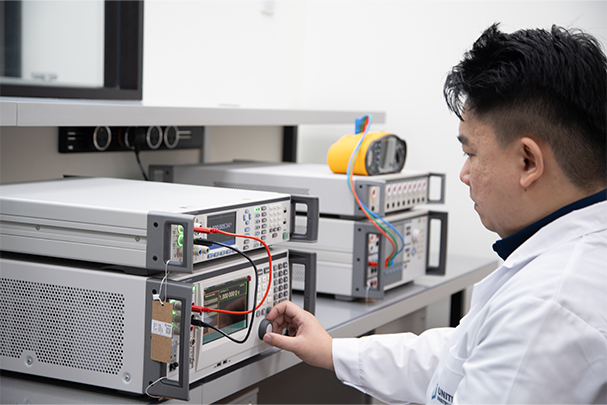
A clamp meter calibration verifies the accuracy of each measurement function against traceable references. For most industrial clamp meters used in Singapore, the calibration covers four areas.
AC current accuracy is calibrated at multiple current levels (typically 10%, 25%, 50%, and 100% of the rated range), at Singapore's power frequency of 50Hz. A precision AC current source (itself calibrated to NMC traceability) injects a known current through a single conductor passed through the jaw. The clamp's reading is compared against the reference. The jaw must be fully closed during calibration. An open or partially open jaw introduces error through increased leakage reluctance.
DC current accuracy is calibrated separately for AC/DC models, using a precision DC current source. The measurement physics are different (Hall effect vs. current transformer), so the calibration procedures and uncertainty budgets are separate. An AC/DC clamp meter calibration certificate should show separate results for the AC and DC functions.
Voltage measurement accuracy is covered where the clamp has voltage measurement terminals that are used for compliance-related purposes, for example, if the voltage measurement function is used in your ISO 9001 documented test procedures. If voltage is measured only for reference and not for quality decisions, this function may be out of scope for the calibration.
Calibration interval: annual calibration is the standard for ISO 9001 and IATF 16949 compliance. The interval should be shortened if the instrument operates in harsh environments (high humidity, vibration, temperature cycling) or has been subjected to mechanical shock (dropped). After any significant shock, the instrument should be recalibrated before use, as the jaw's core material can shift, affecting the current transformer's characteristics and introducing offset error.
Inrush current and leakage current measurement
Beyond steady-state RMS current measurement, many industrial clamp meters offer two additional functions worth understanding before you specify an instrument, since not every model handles them equally well, and the applications differ significantly from routine load-current checks.
Inrush current measurement captures the brief, high-magnitude current spike that occurs when a motor, transformer, or capacitive load is first energised, typically five to eight times the steady-state running current for a direct-on-line motor start, lasting only a few hundred milliseconds. Standard clamp meters, even True RMS models, cannot reliably capture this because their display update rate is too slow relative to the event duration; a dedicated inrush function uses a fast-triggered peak-capture circuit specifically designed to catch and hold this transient value. This matters in Singapore's industrial sector when sizing protective devices (circuit breakers, overload relays) or diagnosing nuisance tripping on motor starters, since a breaker sized correctly for steady-state current but not for the actual inrush profile will trip unpredictably on start-up.
Leakage current measurement uses the same clamp-around principle but exploits a different physical effect: when both the live and neutral conductors of a circuit are clamped together, their magnetic fields should cancel almost completely under normal balanced conditions, and any small residual reading represents current leaking to earth rather than returning through the neutral. This function, available on models like the Fluke 376 FC and several Hioki units, is genuinely useful for tracking down nuisance earth leakage circuit breaker (ELCB) trips, insulation degradation in older wiring, or identifying which specific circuit on a distribution board is contributing to an overall building leakage reading, without needing to isolate and test circuits one at a time.
Safe working practices when using a clamp meter
A clamp meter is designed to make current measurement possible without breaking the circuit, but this convenience does not remove the electrical hazards of working near live conductors, and Singapore's industrial and construction sectors see a steady, avoidable stream of incidents from technicians treating clamp measurement as inherently low-risk.
The CAT rating printed on the instrument (and on its test leads, which must match or exceed the meter's own rating) is not a marketing specification; it defines the transient overvoltage the instrument's insulation is designed to withstand at the specific point in the electrical system where it will be used. Using a CAT III-rated clamp meter at a CAT IV location (a service entrance, a utility meter, an outdoor overhead line connection point) leaves the operator exposed to a fault energy level the instrument was never designed to survive, and this mismatch is a genuine cause of serious injury, not a theoretical compliance gap. Before opening any live enclosure to position the clamp jaw, confirm the panel's fault level and required CAT rating against the instrument's rating, not just its physical fit around the conductor.
Beyond CAT rating, standard safe practice includes wearing appropriate arc-flash-rated PPE when working inside energised switchgear (the clamp meter itself does not protect against an arc-flash event triggered by an unrelated fault while the panel is open), never attempting to clamp a bare or damaged conductor, ensuring the jaw is fully closed before taking a reading (a partially closed jaw both introduces measurement error and can be a sign the operator is working in a cramped, awkward position that increases contact risk), and following a documented lock-out/isolation procedure wherever the measurement task can be performed with the circuit de-energised instead of live. For Singapore facilities operating under a formal Safety Management System, clamp meter use on live equipment should be governed by the same permit-to-work discipline as any other live electrical task, not treated as a lower-risk exception because no direct contact with the conductor is required. A calibrated instrument with the correct CAT rating, in the hands of a technician following a documented safe-work procedure, is what actually delivers the safety benefit the tool is capable of providing.
Frequently asked questions
A clamp meter measures current (AC, and on AC/DC models, DC) non-invasively by clamping around a single conductor. No need to break the circuit or connect in series. It typically also has voltage measurement terminals, but its voltage accuracy and CAT safety rating for voltage measurement are generally lower than a dedicated multimeter. A True RMS multimeter is the better tool for voltage, resistance, capacitance, and diode tests. For industrial electrical work in Singapore, carry both: the clamp meter for current measurement and circuit loading checks, the multimeter for voltage and diagnostic measurements.
Yes, in any industrial environment with VFDs, welding equipment, UPS systems, or non-linear loads. An average-responding clamp meter calculates RMS by multiplying the average of the rectified waveform by 1.1107. A factor that only applies to a pure sine wave. For harmonic-distorted current (VFD outputs produce characteristic 5th, 7th, 11th harmonics), this method reads 20–30% low. True RMS clamp meters measure the actual heating value of the current regardless of waveform, giving correct results for all load types. Non-True-RMS clamps are acceptable only for domestic, purely resistive loads. Not for Singapore industrial M&E work.
A True RMS AC/DC clamp meter with good high-frequency bandwidth. VFDs produce non-sinusoidal output current containing significant harmonics up to the 25th order and above. The Fluke 376 FC and Fluke 374 FC (True RMS, AC/DC, Fluke Connect wireless) are the top choices for VFD applications in Singapore's industrial sector. The Hioki CM4003 is an excellent alternative with competitive True RMS accuracy. For logging current over time across multiple motors on a VFD drive, the Fluke 376 FC with wireless Fluke Connect logging is particularly useful for energy audits and fault diagnosis.
The jaw must clear the outer diameter of the cable or bus bar with the jaw fully closed. For standard LV cables in Singapore's distribution boards and motor control centres, a 40–55mm jaw is usually adequate. For large power cables (185mm² and above), high-current bus bars, or the supply cables on large transformers and generators, a 100mm or 120mm jaw is needed. Kyoritsu's large-jaw models cover these applications. For bus bars that are physically impossible to pass through any rigid jaw, a Rogowski coil flexible clamp (Fluke iFlex, Hioki CT7136) is the solution. It can be looped around any conductor shape.
A Rogowski coil clamp meter uses a flexible coil sensor that can be looped around any conductor (regardless of shape, size, or proximity to adjacent conductors), and then connected at both ends. It is the correct tool for measuring current in large bus bars, cable bundles, and irregularly shaped conductors where a rigid jaw physically cannot fit. Common applications in Singapore include main distribution board incomer measurements, transformer room bus bars, and large generator supply cables. Accuracy is typically ±3–5%, lower than a rigid jaw, but measurement capability is far broader. Common models include the Fluke iFlex i2500 and Hioki CT7136.
Annual calibration is the standard interval for industrial clamp meters used in ISO 9001, IATF 16949, and industrial electrical maintenance. The calibration interval should be reviewed if the instrument is used in harsh environments (high humidity, vibration, frequent temperature cycling), has been dropped or subjected to mechanical shock, or if measured values are drifting noticeably. Some quality systems use a 6-month interval for critical measurement instruments. The calibration must cover AC current accuracy at multiple levels (10%, 25%, 50%, 100% of rated range at 50Hz), DC current for AC/DC models, and voltage measurement if those terminals are used for compliance-related measurements.
Yes. Unitest calibrates clamp meters for both AC current and DC current functions under our SAC-SINGLAS accreditation (no. LA-2023-0845-C), against NMC-traceable precision current sources. We cover all major brands. Fluke, Hioki, Kyoritsu, AEMC, and others. Calibration covers AC current accuracy at multiple current levels at 50Hz, DC current accuracy for AC/DC models, and voltage measurement functions where relevant. Our certificates state measurement uncertainty and carry full traceability to Singapore's National Metrology Centre. Accepted by ISO 9001 auditors and industrial maintenance documentation on first review.

Unitest Instruments Pte. Ltd. is a SAC-SINGLAS accredited calibration laboratory (ISO/IEC 17025, no. LA-2023-0845-C) based in Singapore. We calibrate electrical instruments (including clamp meters, multimeters, and current transformers), for manufacturers, M&E contractors, and regulated industries across Singapore and the region.
Clamp meter calibration (Fluke, Hioki, Kyoritsu), SAC-SINGLAS accredited
AC and DC current calibration against NMC-traceable references. ISO 9001 and industrial maintenance audit-ready.
Verifiable at sac.gov.sg · Acc. No. LA-2023-0845-C