
Key takeaways
- Fluke ScopeMeter 190 series carries CAT III 1000V / CAT IV 600V safety ratings. The only oscilloscope family rated for direct connection to industrial distribution equipment and switchgear in the field.
- Keysight's InfiniiVision 3000G/4000X series offers bandwidths from 100MHz to 1GHz. Essential for signal integrity, embedded systems, and high-speed digital design work beyond the reach of any handheld oscilloscope.
- Both Fluke and Keysight oscilloscopes require periodic calibration. Amplitude accuracy, timebase accuracy, and bandwidth should all be verified; oscilloscope calibration is more complex than a multimeter and requires a specialised signal source.
- For Singapore manufacturers in electronics, semiconductor, or precision engineering, Keysight is the lab standard; for M&E contractors, plant engineers, and industrial maintenance teams, Fluke ScopeMeter is the field standard.
- Keysight (formerly Agilent, formerly Hewlett-Packard) has operated in Singapore since the early 1980s. Its Asia-Pacific support and calibration network is strong, and Keysight-authorised calibration is available locally.
Why oscilloscope choice matters for safety. The CAT rating story
Most engineers who have spent time in electronics laboratories understand oscilloscopes as precision benchtop instruments: mains-powered, high-bandwidth, tethered to a workbench. They are excellent for signal analysis, debugging embedded systems, and characterising component performance. What they are not designed for is connecting to live industrial power circuits, and the reason comes down to a fundamental property of electrical distribution systems that kills instruments and injures people.
Industrial power circuits do not simply carry a steady 230V or 415V. Inductive loads (motors, transformers, solenoids, contactors), store energy in magnetic fields. When that energy is released abruptly (a contactor opens, a motor drive switches, a circuit breaker trips), the result is a high-voltage transient that propagates through the distribution system. A 230V circuit in a typical industrial building can produce transients of 4kV or more from switching events. In heavy industrial environments with large transformers and long cable runs, transients can be significantly higher.
The IEC 61010 safety standard defines Measurement Categories (CAT I through CAT IV) to quantify the energy environment an instrument is designed to operate in. CAT I covers low-energy secondary circuits (signal wiring, control systems), where transient energy is low. CAT II covers single-phase mains from fixed installation outlets. CAT III covers building distribution systems: three-phase circuits, switchgear, distribution panels, bus bars, permanently installed motors. CAT IV covers the origin of the electrical installation. The service entrance, utility metering, overhead lines.
A benchtop oscilloscope carrying a CAT I rating has input protection designed for low-energy signal environments. Connecting it directly to an industrial panel exposes the input circuits to transients the instrument was never designed to handle. The result can range from the instrument being destroyed to a flashover that discharges stored energy through the probe, the oscilloscope casing, and the user. This is not a theoretical risk. It is the reason Fluke developed the ScopeMeter product line in the first place: oscilloscope users in industrial environments needed an instrument with credible safety ratings for the environments they were actually working in.
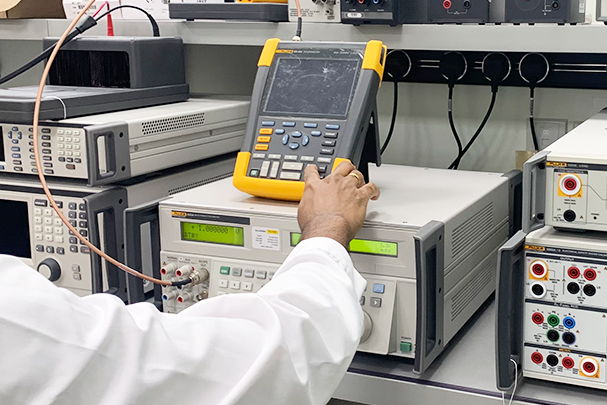
The Fluke ScopeMeter 190 series carries CAT III 1000V / CAT IV 600V ratings. Each input channel is independently isolated from both earth and every other channel. A critical feature when measuring floating circuits like motor drive outputs, where neither terminal is referenced to earth. A conventional benchtop oscilloscope has a single earth reference shared across all channels; connecting that to a floating industrial circuit creates a fault path. The ScopeMeter's isolation architecture prevents this entirely.
Fluke ScopeMeter: built for industrial field use
The Fluke ScopeMeter 190 series (specifically the 190-204, the four-channel flagship), is the most specified portable oscilloscope in Singapore's industrial maintenance and M&E engineering community. Understanding why requires looking beyond the spec sheet to the engineering decisions that define the product.
The 190-204 offers 200MHz bandwidth across four fully isolated channels, with a sample rate of 2.5 GSa/s. At 200MHz, the instrument comfortably captures the fast switching edges of modern variable frequency drives (VFDs), whose PWM switching frequencies typically run between 2kHz and 16kHz, with rise times that translate to signal content up to approximately 3–5MHz. The bandwidth headroom provides margin for accurate rise-time measurements and harmonic analysis well into the double-digit megahertz range.
Battery operation changes what is practically possible in the field. With five or more hours of continuous use from its rechargeable battery pack, the 190-204 operates completely independently of mains power. Essential in plant environments where the nearest outlet may be 50 metres away, or where working near live high-voltage equipment makes trailing a mains lead unsafe. Battery operation also eliminates a ground loop path that can corrupt measurements in environments with multiple reference potentials.
The IP51 rating provides dust and drip resistance. A pragmatic feature for a factory floor instrument. The ScopeMeter's housing is designed to survive being dropped from bench height in a factory environment, with a reinforced case and protection for the display. For field engineers whose instruments routinely travel in tool bags and are set down on oily surfaces, this durability is operationally significant.
The TrendPlot function is one of the ScopeMeter's most practically useful features and one that benchtop oscilloscopes cannot replicate in the field. TrendPlot records measurements (voltage, frequency, duty cycle), continuously over time and plots them on the display, creating a chart recorder function that can capture intermittent faults over hours or days. In troubleshooting applications where a problem occurs only occasionally (a voltage sag during a specific production cycle, an intermittent ground fault), TrendPlot can capture and timestamp the event without continuous operator attention.
The 125MHz and 60MHz ScopeMeter variants serve lighter applications. The 190-102 (100MHz, two channels) is a common choice for single-phase power quality work and HVAC troubleshooting where a four-channel instrument is not required. Accessories extend the capability significantly: current probes allow non-contact current waveform measurement, and the 400-series power quality accessories turn the ScopeMeter into a full power analyser capable of true power, reactive power, and harmonic content analysis.
Keysight InfiniiVision: built for the electronics laboratory
Keysight Technologies carries one of the most distinguished pedigrees in electronic measurement instruments. Its history runs directly from Hewlett-Packard, whose Test and Measurement division became Agilent Technologies in 1999, and then Keysight in 2014. The measurement instruments that Keysight produces today are direct descendants of a product line that set the global standard for laboratory electronic measurement from the 1950s onwards. In Singapore, the HP/Agilent/Keysight presence has been continuous since the early 1980s, and the local support and calibration infrastructure reflects that depth of presence.
The InfiniiVision 3000G and 4000X series are the workhorse laboratory oscilloscopes in Singapore's electronics manufacturing and R&D community. The 3000G series offers bandwidths from 100MHz to 1GHz; the 4000X series extends to 1GHz with hardware-accelerated analysis. At 1GHz bandwidth, the instrument can accurately characterise signal transitions with rise times as fast as 350 picoseconds. Well into the territory of high-speed DDR memory interfaces, gigabit serial buses, and RF modulation analysis.
The memory depth advantage is arguably the most important practical differentiator between Keysight benchtop instruments and any portable oscilloscope. The DSOX1204G offers 1 million points per channel; the 3000G and 4000X series offer up to 4 million points. Compare this to the Fluke ScopeMeter's 10,000 points per channel. At a sample rate of 2 GSa/s, 1 million points allows the instrument to capture 0.5 milliseconds of continuous waveform data at full sample rate. With 10,000 points, the capture window at the same sample rate is only 5 microseconds. For capturing intermittent events in digital communication systems (a glitch on an I2C bus, a spurious pulse on a UART line), the difference between 5µs and 0.5ms determines whether the event appears in the capture at all.
Serial protocol decode is where Keysight's electronics lab orientation is most visible. I2C, SPI, UART, CAN, LIN, RS-232 decode (all available as standard or optional software licence), transforms raw waveforms into decoded packet data. The engineer debugging an embedded system can see not just the electrical signal but the actual data bytes transmitted, the packet headers, and the timing relationships between bus events. This capability is irrelevant for industrial power quality work but indispensable for embedded systems development, IoT hardware validation, and automotive electronics testing.
The built-in waveform generator available on 3000G and 4000X models extends the oscilloscope into a combined stimulus-response platform. The engineer can generate a test signal directly from the oscilloscope (a sine wave at a specified frequency and amplitude, a square wave with programmable duty cycle, an arbitrary waveform), and measure the device under test's response on the same instrument. For characterising filter transfer functions, amplifier frequency response, or power supply loop stability, this eliminates the need for a separate signal generator.
The 8.5-inch WVGA display and software-like user interface reflect Keysight's understanding that laboratory engineers spend hours with an oscilloscope, not minutes. Zone triggering (where the user draws trigger zones directly on the display by touchscreen gesture), represents a user experience that no portable instrument matches. The connectivity options (USB, LAN, WiFi, and optional GPIB) support integration into automated test systems and remote control from test scripts.
Full specification comparison
The table below compares the Fluke ScopeMeter 190-204 against the Keysight DSOX1204G (representative models at similar bandwidth points from each product line), across the parameters that matter most for a purchasing decision in Singapore's industrial and electronics sectors.
| Feature | Fluke ScopeMeter 190-204 | Keysight DSOX1204G |
|---|---|---|
| Type | Handheld / portable | Benchtop laboratory |
| Bandwidth | 200MHz | 70–200MHz (model dependent) |
| Channels | 4 | 4 |
| Sample rate | 2.5 GSa/s | 2 GSa/s |
| Memory depth | 10k points per channel | 1M points per channel |
| Display | 5.7" colour LCD | 8.5" WVGA |
| Safety rating | CAT III 1000V / CAT IV 600V | CAT I only (not for live panel work) |
| Battery powered? | Yes , 5+ hours | No. Mains only |
| Weight | 1.4 kg | 3.2 kg |
| Waveform generator | No | Yes. Built-in |
| Serial decode | Limited | I2C, SPI, UART, CAN, LIN, RS-232 |
| Triggering | Edge, pulse, video | Advanced. Edge, glitch, runt, pattern, zone |
| Spectrum analysis | Yes | Yes (with FFT) |
| PC connectivity | USB, WiFi | USB, LAN, WiFi |
| IP rating | IP51 (dust/drip resistant) | No IP rating |
| Typical price (SG$) | S$5,500 – S$8,000 | S$2,800 – S$5,500 |
| Calibration interval | 12 months (recommended) | 12 months (recommended) |
The safety rating row is not a minor technical detail. It is the deciding factor for any application involving live industrial electrical circuits. A CAT I rating means the instrument should not be connected directly to mains circuits or industrial distribution equipment. Violating this boundary with a benchtop oscilloscope is a documented cause of instrument failure and electrical accidents. For anyone working on live panels, motor control centres, switchgear, or VFD systems, the Fluke ScopeMeter is not an alternative to the Keysight. It is the only appropriate instrument.
On memory depth, the 100:1 ratio in favour of Keysight matters most when capturing digital communication events or intermittent faults with long quiet periods between events. For continuous waveform analysis of power signals (motor current, mains voltage, harmonic content), 10k points is entirely adequate. The practical impact of memory depth is highly application-dependent.
Oscilloscope calibration. What is actually calibrated and how
Oscilloscope calibration is substantially more complex than calibrating a multimeter, and understanding what is and is not verified during a standard calibration is important for interpreting the resulting certificate.
DC gain accuracy is the primary calibration parameter. This verifies that the oscilloscope's voltage axis is accurate, that a displayed amplitude of 1.000V corresponds to an actual input voltage of 1.000V within the stated specification. DC gain is calibrated by applying a precisely known DC voltage from a voltage calibrator and comparing the displayed value to the applied value, across multiple voltage ranges and both polarities. A well-maintained oscilloscope typically holds DC gain accuracy to within ±1–3% of full scale, depending on model and age.
Timebase accuracy verifies the horizontal axis, that the time markings on the display correspond to actual elapsed time within specification. The oscilloscope's internal timebase is driven by a crystal oscillator; this is calibrated by applying a precision frequency reference (from a frequency counter or signal generator with a known-accurate frequency) and verifying the displayed period matches the applied frequency. Crystal oscillators are highly stable but not immune to aging. A small timebase drift can affect frequency measurements and timing analysis over the instrument's life.
Bandwidth verification is the most demanding and least commonly performed calibration check. The bandwidth specification (200MHz, 1GHz, etc.) is defined as the frequency at which the instrument's amplitude response has dropped by −3dB, approximately 70.7% of its DC response. Verifying this requires applying a precision sine wave at the instrument's rated bandwidth frequency and confirming the displayed amplitude corresponds to the −3dB point. At 200MHz, this requires a signal source with flat frequency response to 200MHz and very low harmonic distortion. The kind of source found in specialist RF calibration facilities. At 1GHz, the source requirements are significantly more demanding. Because of the equipment required, bandwidth testing is typically performed by Keysight-authorised service centres or specialist RF calibration labs rather than general-purpose calibration providers.
Most calibration certificates for oscilloscopes (including SAC-SINGLAS accredited certificates from Unitest), cover DC gain accuracy and timebase accuracy. This is the appropriate scope for the drift parameters that are relevant to most industrial and laboratory applications. If bandwidth verification is specifically required (typically for R&D applications where the high-frequency accuracy of the amplitude response is critical), this should be discussed with the calibration provider at the time of booking.
Probe calibration is a separate consideration. The 10:1 passive probes supplied with most oscilloscopes contribute to the measurement system's accuracy; probe compensation (matching the probe's capacitance to the oscilloscope input) is a user-performed adjustment, but probe accuracy itself (the attenuation ratio across frequency), degrades with age and physical damage. High-performance active probes (used for high-bandwidth and differential measurements) may require independent calibration if they are part of a measurement system whose accuracy is documented for audit or quality purposes.
Calibration intervals for oscilloscopes, and what changes if they drift
The standard recommended calibration interval for both Fluke ScopeMeter and Keysight oscilloscopes is twelve months. This is the manufacturer's recommendation, and it aligns with most laboratory quality management systems, ISO 9001 calibration plans, and standard equipment maintenance schedules in Singapore's industrial sector.
In practice, oscilloscopes tend to be stable instruments between calibrations, they do not drift rapidly. The practical risk is not that the instrument goes dramatically out of specification, but that a small, gradual drift in DC gain or timebase accumulates over years of use without being detected. An oscilloscope calibrated three years ago and never recalibrated may still produce readings that appear plausible to the user, while actually reading 3–5% low on voltage amplitude or slightly off on frequency. In troubleshooting applications where the engineer is simply confirming that a waveform is present and broadly correct, this may not matter. In applications where the oscilloscope reading feeds into a documented measurement result. A power quality report, a waveform analysis for acceptance testing, a signal amplitude verification in electronics manufacturing, the drift matters considerably.
The consequence of using an uncalibrated oscilloscope in a measurement that is recorded is straightforward: the reading has no stated accuracy, and any result derived from it cannot be defended in a quality audit or regulatory review. If an ISO 9001 auditor asks for the calibration certificate for the oscilloscope used in a measurement that is referenced in the quality records, "we haven't calibrated it this year" is a non-conformance, and the downstream measurements made with that instrument may need to be reviewed or repeated.
The twelve-month interval should be shortened in specific circumstances. Field instruments that are regularly transported, subject to physical shocks, or used in temperature-extreme environments may warrant a six-month interval. Any oscilloscope that has been dropped, repaired, or shows channel-to-channel inconsistencies in measurements should be calibrated before being returned to service, regardless of the time since its last calibration. For instruments used in GMP environments, where the calibration interval is specified in the validation documentation, the documented interval governs and should not be extended without a formal change control.
When you need a Fluke ScopeMeter. Ten industrial use cases
The following ten scenarios define where the Fluke ScopeMeter is the only appropriate oscilloscope choice. In every case, the ability to safely connect to live high-voltage circuits is non-negotiable.
- VFD output waveform analysis. Variable frequency drives produce a PWM voltage output that looks like a three-phase AC waveform to the motor but contains fast switching transients up to 1200V at the drive terminals. Measuring this safely requires isolated inputs and CAT III ratings. The ScopeMeter 190-204 handles this as a primary application.
- Power quality troubleshooting on distribution panels. Voltage sags, swells, harmonics, and flicker on a 415V three-phase distribution panel require direct connection to live busbars. CAT III 1000V is the minimum safe rating for this work.
- Harmonic analysis on HVAC systems. Large chillers, AHUs, and HVAC motor systems generate harmonic currents that can cause transformer heating, neutral conductor overloads, and power quality problems. The ScopeMeter's harmonic analysis mode, combined with current clamp accessories, makes this practical without taking systems offline.
- Intermittent voltage sag investigation in production equipment. The TrendPlot function captures measurement parameters over hours and flags when a threshold is crossed. Essential for capturing voltage sags that occur only during specific production cycles or mechanical loading events.
- Earthing and grounding verification. Verifying that earth connections are effective in a live production environment (measuring earth resistance, stray voltages, and potential differences between earth references), requires safe isolated connections to live circuits.
- Phase angle and power factor measurement. Measuring the phase relationship between voltage and current waveforms across a load requires simultaneous measurement on live conductors. The ScopeMeter's isolated channels allow this without creating a fault path.
- Cable and transformer fault analysis. Checking transformer output waveforms, identifying cable insulation degradation through leakage current patterns, or verifying transformer ratio under load are all live-circuit measurements that require appropriate safety ratings.
- UPS output waveform verification. Confirming that a UPS under load produces a clean sine wave (not a clipped or distorted output), requires connecting to the UPS output terminals, which carry mains voltage. This is a routine field measurement that the ScopeMeter handles safely.
- Generator output quality assessment. Verifying the frequency stability, voltage regulation, and harmonic content of a generator during commissioning or fault investigation involves connecting to live generator terminals, a CAT III application.
- Rectifier and inverter switching waveform analysis. Industrial battery chargers, rectifiers, and soft starters produce complex switching waveforms that are informative for fault diagnosis. The isolated inputs allow measurements across switching elements in live circuits without instrument damage or safety hazard.
When you need a Keysight oscilloscope. Ten electronics lab use cases
The following ten scenarios define where Keysight's laboratory instruments are the appropriate (and in most cases the only practical), choice. In every case, the bandwidth, memory depth, or analysis capabilities of a benchtop instrument are required.
- PCB signal integrity analysis. Characterising signal reflections, impedance discontinuities, and crosstalk on high-speed PCB traces requires bandwidth well above 200MHz and precise timing measurements that benefit from deep memory and high sample rates.
- Embedded system debugging (I2C, SPI, UART). Serial protocol decode on a microcontroller design (tracking a corrupt data packet, timing a boot sequence, verifying SPI timing margins), requires decoded packet display and deep capture memory. This is a primary Keysight InfiniiVision use case.
- Clock jitter and timing verification. Measuring cycle-to-cycle jitter on a system clock, verifying setup and hold times on a memory interface, or characterising phase noise on an oscillator requires bandwidth, low instrument noise floor, and statistical jitter analysis tools that benchtop instruments provide.
- Power supply design and loop stability. Characterising a switching power supply's output ripple, measuring loop gain and phase margin, and verifying transient response to load steps are all low-voltage, low-energy measurements where the Keysight's bandwidth and waveform generator make it the ideal tool.
- EMC pre-compliance testing. Using an oscilloscope as a preliminary EMC tool (checking conducted emissions on power supply inputs, verifying that high-speed clock signals are adequately filtered), benefits from the bandwidth and FFT spectral analysis of the 3000G and 4000X series.
- RF signal analysis up to 1GHz. Characterising AM/FM modulation, measuring RF burst timing, or verifying frequency hopping behaviour on a wireless module are within the reach of a 1GHz Keysight oscilloscope and require bandwidth no handheld instrument provides.
- DAC output verification. Verifying the output waveform of a digital-to-analogue converter in an audio, control, or data acquisition system (checking linearity, spectral purity, and settling time), is a benchtop laboratory measurement benefiting from Keysight's measurement resolution and analysis tools.
- Servo drive and motion control signal analysis. Debugging encoder feedback signals, verifying PWM command timing, and characterising servo amplifier response are mixed-signal measurement tasks where serial decode and multi-channel synchronised capture are valuable.
- Automated test system integration. In electronics manufacturing, oscilloscopes are integrated into automated test equipment (ATE) via LAN, USB, or GPIB and controlled from Python or LabVIEW test scripts. Keysight oscilloscopes have well-documented programmability and extensive IVI driver support for this purpose.
- R&D component characterisation. Characterising the performance of a new IC, verifying that a prototype circuit meets its timing budget, or measuring the propagation delay of a logic gate across supply voltage and temperature corners. These are laboratory bench measurements that define what the Keysight InfiniiVision series exists to support.
Calibrate your Fluke ScopeMeter or Keysight oscilloscope. Accredited certificates ready for audit
Unitest calibrates oscilloscopes (DC gain, timebase) against NMC-traceable references. SAC-SINGLAS accredited certificates for both handheld and laboratory instruments. Typical turnaround 5–7 working days.
The hybrid approach: keeping both on your team
Many Singapore manufacturing and engineering organisations that span both industrial operations and electronics development find they need both instrument types, and this is the right approach when both use cases genuinely exist within the same organisation.
Consider a Singapore precision engineering company that runs a production floor with motor-driven CNC machines and also has an electronics design team developing control systems. The plant engineering team needs a Fluke ScopeMeter for safe electrical maintenance work on the production equipment. VFD drives, motor starters, distribution panels. The electronics team needs a Keysight or similar benchtop oscilloscope for PCB debugging, firmware validation, and signal integrity work on the control system designs. These two instruments serve distinct needs that the other cannot safely or practically cover.
From a budget perspective, a Keysight DSOX1204G (200MHz, four channels) can be acquired for S$2,800–4,000 new, or significantly less on the used instrument market. A Fluke ScopeMeter 190-204 runs S$5,500–7,000 new. The total investment for both is well under S$15,000. A figure that is typically minor relative to the cost of an electrical accident, an instrument failure on a live industrial circuit, or repeated troubleshooting that takes longer than it should because the wrong instrument is being used.
For organisations that currently have only a benchtop oscilloscope and whose field engineers are using it for industrial electrical work, the priority is clear: acquire a ScopeMeter before a safety incident occurs. The inverse situation (having a ScopeMeter but no laboratory instrument), is less urgent from a safety standpoint, but limits the electronics engineering work that can be done effectively in-house.
Calibration support for both in Singapore
Both Fluke ScopeMeter and Keysight oscilloscopes have strong calibration support available in Singapore, though through different channels.
Keysight operates a Singapore service and calibration centre directly, and Keysight-authorised calibration is available through its local distribution network. This ensures that bandwidth-critical Keysight calibrations (particularly for high-bandwidth models where the measurement requires Keysight-specific tooling and procedures), can be performed to the manufacturer's specification in Singapore without shipping instruments overseas.
Fluke oscilloscope calibration is available through Fluke-authorised distributors and independent calibration laboratories. Unitest calibrates Fluke ScopeMeters as part of its regular calibration service scope, covering DC gain accuracy and timebase accuracy. The primary drift parameters for field instruments used in industrial electrical applications.
Unitest calibrates both Fluke ScopeMeters and Keysight oscilloscopes against NMC-traceable reference standards, issuing SAC-SINGLAS accredited calibration certificates under accreditation no. LA-2023-0845-C. The certificates state measurement uncertainty for each calibrated parameter and carry full traceability documentation. For ISO 9001 quality systems, GMP environments, and any application where the oscilloscope's use is referenced in quality records, an accredited certificate provides the traceability evidence that an auditor can verify independently at sac.gov.sg.
When booking oscilloscope calibration, it is worth confirming with the calibration provider exactly which parameters are covered and whether the calibration scope includes bandwidth verification if that parameter is critical to your application. For the majority of industrial and general laboratory uses, DC gain and timebase accuracy are the relevant parameters, and standard accredited calibration covers these completely.
Frequently asked questions
No. Keysight InfiniiVision and Infiniium series oscilloscopes carry a CAT I safety rating. They are designed for low-energy secondary circuits only, not for direct connection to live distribution equipment. Industrial distribution panels can produce switching transients of 4kV or more; connecting a CAT I instrument to such a circuit is a documented safety hazard that can destroy the instrument and cause a flashover, injuring the user. For live panel work, switchgear, motor drives, or any directly connected industrial circuit, only a Fluke ScopeMeter (CAT III 1000V / CAT IV 600V) should be used. This is not a question of preference. It is a fundamental safety boundary defined by IEC 61010.
CAT (Measurement Category) ratings under IEC 61010 define the maximum transient energy an instrument is designed to withstand safely. CAT I applies to low-energy secondary circuits. Signal and control wiring far removed from the main supply source. CAT II covers single-phase residential and commercial mains outlets. CAT III covers building distribution systems (three-phase wiring, switchgear, distribution panels, bus bars, permanently installed motors), where transient voltages from switching events can be very high. CAT IV covers the origin of the electrical installation. Service entrances, overhead lines, utility metering. The rated voltage alongside the category (e.g. CAT III 1000V) specifies the maximum working voltage within that category. Using an instrument below the required CAT rating for a measurement environment is a safety violation, not just a specification issue.
The standard recommendation for both Fluke ScopeMeter and Keysight oscilloscopes is a 12-month calibration interval. This aligns with manufacturer recommendations and most laboratory quality management systems. Shorten the interval to six months for instruments used in demanding field environments, subject to frequent physical shocks, or used in any application where the oscilloscope reading feeds directly into a documented quality record. Any instrument that has been dropped, repaired, or shows inconsistent readings should be calibrated before returning to service, regardless of the scheduled interval. For GMP-regulated environments, the calibration interval is typically specified in the equipment validation documentation and must be followed exactly.
Standard oscilloscope calibration covers two primary parameters: DC gain accuracy. Verifying that the voltage axis is correct, that a displayed amplitude of 1.000V corresponds to an actual applied voltage of 1.000V within specification, and timebase accuracy, verifying that the time axis is correct using a precision frequency reference. Bandwidth verification (confirming the instrument achieves its rated −3dB point) is a more demanding test requiring a precision high-frequency signal source; it is performed by specialist RF calibration facilities and Keysight-authorised service centres rather than as routine calibration. Probe calibration is a separate consideration for high-precision applications. SAC-SINGLAS accredited certificates from Unitest cover DC gain and timebase accuracy with stated measurement uncertainty.
For industrial electrical applications involving live circuits, the ScopeMeter is not a more expensive alternative to the Keysight. It is the only safe option. The Fluke ScopeMeter 190-204 costs S$5,500–8,000, while a comparable Keysight DSOX1204G runs S$2,800–5,500. But the Keysight cannot be safely connected to live distribution panels, motor drives, or switchgear at all. For an industrial maintenance team, the ScopeMeter's safety ratings justify the premium entirely. For a pure electronics laboratory application (PCB debugging, embedded systems, signal integrity), the Keysight offers superior bandwidth, memory depth, and serial decode capabilities at lower cost, and the Fluke ScopeMeter offers no advantage in that environment.
Yes. Unitest calibrates both Fluke ScopeMeters and Keysight oscilloscopes against NMC-traceable reference standards, issuing SAC-SINGLAS accredited calibration certificates under accreditation no. LA-2023-0845-C. The calibration scope covers DC gain accuracy and timebase accuracy. The primary parameters that drift during normal use. All certificates state measurement uncertainty and carry full traceability documentation suitable for ISO 9001, GMP, and audit purposes. Typical turnaround is 5–7 working days. Contact Unitest for a quote specific to your oscilloscope model and the parameters you need covered.
For the great majority of industrial motor drive and power quality work, 100–200MHz bandwidth is more than sufficient. Variable frequency drive (VFD) switching frequencies typically fall between 2kHz and 16kHz, and the fastest voltage transitions on VFD outputs have rise times in the range of 100ns–1µs. Signal content up to approximately 3–5MHz. A 200MHz oscilloscope provides a factor-of-40 bandwidth margin over the signal content being measured, which is entirely adequate. The Fluke ScopeMeter 190-204 (200MHz) and the 190-102 (100MHz) both comfortably cover these applications. The more important selection factors for VFD work are the CAT III/IV safety rating and isolated inputs, not bandwidth. A 1GHz benchtop oscilloscope with a CAT I rating would be the wrong choice regardless of its bandwidth.

Unitest Instruments Pte. Ltd. is a SAC-SINGLAS accredited calibration laboratory (ISO/IEC 17025, no. LA-2023-0845-C) based in Singapore. We calibrate Fluke ScopeMeters, Keysight oscilloscopes, and a wide range of electrical, temperature, pressure, and humidity instruments for manufacturers, M&E contractors, and regulated industries across Singapore and the region.
Oscilloscope calibration. Fluke ScopeMeter and Keysight both covered
Unitest calibrates handheld and laboratory oscilloscopes with SAC-SINGLAS accredited certificates. DC gain, timebase, and traceable uncertainty, everything your quality audit needs.
Verifiable at sac.gov.sg · Acc. No. LA-2023-0845-C