
Key Takeaways
- Singapore's tropical climate (typically 75–85% RH outdoors), demands a meter with a wide measurement range (10–95% RH minimum) and condensation recovery.
- For regulatory compliance (ISO 9001, GMP, PIC/S GDP, SS 554), your calibration certificate must be traceable to Singapore's NMC via a SAC-SINGLAS accredited lab.
- Capacitive polymer sensors outperform resistive sensors in high-humidity, high-temperature field conditions and are standard on all recommended models.
- Dew point display is essential for corrosion-control, painting inspection, and server room applications; check for it explicitly if relevant to your work.
- Plan for annual recalibration at minimum; consider 6-month intervals for instruments exposed to outdoor Singapore conditions or used in regulated environments.
Who Needs a Handheld Humidity Meter in Singapore?
Humidity is one of the most consequential environmental variables in a tropical city-state where ambient relative humidity routinely exceeds 80% outdoors and can vary dramatically the moment you step into an air-conditioned space. The practical list of professionals who rely on handheld RH meters every day is wide: HVAC engineers commissioning new buildings to SS 553 standards, facilities managers troubleshooting condensation and mould problems, food safety officers verifying cold room and dry store conditions, pharmaceutical QA technicians documenting GDP-compliant storage records, painting and coating inspectors checking surface conditions before blast-and-coat operations, and heritage conservators monitoring archival environments at museums and libraries.
For all these users, a handheld meter (rather than a fixed data logger), is the tool of choice because the work is inherently mobile: you are moving between rooms, floors, or sites, taking spot readings, and making real-time decisions. A good handheld instrument gives you accurate, immediate data wherever you stand; a poor one gives you numbers you cannot trust, which is worse than no data at all.
Understanding what separates a reliable field instrument from a commodity gadget starts with the sensor technology, the measurement range, the stated accuracy, and the calibration traceability behind the certificate in the box.
Key Specifications to Evaluate Before You Buy
When evaluating handheld humidity meters, resist the temptation to pick solely on price. A cheaper instrument that drifts by 5% RH after six months in Singapore's heat will generate compliance failures and re-work costs that dwarf the original saving. Focus on these parameters:
- Measurement range: Singapore's outdoor RH regularly sits above 80%. Your meter must be rated to at least 95% RH non-condensing, with ideally 98% or full-scale capability for confined-space and duct-work measurements.
- Accuracy: Stated as ± X% RH at a reference temperature. For general use, ±2–3% RH is acceptable. For pharmaceutical, cleanroom, or archive-grade work, demand ±1% RH or better from a validated sensor.
- Sensor type: Capacitive polymer sensors are the current standard for portable instruments, offering fast response (typically 30–60 seconds to 90% of true value), good chemical resistance, and the ability to recover from brief condensation episodes without permanent damage. Avoid instruments still using bulk resistive sensors for field work.
- Operating temperature range: Singapore ambient temperatures are typically 26–34°C outdoors and 18–24°C in air-conditioned spaces. Meters that specify accuracy only in a narrow 20–25°C band will be out-of-spec for much of the day.
- Dew point calculation: Displayed directly or calculated from RH and temperature. Essential for coatings, server rooms, and compressed air applications.
- IP rating and build quality: Construction and industrial plant work exposes meters to dust, splashes, and drops. IP54 is the practical minimum; IP65 for outdoor or wet-process environments.
- Data logging and connectivity: For compliance records, a USB or Bluetooth connection to export timestamped readings is far more reliable than manual transcription.
- Calibration certificate status: Check whether the included certificate is a factory document or one issued by a UKAS, DAkkS, or SAC-SINGLAS accredited laboratory. For Singapore regulatory purposes, SAC-SINGLAS accreditation is the locally recognised standard.
Top Handheld Humidity Meters Available Through Unitest
The following four instruments represent the practical range from professional general-purpose to high-precision laboratory-portable. All are available through Unitest Instruments in Singapore, and all can be supplied with or subsequently calibrated to a SAC-SINGLAS accredited certificate (Acc. No. LA-2023-0845-C) before deployment.
| Model | Brand | RH Range | RH Accuracy | Dew Point | IP Rating | Price Range (SGD) | Best For |
|---|---|---|---|---|---|---|---|
| Fluke 971 | Fluke | 5–95% RH | ±2.5% RH | Yes | IP40 | S$320–400 | HVAC commissioning, facilities management, general field surveys |
| Rotronic HygroPalm HP22-A | Rotronic | 0–100% RH | ±1.0% RH | Yes | IP65 (probe) | S$1,100–1,400 | Pharmaceutical GDP, cleanrooms, heritage conservation, precision QA |
| Comark C9555 | Comark | 0–99.9% RH | ±2.0% RH | Yes | IP65 | S$450–580 | Food cold chain, outdoor site surveys, catering and hospitality compliance |
| Fluke 975 AirMeter | Fluke | 5–95% RH | ±2.5% RH | Yes | IP40 | S$780–950 | HVAC balancing, CO₂/CO monitoring alongside humidity, multi-parameter IAQ audits |
Prices are indicative SGD ranges as of mid-2024. Contact unitestshop.com for current pricing, availability, and bundle options including calibration.
Need your humidity meter calibrated to a traceable standard?
Unitest Instruments provides SAC-SINGLAS accredited humidity and temperature calibration (Acc. No. LA-2023-0845-C). Certificates are accepted by ISO 9001 and GMP auditors. Same-week turnaround available.
Model Deep-Dives: Which One Is Right for Your Application?
Fluke 971. The Field Workhorse
The Fluke 971 Temperature Humidity Meter is the most common professional handheld instrument you will find on Singapore HVAC sites and in facilities management departments. Its combination of ±2.5% RH accuracy, simultaneous temperature and humidity display, dew point and wet-bulb readout, and a backlit LCD that is readable in plant-room gloom makes it a highly practical everyday tool. The sensor is a fast-response capacitive element mounted on a compact housing that fits comfortably in a tool bag alongside multimeters and clamp meters, which is exactly where most HVAC technicians keep it.
The 971's IP40 rating means it handles dust but not sustained moisture exposure, so it is not the right choice for outdoor rain-exposed surveys. For indoor surveys, cold room inspections, and ductwork spot-checks, it performs reliably. Available at unitestshop.com, it can be purchased with a Unitest SAC-SINGLAS calibration certificate ready for use on regulated sites.
Rotronic HygroPalm HP22-A. Precision for Critical Environments
When ±1% RH accuracy matters (pharmaceutical stability rooms, museum conservation vaults, ISO Class 7 or 8 cleanrooms), the Rotronic HygroPalm HP22-A is in a different league from general HVAC instruments. Its interchangeable Hygromer IN-1 capacitive sensor provides stable, drift-resistant performance, and the probe itself carries an IP65 rating so it can be deployed into humid chambers, walk-in cold stores, and outdoor sheltered environments without risk to the sensing element.
The HP22-A's memory function stores up to 16,000 readings with timestamps, making it straightforward to produce documented spot-check records for GMP audits. Rotronic calibration certificates are issued traceable to national standards; when purchased through Unitest Instruments, the instrument can be supplied with a SAC-SINGLAS accredited certificate traceable specifically to Singapore's NMC, which is the requirement under PIC/S GDP guidelines adopted by the Health Sciences Authority (HSA). This is a significant compliance advantage for pharmaceutical companies operating under local regulatory oversight.
Comark C9555. Built for Food Safety and Outdoor Conditions
The Comark C9555 is designed with the food industry firmly in mind: it carries an IP65 ingress protection rating on the entire instrument body, a stainless-steel probe housing that tolerates cleaning chemical exposure, and a measurement range that extends to 99.9% RH. Important for cold rooms where relative humidity is deliberately held very high to limit product weight loss. Food safety officers conducting pre-operational checks of cold stores, dry stores, and receiving bays will appreciate its rugged construction and the clear pass/fail alarm functionality.
Beyond food applications, the C9555's IP65 rating makes it one of the few instruments in this category suited to outdoor Singapore construction site surveys, where brief exposure to rain or condensation on the probe is a routine hazard rather than an exceptional event. Its ±2.0% RH accuracy is slightly tighter than the Fluke 971 and its price point sits between the two Fluke models, making it a strong mid-tier option for organisations that need both indoor and outdoor capability.
Fluke 975 AirMeter. Multi-Parameter IAQ Tool
Indoor air quality investigations in Singapore increasingly require simultaneous monitoring of multiple parameters: relative humidity and temperature alongside CO₂ concentration, carbon monoxide, and airflow velocity. The Fluke 975 AirMeter measures all five from a single handheld instrument, which dramatically reduces the number of tools an IAQ consultant needs to carry to site. Its humidity accuracy matches the 971 at ±2.5% RH, and it shares the same dew point and wet-bulb calculation capability.
For dedicated humidity work, the 975 is more than you need and the additional cost is not justified. But for HVAC commissioning teams who need to demonstrate SS 554 compliance across all relevant parameters in a single site visit, or for indoor environment consultants working across multiple building types, the 975 pays back its premium through reduced equipment burden and a single calibration record covering all measured quantities.
Calibration Requirements for Singapore Compliance
Purchasing the right instrument is only half the equation. In Singapore's regulated industries, the calibration status of your humidity meter is as important as the meter itself. Accredited calibration (specifically SAC-SINGLAS accreditation under Singapore's national accreditation body), provides the formal evidence that your meter's readings are traceable through an unbroken chain of comparisons to Singapore's National Metrology Centre, which in turn links to international SI units.
This matters because ISO 9001:2015 Clause 7.1.5 requires organisations to ensure that measurement equipment is calibrated or verified against measurement standards traceable to international or national standards. An ISO 9001 auditor reviewing your humidity monitoring records will look for SAC-SINGLAS accredited certificates, not just manufacturer datasheets. Similarly, HSA GDP inspectors, NEA food hygiene officers, and BCA building performance assessors all expect calibrated instruments with traceable certificates when reviewing environmental monitoring data.
It is also worth understanding what the calibration certificate actually tells you. Our guide on reading a calibration certificate walks through each section (the measurement results, the expanded uncertainty, and the traceability statement), so you can use the document intelligently rather than treating it as a compliance formality.
Calibration Intervals and Maintenance in Singapore's Climate
Capacitive polymer humidity sensors drift over time, and the rate of drift is accelerated by sustained exposure to extremes of temperature and humidity. Conditions that are everyday reality for field instruments used in Singapore. Most manufacturers recommend an annual calibration interval as a starting point, and this is appropriate for instruments used primarily indoors in air-conditioned environments. For instruments regularly deployed outdoors (on construction sites, in plant rooms, or for spot checks in uncontrolled warehouse environments), a 6-month interval is a more defensible practice, particularly if the meter is also used to generate compliance records.
Beyond scheduled recalibration, several maintenance practices extend the service life and accuracy stability of handheld humidity meters in tropical conditions: always store the instrument in a sealed case with a desiccant sachet when not in use; replace sensor caps or probe filters at the manufacturer-recommended interval (typically annually); allow the sensor adequate equilibration time before recording readings in environments that differ markedly from where the instrument was stored; and visually inspect the sensor surface for contamination or physical damage before each use.
If your instrument is dropped, immersed, or exposed to chemical contaminants, treat it as potentially out-of-calibration until it has been checked and recalibrated regardless of the scheduled interval. A drift event triggered by a physical incident is not captured by a routine calendar-based calibration schedule.
Singapore Industry Applications at a Glance
To make the model selection decision concrete, here is how each recommended instrument maps to common Singapore industry use cases:
- Building and HVAC commissioning (BCA Green Mark): Fluke 971 or 975 AirMeter. Green Mark assessments require documented environmental performance data; instruments must be calibrated with traceable certificates.
- Pharmaceutical and medical device storage (HSA GDP): Rotronic HygroPalm HP22-A. ±1% RH accuracy and interchangeable calibrated probes align with GDP documentation requirements.
- Food manufacturing and cold chain (SFA, HACCP): Comark C9555. IP65 rating and food-industry sensor materials suit the cleaning and sanitation demands of food-grade environments.
- Corrosion prevention and protective coatings (MOM, SS ISO 8502-4): Fluke 971 with dew point display or any of the above. SS ISO 8502-4 requires measurement of dew point, surface temperature, and their differential before blasting and coating operations on structural steel.
- Museum and archive conservation (NLB, NHB): Rotronic HygroPalm HP22-A. Heritage institutions need ±1% RH or better for artefact-safe humidity management; calibration traceability supports insurance and accreditation requirements.
- Server rooms and data centres (TIA-942, SS 507): Fluke 971 or 975. ASHRAE thermal guidelines and local data centre standards specify RH bands of 20–80% non-condensing; regular spot checks with a calibrated meter support preventive maintenance records.
Frequently Asked Questions
For most commercial and light industrial applications in Singapore, a relative humidity accuracy of ±2–3% RH across the 20–80% RH range is adequate. Critical environments such as pharmaceutical cold stores, cleanrooms, or heritage conservation vaults require ±1% RH or better. Always verify the accuracy specification at the ambient temperature range you will actually work in, some sensors degrade outside 15–35°C.
Yes. A new instrument arrives with a factory calibration certificate, but factory certificates are not always traceable to a national metrology institute and may not be accepted by ISO 9001 or GMP auditors. For regulatory compliance in Singapore, you should obtain an SAC-SINGLAS accredited calibration certificate before first use, so the instrument's readings are traceable to Singapore's National Metrology Centre (NMC).
SS 554:2016 (Code of Practice for Indoor Air Quality) and the Ministry of Manpower Workplace Safety and Health guidelines reference indoor temperature and humidity targets. For cleanrooms, SS ISO 14644-1 specifies classification requirements including humidity limits. Pharmaceutical facilities follow PIC/S GDP guidelines, which require calibrated, traceable humidity monitoring records.
The terms are used interchangeably in the field. Technically, a hygrometer is any instrument that measures atmospheric moisture; a humidity meter typically refers to a portable electronic instrument displaying relative humidity (RH%) and temperature. Modern handheld devices may also calculate derived quantities such as dew point, wet-bulb temperature, and absolute humidity from the same sensor readings.
Most manufacturers recommend a 12-month calibration interval for handheld RH meters. Instruments used in high-humidity outdoor environments (common in Singapore) or frequently dropped and transported may drift faster and benefit from a 6-month interval. Regulated industries such as pharmaceuticals and food manufacturing typically mandate at minimum annual recalibration with an accredited certificate. See our detailed guide on calibration intervals for more guidance.
Yes, provided the instrument has been calibrated by a SAC-SINGLAS accredited laboratory and the certificate is traceable to Singapore's NMC. PIC/S GDP and HSA guidelines require documented evidence of calibration traceability for all instruments used in temperature and humidity monitoring of medicinal products. A factory certificate alone is generally insufficient for GDP compliance; you need an accredited calibration certificate.
Capacitive polymer sensors (used in Fluke, Rotronic, and Comark instruments) offer the best combination of accuracy, response time, and resistance to condensation compared with older resistive or mechanical sensors. For heavy outdoor exposure (construction sites, marine environments, or industrial plant rooms), look for an IP54 or higher ingress protection rating, a replaceable sensor cap, and a sensor that can be dried out and restored after brief condensation events.
Dew point is the temperature at which moisture in the air will begin to condense on a surface. It is directly relevant for corrosion prevention in steel fabrication and painting (SS ISO 8502-4 requires dew point checks before and during coating work), server room management, and compressed air quality verification. If your application involves any of these, choose a meter that displays dew point directly rather than requiring you to calculate it from RH and temperature tables.
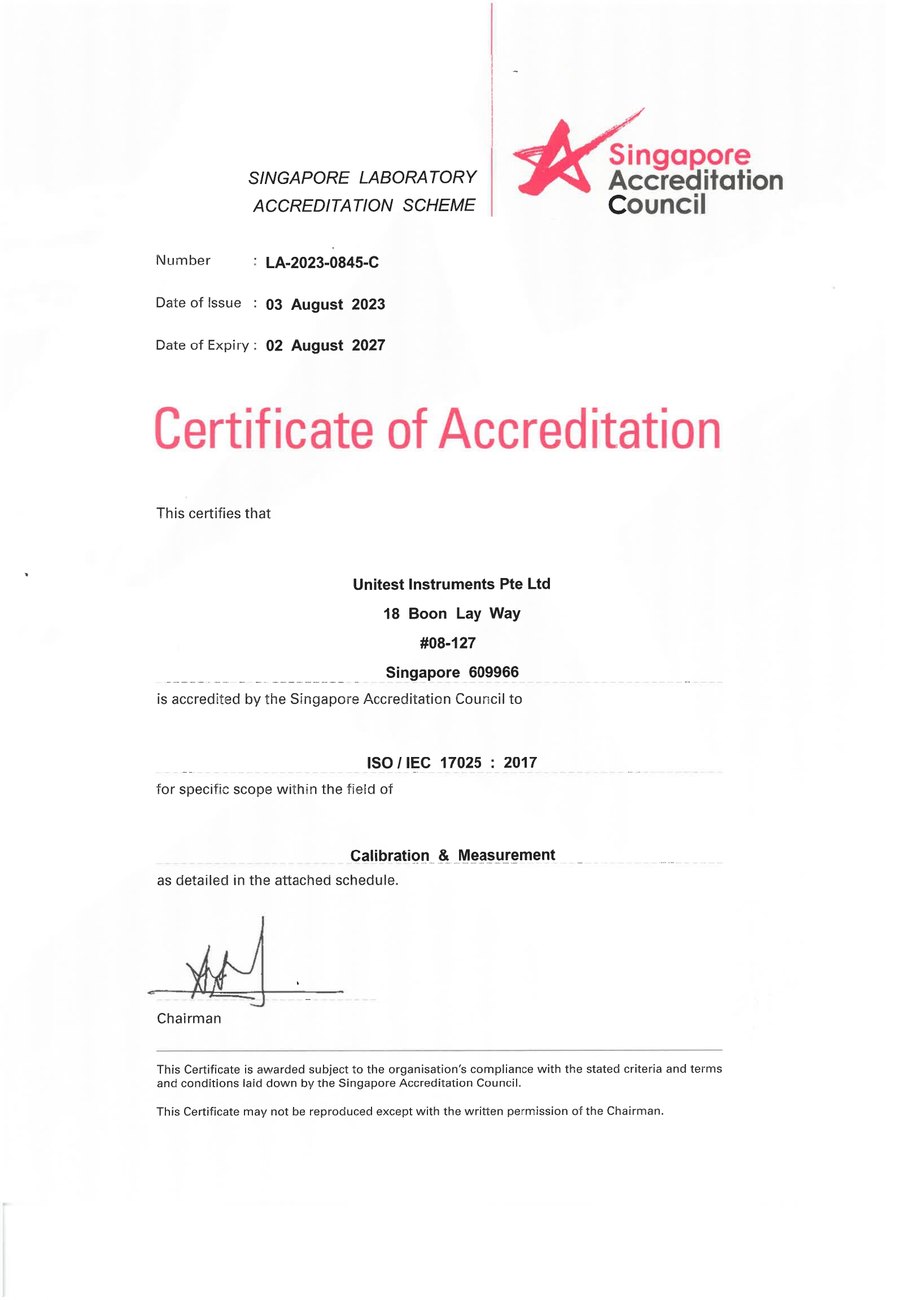
SAC-SINGLAS accredited calibration laboratory (Acc. No. LA-2023-0845-C) serving Singapore's industrial, pharmaceutical, and manufacturing sectors. All content reflects our ISO/IEC 17025 accredited scope and is reviewed by our technical calibration team.
Need humidity meter calibration in Singapore?
Unitest Instruments is SAC-SINGLAS accredited (Acc. No. LA-2023-0845-C) to ISO/IEC 17025. Same-week turnaround, certificates accepted by ISO 9001 auditors.