
Key Takeaways
- Fluke excels in build ruggedness, drop resistance, and field-service durability. Ideal for electricians and maintenance technicians.
- Hioki typically offers tighter accuracy specifications and superior power quality analysis at comparable or lower price points.
- Both brands manufacture CAT III and CAT IV rated models appropriate for Singapore's industrial and utilities sectors.
- True-RMS measurement is essential in facilities with VFDs, LED drivers, or switch-mode power supplies. Verify this feature before purchasing either brand.
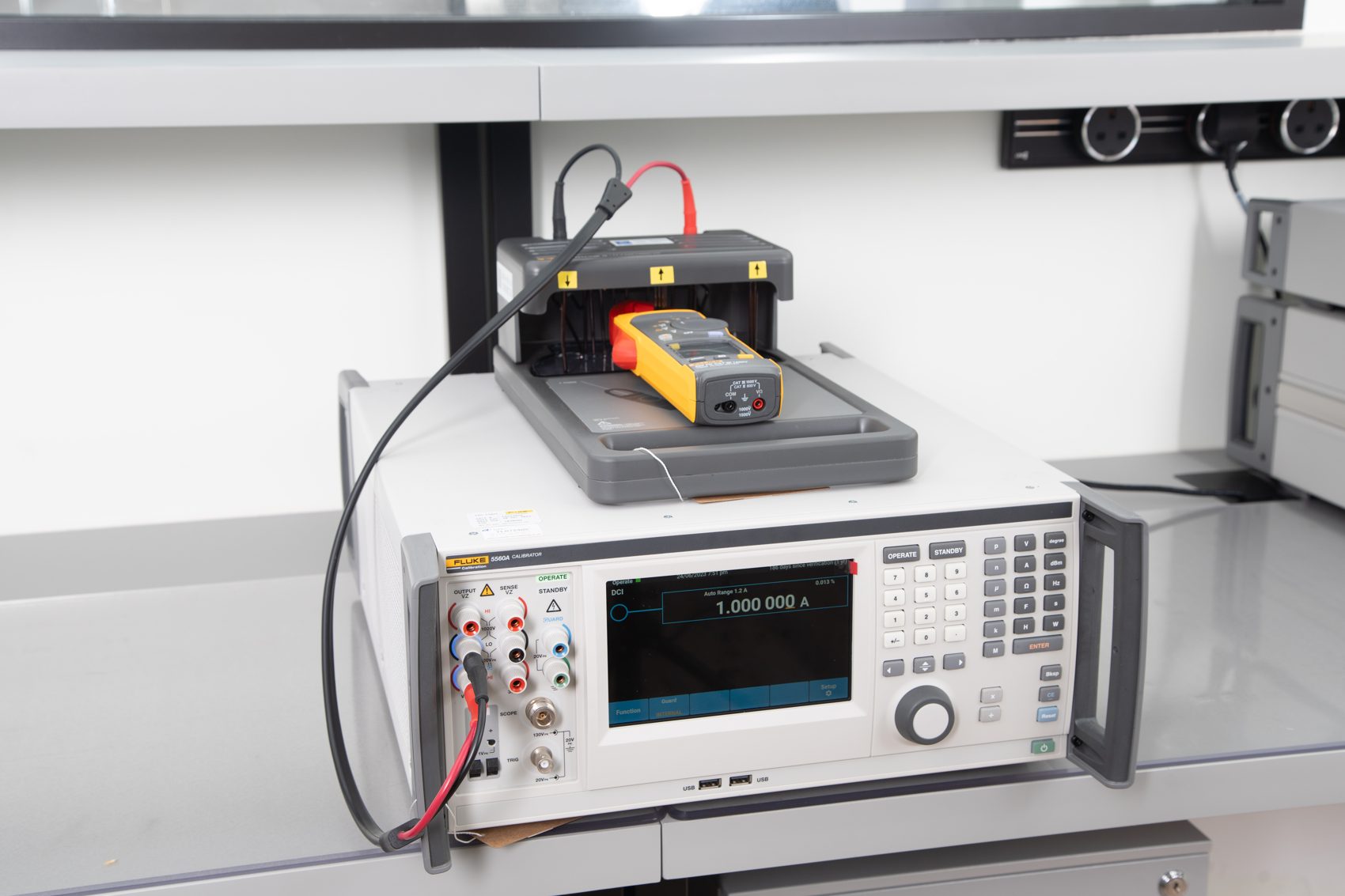
- All clamp meters require periodic calibration by an accredited laboratory to maintain validity for ISO 9001, ISO 45001, and other regulated frameworks.
- Unitest Instruments supplies and calibrates both Fluke and Hioki clamp meters from our SAC-SINGLAS accredited laboratory.
Why This Comparison Matters for Singapore Buyers
Singapore's industrial and construction sectors operate under tight quality management obligations. Whether you are managing a manufacturing line under ISO 9001, maintaining electrical systems in a pharmaceutical facility, or commissioning power distribution for a new data centre, the clamp meters in your toolbox are considered measuring instruments, and measuring instruments must be calibrated.
When it comes time to specify or replace clamp meters, procurement teams in Singapore face a straightforward choice between two dominant brands at the professional tier: Fluke (USA) and Hioki (Japan). Both are sold in Singapore, both are widely used, and both are calibratable by accredited laboratories. The question is which one is the right tool for your specific measurement tasks and operational context.
This comparison is written by Unitest Instruments, a SAC-SINGLAS accredited calibration laboratory. We calibrate and supply instruments from both brands. We have no incentive to favour either. Our goal is to give you the information you need to make the right procurement decision.
Brand Overview: Fluke vs Hioki at a Glance
Fluke Corporation is an American test and measurement company founded in 1948, headquartered in Everett, Washington. They are arguably the most recognised name in handheld electrical test equipment globally. Fluke's product range spans digital multimeters, clamp meters, thermal imagers, power quality analysers, and more. Their clamp meter lineup (anchored by the 300 series and 370 series), is a staple on industrial sites across Singapore.
Hioki E.E. Corporation is a Japanese metrology company founded in 1935, headquartered in Nagano, Japan. Hioki is less well known than Fluke outside of Asia, but among engineers and metrologists in the region, they are a highly respected manufacturer. Their clamp meter lineup (including the CM series and the flagship CT/PW series power clamp meters), is known for tight accuracy tolerances, thoughtful ergonomics, and strong performance on power quality measurement tasks.
Both companies have been manufacturing electrical measurement instruments for over 80 years, both have broad product lines covering entry-level to professional-grade instruments, and both provide calibration support services. Neither is a budget brand, and neither should be treated as such.
Head-to-Head Specification Comparison
The table below compares representative mid-range models from each brand: the Fluke 376 FC and the Hioki CM4372. These are professional-grade true-RMS clamp meters with similar target use cases and price positioning, making them a reasonable basis for comparison.
| Feature | Fluke 376 FC | Hioki CM4372 |
|---|---|---|
| AC Current Range | 1 A – 1000 A | 1 A – 1000 A |
| DC Current Range | 1 A – 1000 A (via iFlex) | 1 A – 1000 A |
| AC Current Accuracy | ±1.5% + 5 digits | ±1.0% + 3 digits |
| DC Current Accuracy | ±2.0% + 5 digits | ±1.5% + 5 digits |
| Voltage Range | AC/DC 600 V | AC/DC 600 V |
| True-RMS | Yes | Yes |
| Harmonic Analysis | Via Fluke Connect app | Up to 40th harmonic, on-device |
| Safety Rating | CAT III 1000 V / CAT IV 600 V | CAT III 600 V / CAT IV 300 V |
| Jaw Opening | 28 mm | 55 mm |
| Display | Backlit LCD | Backlit LCD + bar graph |
| Wireless Connectivity | Fluke Connect (Bluetooth) | Optional (CM7290 model) |
| Approx. Singapore Price | S$550 – S$720 | S$480 – S$620 |
| Warranty | 3 years | 3 years |
Note: Prices are indicative based on typical Singapore distributor pricing and will vary. Always verify current pricing with your supplier. Unitest Instruments can advise on current availability and lead times for both brands.
Build Quality and Durability
This is where Fluke's reputation is most firmly established. Fluke clamp meters are built to military-grade drop test standards (most models are rated for 1-metre or 2-metre drop survival), and their housings are designed with a pragmatism born from decades of feedback from field electricians. The rubber over-moulding, the recessed jaw release lever, the protective boot design on higher-end models: these details reflect Fluke's understanding that field instruments get knocked, dropped, and used in dusty or wet conditions.
Hioki instruments are also well built. Their quality control from the Nagano factory is excellent, and failures in normal use are uncommon. However, Hioki's design philosophy leans more toward laboratory and panel room use, where instruments are handled carefully and kept clean. The housings are solid but typically lack the aggressive over-moulding and drop certification that Fluke leads with. If your clamp meters are used by technicians working from ladders or in cramped switchboard cabinets, Fluke's physical robustness is a genuine differentiator.
For engineers using clamp meters in a control room, energy management centre, or dedicated testing environment, Hioki's build quality is entirely adequate and the physical robustness difference is largely irrelevant.
Calibrate Your Clamp Meters. Fluke, Hioki, or Any Brand
Unitest Instruments is Singapore's SAC-SINGLAS accredited calibration laboratory. We issue traceable calibration certificates accepted by ISO 9001 auditors, with same-week turnaround available.
Measurement Accuracy and Power Quality Analysis
On pure measurement accuracy, Hioki consistently edges Fluke at similar price points. Compare the AC current accuracy of the two models above: Fluke at ±1.5% + 5 digits versus Hioki at ±1.0% + 3 digits. On a 100 A reading, the Hioki specification allows for approximately 1 A of error; the Fluke allows approximately 1.5 A plus the digit term. For most routine electrical maintenance tasks, this difference is inconsequential. For energy auditing, billing verification, or precision power monitoring, it can matter.
Hioki's advantage is more pronounced in harmonic analysis. The Hioki CM4372 and similar models can display individual harmonics up to the 40th order directly on the instrument, without requiring a connected mobile device or software. This is extremely useful for diagnosing power quality problems. Identifying which harmonic frequencies are causing distortion, overheating neutrals, or tripping sensitive equipment. Fluke offers equivalent power quality analysis through their Fluke Connect ecosystem, but this requires a smartphone or tablet and the accompanying app. In noisy or space-constrained environments, on-device harmonic display is a practical advantage.
For DC current measurement (increasingly important as solar PV installations, battery storage systems, and DC bus architectures become more common), Hioki's zero-flux Hall-sensor technology in their higher-end models delivers particularly clean DC current readings. Fluke's iFlex flexible current probe system is a creative solution for measuring DC in awkward locations, but the core DC accuracy on their standard jaw clamp meters is not class-leading.
Safety Ratings and Singapore Compliance
Both Fluke and Hioki manufacture instruments complying with IEC 61010-2-032, the international safety standard for clamp-on and hand-held current measuring instruments. Both publish instruments across the CAT (Category) rating spectrum from CAT II through CAT IV.
For typical Singapore industrial applications (measuring current in distribution boards, motor control centres, and panel room feeder circuits), CAT III 600 V is the minimum appropriate rating. For utility-side measurements or service entrance work, CAT IV is required. The Fluke 376 FC's CAT III 1000 V / CAT IV 600 V rating gives it a slight edge in the highest-energy applications. The Hioki CM4372's CAT III 600 V / CAT IV 300 V rating is appropriate for the vast majority of building services and industrial applications but should be checked against your specific application before purchase.
Understanding what a calibration certificate covers is equally important. A CAT IV rated instrument with an expired or non-accredited calibration certificate is still a compliance risk in a regulated facility. The instrument's safety rating and its calibration status are two separate but equally important factors.
Which Brand Wins Per Use Case
There is no single winner in the Fluke vs Hioki comparison. The right choice depends on your specific situation. Below is our recommendation by use case, based on the instruments we see calibrated and the feedback we receive from customers across Singapore's industrial, pharmaceutical, and construction sectors.
| Use Case | Recommended Brand | Reason |
|---|---|---|
| General electrical maintenance & fault-finding | Fluke | Superior ruggedness, field-proven, technician-friendly ergonomics |
| Energy auditing & efficiency reporting | Hioki | Tighter AC accuracy, on-device power factor and harmonic display |
| Power quality diagnostics (VFDs, harmonics) | Hioki | On-device harmonic analysis to 40th order without requiring app |
| Solar PV / battery storage DC measurement | Hioki | Hall-sensor DC clamps with superior DC accuracy specification |
| High-voltage utility & switchgear work | Fluke | CAT III 1000 V / CAT IV 600 V ratings on standard mid-range models |
| ISO 9001 regulated production environment | Either | Both calibratable; choose based on measurement range needed |
| Budget-conscious procurement at professional spec | Hioki | Comparable or better specs at typically lower Singapore street price |
| Facilities with existing Fluke Connect ecosystem | Fluke | Wireless logging, trend capture, and multi-instrument data in one app |
One practical note for Singapore procurement teams: Fluke instruments tend to be more immediately available from local distributors and are more widely recognised by auditors who may not be familiar with Japanese brands. If ease of auditor acceptance is a priority (particularly in government-adjacent facilities or internationally audited supply chains), Fluke's name recognition can smooth the process. Hioki is equally valid, but you may occasionally need to explain the brand to an auditor who is unfamiliar with it.
Calibration Obligations. What Both Brands Share
Whatever brand you choose, the calibration obligation is the same. Clamp meters are measuring instruments, and measuring instruments drift. The Hall-effect sensors in the jaws, the shunt resistors, the reference voltage circuits. All of these components age, and their drift accumulates into measurement error. The only way to know your instrument is still reading correctly is to compare it against a calibrated reference standard in a controlled environment.
For regulated facilities in Singapore (those operating under ISO 9001, ISO 45001, ISO 13485, or Singapore's Workplace Safety and Health regulations), calibration must be traceable to a national standard. This means the calibration laboratory must itself be accredited and must use reference standards traceable back through an unbroken chain to Singapore's National Metrology Centre (NMC) or an equivalent national body. A calibration performed with non-traceable reference equipment, or by a non-accredited laboratory, does not satisfy this requirement.
This is an important distinction that is not always understood by procurement teams. It is not enough for a service provider to claim they offer "calibration". The calibration must be performed by an accredited laboratory if the certificate is to be accepted by quality auditors. Unitest Instruments holds SAC-SINGLAS accreditation (Acc. No. LA-2023-0845-C) and calibrates both Fluke and Hioki clamp meters to the requirements of ISO/IEC 17025 with full traceability.
Software Ecosystems: Fluke Connect vs Hioki's On-Device Approach
The two brands take genuinely different philosophies toward how measurement data leaves the instrument and reaches a report, and this is worth weighing separately from the hardware specification comparison, since it affects daily workflow more than most buyers initially expect.
Fluke Connect centres on a smartphone app paired to the instrument over Bluetooth, allowing live readings to stream to a phone or tablet, be logged over time, shared with a remote colleague, and exported into a report. This ecosystem approach is powerful when it works, but it does introduce a dependency: a technician working in a shielded plant room or basement switchgear area with poor mobile signal loses much of the convenience, and staff turnover means re-training new technicians on the app's interface in addition to the instrument itself. Hioki's flagship clamp meters lean toward doing the analysis on the instrument's own screen, on-device harmonic display, on-device data logging with an internal memory card on select models, which trades some of the polish of a modern app interface for a workflow that functions identically regardless of mobile signal, paired-device availability, or app version compatibility.
Neither approach is objectively superior. Facilities already standardised on Fluke Connect across other instrument types (thermal imagers, insulation testers) gain real workflow value from staying within that ecosystem for clamp meters too, since readings from multiple instrument types consolidate into a single reporting app. Facilities without an existing app-based workflow, or working in signal-poor industrial environments, often find Hioki's self-contained on-device approach less friction-prone day to day.
Spare Parts, Accessories, and Long-Term Ownership
Over a multi-year ownership period, replacement leads, protective boots, and (for some models) jaw assemblies become a real, if modest, ongoing cost, and availability differs between the two brands in the Singapore market. Fluke's larger installed base in Singapore means test leads, replacement boots, and common accessories are more readily available through general electrical wholesalers as well as the authorised distributor, often with same-day or next-day availability. Hioki accessories are equally genuine and well-made, but are more commonly sourced specifically through the authorised distributor channel rather than general wholesale stock, which can mean a marginally longer wait for an unusual replacement part.
For facilities standardising a fleet on either brand, we recommend holding a small stock of the most failure-prone consumables (test leads, in particular, which are the most common accessory to wear out or be damaged on-site) rather than relying on next-day ordering when a technician reports a damaged lead mid-project. Unitest, as a distributor and calibration provider for both brands, can advise on typical accessory lead times for the specific models you are standardising on.
A Word on Counterfeit and Grey-Market Instruments
Both Fluke and Hioki, as globally recognised brands, are targets for counterfeiting and grey-market importation, and Singapore's role as a regional trading hub means procurement teams occasionally encounter instruments sourced through channels that are not the authorised local distributor. This is worth flagging as a genuine risk, not just a brand-loyalty argument.
A counterfeit or grey-market clamp meter carries two distinct risks beyond simple measurement inaccuracy. First, safety: CAT III/CAT IV ratings depend on internal insulation, creepage distances, and overcurrent protection components that a counterfeit unit may not genuinely provide, even while displaying the correct rating markings on its housing, a real hazard when the instrument is used on live equipment. Second, calibration validity: an accredited laboratory calibrates against the manufacturer's published specification for that exact model, and a grey-market or counterfeit unit may not match the specification of the genuine article closely enough for the calibration to be meaningful, even if the instrument physically accepts the calibration process. Purchasing through Unitest as an authorised distributor, or verifying serial numbers directly with Fluke or Hioki's regional offices for instruments sourced elsewhere, is a straightforward way to eliminate this risk before it becomes a safety incident or an audit finding. It is a small amount of upfront diligence relative to the cost, financial and reputational, of a field incident traced back to an instrument that was never what it appeared to be.
Frequently Asked Questions
It depends on the application. Fluke is generally the stronger choice for electricians and field technicians who need rugged build quality, wide brand recognition, and broad third-party support. Hioki tends to outperform Fluke on pure measurement accuracy and harmonic analysis at comparable price points, making it the better choice for engineers doing power quality diagnostics or precision energy audits. For most Singaporean industrial facilities, either brand is appropriate. The key is matching the model to your measurement range, CAT rating, and calibration interval requirements.
Yes. All clamp meters (regardless of brand), drift over time due to component ageing, thermal cycling, and mechanical stress. Manufacturers typically recommend annual calibration, though high-usage instruments or those operating in demanding environments may need calibration every six months. For ISO 9001, ISO 45001, or regulated environments in Singapore, calibration certificates must be traceable to a national standard. Unitest Instruments is SAC-SINGLAS accredited (Acc. No. LA-2023-0845-C) to calibrate both Fluke and Hioki clamp meters with full traceability to Singapore's National Metrology Centre.
CAT (Category) ratings define the transient overvoltage protection level of a measuring instrument. CAT III covers three-phase distribution at the fixed installation level (panel boards, bus bars, and feeder circuits inside a building. CAT IV covers the point of entry into a building), utility meters, overhead lines, and underground service cables. If you are measuring at the distribution board or within a facility, CAT III 600 V is typically sufficient. If you are working at the service entrance or on outdoor overhead conductors, CAT IV is required. Always choose the CAT rating that matches the highest-energy point where the meter will be used.
Yes, provided the calibration certificate is issued by an accredited laboratory traceable to a national standard. A calibration certificate from a non-accredited provider is generally not accepted by ISO 9001 auditors. In Singapore, the relevant accreditation body is the Singapore Accreditation Council (SAC), and calibrations should be performed by a SAC-SINGLAS accredited laboratory. Unitest Instruments holds SAC-SINGLAS accreditation (Acc. No. LA-2023-0845-C) and issues certificates that are accepted across Singapore's regulatory and audit ecosystem.
Hioki's own recommendation for most clamp meters is annual calibration under normal use conditions. However, if the instrument is used daily in harsh environments (high heat, vibration, humidity, or near strong electromagnetic fields), a six-month interval is more prudent. For instruments used in safety-critical or regulated measurement applications, follow the calibration interval required by your quality management system or regulatory body, which is often defined in your documented calibration procedure. For a full decision framework, see our guide on how often to calibrate your instruments.
Yes. Unitest Instruments calibrates clamp meters from both Fluke and Hioki, as well as most other major brands. Our SAC-SINGLAS accredited laboratory (Acc. No. LA-2023-0845-C) covers AC and DC current measurement, AC voltage, and resistance within our accredited scope, with full traceability to Singapore's National Metrology Centre. We also supply both brands. Contact us for current pricing and availability.
Clamp meter accuracy is typically stated as a percentage of reading plus a number of digits, for example, ±1.5% + 5 digits. The percentage-of-reading term dominates at higher currents, while the digit term matters more near the low end of a range. When comparing models, check the accuracy spec at the specific current range you will use most often, not just the headline figure. Also check the frequency response: many budget clamp meters are accurate only at 50/60 Hz, while true-RMS models handle non-sinusoidal waveforms correctly. In facilities with VFDs, LED lighting, or switched-mode power supplies, a true-RMS clamp meter is essential for meaningful current readings.
Yes. Hioki E.E. Corporation is a Japanese metrology company with over 80 years of history, headquartered in Nagano, Japan. They manufacture a full range of electrical measuring instruments (including clamp meters, power analyzers, insulation testers, and data loggers), that are well regarded by engineers across Asia, Europe, and increasingly North America. Hioki instruments are used in calibration laboratories, power utilities, automotive R&D, and semiconductor manufacturing. They are an entirely legitimate and well-regarded alternative to Fluke, with particular strengths in power quality analysis and high-accuracy DC current measurement.
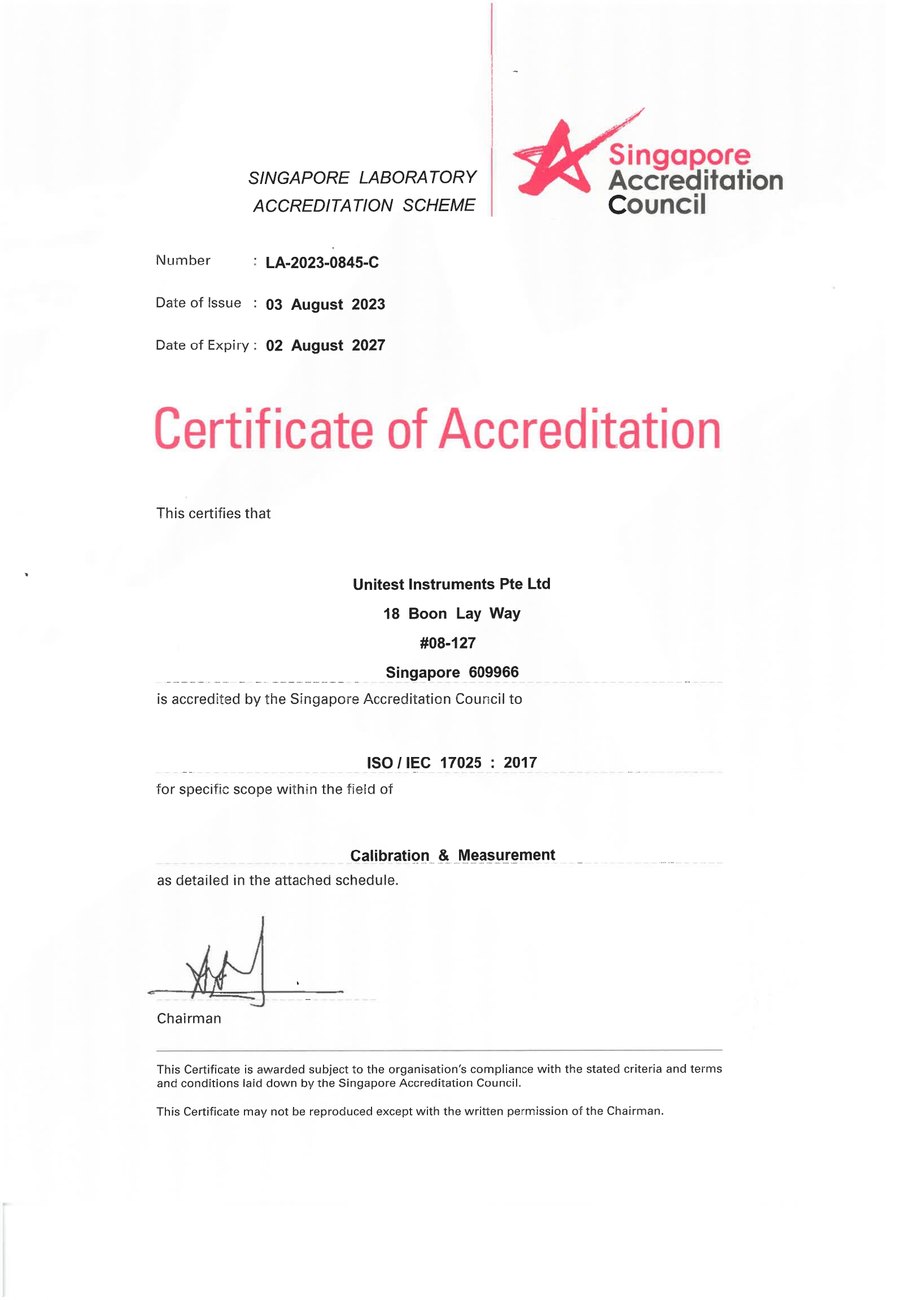
SAC-SINGLAS accredited calibration laboratory (Acc. No. LA-2023-0845-C) serving Singapore's industrial, pharmaceutical, and manufacturing sectors. All content reflects our ISO/IEC 17025 accredited scope and is reviewed by our technical calibration team.
Need clamp meter calibration in Singapore?
Unitest Instruments is SAC-SINGLAS accredited (Acc. No. LA-2023-0845-C) to ISO/IEC 17025. Same-week turnaround, certificates accepted by ISO 9001 auditors.