
Key takeaways
- Both brands make professional, True RMS multimeters suitable for industrial electrical work. This is not a premium vs budget comparison.
- Fluke's CAT IV 600V / CAT III 1000V ratings and Fluke Connect ecosystem make it the default for electrical maintenance and site work in Singapore.
- Hioki's DT series offers AC voltage accuracy specifications that match or exceed Fluke at lower price points. A genuine advantage in precision measurement applications.
- For power quality and harmonic analysis, Hioki's dedicated power analysers (PW series) are widely regarded as superior to Fluke equivalents in the same class.
- Both brands require periodic calibration to maintain accuracy, the stated ±(0.05% + 2) specifications degrade if instruments are not recalibrated on schedule.
Why this comparison matters in Singapore
Singapore's electrical and industrial sector is well served by both brands. Fluke products have been distributed here for decades through established channels, and Fluke's market presence in Southeast Asia means that most Singapore electricians, contractors, and maintenance engineers have grown up using orange meters. The brand is deeply embedded in the vocabulary of site work , "grab your Fluke" is as common a phrase on a Singapore electrical panel as it is anywhere in the world.
Hioki arrived in the Singapore market more gradually but has built a strong following, particularly in electronics manufacturing, semiconductor-adjacent industries, and facilities that require precise power measurements. Japanese test equipment has a long-standing reputation for accuracy and build quality in Asia, and Hioki is the most visible brand in that category for handheld electrical instruments.
What makes this comparison genuinely useful (rather than just brand loyalty versus novelty), is that both instruments operate in the same professional tier. This is not a comparison of a professional tool against a hardware store multimeter. It is a comparison between two instruments that Singapore's accredited calibration labs, including Unitest, calibrate regularly against the same traceable reference standards. The differences between them are real and specification-driven, not marketing. Understanding those differences lets you select the instrument that actually fits your measurement requirements, and then maintain it correctly with a calibration programme that keeps it within specification.
Fluke: the electrical maintenance standard
Fluke Corporation was founded in 1948 in the United States and became the dominant name in handheld electrical test equipment over the following four decades. The company is now part of Fortive Corporation, a Nasdaq-listed diversified industrial group. For most working electricians and electrical engineers globally, "Fluke" is functionally synonymous with "professional multimeter". A level of brand recognition that few instrument manufacturers in any category achieve.
In Singapore, Fluke's dominance in the electrical maintenance market rests on several pillars. The first is its CAT rating leadership. Fluke has consistently been at or near the top of the market for overvoltage protection, and the Fluke 87V (the flagship handheld DMM), carries a CAT III 1000V / CAT IV 600V rating with input protection designed for the transient voltages seen in industrial panel work and distribution systems. These ratings are independently tested and are printed on the meter's face, not just in the manual. For a contractor working in a Singapore industrial estate or commercial building, that visible rating matters. It is evidence that the instrument was designed for the environment.
The second pillar is ruggedness. Fluke meters are built to withstand drops, dust, and humidity. The 87V carries an IP67 rating, meaning it is fully dustproof and can be submerged in water up to one metre. Site environments (construction, maintenance, manufacturing floor), are hard on instruments. The Fluke design philosophy has always prioritised survival of the instrument in rough conditions over squeezing maximum accuracy out of a fragile design.
The third pillar is the Fluke Connect ecosystem. Fluke's wireless measurement ecosystem allows compatible meters, clamps, and modules to connect to smartphones and share data in real time. For facility maintenance teams conducting asset-level tracking, the ability to log readings automatically against a timestamp and location has real operational value. The ecosystem is proprietary, which creates lock-in, but for teams already invested in it, this becomes a switching cost that reinforces brand loyalty.
Fluke's AC True RMS measurement in the 87V uses a frequency response that extends to 20 kHz, which is adequate for the vast majority of electrical maintenance applications. Its DC voltage specification of ±0.05% + 1 digit is excellent. Where Fluke is comparatively weaker is in its AC voltage specification at power frequencies (±0.5% + 2 digits at 50/60 Hz), which is good but not exceptional for precision work.
Hioki: Japan's precision electrical measurement leader
Hioki E.E. Corporation was founded in 1935 in Nagano, Japan. The company's history is longer than Fluke's, though its international brand recognition outside Asia is considerably lower. In Japan and across East and Southeast Asia, Hioki is regarded as the benchmark for precision electrical measurement. Particularly for AC power analysis, harmonic measurement, and high-accuracy voltage and current work.
Hioki's product range divides into two tiers that matter for this comparison. The DT series handheld multimeters (the DT4281 being the current flagship), compete directly with Fluke's 87V in the professional handheld market. The PW series power quality analysers are a step above handheld multimeters and compete with Fluke's high-end power quality tools, but at a level of AC measurement precision that Fluke has historically found difficult to match.
The DT4281's most notable specification advantage over the Fluke 87V is its AC voltage accuracy: ±0.1% + 3 digits at 50/60 Hz, versus the Fluke 87V's ±0.5% + 2 digits. This is not a small difference (Hioki's AC accuracy specification is five times tighter. For measurements where that accuracy matters), precision power measurements in a test laboratory, verification of voltage levels in semiconductor manufacturing, or any application where you are making compliance decisions based on AC voltage readings. The Hioki specification is meaningfully better.
Hioki also leads on AC frequency bandwidth. The DT4281 measures AC voltage with True RMS up to 100 kHz, compared to 20 kHz for the Fluke 87V. In environments with switching power supplies, variable-frequency drives, and power electronics (exactly the kind of equipment common in Singapore's electronics and precision manufacturing sector), higher bandwidth means more accurate measurements of the actual waveforms present in the system.
The DT4281's resistance range extends to 100 MΩ, double the Fluke 87V's 50 MΩ, which is useful for insulation resistance checks on high-impedance circuits. The street price in Singapore (approximately S$380–440 for the DT4281 versus S$480–560 for the Fluke 87V), means Hioki delivers these specification advantages at a lower price point, which is a genuine value proposition for specification-driven buyers.
Where Hioki is comparatively weaker is in ecosystem integration (no native wireless connectivity on the DT4281), brand recognition in general electrical contracting (many Singapore electricians are simply not familiar with Hioki handhelds), and the perception (often inaccurate but persistent), that a less familiar brand name implies lower quality.
Specification comparison: Fluke 87V vs Hioki DT4281
The most direct way to understand the real differences between these two instruments is to compare their published specifications side by side. Both the Fluke 87V and Hioki DT4281 are the respective brand's flagship professional handheld multimeter, making them the appropriate comparison pair for the professional market in Singapore.
| Specification | Fluke 87V | Hioki DT4281 |
|---|---|---|
| DC voltage accuracy | ±0.05% + 1 | ±0.025% + 3 |
| AC voltage accuracy (50/60 Hz) | ±0.5% + 2 | ±0.1% + 3 |
| True RMS | Yes (AC+DC) | Yes (AC+DC) |
| Frequency response | 20 kHz (AC) | 100 kHz (AC) |
| CAT rating | CAT III 1000V / CAT IV 600V | CAT III 1000V / CAT IV 600V |
| Resistance range | 50 MΩ | 100 MΩ |
| Capacitance | 10,000 µF | 10,000 µF |
| Temperature measurement | Yes (Type K) | Yes (Type K/J) |
| Min/Max/Average | Yes | Yes |
| Data logging | No | No |
| Bluetooth connectivity | With iFlex only | No |
| Approx. Singapore street price | S$480–560 | S$380–440 |
| Calibration interval (typical) | 12 months | 12 months |
Several aspects of this comparison deserve plain-language explanation. The DC voltage accuracy figures look similar at first glance, but the Hioki's ±0.025% + 3 specification is technically tighter in percentage terms, while Fluke's ±0.05% + 1 has fewer added digits, whether one or the other is better for a specific measurement depends on the range and what the "digits" part contributes at the measurement level you care about.
The AC voltage accuracy difference is unambiguous. The Hioki's ±0.1% + 3 specification at 50/60 Hz is five times tighter in percentage terms than the Fluke's ±0.5% + 2. At a 230V measurement (a typical Singapore single-phase supply), the Fluke's ±0.5% gives you ±1.15V of percentage-related uncertainty, while the Hioki's ±0.1% gives you ±0.23V. For most electrical maintenance purposes, both are perfectly adequate. For laboratory verification or precision power measurements, the Hioki specification is genuinely superior.
The frequency response difference (100 kHz for Hioki versus 20 kHz for Fluke), is more significant in environments with power electronics and drives than in simple AC power circuits. At 50 Hz industrial supply, both instruments will produce excellent results. Where the harmonics of switching equipment extend into the tens of kilohertz range, the Hioki's wider bandwidth captures more of the actual signal.
Both instruments carry identical CAT III 1000V / CAT IV 600V ratings, which is the critical safety specification for industrial electrical work. Neither has an advantage here.
When Fluke is the right choice
Fluke is the right choice for the majority of Singapore electrical maintenance, contracting, and field service work. The reasons are partly about specifications and partly about the practical realities of professional tool ownership.
For electrical contractors and site electricians, Fluke's rugged construction and IP67 rating mean the instrument survives the physical abuse of daily site work. The Fluke 87V has been drop-tested to IEC 61010-1 standards and is designed to keep working after the kind of impacts that happen on construction sites, in cable trays, and around switchgear. The Hioki DT4281 is also robustly built, but Fluke's reputation for surviving abuse in field conditions is unmatched.
For work in CAT IV environments (at the service entrance, utility meters, or outdoor conductors), both meters carry the correct rating, but Fluke's input protection design and the brand's decades of experience in high-transient environments give many professionals greater confidence in the instrument's ability to survive an unexpected transient. This is partly rational (Fluke's input protection has been extensively tested and documented), and partly the credibility that comes from a brand that has been the default in that environment for generations of electricians.
For teams using the Fluke Connect ecosystem (wireless measurement modules, smartphone connectivity, iFlex flexible current probes with Bluetooth), Fluke is the obvious choice. The ecosystem is mature, widely used in Singapore's facilities management sector, and the wireless logging capability adds real operational value for preventive maintenance programmes and asset documentation.
For applications where brand recognition matters for insurance, warranty, or client-facing purposes (contractors who need to demonstrate to a client or insurer that professional-grade instruments were used), Fluke's name recognition is an asset. For a Hioki of equivalent or superior specification, you may find yourself explaining what the brand is. For a Fluke, no explanation is needed.
Calibrate your Fluke or Hioki to manufacturer specification
Unitest calibrates Fluke and Hioki multimeters against traceable reference standards. Every certificate states measurement uncertainty. Keeping your instruments within specification and your audits clean.
When Hioki is the right choice
Hioki earns its place at the professional level through genuine specification advantages in specific application domains. Knowing those domains helps you make the right selection rather than defaulting to the more familiar brand when a better-specified alternative is available.
For precision electrical laboratories and test environments, Hioki's AC accuracy advantage is real and matters. If you are verifying transformer output voltages, testing power supply regulation, or making compliance measurements against tight voltage tolerance requirements, the DT4281's ±0.1% AC accuracy specification gives you a smaller uncertainty contribution from the meter, which means more of your measurement budget is available for the actual measurement rather than being consumed by instrument error.
For electronics manufacturing and semiconductor-adjacent applications, Hioki's 100 kHz AC frequency response is the better choice. Singapore's electronics manufacturing sector (PCB assembly, precision machining, semiconductor packaging), operates equipment that generates significant harmonic content above 20 kHz. The Hioki captures this content accurately; the Fluke's 20 kHz limit means it may underread in these environments.
For power quality measurement and harmonic analysis, Hioki's broader product ecosystem is the compelling reason to enter the brand. The DT4281 is only the entry point. Hioki's PW series power quality analysers are among the most highly regarded instruments in their class globally, used by utilities, test laboratories, and research institutions. Once a team is working with Hioki for power quality analysis, the DT4281 as a complementary handheld is a natural fit.
For specification-driven procurement. Procurement managers or quality engineers who are selecting instruments based on documented specification rather than brand preference. The Hioki DT4281 frequently wins on value per specification dollar. The instrument delivers tighter AC accuracy and wider bandwidth at a lower street price than the Fluke 87V. For organisations where measurement capability rather than brand recognition is the decision criterion, Hioki is a strong and legitimate choice.
The calibration question: does brand affect calibration?
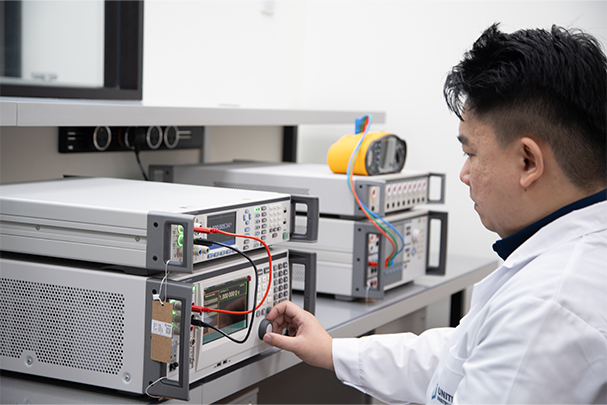
From the calibration laboratory's perspective, brand is irrelevant to the calibration process. Whether the instrument on the bench is a Fluke 87V or a Hioki DT4281, the calibration procedure follows the same principles: apply known reference values from traceable reference standards, compare the instrument's indicated values against those references, calculate the error at each measurement point, and issue a certificate that states the results with measurement uncertainty.
Unitest calibrates both brands under our SAC-SINGLAS accreditation. The reference standards used (precision DC voltage sources, AC signal generators, resistance decade boxes), are the same regardless of what instrument is being calibrated. The measurement uncertainty on the certificate reflects the combined uncertainty of the reference system and the measurement process, not anything specific to the instrument brand.
What does matter in calibration is the instrument's stated specification. A calibration certificate tells you the instrument's actual error at each measurement point. Whether those errors are acceptable depends on whether they fall within the manufacturer's published specification tolerances. An instrument showing an error of ±0.4% on AC voltage is within specification for a Fluke 87V (±0.5%), but outside specification for a Hioki DT4281 (±0.1%). The brand determines what the pass/fail threshold is; the calibration determines whether the instrument meets it.
This means that choosing a tighter-specification instrument like the Hioki for precision applications creates a higher calibration bar. The instrument is held to a tighter standard, and drift that would be acceptable on a Fluke may constitute a specification failure on a Hioki. This is not a disadvantage. It is simply the consequence of using a more precise instrument. The calibration certificate makes this transparent: any ISO 9001 auditor or quality engineer can read the certificate and see both what the instrument measured and whether those measurements were within the stated specification.
Both brands recommend a 12-month calibration interval. At Unitest, we calibrate both Fluke and Hioki multimeters and can advise on appropriate intervals based on the drift data observed across the calibration history of your specific instruments. An instrument that consistently shows low drift may support extension to 18 or 24 months with documented justification; an instrument used heavily in demanding conditions may warrant a 6-month cycle. The data drives the decision, not the brand name on the front.
Making the decision
The practical decision framework for choosing between Fluke and Hioki for Singapore industrial and professional electrical use comes down to four questions.
What are you primarily measuring? General electrical maintenance (panels, switchgear, building systems, site electrical), favours Fluke. Precision AC measurement, power quality analysis, electronics manufacturing, and precision laboratory work favour Hioki.
What environment will the instrument work in? Rough site conditions, construction environments, and outdoor work favour Fluke's ruggedness and IP67 rating. Controlled laboratory and workshop environments level the playing field, where Hioki's specification advantages become more relevant than its somewhat less rugged design philosophy.
Do you need ecosystem connectivity? If wireless measurement logging and the Fluke Connect platform are requirements, Fluke is the clear choice. If standalone measurement capability is sufficient (as it is for most applications), the connectivity advantage disappears.
Does your organisation have a calibration programme? If the answer is yes (and for any ISO 9001 compliant operation in Singapore it should be), then both instruments can be maintained within specification through regular accredited calibration. The brand on the instrument does not affect the quality of the calibration evidence. What matters is that the instruments are calibrated on schedule, the certificates state measurement uncertainty, and the calibration is performed by an SAC-SINGLAS accredited laboratory. Both the Fluke 87V and the Hioki DT4281 are professional instruments capable of producing measurement results that satisfy ISO 9001 clause 7.1.5 when properly calibrated and used within their specification.
The instrument brand is the beginning of the decision, not the end of it. Buying the right instrument and then operating it without a calibration programme means working with measurements of unknown accuracy. Buying either of these instruments and maintaining them with accredited calibration means you always know exactly how accurate your measurements are, and that knowledge is what professional electrical work in Singapore requires.
Frequently asked questions
Neither brand is categorically better. The right choice depends on your application. Fluke leads on ruggedness, CAT IV safety ratings, and recognition in general electrical maintenance and site work. Hioki leads on AC voltage accuracy (±0.1% vs Fluke's ±0.5% at 50/60 Hz), high-frequency bandwidth (100 kHz vs 20 kHz), and value for specification in precision measurement and electronics applications. For most Singapore electrical contractors and maintenance teams, Fluke is the default. For precision labs, power quality work, and electronics manufacturing, Hioki often delivers better specifications at lower cost.
Yes. Unitest calibrates both Fluke and Hioki multimeters under our SAC-SINGLAS accreditation (no. LA-2023-0845-C). Calibration is performed against traceable reference standards regardless of brand. Every certificate states measurement uncertainty and carries NMC traceability. Accepted by auditors for ISO 9001 clause 7.1.5 and GMP compliance. Contact us for a quote or to arrange collection.
Both manufacturers recommend a 12-month calibration interval as a standard starting point. The appropriate interval for your specific instrument depends on usage frequency, the harshness of the working environment, whether the instrument has been dropped or subjected to overload events, and the tolerance requirements of your measurements. High-use instruments in demanding environments may warrant a 6-month interval. Instruments used occasionally in controlled environments may be defensibly extended to 24 months with documented risk assessment. Calibration history (the drift data observed across successive calibration cycles), is the best evidence base for interval decisions.
True RMS (Root Mean Square) is the correct method for measuring the effective value of an AC waveform that is not a pure sine wave. In industrial environments (variable-speed drives, switching power supplies, UPS systems, fluorescent and LED lighting), the current and voltage waveforms contain harmonics that make them non-sinusoidal. A meter without True RMS capability measures these waveforms incorrectly, typically reading low by 10–40% on distorted waveforms. Both Fluke and Hioki professional multimeters include True RMS measurement as standard. Any professional multimeter used for Singapore industrial electrical work should include True RMS as a minimum requirement.
For electrical maintenance work on industrial panels, distribution boards, and switchgear in Singapore, CAT III 1000V is the minimum appropriate rating. CAT IV 600V is required for work at the origin of the installation. Service entrance, utility meters, outdoor conductors. The CAT rating reflects the potential for voltage transients (short-circuit current impulses) at different points in the electrical system. Both the Fluke 87V and Hioki DT4281 carry CAT III 1000V / CAT IV 600V ratings, making them appropriate for the full range of industrial electrical work. Never use a lower-rated instrument in a higher-category environment, the safety risk is genuine.
Yes. Hioki E.E. Corporation is a Japanese test and measurement manufacturer founded in 1935 and headquartered in Nagano, Japan. Their instruments are used in semiconductor manufacturing, power electronics development, and accredited calibration laboratories worldwide. In Singapore, Hioki products are sold through authorised distributors and supported for warranty and service. The brand's relative unfamiliarity to some Singapore electricians reflects market history, not quality. Hioki's measurement instruments are reference-class in their application domains and are well regarded by calibration engineers and precision measurement professionals in Asia.
All multimeters drift over time. Internal reference components age, mechanical contacts wear, and environmental exposure causes subtle changes in component values. The manufacturer's stated accuracy specification is only guaranteed at the time of calibration, and the drift rate over the following 12 months is covered by the calibration interval assumption. An instrument used beyond its calibration due date may still read within specification, or it may have drifted outside, you cannot know without recalibration. For quality-critical measurements, operating an instrument past its calibration date means making measurements of unknown accuracy. Regular accredited calibration keeps you within the stated specification and provides the documentation that your measurement results are traceable.
Unitest Instruments Pte. Ltd. is a SAC-SINGLAS accredited calibration laboratory (ISO/IEC 17025, no. LA-2023-0845-C) based in Singapore. We calibrate electrical instruments (including Fluke and Hioki multimeters), against traceable reference standards for manufacturers, service providers, and regulated industries across Singapore and the region.
Send your Fluke or Hioki for accredited calibration
Unitest calibrates electrical instruments including multimeters against SAC-SINGLAS accredited references. Stated uncertainty, NMC traceability, ready for ISO 9001 audit.
Verifiable at sac.gov.sg · Acc. No. LA-2023-0845-C