
Key takeaways
- Hioki is dominant in Singapore's electronics manufacturing and semiconductor sectors. Fast response, compact design, excellent safety ratings.
- Yokogawa multimeters have a stronger presence in process industries (petrochemical, pharmaceutical) where Yokogawa's broader instrumentation brand is the standard.
- Both brands offer CAT IV 600V / CAT III 1000V ratings on their mid-to-top tier models , safety parity at the model level that matters most.
- Calibration is brand-agnostic. Unitest calibrates both Hioki and Yokogawa to the same SAC-SINGLAS accredited standard.
- The standard calibration interval for both is 12 months for industrial use.
Hioki: Japan's electronics-first multimeter
Hioki E.E. Corporation, founded in Nagano, Japan in 1935, built its reputation on precision electrical measurement instruments. The Hioki DT series multimeters (particularly the DT4281, DT4282, and DT4256-50), are widely respected for their fast response time (useful in production test where speed matters), excellent CAT IV 600V safety ratings, and durability under the daily use conditions of electronics manufacturing. The DT4281 offers 60,000 count resolution and 0.025% DC voltage accuracy. Placing it in the premium instrument tier.
In Singapore, Hioki multimeters are a common sight in EMS companies, semiconductor fabs, and PCB assembly operations. The Japanese engineering culture that produced Hioki (similar to the attention to precision that characterises Mitutoyo (metrology) and Shimadzu (analytical instruments)), resonates with quality-focused manufacturing operations. Hioki's Singapore distribution is well-established through authorised distributors, making support and replacement parts accessible.
Hioki's broader instrument catalogue, beyond the handheld multimeter range, includes battery testers, insulation resistance testers, clamp meters, and power analysers built around the same measurement philosophy: fast, precise, and tuned for the pace of a production or R&D bench rather than a slower-paced field maintenance workflow. Facilities that adopt Hioki multimeters frequently end up standardising across this wider catalogue too, since the instruments share a common design language, similar accessory ecosystems (test leads, probes, cases), and a consistent calibration approach across the range, a practical convenience for a metrology or quality team managing a mixed instrument fleet.
Yokogawa: process industry's trusted multimeter
Yokogawa Electric Corporation is best known in Singapore as a manufacturer of process instrumentation. Differential pressure transmitters, HART communicators, yokogawa DCS systems, and data recorders. The Yokogawa TX and MT series multimeters are a natural extension of this brand into the measurement and test segment. Engineers who work with Yokogawa's process instruments daily often choose Yokogawa multimeters because of the cross-brand familiarity and the confidence that comes from one vendor's quality system.
The Yokogawa TX1002 (10,000 count) and TX1040 (40,000 count) are representative models. Solid, dependable instruments with the accuracy specifications needed for maintenance and process calibration work. Yokogawa's focus in the multimeter segment has historically been on the process industry user rather than the electronics bench user, which is reflected in the feature set: good 4-20mA loop current measurement, process signal functions, and rugged design for field use.
| Attribute | Hioki DT4281 | Yokogawa TX1040 |
|---|---|---|
| Display count | 60,000 count | 40,000 count |
| DC voltage accuracy | ±0.025% rdg + 3 dgt (600V range) | ±0.05% rdg + 5 dgt (typical) |
| Safety rating | CAT IV 600V / CAT III 1000V | CAT III 600V (model dependent) |
| Response time | Fast. Suited to production test | Standard. Suited to maintenance and process |
| Primary market in SG | Electronics manufacturing, semiconductor, EMS | Process industries, petrochemical, utilities |
| Calibration interval | 12 months | 12 months |
We calibrate Hioki and Yokogawa multimeters with full SAC-SINGLAS traceability
Unitest calibrates digital multimeters from all major brands. Every certificate includes as-found/as-left readings, deviations, and expanded uncertainties. The data ISO 9001 auditors look for.
CAT ratings: where the two brands actually reach parity
Unlike the clamp meter comparison between premium and budget brands, Hioki and Yokogawa's mid-to-top-tier multimeters largely reach parity on Category (CAT) safety ratings, both offering CAT IV 600V / CAT III 1000V on their higher-specification models. This matters because CAT ratings describe an instrument's ability to withstand transient overvoltages at different points in an electrical system, CAT III covering distribution-level circuits and CAT IV covering the origin of the installation and service entrance, where transient energy is highest. Where the two brands genuinely diverge is not in the rating itself but in which specific models within each range carry it: buyers should check the datasheet for the exact model under consideration rather than assuming every Hioki or every Yokogawa multimeter automatically carries CAT IV, entry-level models from both manufacturers may specify a lower CAT III or CAT II rating appropriate to bench-level rather than field switchboard work. For any application touching main distribution boards or service-entrance-level testing, verifying the specific model's CAT rating against the actual electrical environment it will be used in is a non-negotiable step, regardless of brand.
Temperature stability and long-term drift characteristics
Singapore's ambient conditions, consistently warm and humid year-round without the large seasonal temperature swings some markets contend with, actually work in favour of both brands' long-term stability, since neither instrument is regularly cycled through the wide temperature ranges that most stress an electronic measurement instrument's internal reference components. That said, both Hioki and Yokogawa publish a temperature coefficient specification, describing how much additional accuracy error to expect per degree of deviation from the reference calibration temperature (typically 23°C ±5°C), relevant for instruments used in genuinely hot environments such as near furnaces, outdoor switchgear under direct sun, or unconditioned plant rooms where ambient temperature can run well above the reference range. An instrument used consistently outside its reference temperature band should have this factored into its effective accuracy budget, and where the application allows it, storing and using precision instruments closer to the reference temperature range preserves more of the manufacturer's stated accuracy specification in practice.
Local support and warranty: a practical Singapore consideration
Both brands maintain established distribution in Singapore, but the depth of local technical support differs by sector presence rather than brand size alone. Hioki's strong footprint in electronics manufacturing and semiconductor fabs means authorised distributors and service partners here are well-versed in the DT series' production-test use cases, calibration turnaround, and firmware or accessory support. Yokogawa's Singapore presence, built primarily around its dominant position in process instrumentation (transmitters, recorders, DCS systems), extends naturally to strong support for its multimeter range among the same process-industry customer base, engineers can often get support for their multimeter through the same account relationship they already maintain for Yokogawa's broader instrumentation portfolio. Neither brand is meaningfully harder to get support for in Singapore than the other; the practical difference is which support ecosystem a given engineering team is already plugged into, which circles back to the sector-fit reasoning that should drive most of this purchase decision in the first place.
Reading "rdg + dgt" accuracy specifications correctly
Comparing the DC voltage accuracy figures in the table above, ±0.025% rdg + 3 dgt for the Hioki against ±0.05% rdg + 5 dgt for the Yokogawa, requires understanding what the two components actually mean, because the headline percentage alone is misleading on its own. The "rdg" (reading) term scales with the actual value measured: 0.025% of a 100V reading is 25mV. The "dgt" (digit) term is a fixed number of least-significant-digit counts added regardless of the reading's size, reflecting the noise floor of the instrument's internal analogue-to-digital conversion. For a 60,000-count display, 3 digits at the 100V range (0.001V resolution at that range) adds roughly 3mV; for the Yokogawa's 40,000-count display, 5 digits might add a slightly different fixed offset depending on its resolution at that range. At high readings near full range, the "rdg" term dominates and the two instruments' practical accuracy converges; at low readings well below full range, the fixed "dgt" term becomes proportionally larger, and the instrument with the tighter digit count (fewer counts of fixed offset) pulls ahead. This is why comparing two multimeters on the single percentage figure alone, without accounting for the digit term at the actual reading size you care about, can lead to a wrong conclusion about which instrument is genuinely more accurate for your specific measurement.
4-20mA loop current: where Yokogawa's process heritage shows
Process industry engineers spend a disproportionate share of their multimeter time verifying 4-20mA current loop signals, the standard analogue signal used by transmitters, controllers, and final control elements across Singapore's petrochemical, pharmaceutical, and utility sectors. Yokogawa's process instrumentation heritage shows up directly in this function: features like loop-powered current measurement without disrupting the loop, percentage-of-span readouts calibrated directly against a 4-20mA = 0-100% convention, and HART-compatible resistor insertion points are refined specifically around the workflow of a process instrumentation technician troubleshooting a transmitter in the field. Hioki's instruments measure 4-20mA current perfectly competently as a standard DC current function, but without the process-specific conveniences Yokogawa builds around it. For a technician spending most of the working day verifying loop signals against DCS readings, that difference in workflow fit is a genuine productivity factor, separate from and additional to the raw accuracy specifications compared elsewhere in this article.
Response time and bar graphs: why production test environments favour Hioki
A digital multimeter's numeric display updates several times per second at best, too slow to give useful feedback when adjusting a variable supply or hunting for an intermittent connection. Hioki's DT series is specifically engineered around fast response and a responsive analogue bar graph display, letting a production test technician see a trend (rising, falling, fluctuating) in near real time rather than waiting for the digital display to settle. In a high-throughput electronics production or incoming-inspection environment, where a technician may be testing dozens of units per hour, this responsiveness measurably affects test throughput, not just user comfort. Yokogawa's multimeters, tuned more toward the steadier pace of process maintenance and calibration work, do not prioritise this characteristic to the same degree, which is one of the genuine, non-marketing reasons the two brands split so cleanly along sector lines in Singapore rather than competing head-to-head for the same buyers.
What calibration checks on both brands
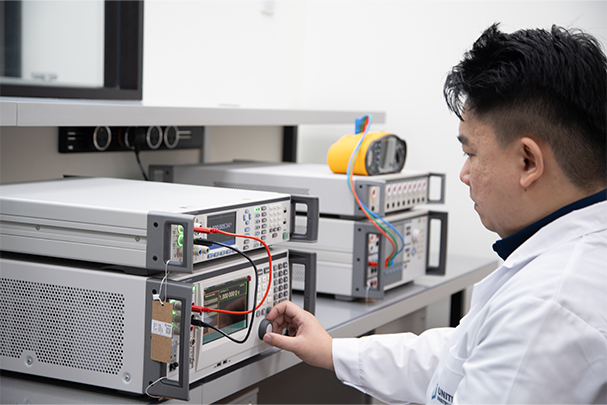
Calibration of Hioki and Yokogawa multimeters follows the same verification process: the instrument's reading at each test point is compared against a traceable reference standard. The test points cover DC voltage (multiple voltage values across each range), AC voltage (at representative frequencies and voltage levels), DC current, AC current, and resistance. The calibration certificate records as-found readings (before adjustment), as-left readings (after adjustment where needed), the deviation from nominal, and the expanded measurement uncertainty at each test point.
The key question for any multimeter calibration is whether the instrument's reading falls within the manufacturer's stated accuracy specification, and if not, whether it can be adjusted back into specification or should be removed from service. SAC-SINGLAS accredited calibration provides this determination with documented traceability to Singapore's NMC, satisfying the evidence requirements of ISO 9001, IATF 16949, and industry-specific quality standards.
Which should you choose for Singapore industrial use?
For most decisions, the answer comes down to sector and team familiarity:
- Electronics manufacturing, EMS, or semiconductor: Hioki DT series. The fast response, high count display, and CAT IV ratings are well-matched to the requirements of electronics production and test environments. Hioki's local support in Singapore is strong.
- Process industries (petrochemical, pharmaceutical, utilities): Yokogawa TX series. If your team already uses Yokogawa process instruments and HART communicators, standardising on Yokogawa multimeters reduces the number of brands your engineers need to be trained and familiar with.
- Electrical maintenance across both: Either brand at the CAT IV 600V level performs well. The DT4281's higher accuracy and display count give it an edge for precision measurements, but for standard electrical maintenance both are more than capable.
A worked example: comparing the two at a realistic reading
Consider both multimeters measuring a nominal 24V DC control signal, a very common measurement in both electronics production and process instrumentation. On the Hioki DT4281's specification of ±0.025% rdg + 3 dgt at an appropriate range, the total uncertainty contribution is a fraction of a millivolt from the reading term plus a small fixed digit offset, well under 10mV total for most range settings. On the Yokogawa TX1040's ±0.05% rdg + 5 dgt specification, the total is somewhat larger but still comfortably under 20mV for the same nominal reading. In absolute terms, at 24V, the practical difference between the two instruments is a matter of a few millivolts, immaterial for the overwhelming majority of control-signal verification, continuity checking, and general troubleshooting either brand is used for. The accuracy gap only becomes practically meaningful at the tightest end of precision measurement, verifying a reference voltage source, calibrating another instrument, or checking a tolerance specified in single-digit millivolts, work more commonly found in a metrology lab than a production floor or a process plant, which is exactly where Hioki's premium accuracy tier earns its keep and where Yokogawa's more moderate specification is a perfectly reasonable trade for its stronger process-instrumentation feature set.
Common mistakes when comparing multimeter specifications
- Comparing headline accuracy percentages without checking the digit term, which as shown above can flip the practical comparison at low readings.
- Assuming higher display count always means higher accuracy. Display resolution (how many digits are shown) and measurement accuracy (how close the reading is to the true value) are related but distinct specifications; a 60,000-count display with poor accuracy is still a poor instrument.
- Ignoring CAT rating in favour of accuracy specs. A highly accurate multimeter with an insufficient CAT rating for the panel it will be used on is a safety liability the accuracy figure does not compensate for.
- Standardising on a brand without checking the specific model's specification, both Hioki and Yokogawa offer ranges spanning basic to premium tiers, and "we use Hioki" does not by itself guarantee CAT IV or 0.025% accuracy unless the specific model purchased actually carries those specifications.
Calibration is the equaliser: choosing an accredited lab regardless of brand
Whichever brand a facility standardises on, the calibration programme wrapped around it matters more to measurement trustworthiness than the brand choice itself. A Hioki or Yokogawa multimeter calibrated by a SAC-SINGLAS accredited laboratory, with traceability to Singapore's NMC and a stated expanded uncertainty at each test point, carries equally defensible evidence for an ISO 9001, IATF 16949, or customer quality audit. Before committing a fleet to either brand, it is worth confirming with your intended calibration provider that both are within their accredited scope (some labs specialise more heavily toward one brand's ecosystem, particularly where a process instrumentation-focused lab has deeper Yokogawa familiarity), and that the certificate format, as-found/as-left data, deviation, and expanded uncertainty at each point, meets what your quality system actually requires, independent of which logo is printed on the front of the meter.
Frequently asked questions
Hioki multimeters (DT series) are designed for electronics manufacturing and electrical maintenance. Fast response, high display count (up to 60,000), excellent CAT IV safety ratings, and competitive accuracy. Yokogawa multimeters (TX/MT series) are traditional instruments well-regarded in process industries where Yokogawa's transmitter and recorder brand is already dominant. Both are quality instruments; the choice typically reflects the sector you work in and which brand your team is already familiar with.
Yes. Hioki is widely used in Singapore's electronics manufacturing, EMS, and semiconductor sectors. Many Singapore electronics operations standardise on Hioki alongside Fluke, appreciating the Japanese quality engineering, fast response, and CAT IV safety ratings. Hioki's distribution network in Singapore is well-established. Yokogawa multimeters are less common in electronics but are frequently seen in process industries (petrochemical, pharmaceutical, utilities) where Yokogawa's broader brand is the standard.
Both brands require calibration with traceable standards when used for quality, compliance, or production test decisions under ISO 9001 clause 7.1.5. The requirement is determined by how the instrument is used, not which brand it is. SAC-SINGLAS accredited calibration provides the independent traceability verification that ISO 9001, IATF 16949, and other quality management system auditors expect. Unitest calibrates both Hioki and Yokogawa multimeters with stated uncertainties and full NMC traceability.
Multimeter calibration checks DC voltage accuracy (at multiple voltage points across each range), AC voltage accuracy (at multiple frequencies and voltage levels), DC current accuracy, AC current accuracy, and resistance accuracy. The calibration uses traceable reference standards to compare each reading against a known value. The certificate records as-found and as-left readings at each point with the deviation and expanded uncertainty. The format required by ISO 9001 clause 7.1.5.
The Hioki DT4281 specifies DC voltage accuracy of ±0.025% rdg + 3 dgt. Placing it in the premium instrument tier. Yokogawa TX series models typically offer ±0.05–0.1% accuracy. For most industrial electrical maintenance and production test applications, both are more than adequate. Accuracy becomes a critical differentiator only when the multimeter is being used as a reference for calibrating other instruments, in those cases, apply the 4:1 test-to-tolerance ratio to confirm which model meets your reference requirement.
On-site calibration is available and Unitest can arrange it for organisations with large numbers of multimeters or instruments that cannot easily be removed from service. On-site calibration uses a portable reference calibrator and achieves slightly higher measurement uncertainty than in-lab calibration due to environmental variation. For most industrial applications, on-site uncertainty is well within acceptable limits. Contact us to discuss whether on-site calibration is appropriate for your situation.
12 months is the standard calibration interval for digital multimeters from both brands. Consistent with manufacturer recommendations and accepted by ISO 9001, IATF 16949, and other quality system auditors. Review the interval using as-found calibration data: if the instrument consistently returns well within specification, extending to 18 months may be justifiable with documented evidence; if it is drifting, reduce to 6 months.

Unitest Instruments Pte. Ltd. is a SAC-SINGLAS accredited calibration laboratory (ISO/IEC 17025, no. LA-2023-0845-C) based in Singapore. We calibrate electrical, temperature, pressure, humidity, and related instruments for manufacturers, service providers, and regulated industries across Singapore and the region.
Calibrate your Hioki or Yokogawa multimeter at Singapore's accredited lab
Unitest holds SAC-SINGLAS accreditation no. LA-2023-0845-C. We calibrate multimeters from all major brands with stated uncertainties and NMC traceability. Accepted by ISO 9001 and industry-specific auditors.
Verifiable at sac.gov.sg · Acc. No. LA-2023-0845-C