
Key Takeaways
- Dew point is an absolute temperature value, not a percentage. It does not change when air temperature changes (unlike relative humidity).
- Chilled mirror hygrometry is the highest-accuracy method (±0.1°C to ±0.2°C) and the preferred reference for calibration laboratories.
- ISO 8573-1:2010 classifies compressed air quality by pressure dew point; Class 1 requires −70°C or below.
- Dew-point sensors must be calibrated at conditions representative of their actual use. Pressure correction is mandatory for in-line compressed-air sensors.
- In Singapore, SAC-SINGLAS accredited calibration certificates (issued under ISO/IEC 17025) are required by HSA, AVA, and MOM-regulated facilities.
- The five most common measurement errors are contamination, slow sensor equilibration, pressure-correction omission, poor reference traceability, and confusing RH with dew point.
Dew Point Defined: The Precise Technical Statement
The dew point temperature (Tdp) is defined as the temperature at which the partial pressure of water vapour in a gas mixture equals the saturation vapour pressure of water at that temperature. Put plainly: it is the temperature at which the air can hold no more water in its vapour state and condensation begins. The term originates from the visible effect (dew forming on grass or a cold glass), but the concept applies equally to invisible moisture condensing inside compressed-air lines, pharmaceutical clean rooms, and semiconductor fabrication environments.
Dew point is expressed in degrees Celsius (or Fahrenheit) and has a fixed, unambiguous value for any given parcel of air with a known moisture content. This is its key engineering advantage over relative humidity. Relative humidity states what fraction of the saturation capacity the air is currently using; that fraction changes every time temperature changes, even if no moisture is added or removed. Dew point stays constant as long as the moisture content is unchanged, making it far more reliable as a process specification.
Numerically, dew point and relative humidity are linked by the Magnus formula (an approximation of the Clausius-Clapeyron equation). For practical engineering use, the Buck equation provides accuracy better than 0.05% over the range −40°C to +50°C. Most data loggers and humidity transmitters perform this conversion internally, but the underlying physical quantity measured is almost always either relative humidity or the chilled-mirror condensation temperature. Never dew point itself as a primary signal.
The Underlying Physics: Why Air Has a Dew Point
Water molecules in air are in continuous motion. At any given temperature, a specific maximum number of water molecules can exist in the vapour phase; this limit is described by the saturation vapour pressure, which rises steeply with temperature. At 30°C the saturation vapour pressure of water is approximately 4.24 kPa; at 10°C it falls to 1.23 kPa, a 3.4-fold reduction for just a 20°C drop. This steep, nonlinear relationship (governed by the Clausius-Clapeyron equation) explains why tropical air carries so much more moisture than temperate air at the same relative humidity.
When air is cooled below its dew point, the partial pressure of water vapour exceeds the new saturation limit and the excess moisture must leave the vapour phase. On surfaces it appears as liquid water (dew, condensation) or, below 0°C, as frost or ice. Inside industrial equipment this means corrosion, dielectric breakdown in electrical insulation, mould growth, and product contamination. Inside pharmaceutical cold stores, condensation on product surfaces creates microbial risk, which is why WHO GDP and Singapore HSA Good Distribution Practice guidelines set dew-point monitoring requirements for cold-chain environments.
The heat released when water vapour condenses (latent heat of vaporisation, approximately 2,450 J/g at 20°C) is an important secondary effect in large HVAC systems and compressed-air dryers. Engineers designing these systems must account for the enthalpy of condensation, not merely the dew-point temperature.
Measurement Methods: How Dew Point Is Actually Measured
Three primary technologies dominate industrial and laboratory dew-point measurement, each with a different accuracy range, cost, and application domain.
1. Chilled Mirror Hygrometry
A thermoelectrically cooled mirror is exposed to the gas sample. An optical bridge detects the instant condensation (or frost) forms on the mirror surface; the mirror temperature at that moment is recorded as the dew point (or frost point). Because the measurement is based on a direct thermodynamic equilibrium, chilled mirror hygrometers are primary reference instruments. Uncertainty of ±0.1°C to ±0.2°C at the dew point is achievable, and top-tier instruments are traceable to national metrology institutes (NMIs). They are used as transfer standards in accredited laboratories and to calibrate secondary sensors. Their main limitations are high cost (S$8,000–S$30,000 for laboratory-grade units), sensitivity to contamination from oils and particulates, and slow response (minutes per reading).
2. Capacitive Polymer Sensors
A thin polymer film absorbs water vapour in proportion to the ambient relative humidity; the change in dielectric properties alters the sensor's capacitance, which is converted electronically to a humidity reading and then (via the Magnus or similar formula), to dew point. Capacitive sensors are inexpensive (S$50–S$500 for the sensing element), compact, and offer response times of 10–60 seconds. Typical accuracy after calibration is ±1–3°C dew point over the normal operating range. They are widely used for HVAC, cleanroom, and general industrial monitoring. Drift from chemical exposure (solvents, ammonia) and high humidity cycling can be significant; annual or biannual calibration against a reference hygrometer is standard practice.
3. Aluminium Oxide and Electrolytic Sensors
For very low dew points encountered in compressed gases, natural gas pipelines, and cryogenic applications, aluminium oxide sensors are preferred. An anodised aluminium strip coated with a thin gold layer acts as a capacitor; the oxide layer absorbs water molecules and changes impedance in proportion to water vapour partial pressure. These sensors can measure pressure dew points as low as −100°C and respond in seconds. They are, however, susceptible to contamination by polar solvents and require more frequent calibration at the lower end of their range. Electrolytic (P2O5) sensors provide absolute measurements of water concentration (ppmv) and are used as references in gas analysis.
| Method | Typical Accuracy | Range | Best For | Key Limitation |
|---|---|---|---|---|
| Chilled Mirror | ±0.1–0.2°C Td | −75°C to +95°C Td | Reference, laboratory, high-accuracy process | Contamination sensitive; high cost |
| Capacitive Polymer | ±1–3°C Td | −40°C to +60°C Td | HVAC, cleanroom, general industrial | Chemical drift; requires frequent calibration |
| Aluminium Oxide | ±2–3°C Td | −100°C to +20°C Td | Compressed air, gas pipelines, cryogenics | Solvent sensitivity; non-linear at low Td |
| Electrolytic (P2O5) | ±1–2 ppmv | 0–2000 ppmv H₂O | Trace moisture in inert gases | Flow-rate dependent; not suitable for high RH |
Need dew-point or humidity sensor calibration in Singapore?
Unitest Instruments issues ISO/IEC 17025 calibration certificates for humidity transmitters, dew-point sensors, and dataloggers. Traceable to Singapore's NMC and accepted by HSA, AVA, and ISO 9001 auditors.
Calibration Implications: What ISO/IEC 17025 Requires
Dew-point and humidity sensors used in regulated processes must be calibrated against traceable references. Under ISO/IEC 17025:2017, a calibration laboratory must demonstrate that its reference standards are connected by an unbroken chain of comparisons to the relevant national or international measurement standards, in Singapore, this means traceability to the National Metrology Centre (NMC) at A*STAR. Laboratories that cannot demonstrate this traceability cannot issue certificates that satisfy regulatory requirements.
As explained in our article on what traceability means in calibration, the concept is not merely about which lab issued the certificate. It is about whether every link in the chain from the sensor under test back to the NMC carries a documented uncertainty statement. For dew-point calibration, the reference chain typically runs: NMC fundamental humidity generator → accredited laboratory's chilled mirror transfer standard → customer's sensor under calibration.
The calibration certificate issued must include at minimum: the instrument identification, calibration date, environmental conditions during calibration, reference standard used (with its own certificate number and traceability), the measured values at each calibration point, the as-found and as-left corrections, and the expanded measurement uncertainty (typically expressed at k=2, 95% confidence). A certificate that omits the uncertainty statement is non-compliant with ISO/IEC 17025 and should not be accepted by ISO 9001 or GMP auditors. See our detailed guide to reading a calibration certificate for a field-by-field breakdown.
Dew Point in Compressed Air: ISO 8573-1 in Practice
Compressed air quality is one of the most critical dew-point applications in Singaporean industry. When air is compressed, its pressure increases but its absolute moisture content (mass of water per unit volume) does not immediately decrease. Meaning the pressure dew point (the dew point measured at the working pressure of the system) can be significantly higher than the atmospheric dew point. A dryer that appears to be working adequately at atmospheric conditions may be allowing condensation downstream when the line pressure is factored in.
ISO 8573-1:2010 is the internationally recognised standard for compressed air purity classes. The seven classes for moisture are defined by pressure dew point. Class 1 (the driest, used in electronics and pharmaceutical applications) requires a pressure dew point of −70°C or below. Class 4 (acceptable for general workshop tools where liquid water is tolerable at low concentrations) allows up to +3°C. Most food and beverage and pharmaceutical manufacturers in Singapore specify Class 2 (−40°C) or Class 3 (−20°C) at point of use.
The practical implication for calibration is that an in-line dew-point sensor mounted on a compressed-air dryer outlet operates at elevated pressure. The sensor must either be designed for in-line measurement at that pressure, or a sample must be extracted and pressure-reduced before measurement. When extracting a sample, the pressure reduction must be performed before the sample reaches the sensor (not after), to avoid condensation in the sample line. Failure to follow this procedure is one of the most common sources of erroneous low-side readings in compressed-air monitoring programmes.
Common Mistakes in Dew-Point Measurement
Despite the apparent simplicity of dew-point measurement, engineering teams make five recurring errors that undermine data quality and regulatory compliance.
1. Sensor contamination without recognition. Oil mist from compressors, solvent vapours in chemical processes, and particulate matter from machining operations all coat sensor surfaces and alter their response. A contaminated capacitive sensor may read several degrees drier than reality. The tell-tale sign is a sudden step change in reading followed by a new, stable but incorrect baseline. Maintenance procedures should include periodic sensor inspection and cleaning per manufacturer guidelines, and a calibration check after any known contamination event.
2. Premature readings from slow-equilibrating sensors. Capacitive polymer sensors have a thermal and diffusion lag. After a step change in humidity (opening a cold store door, switching between gas supplies), a sensor may take 15–30 minutes to reach its true equilibrium reading. Recording the measurement before equilibration is complete produces a reading that appears precise (the display is stable to two decimal places) but is systematically wrong. Always allow the sensor to stabilise before logging a calibration point.
3. Omitting pressure correction. Any sensor calibrated at atmospheric pressure and used at elevated system pressure will produce an incorrect dew-point reading unless a pressure correction is applied. The correction can be significant: a pressure dew point of −20°C at 700 kPa (7 bar g) corresponds to an atmospheric dew point of approximately +8°C. Many data acquisition systems allow a fixed pressure offset to be configured; verify that this has been set correctly and that it matches the actual operating pressure, which may drift over time.
4. Using a non-accredited reference for verification. A common shortcut is to verify a process sensor against a hand-held hygrometer purchased without calibration documentation. If the hand-held unit has unknown uncertainty (because it was never calibrated, or because its calibration is not traceable to a national standard), the verification is scientifically meaningless. It may satisfy an informal audit but will not withstand scrutiny from a competent regulatory body or ISO 9001 third-party assessor.
5. Conflating dew point with relative humidity at a different temperature. An operator may read 75% RH on a sensor installed in a 30°C room and calculate the dew point as approximately 25°C using a smartphone app. They then compare this to a dew-point transmitter installed in a 20°C section of the same duct, which reads 60% RH. Both sensors could be reading correctly even though the RH values differ, because the dew point (the physically invariant quantity) is the same in both locations. Comparing RH readings between instruments at different temperatures without converting to dew point or absolute humidity creates apparent discrepancies that trigger unnecessary maintenance investigations.
Calibration Intervals and Drift Monitoring for Dew-Point Sensors
ISO/IEC 17025 and ISO 9001 both require that calibration intervals be based on evidence of instrument performance. Not simply on a fixed schedule chosen arbitrarily. For dew-point and humidity sensors, a practical approach is to establish an initial interval (typically 6–12 months for capacitive sensors, 12 months for chilled mirror references), then adjust based on observed drift data from successive calibrations.
If a sensor consistently returns within ±1°C of its previous calibration value at each annual check, it may be acceptable to extend the interval to 18 months with documented justification. Conversely, if a sensor in a corrosive or high-humidity environment shows drift of ±3°C or more within six months, shortening the interval to quarterly calibration is prudent. The calibration record should include the as-found deviation at each calibration event. This is the raw data that allows interval optimisation.
For sensors used in GMP pharmaceutical environments, HSA's guidance aligns with the ISPE Good Practice Guide: Calibration Management, which recommends that calibration intervals be reviewed at least annually and that the review be documented. Sensors used for batch release decisions should generally carry a shorter interval than sensors used only for trend monitoring. See our dedicated article on how often instruments should be calibrated for a structured framework to set and justify your intervals.
Understanding measurement uncertainty is also essential when interpreting dew-point calibration results. A sensor with a specified accuracy of ±2°C dew point and a calibration certificate uncertainty of ±0.8°C (k=2) has a total in-use uncertainty larger than either figure alone. The two must be combined using root-sum-of-squares or an equivalent method. For critical applications, the combined uncertainty must be compared against the permitted tolerance in the process specification to confirm the sensor is fit for purpose. Our article on measurement uncertainty walks through this calculation in detail.
Frequently Asked Questions
Dew point is the temperature to which air must be cooled, at constant pressure and constant water vapour content, for condensation to begin. When air reaches its dew point, relative humidity hits 100% and water droplets form on surfaces. A dew point of 20°C means air cooled to 20°C will start to condense moisture; above that temperature the air is unsaturated.
Relative humidity (RH) expresses how much water vapour is present as a percentage of the maximum the air can hold at that temperature. Dew point is an absolute measure: it states the actual temperature at which condensation occurs, regardless of the current air temperature. RH changes as temperature changes even if the actual moisture content stays the same; dew point does not. This makes dew point more useful for process control, compressed air quality, and pharmaceutical storage specifications.
The three main industrial methods are: (1) chilled mirror hygrometry. A mirror is cooled until condensation forms; the mirror temperature at that moment is the dew point, offering the highest accuracy (±0.1°C to ±0.2°C); (2) capacitive polymer sensors. A hygroscopic polymer film changes capacitance with humidity, widely used for general-purpose monitoring (typical accuracy ±1–3°C dew point); (3) aluminium oxide sensors. Used for very low dew point measurements in compressed air and gas systems, capable of measuring down to −80°C dew point. Each method requires periodic calibration traceable to national standards.
Compressed air dryers must maintain dew point well below the lowest ambient temperature in the system to prevent liquid water forming in pipes, valves, and pneumatic tools. ISO 8573-1:2010 classifies compressed air quality by dew point: Class 1 requires a pressure dew point of −70°C or below; Class 4 allows up to +3°C. In Singapore's humid climate, uncontrolled compressed air can carry significant moisture that corrodes equipment and contaminates products. Dew-point sensors on dryer outlets must be calibrated regularly to maintain compliance.
Key standards include: ISO/IEC 17025:2017 (general requirements for the competence of testing and calibration laboratories), ASTM E337 (Standard Practice for Measuring Humidity with a Psychrometer), IEC 60068-3-4 (guidance on humidity measurement), and OIML R 121 (the scale of relative humidity). In Singapore, calibration laboratories must be accredited by SAC-SINGLAS under the EA-4/02 framework to issue certificates accepted by regulatory bodies including HSA, AVA, and MOM.
Below 0°C, the phase transition of water vapour is directly to ice rather than liquid water. The temperature at which this occurs is called the frost point. For the same moisture content, frost point is numerically higher (less negative) than dew point below 0°C, for example, air with a dew point of −20°C has a frost point of approximately −18.4°C. Chilled mirror instruments detect whichever phase forms first. For compressed gas and refrigeration applications operating below freezing, frost point is the more relevant parameter.
Calibration interval depends on the sensor type, operating environment, and how the reading is used. As a general guideline: chilled mirror hygrometers used as reference standards should be calibrated annually or after any physical shock; process capacitive sensors in stable environments are typically calibrated every 6–12 months; sensors in harsh or corrosive gas streams may need quarterly checks. ISO/IEC 17025 requires the interval to be based on documented evidence of drift rather than arbitrary time periods.
The five most common errors are: (1) contamination (oils, solvents, or particulates coating the sensor alter its response; (2) slow equilibration), capacitive sensors can take 15–30 minutes to stabilise after a step change, leading to premature readings; (3) pressure errors. A sensor calibrated at atmospheric pressure used in a pressurised line will read incorrectly unless a pressure correction is applied; (4) incorrect reference. Comparing a capacitive sensor against a non-accredited reference introduces unknown uncertainty; (5) confusing dew point with relative humidity. Using RH at a different temperature to infer dew point without applying the correct psychrometric calculation.
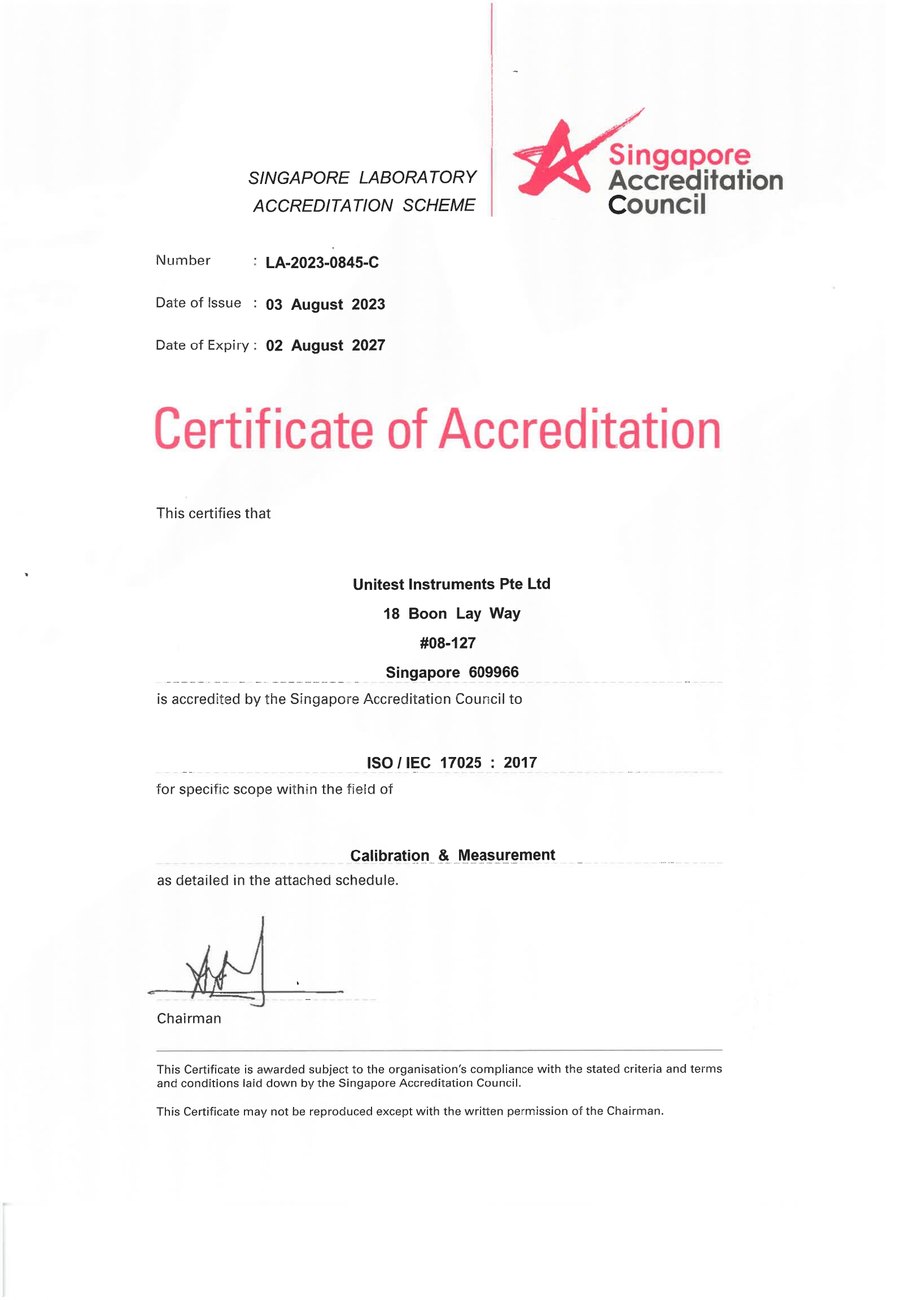
SAC-SINGLAS accredited calibration laboratory (Acc. No. LA-2023-0845-C) serving Singapore's industrial, pharmaceutical, and manufacturing sectors. All content reflects our ISO/IEC 17025 accredited scope and is reviewed by our technical calibration team.
Need humidity and dew-point calibration in Singapore?
Unitest Instruments is SAC-SINGLAS accredited (Acc. No. LA-2023-0845-C) to ISO/IEC 17025. Same-week turnaround, certificates accepted by ISO 9001 auditors and Singapore regulatory bodies.