
Key Takeaways
- The cell constant (K, cm⁻¹) is the core parameter verified during calibration. It drifts with electrode wear and fouling, requiring formal correction.
- Certified KCl reference solutions at 0.01, 0.1, and 1.0 mol/L are the primary standards, traceable to Singapore's National Metrology Centre (NMC).
- Temperature compensation must be verified separately. A 1°C error in temperature measurement introduces roughly 2% error in the conductivity reading.
- Annual calibration satisfies ISO 9001; pharmaceutical (HSA/GMP) applications typically require 6-month intervals; critical process control may require quarterly checks.
- Only an SAC-SINGLAS accredited certificate (Acc. No. LA-2023-0845-C) satisfies ISO 9001 auditors, GMP inspectors, and Singapore regulatory bodies such as NEA and PUB.
What Happens During Conductivity Meter Calibration?
Conductivity measurement is deceptively simple in operation but technically demanding to calibrate correctly. Your meter applies an alternating electrical potential across two or more electrodes immersed in a solution, measures the resulting current, and converts this to conductivity in µS/cm or mS/cm. The accuracy of every reading depends on three tightly coupled factors: the geometry of the probe (expressed as the cell constant), the accuracy of the resistance-to-conductivity conversion circuit, and the temperature compensation applied to normalise readings to a reference temperature of 25°C.
A formal calibration (as performed at Unitest Instruments under SAC-SINGLAS Acc. No. LA-2023-0845-C), addresses all three. The calibration technician begins by allowing the meter, probe, and reference solutions to equilibrate to the controlled laboratory temperature (typically 25.0 ± 0.1°C). Certified KCl reference solutions are then applied in ascending order of concentration, and the displayed conductivity reading at each point is recorded and compared against the certified reference value. Any systematic offset or span error is documented as the as-found condition. If the instrument permits, a correction is applied and as-left readings are recorded. The full procedure, uncertainty budget, and reference solution traceability are documented on the calibration certificate.
Understanding the Cell Constant and Why It Drifts
The cell constant (K, measured in cm⁻¹) is a geometric descriptor of the conductivity probe. In its simplest form, K = d/A, where d is the distance between the electrodes and A is their active surface area. A probe with a cell constant of 1.0 cm⁻¹ is optimised for mid-range conductivities (approximately 200 µS/cm to 20 mS/cm); probes with K = 0.1 cm⁻¹ are used for ultra-pure water, and K = 10 cm⁻¹ for high-conductivity industrial brines.
The cell constant is not permanently fixed. Electrode surfaces foul with mineral deposits, biological films, or chemical residues, effectively increasing the active area and lowering the apparent K value. Causing the meter to read lower than the true conductivity. Physical damage or abrasion has the opposite effect. Probes used in aggressive chemical environments, frequently cleaned with strong acids or bases, or operated at elevated temperatures will drift faster than those in clean laboratory water. Unitest's calibration data shows cell constants drifting by 3–8% over 12 months in typical industrial applications, and up to 15% in high-duty pharmaceutical cleaning validation environments. This is why calibration is not optional for any application where conductivity is used as a quality or compliance parameter.
Reference Standards Used in Conductivity Calibration
The foundation of any traceable conductivity calibration is the reference solution. Internationally, Potassium Chloride (KCl) solutions prepared to precise molar concentrations are the primary standard. Their conductivity values at 25°C are well-characterised and published in international standards including IEC 60746-3 and ASTM D1125. The three working concentrations used at Unitest are:
- 0.01 mol/L KCl. Certified conductivity of 1412 µS/cm at 25°C, used for low-range instruments including purified water monitors.
- 0.1 mol/L KCl, certified conductivity of 12.88 mS/cm at 25°C, the workhorse reference for most industrial and laboratory meters.
- 1.0 mol/L KCl, certified conductivity of 111.9 mS/cm at 25°C, used for high-range meters in process control, food, and chemical industries.
Each reference solution used at Unitest is sourced from accredited suppliers with certificates of analysis traceable to the National Metrology Centre (NMC) Singapore, which maintains Singapore's primary realisations of electrical and physical measurement units. This unbroken chain (from your instrument's reading, through our reference solutions, to NMC), is what the term "traceable to NMC Singapore" means on a SAC-SINGLAS calibration certificate. For a deeper explanation of traceability chains, see our article on what calibration traceability means and why it matters.
Temperature Compensation: The Most Overlooked Variable
Conductivity is highly temperature-dependent. For most aqueous electrolyte solutions, conductivity increases by approximately 2% per degree Celsius rise in temperature. This means a solution measured at 30°C will appear to have a conductivity roughly 10% higher than the same solution measured at 25°C. To make measurements comparable and meaningful, conductivity meters apply a temperature compensation algorithm. Either linear (using a fixed %/°C coefficient, denoted α) or non-linear (using solution-specific curves).
The most common temperature coefficient for general laboratory solutions is α = 2.0 %/°C. However, this is not universal: ultra-pure water follows a non-linear curve (as per ASTM D5391 and USP <645>), natural waters typically use α = 1.9 %/°C, and some industrial electrolytes require application-specific coefficients. Using the wrong α value introduces a systematic error that no amount of cell constant correction will fix.
During calibration at Unitest, the temperature compensation is verified by measuring the same reference solution at two or more temperatures and confirming that the temperature-corrected readings remain consistent within the instrument's specification. The calibration certificate records the ambient temperature, the α value used, and whether conductivity values are reported at measured temperature or normalised to 25°C. This information is essential for correctly interpreting results, and for understanding your measurement uncertainty. For a full explanation of how temperature errors propagate into uncertainty, see our article on measurement uncertainty in calibration.
Need a traceable conductivity meter calibration certificate in Singapore?
Unitest Instruments (Acc. No. LA-2023-0845-C) calibrates conductivity meters across the full range, from ultra-pure water monitors to high-conductivity process instruments. Same-week turnaround, certificates accepted by ISO 9001 and GMP auditors.
Field Calibration vs. Laboratory Calibration: Which Do You Need?
Conductivity meters are used both in fixed laboratory settings and in the field. Monitoring rivers, cooling towers, effluent discharge points, and process streams. The calibration approach differs significantly between these contexts, and the choice has real compliance implications.
| Factor | Field Calibration (On-Site) | Laboratory Calibration (Accredited) |
|---|---|---|
| Who performs it | User or field technician | SAC-SINGLAS accredited lab (e.g. Unitest, LA-2023-0845-C) |
| Reference standards | Portable KCl solution sachets (limited traceability) | Certified KCl solutions traceable to NMC Singapore |
| Temperature control | Ambient. Often poorly controlled | Controlled lab environment (25.0 ± 0.1°C) |
| Uncertainty statement | Not formally calculated | Documented, calculated per JCGM 100:2008 (GUM) |
| Certificate format | Informal calibration record | Formal calibration certificate with accreditation mark |
| Accepted by ISO 9001 auditors | Rarely. Only as interim check | Yes. Required for formal calibration records |
| Accepted by NEA / PUB / HSA | No. Not for compliance reporting | Yes. Satisfies regulatory requirements |
| Typical use case | Daily verification, drift check between formal calibrations | Annual or 6-monthly formal calibration for compliance |
The practical approach for most Singapore operations is to use accredited laboratory calibration (at Unitest or equivalent) to establish the instrument's formal baseline, and then perform daily or weekly field verification using portable KCl sachets to catch gross drift between calibrations. Field checks are not a substitute for accredited calibration, they are an early-warning system.
What a Proper Conductivity Calibration Certificate Must Show
A calibration certificate is only as useful as its content. Under ISO/IEC 17025, which governs Unitest Instruments' accredited scope (Acc. No. LA-2023-0845-C), a calibration certificate for a conductivity meter must include the following minimum content:
- Instrument identification. Make, model, serial number, and asset tag.
- Calibration date and due date. When calibration was performed and the recommended next calibration date.
- Reference standards used. Identification of the KCl reference solutions, their certified values, and their own traceability certificate numbers.
- Measurement conditions. Laboratory temperature and humidity at the time of calibration.
- Measurement results, as-found and as-left readings at each calibration point, with reference values for comparison.
- Measurement uncertainty. Expanded uncertainty (U) at each calibration point, stated at a 95% confidence level (coverage factor k=2).
- Temperature compensation settings. The α coefficient applied and reference temperature used.
- Accreditation mark. The SAC-SINGLAS logo and accreditation number LA-2023-0845-C.
- Authorised signatory. Name and signature of the calibration technician and approving technical authority.
Certificates that omit measurement uncertainty are not compliant with ISO/IEC 17025 and will increasingly fail auditor scrutiny. If you are unsure whether your current supplier's certificates meet this standard, our article on how to read a calibration certificate walks through each field in detail.
Singapore Regulatory Context: Who Requires Conductivity Calibration?
Conductivity measurement sits at the intersection of several Singapore regulatory frameworks. Understanding which authority applies to your operation will determine your required calibration frequency and certificate standard.
PUB (Public Utilities Board) regulates process water under the Water Reclamation (Network) Code and the Industrial Water (Usage) Regulations. Facilities discharging into the public sewer system or using reclaimed water in cooling towers must monitor conductivity with calibrated, traceable instruments. PUB inspectors may request calibration records during site audits.
NEA (National Environment Agency) administers the Environmental Protection and Management Act (EPMA). Wastewater discharge permits require that monitoring instruments (including conductivity meters used to verify effluent quality), are maintained in calibration with records available for inspection. NEA accepts accredited calibration certificates from SAC-SINGLAS laboratories.
HSA (Health Sciences Authority) governs pharmaceutical manufacturing under GMP guidelines aligned with PIC/S PE 009. Purified Water (PW) and Water for Injection (WFI) systems must be monitored for conductivity per USP <645> or EP 2.2.38. GMP requires in-specification conductivity meters with documented calibration records traceable to national standards, typically on a 6-month interval. Conductivity meters used in pharmaceutical grade water systems should ideally carry SAC-SINGLAS accredited calibration certificates.
BCA (Building and Construction Authority) and the Singapore Standard SS 636 for water efficiency management may require conductivity monitoring in water recycling systems within Green Mark certified buildings. Calibrated instrumentation is part of the evidence base for Green Mark documentation.
ISO 9001 certified facilities in any sector must demonstrate that measuring equipment is calibrated at specified intervals against measurement standards traceable to international or national measurement standards, per Clause 7.1.5.2. SAC-SINGLAS accreditation (Acc. No. LA-2023-0845-C) provides the third-party assurance that ISO 9001 auditors look for. Facilities choosing non-accredited calibration suppliers must provide a documented justification for why accredited calibration is not available or applicable. A bar that is increasingly difficult to meet. For a side-by-side breakdown, read our guide on accredited vs non-accredited calibration.
Recommended Calibration Intervals for Conductivity Meters
There is no single universally mandated calibration interval for conductivity meters, but there are well-established norms by application type. The table below summarises the recommended intervals based on Unitest's calibration experience and prevailing Singapore regulatory and quality standards. Your quality team should formally document the selected interval and its justification in your calibration management plan.
| Application Type | Recommended Interval | Key Driver |
|---|---|---|
| General laboratory / ISO 9001 facility | 12 months | ISO 9001 Clause 7.1.5.2; standard industry practice |
| Pharmaceutical / HSA GMP | 6 months | USP <645>, PIC/S GMP, critical water system monitoring |
| Environmental / NEA discharge monitoring | 6–12 months | Environmental permit conditions; frequency depends on permit |
| PUB reclaimed water / cooling tower | 12 months | Water Reclamation Network Code; operator discretion |
| High-duty industrial process control | 3–6 months | Aggressive media, frequent cleaning, or critical setpoints |
| Ultra-pure water (semiconductor / medical device) | 6 months | Tight specification limits; high financial consequence of drift |
Between formal calibrations, it is good practice to perform a daily or weekly in-house verification using a secondary reference solution. Any reading outside ±5% of the reference value should trigger an out-of-calibration investigation and early return to the laboratory. Regardless of the scheduled calibration date. For more guidance on setting intervals, see our detailed article on how often calibration should be done.
Purchasing a Conductivity Meter: What to Look For Before You Calibrate
Selecting the right conductivity meter for your application determines how accurately it can be calibrated and how long the calibration will hold. Key specifications to evaluate include the cell constant range (match it to your expected conductivity range), the temperature compensation mode (automatic vs. manual, and whether it supports custom α values), the measurement range and resolution, and IP rating for the operating environment.
For Singapore's industrial, pharmaceutical, and environmental monitoring applications, Unitest supplies a range of calibrated conductivity meters suited to each use case. Instruments purchased through unitestshop.com can be ordered with an initial factory calibration or dispatched to our SAC-SINGLAS accredited laboratory (Acc. No. LA-2023-0845-C) for calibration before delivery. Ensuring your instrument arrives ready for immediate use with a traceable certificate in hand.
Frequently Asked Questions
During conductivity meter calibration, the laboratory verifies the cell constant (K) of the probe using certified KCl reference solutions at known concentrations, checks the instrument's temperature compensation accuracy, and measures the conductivity reading at multiple points across the working range. The technician compares measured values against reference values, calculates measurement uncertainty, and issues a traceable certificate showing as-found and as-left values with any corrections applied.
Accredited laboratories use certified Potassium Chloride (KCl) reference solutions as the primary standard. Common concentrations include 0.01 mol/L KCl (approximately 1412 µS/cm at 25°C), 0.1 mol/L KCl (approximately 12.88 mS/cm at 25°C), and 1.0 mol/L KCl (approximately 111.9 mS/cm at 25°C). These solutions are traceable to NIST or equivalent national metrology institutes, and in Singapore to the National Metrology Centre (NMC).
The cell constant (K, measured in cm⁻¹) is a geometric factor that accounts for the electrode gap distance and active surface area of a conductivity probe. It relates the raw electrical resistance measurement to the actual conductivity of the solution. The cell constant drifts over time due to electrode fouling, physical wear, and electrolyte contamination, making periodic calibration essential. A probe with a nominal K of 1.0 cm⁻¹ may drift by ±5% or more after 12 months of heavy use.
For most industrial and laboratory applications in Singapore, an annual calibration interval (every 12 months) is the standard recommendation and satisfies ISO 9001 and ISO/IEC 17025 requirements. Pharmaceutical applications regulated by HSA or GMP guidelines typically require calibration every 6 months. High-duty environments with aggressive media, frequent cleaning, or critical process control may require quarterly calibration. The calibration interval should be formally justified in your measurement management plan.
Yes. A complete conductivity calibration certificate must document the temperature at which each measurement was made, the temperature coefficient (alpha, %/°C) used for compensation, and whether readings are reported at the measurement temperature or referenced to 25°C. The certificate should also state the uncertainty contribution from temperature measurement, as a 1°C error in temperature compensation can introduce approximately 2% error in the conductivity reading for most aqueous solutions.
Several Singapore regulatory frameworks mandate traceable conductivity meter calibration. PUB requires calibrated instruments for process water and reclaimed water monitoring. NEA requires calibrated conductivity meters for wastewater discharge compliance testing under the EPMA. HSA GMP guidelines require pharmaceutical-grade water systems to use calibrated conductivity meters (typically 6-month intervals). ISO 9001-certified facilities must demonstrate instrument traceability as part of their quality management system under Clause 7.1.5.2.
An accredited conductivity calibration from a SAC-SINGLAS accredited laboratory (such as Unitest Instruments, Acc. No. LA-2023-0845-C) means the calibration is performed under a formally assessed quality system, using reference standards with unbroken traceability to national standards, with documented measurement uncertainty. Non-accredited calibration may use similar equipment but lacks third-party oversight and often cannot demonstrate full traceability. ISO 9001 and GMP auditors increasingly require accredited calibration certificates; non-accredited certificates may not be accepted.
In-house calibration using certified KCl reference solutions is acceptable for routine verification checks between formal calibrations. However, for calibration certificates accepted by ISO 9001 auditors, GMP inspectors, or regulatory bodies such as NEA and PUB, an externally issued certificate from an accredited laboratory (SAC-SINGLAS or equivalent) is required. In-house checks cannot generate the measurement uncertainty statements or demonstrate the reference standard traceability chain that accredited certificates provide.
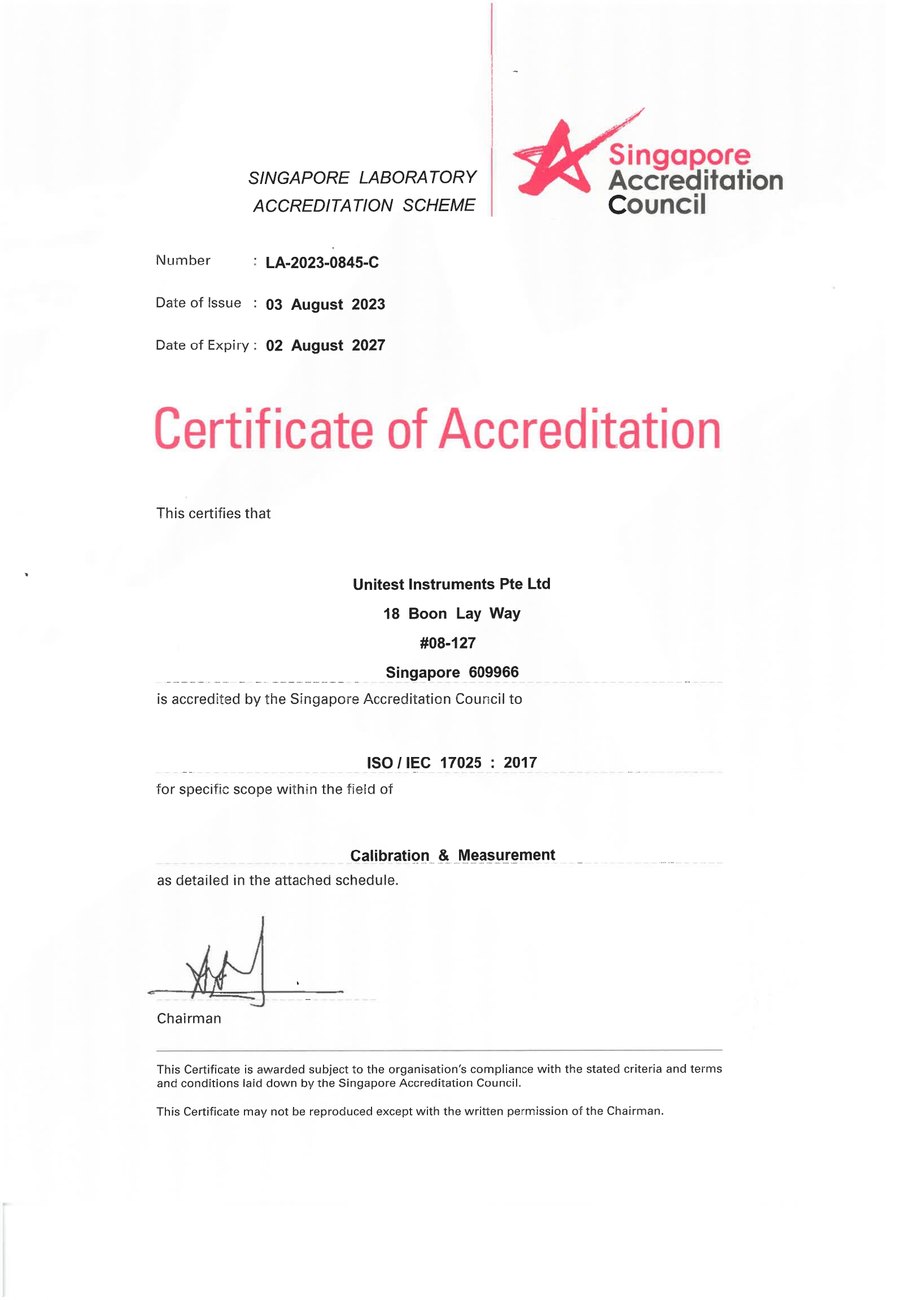
SAC-SINGLAS accredited calibration laboratory (Acc. No. LA-2023-0845-C) serving Singapore's industrial, pharmaceutical, and manufacturing sectors. All content reflects our ISO/IEC 17025 accredited scope and is reviewed by our technical calibration team.
Need conductivity meter calibration in Singapore?
Unitest Instruments is SAC-SINGLAS accredited (Acc. No. LA-2023-0845-C) to ISO/IEC 17025. Same-week turnaround, certificates accepted by ISO 9001 auditors.