
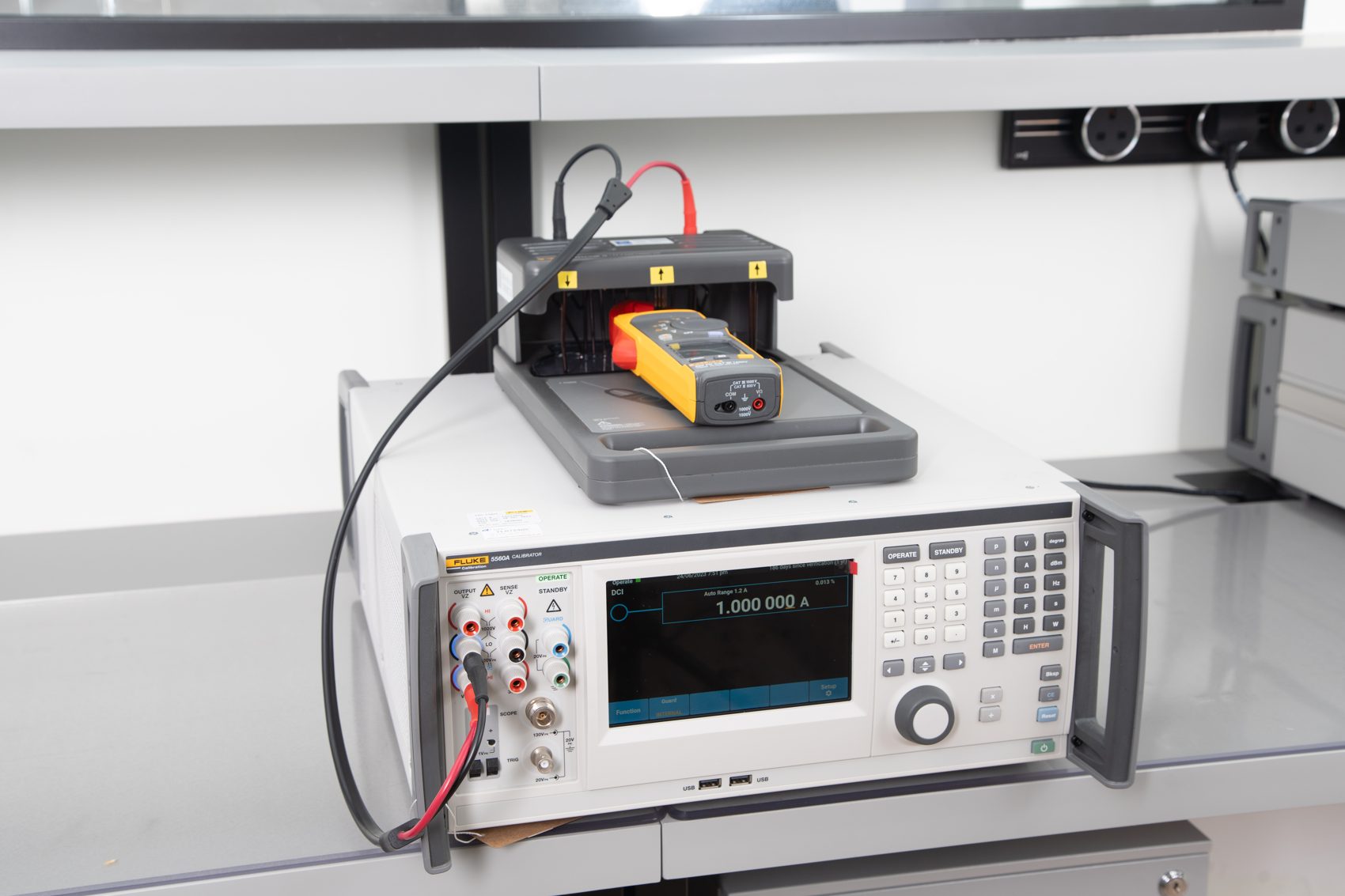
Key Takeaways
- Accuracy requirements differ significantly between laboratory (±0.01 pH) and field (±0.02–0.05 pH) applications. Match the instrument to the task.
- Singapore's NEA trade effluent regulations and SS EN ISO 10523 both expect traceable calibration; a factory certificate is not sufficient for compliance audits.
- Electrode quality often matters more than meter electronics. Invest in the correct electrode type for your sample matrix (low-ionic, high-protein, high-temperature, etc.).
- A SAC-SINGLAS accredited calibration from Unitest Instruments gives you a certificate accepted by ISO 9001 and ISO 17025 auditors across Singapore.
- New instruments should be calibrated before first use; annual recalibration (or more frequent for regulated measurements) is the industry norm.
Who Needs a pH Meter in Singapore?
pH measurement sits at the heart of a surprisingly wide range of industries operating in Singapore. Pharmaceutical manufacturers in Tuas and Jurong must monitor buffer pH for API synthesis and final product QC under guidelines aligned with the Health Sciences Authority (HSA) and international GMP frameworks. Water treatment and NEA-licensed trade effluent dischargers must verify that outflows fall within the prescribed pH window (typically 6.0 to 9.0), before discharge into the public sewer network.
Food and beverage producers rely on pH to control fermentation, confirm food safety compliance under Singapore Food Agency (SFA) regulations, and extend shelf life. Environmental consultants sample groundwater, stormwater, and soil leachate across Singapore's industrial sites, where portable field meters are essential. Semiconductor fabs, PCB manufacturers, and chemical distributors in Jurong Island round out the picture. Often requiring continuous in-line pH monitoring rather than batch grab-sampling.
Each of these contexts has distinct requirements for accuracy, ruggedness, electrode chemistry, and calibration traceability. The model that excels in a university research lab is not necessarily the right choice for a field technician collecting samples in Singapore's tropical heat and humidity.
What to Look for When Buying a pH Meter
Accuracy and Resolution
Accuracy (how close the reading is to the true value) and resolution (the smallest increment the display can show) are related but different. A benchtop meter with ±0.002 pH accuracy and 0.001 pH resolution is appropriate for pharmaceutical QC. A portable meter rated at ±0.02 pH with 0.01 pH resolution is perfectly adequate for environmental monitoring. Buying more accuracy than you need wastes money; buying less can invalidate your data in an audit.
Temperature Compensation
pH is strongly temperature-dependent, approximately 0.003 pH units per °C near pH 7. Automatic Temperature Compensation (ATC) corrects for this in real time using a built-in or external temperature probe. In Singapore, where ambient and sample temperatures can range from 20°C (air-conditioned labs) to 40°C+ (outdoor field sites or process streams), ATC is non-negotiable for any serious measurement.
Electrode Compatibility and Sample Matrix
The glass electrode is the consumable heart of any pH system. Different electrode types are designed for different matrices: combination electrodes with a porous ceramic junction for general water samples, low-maintenance gel-filled electrodes for field use, and specialised electrodes for high-protein samples (food, fermentation broth) or non-aqueous solvents. Always verify that the electrode you pair with a meter is rated for your sample type. A mismatch is the most common cause of drifting or erratic readings.
IP Rating and Ruggedness
For Singapore field work, look for at least IP54 (splash-proof) on the meter body, and ideally IP67 (submersion to 1 m for 30 minutes) for the probe. High humidity degrades exposed connectors; a sealed BNC or proprietary digital connector (like Hach's Intellical or WTW's IDS system) significantly extends service life in tropical conditions.
Data Logging and Connectivity
For regulated laboratories, the ability to log data with a timestamp and export to LIMS or Excel is increasingly important. USB, Bluetooth, and Ethernet connectivity are standard on benchtop instruments. Portable meters increasingly support Bluetooth to smartphone apps, enabling real-time data capture without paper field sheets.
Top pH Meters Available in Singapore. Comparison
The following models represent the most widely specified pH meters across Singapore's laboratory, pharmaceutical, food, and environmental sectors. All are available through Unitest or its distribution network, and all can be submitted for SAC-SINGLAS accredited calibration.
| Model | Type | Accuracy | IP Rating | Price Range (SGD) | Best For |
|---|---|---|---|---|---|
| Hach HQ430d | Benchtop / Portable | ±0.002 pH | IP67 (probe) | S$1,200–1,800 | Water/wastewater labs, NEA compliance |
| Mettler-Toledo FiveEasy Plus FP20 | Benchtop | ±0.001 pH | IP54 (bench) | S$900–1,400 | Pharma QC, research, GMP labs |
| WTW Multi 3630 IDS | Portable / Field | ±0.005 pH | IP67 | S$1,400–2,000 | Environmental field sampling, multi-parameter |
| Hach sensION+ PH1 | Benchtop | ±0.002 pH | IP54 | S$600–900 | General lab, food & beverage, education |
| Comark C9555 | Portable / Pen | ±0.05 pH | IP67 | S$200–400 | Food safety spot checks, HACCP monitoring |
Price ranges are indicative and subject to change. Contact unitestshop.com for current Singapore pricing and availability.
Model Deep-Dives
Hach HQ430d. Best All-Rounder for Singapore Water Labs
The Hach HQ430d is arguably the most widely deployed pH benchtop meter in Singapore's water and wastewater sector, and for good reason. Its Intellical digital electrode system eliminates manual entry of calibration data. The probe stores its own calibration history, blank values, and GLP records. The meter accepts pH, dissolved oxygen, conductivity, and turbidity probes interchangeably, making it a genuinely multi-parameter platform rather than just a pH meter.
For NEA compliance testing, the HQ430d's audit trail capabilities are particularly valuable: every reading is stamped with a user ID, date, time, and the most recent calibration data, which can be exported directly to USB. Its IP67-rated probe withstands the daily reality of Singapore field and workshop environments. Browse the Hach HQ Series at unitestshop.com.
Mettler-Toledo FiveEasy Plus FP20. Pharmaceutical and Research Standard
When regulatory grade matters (USP <791>, EP 2.2.3, GMP batch records), the Mettler-Toledo FiveEasy Plus FP20 is the benchtop meter that Singapore's pharmaceutical sector reaches for. Its ±0.001 pH accuracy, multi-point calibration (up to 5 buffer points), and built-in GLP data logging make it straightforwardly audit-ready. The colour-coded calibration status indicator gives technicians immediate visual confirmation that the system is within specification, reducing transcription error and operator risk.
Mettler-Toledo's InLab electrode range covers virtually every sample matrix, from ultra-pure water (which requires a low-ionic-strength electrode) to viscous fermentation broths. This flexibility makes the FP20 a long-term investment rather than a single-use instrument.
WTW Multi 3630 IDS. Top Choice for Environmental Field Work
Environmental consultants and industrial hygienists working across Singapore's Jurong, Tuas, and Changi industrial corridors consistently favour the WTW Multi 3630 IDS for its combination of genuine laboratory-grade accuracy (±0.005 pH) in an IP67-rated portable body. The IDS (Intelligent Digital Sensor) electrode system digitises calibration at the probe head, eliminating the signal degradation of long cable runs. Critical when sampling deep boreholes or process vessels.
The Multi 3630 supports simultaneous pH, dissolved oxygen, conductivity, and turbidity measurement, which is particularly relevant for SS 211 (Water Quality. Monitoring of Freshwater) and NEA stormwater sampling protocols that require multiple parameters from a single sample event.
Get your pH meter calibrated before first use
A factory calibration certificate is not the same as accredited calibration. Unitest Instruments issues SAC-SINGLAS accredited pH calibration certificates traceable to NMC Singapore. Accepted by NEA, HSA, and ISO 9001 auditors. Same-week turnaround available.
Singapore Standards and Regulatory Context
pH measurement in Singapore sits within a structured regulatory framework that differs depending on your industry. Understanding which standard governs your measurements determines both the instrument specification you need and the calibration traceability required.
SS EN ISO 10523 (Water Quality. Determination of pH) is the primary standard for water testing in Singapore, aligned with the international ISO 10523. It specifies buffer preparation, temperature correction, electrode conditioning, and the requirement for two-point calibration bracketing the measurement range. Calibration traceability to a national standard is explicitly required.
NEA Trade Effluent Regulations set a pH discharge limit of 6.0 to 9.0 for trade effluent into the public sewer, with on-site monitoring obligations for major dischargers. Self-monitoring data submitted to NEA must be collected with instruments that have traceable calibration. A factory certificate does not satisfy this requirement.
Singapore Food Agency (SFA) guidelines for food manufacturers reference CODEX methods and AOAC protocols, which specify pH measurement for acidified foods, beverages, and pH-controlled products. HACCP-based systems require documented instrument verification records.
For a deeper understanding of what traceability means in the context of Singapore's calibration hierarchy, see our article on what is traceability in calibration. And if you are unsure whether an accredited or non-accredited calibration certificate will satisfy your auditor, our article on accredited vs non-accredited calibration sets out the differences clearly.
Calibrating Your pH Meter After Purchase
One of the most common mistakes Singapore laboratories make is assuming that a new pH meter from a reputable manufacturer is ready to use straight out of the box for regulated measurements. It is not. The factory calibration (if a certificate is supplied at all), is performed at the point of manufacture, not at your facility, and is not traceable to Singapore's National Metrology Centre (NMC) unless the manufacturer explicitly states this and provides an accredited certificate.
For any measurement that will be used to demonstrate compliance with NEA regulations, HSA or GMP requirements, ISO 9001/14001 quality systems, or customer specifications, you need an accredited calibration certificate issued by a SAC-SINGLAS accredited laboratory. Unitest Instruments holds SAC-SINGLAS accreditation (Acc. No. LA-2023-0845-C) to ISO/IEC 17025 for pH measurement, meaning our calibration certificates carry formal recognition by Singapore's national accreditation body.
The calibration process involves presenting your pH meter and electrode system to our laboratory, where we measure its response against reference buffer solutions whose pH values are traceable to NMC. We calculate the measurement uncertainty of your instrument, document any bias or correction factors, and issue a certificate that gives you (and your auditor), full confidence in your data. For more on what a calibration certificate should contain, see our article on understanding your calibration certificate.
Electrode Maintenance in Singapore's Tropical Climate
Singapore's year-round heat and humidity create specific challenges for pH electrode maintenance. Glass electrodes rely on a hydrated gel layer on the glass membrane; if the electrode dries out (even briefly), this layer is disrupted and readings become sluggish or erratic. Always store electrodes in storage solution (typically pH 4 buffer or proprietary KCl solution), never in distilled water and never dry.
The reference junction (the porous plug or sleeve that allows electrical contact between the reference electrolyte and the sample), is the most maintenance-sensitive part of the electrode. In Singapore's high-humidity environment, fungal or bacterial growth inside refillable reference electrolyte chambers can block the junction and cause reference potential drift. Sealed, gel-filled reference systems are significantly more reliable in tropical conditions and are strongly recommended for field use.
Inspect electrodes monthly for cracks, clouding of the glass membrane, or discolouration of the junction. A well-maintained combination electrode should give 12–18 months of reliable service in a laboratory setting; field electrodes may need replacement every 6–9 months depending on sample exposure.
Understanding Electrode Slope and Offset: The Numbers Behind the Reading
Most modern pH meters display a slope and offset value after each calibration, and understanding what these numbers mean is genuinely useful for deciding whether an electrode is still fit for service or quietly approaching the end of its useful life, rather than waiting for a reading to become obviously wrong.
Slope describes how much the electrode's millivolt output changes per pH unit, expressed as a percentage of the theoretical (Nernstian) value of approximately 59.16 mV per pH unit at 25°C. A brand-new, healthy electrode typically calibrates to 95–105% of theoretical slope. As the glass membrane ages, the gel layer degrades, or the reference junction becomes partially blocked, slope gradually declines, and most manufacturers and quality systems flag an electrode for replacement once slope falls below roughly 90–92%, since a low-slope electrode becomes progressively less responsive to genuine pH changes and produces measurements that appear stable but are actually compressed toward the calibration buffer values. Offset (or the electrode's zero-point, or asymmetry potential) indicates how far the electrode's actual response at pH 7 deviates from the theoretical zero millivolt reading, and a large or rapidly changing offset between successive calibrations is often the earliest sign of a failing reference junction, even before the slope itself has degraded noticeably.
Tracking slope and offset over successive calibrations, rather than only checking whether the electrode passed or failed the immediate calibration, gives a laboratory a genuine early-warning trend line for electrode health. Many benchtop meters, including the Hach HQ430d and Mettler-Toledo FP20 discussed above, log this history automatically and can flag a declining trend before the electrode actually fails a calibration outright, a genuinely useful feature for labs managing electrode replacement budgets proactively rather than reactively.
Troubleshooting Common pH Measurement Problems in Singapore
A handful of measurement problems recur often enough across Singapore's laboratories and field teams that they are worth recognising quickly rather than assuming a full electrode replacement is always the answer.
- Slow response, drifting reading that never fully settles: most often a dehydrated or coated glass membrane. Soaking the electrode in fresh storage solution for several hours, or gently cleaning a protein or oil coating with the appropriate cleaning solution for the sample matrix, often restores normal response before assuming the electrode has failed outright.
- Reading jumps or is erratic in low-ionic-strength samples: a common issue when a standard electrode is used on deionised or reverse-osmosis water, since low-ionic samples cannot properly complete the electrical circuit through a standard reference junction. A dedicated low-ionic-strength electrode, designed with a different junction geometry, resolves this.
- Consistent offset that reappears after each recalibration: often points to a reference junction problem (blockage, contamination, or depleted electrolyte in refillable electrodes) rather than a genuine sample issue, particularly if the offset is similar in magnitude across different sample types.
- Buffer calibration passes but sample readings seem implausible: check that the sample temperature is within the electrode's rated range and that ATC is correctly connected and functioning, since a failed or disconnected temperature probe silently defaults to a fixed assumed temperature on many meters, introducing a systematic error that a routine buffer calibration would not catch.
When troubleshooting does not resolve the issue within a reasonable number of attempts, sending the complete meter-and-electrode system to an accredited laboratory for a full diagnostic calibration is more cost-effective than continuing to guess in the field, particularly when the readings in question feed into a compliance record or a batch release decision where the cost of an undetected measurement error far exceeds the cost of the calibration visit itself. A laboratory that regularly calibrates the same instrument population, such as Unitest, also builds up a useful history of that specific meter and electrode combination's typical behaviour, making it easier to distinguish a genuine new fault from a known, previously documented quirk of that particular instrument.
Frequently Asked Questions
For general laboratory use, a pH meter with ±0.01 pH accuracy is the standard minimum. High-precision work (such as pharmaceutical QC, NEA-regulated water testing, or research under ISO 17025 protocols), typically requires ±0.002 pH or better. Benchtop meters from brands like Hach, Mettler-Toledo, and WTW achieve this level. Field meters are generally rated at ±0.02 to ±0.05 pH, which is acceptable for environmental monitoring and process control in Singapore's industrial sites.
Yes. Even new pH meters should be calibrated before use, particularly if the readings will be used to demonstrate compliance with regulatory standards (e.g. NEA discharge limits, SS EN ISO 10523, or pharmaceutical USP requirements). A factory calibration certificate from the manufacturer does not constitute accredited calibration. For audit-ready traceability, you need a SAC-SINGLAS accredited calibration certificate traceable to Singapore's National Metrology Centre (NMC). Unitest Instruments provides this service with same-week turnaround available.
Benchtop pH meters are designed for controlled laboratory environments. They offer higher accuracy (±0.001–0.01 pH), larger displays, multi-parameter capability, and data logging via USB or Ethernet. Portable pH meters are battery-operated, ruggedised, and designed for field sampling. Such as NEA stormwater monitoring, food factory floor checks, or aquaculture sites. The trade-off is slightly lower accuracy and fewer connectivity options. In Singapore, many users buy one of each: a benchtop as the reference standard and a portable for day-to-day site work.
The primary standard for pH measurement of water in Singapore is SS EN ISO 10523 (Water Quality, determination of pH). For wastewater and trade effluent, the NEA's Trade Effluent Regulations set pH discharge limits (typically 6–9) and specify measurement methods. Pharmaceutical manufacturers must comply with USP <791> or EP 2.2.3. All of these frameworks expect that measuring instruments have traceable calibration certificates. Ideally from a SAC-SINGLAS accredited laboratory such as Unitest Instruments.
For most laboratory applications in Singapore, pH electrodes should be calibrated with buffer solutions before each use (daily or per shift). The instrument itself (the pH meter), should undergo formal traceable calibration at least annually, or more frequently if it is used for regulated measurements such as pharmaceutical batch release or NEA compliance. If the electrode is replaced, the system should be re-verified. Our detailed article on how often to calibrate your instruments provides a framework for setting intervals based on measurement risk.
Some mid-range meters (e.g. Hach HQ Series or WTW Multi 3630) are designed as hybrid instruments. Sufficiently accurate for laboratory reference work yet robust enough for field conditions. However, if your laboratory operates under ISO 17025 or GLP requirements, regulators and auditors may expect dedicated laboratory equipment with documented uncertainty budgets. Using a single instrument across both environments requires a robust cleaning and verification protocol between uses to prevent cross-contamination.
The most common calibration buffers are pH 4.00, 7.00, and 10.00 at 25°C. NIST-traceable buffers are strongly preferred for any regulated measurement. In Singapore's humid climate, buffer sachets or sealed ampoules are more reliable than open reagent bottles, which absorb CO2 and drift over time. Always check the expiry date and store unused buffers as per the manufacturer's instructions. Buffers used for accredited-scope measurements should themselves have a certificate of analysis traceable to NMC.
Unitest Instruments is a SAC-SINGLAS accredited calibration laboratory (Acc. No. LA-2023-0845-C) serving Singapore's laboratory, pharmaceutical, and industrial sectors. You can browse pH meters and related water quality instruments at unitestshop.com, and arrange accredited calibration through our service team. We offer same-week turnaround on most pH meter calibration jobs, and our certificates are accepted by ISO 9001 and ISO 17025 auditors across Singapore.
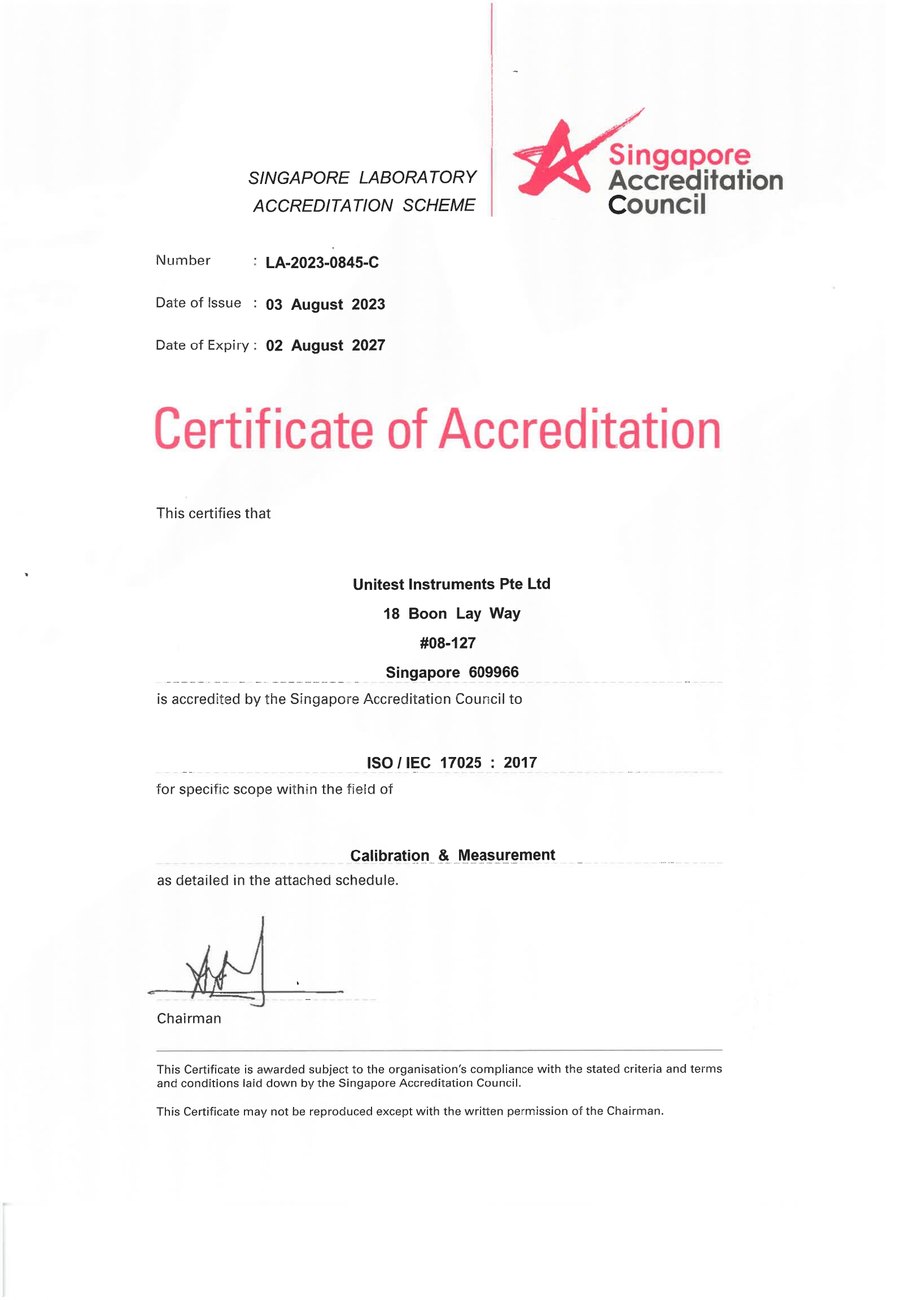
SAC-SINGLAS accredited calibration laboratory (Acc. No. LA-2023-0845-C) serving Singapore's industrial, pharmaceutical, and manufacturing sectors. All content reflects our ISO/IEC 17025 accredited scope and is reviewed by our technical calibration team.
Need pH meter calibration in Singapore?
Unitest Instruments is SAC-SINGLAS accredited (Acc. No. LA-2023-0845-C) to ISO/IEC 17025. Same-week turnaround, certificates accepted by ISO 9001 auditors.