
Key Takeaways
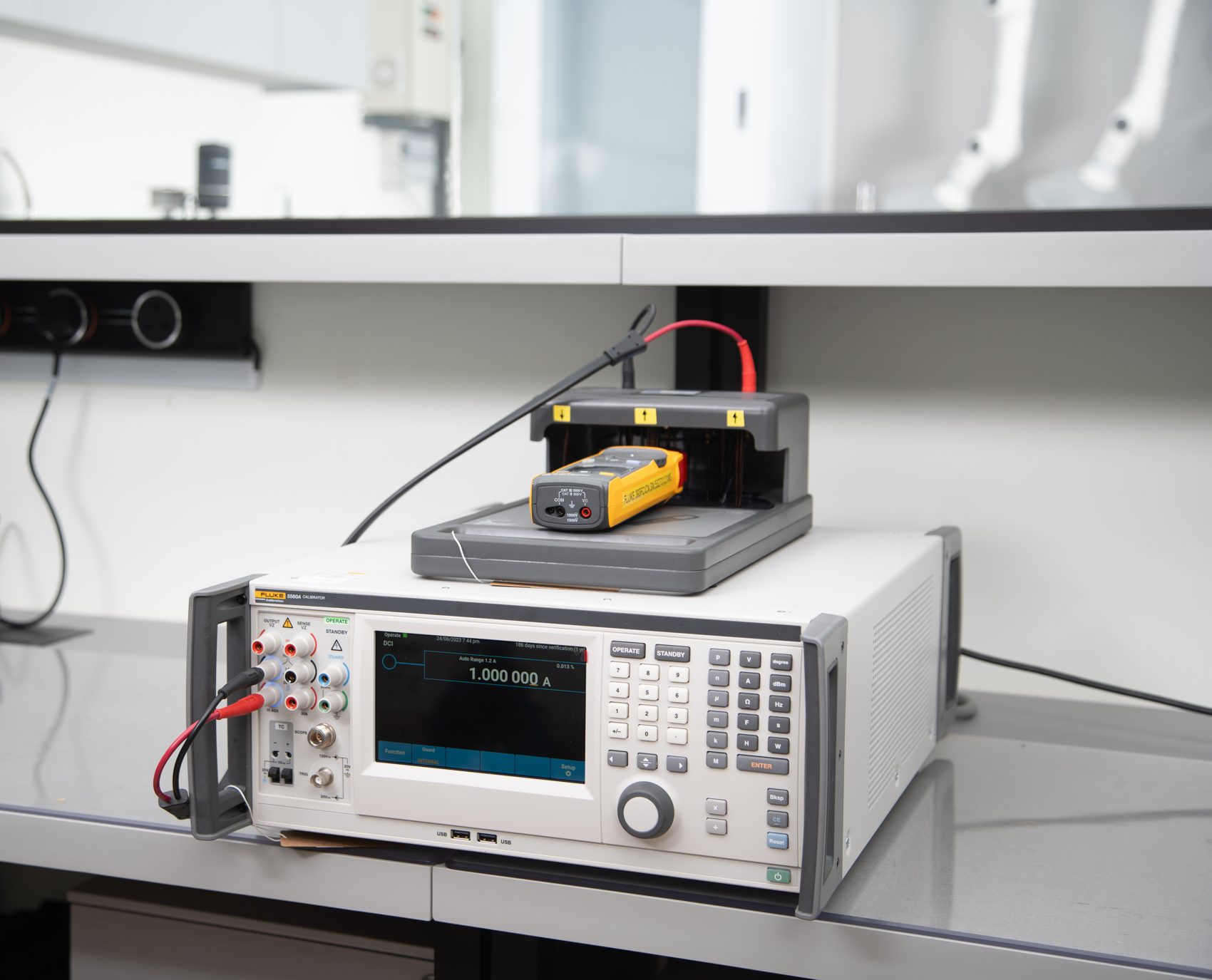
- Calibration uses certified saturated salt solutions (LiCl, MgCl₂, NaCl, K₂SO₄) as reference standards. Aw values are temperature-dependent and must be corrected at the actual calibration temperature.
- A valid ISO/IEC 17025 certificate must state expanded measurement uncertainty (U) at k=2. Certificates without uncertainty values are non-conforming and will fail external audits.
- Food labs under SFA HACCP should calibrate annually with quarterly user verification; pharmaceutical labs under HSA GMP should calibrate every 6 months.
- Singapore's high ambient humidity (average RH 80–84%) accelerates capacitance-sensor drift. Calibration intervals tighter than in temperate climates are recommended.
- SAC-SINGLAS accreditation (Acc. No. LA-2023-0845-C) means the laboratory's measurement results are internationally recognised under the ILAC Mutual Recognition Arrangement.
- Field salt-point checks by the operator do not replace accredited calibration. They supplement it between formal calibration cycles.
What Is Water Activity and Why Does Accurate Measurement Matter?
Water activity (aw) is the ratio of the vapour pressure of water in a product to the vapour pressure of pure water at the same temperature. It is expressed on a scale of 0 (bone dry) to 1.0 (pure water). Unlike total moisture content, water activity describes how available the water is for microbial growth, enzymatic reactions, and chemical deterioration. This makes it a primary safety and shelf-life parameter in food manufacturing and pharmaceutical production.
In food science, most spoilage bacteria cannot grow below aw 0.91, and most moulds are inhibited below aw 0.70. Regulatory frameworks including Singapore's Food Hygiene Regulations and HACCP certification schemes therefore treat water activity as a Critical Control Point (CCP) measurement. In pharmaceuticals, ICH Q6A and BP/USP monographs specify aw limits for solid dosage forms, excipients, and active ingredients. Errors in aw measurement can compromise product stability, potency, and patient safety.
An uncalibrated or out-of-tolerance water activity meter introduces systematic error into every aw reading it produces. A meter reading aw 0.840 when the true value is aw 0.870 could cause a food manufacturer to release a product that is actually at risk. One reason that Singapore's SFA auditors and ISO 22000 certification bodies require traceable calibration records for all measuring equipment at CCPs.
How Water Activity Meter Calibration Works: The Salt-Point Method
The universally accepted method for calibrating water activity meters is the saturated salt solution method. A saturated salt solution (one in which excess solid salt is present), maintains a known, stable equilibrium relative humidity (ERH) above its surface at a given temperature. When the headspace above this solution is sealed in a small chamber containing the meter's sensor, the instrument reads the equilibrium humidity and displays it as aw.
Reference Salt Standards and Their aw Values
Calibration laboratories use multiple certified reference salts to span the instrument's measurement range. The most commonly used salts and their approximate aw values at 25°C are:
| Salt Solution | aw at 25°C (approx.) | Typical Application Range | Notes |
|---|---|---|---|
| Lithium Chloride (LiCl) | 0.113 | Very dry products: crackers, powders, freeze-dried | Strong temperature dependence; precise temp control essential |
| Magnesium Chloride (MgCl₂) | 0.328 | Low-moisture products: nuts, cereals, dried fruit | Stable; widely used as lower calibration point |
| Magnesium Nitrate (Mg(NO₃)₂) | 0.529 | Mid-range check point | Useful for instruments used across the full range |
| Sodium Chloride (NaCl) | 0.753 | Cured meats, cheese, seafood, soft confectionery | Most stable and reproducible; primary upper-mid point |
| Potassium Sulphate (K₂SO₄) | 0.973 | High-moisture products; sensor linearity check | Near-saturation; sensitive to temperature variation |
All aw values are temperature-dependent. The accredited laboratory applies published temperature correction equations (NIST data or equivalent) based on the measured calibration temperature, and this corrected reference value appears on the calibration certificate. Unitest's laboratory maintains temperature stability of ±0.1°C during calibration to minimise this source of uncertainty.
Step-by-Step Calibration Procedure
A calibration at Unitest's SAC-SINGLAS accredited laboratory (Acc. No. LA-2023-0845-C) follows a documented procedure aligned with ISO/IEC 17025:2017. The instrument is first visually inspected and cleaned if necessary. It is then allowed to equilibrate to the laboratory's controlled temperature environment, typically 25°C ± 0.5°C. The reference salt solutions, prepared from certified-purity salts with traceability documented to NMC Singapore, are introduced to the instrument's measurement chamber sequentially from the lowest to highest aw point. At each point, the instrument's displayed reading is recorded once equilibrium is confirmed (indicated by a stable reading over successive measurement cycles). The error at each point (displayed value minus reference value), is calculated, and if the error exceeds the instrument's specification or the laboratory's acceptance limit, an adjustment or offset correction is applied. Finally, all readings, corrections, and the expanded measurement uncertainty are documented on the calibration certificate.
Need your water activity meter calibrated with a traceable certificate?
Unitest issues SAC-SINGLAS calibration certificates (Acc. No. LA-2023-0845-C) accepted by SFA, HSA, ISO 22000, and ISO 9001 auditors. Same-week turnaround available for most instruments.
Field Verification vs. Accredited Laboratory Calibration
It is important to distinguish between two types of checks that users perform on water activity meters. Field verification (also called user verification or in-situ check) is a quick, single-point salt solution check that the operator performs in-house. Full laboratory calibration is a multi-point procedure conducted by an accredited laboratory that produces a formal traceable certificate.
| Feature | Field Verification (User Check) | Accredited Lab Calibration (Unitest) |
|---|---|---|
| Performed by | Operator / in-house QC technician | ISO/IEC 17025 accredited laboratory |
| Number of calibration points | 1 (single salt capsule) | 2–4 points across the measurement range |
| Reference standard traceability | Manufacturer's salt capsule (may or may not be traceable) | Certified reference standards traceable to NMC Singapore |
| Measurement uncertainty stated | No | Yes. Required by ISO/IEC 17025:2017 clause 7.8 |
| Certificate issued | No formal certificate | SAC-SINGLAS calibration certificate (Acc. No. LA-2023-0845-C) |
| Acceptable for external audits | No. Supplementary record only | Yes. Accepted by SFA, HSA, ISO 22000, ISO 9001 |
| Recommended frequency | Monthly or before critical production runs | Every 6–12 months depending on industry |
| Cost | Low (salt capsule cost only) | Moderate. Justified by audit compliance value |
The two approaches are complementary, not competing. Best practice in Singapore's food and pharmaceutical industries is to conduct accredited calibration on the formal schedule, and use field verification checks in between to catch any sudden sensor drift before it affects production decisions. As explained in our guide on accredited vs non-accredited calibration, only a SAC-SINGLAS certificate provides the legal and contractual standing required for regulatory compliance in Singapore.
What a Valid Calibration Certificate Must Show
Under ISO/IEC 17025:2017 clause 7.8, a calibration certificate issued by an accredited laboratory must contain specific information. Many laboratories (particularly non-accredited ones), omit measurement uncertainty, which is a non-conformance that will be flagged by any competent auditor. Before accepting a calibration certificate for your water activity meter, verify that it contains all of the following elements.
- Laboratory name, address, and SAC-SINGLAS accreditation number, for Unitest, this is Acc. No. LA-2023-0845-C.
- Instrument identification. Make, model, serial number, and asset number if applicable.
- Reference standards used. Each salt solution with its certified aw value, temperature correction applied, and its own traceability chain to NMC Singapore or a national metrology institute.
- Calibration temperature, stated to ±0.1°C; critical because aw values of salt solutions vary with temperature.
- Results at each calibration point. Reference value, instrument reading, and error (correction).
- Expanded measurement uncertainty (U). Stated at k=2 (95% confidence level). This is the most commonly missing item on non-accredited certificates.
- Calibration date and next recommended calibration date.
- Authorised signatory. The technically competent person who reviewed and approved the results.
- Statement of accreditation scope conformance. Confirming the calibration is within the laboratory's accredited scope.
For a detailed explanation of what each element on a calibration certificate means and how to interpret it, see our article on how to read a calibration certificate.
Calibration Intervals: How Often Should You Calibrate?
Calibration interval recommendations for water activity meters depend on the industry sector, the criticality of the measurement, instrument type, and (critically in Singapore), the ambient humidity environment. Singapore's year-round tropical humidity (average 80–84% RH, peaking at over 90% RH during monsoon periods) is significantly harsher for humidity and water activity sensors than the temperate conditions assumed by most international instrument manufacturers when setting default calibration intervals.
Recommended Intervals by Sector
Food manufacturing (SFA / HACCP): Accredited calibration every 12 months is the minimum for most SFA-audited food factories, supported by a formal documented user verification check at every new salt batch or at least quarterly. For high-throughput facilities or CCPs with tight aw specifications (e.g. baked goods targeting aw 0.86 ± 0.01), a 6-month calibration cycle is advisable.
Pharmaceutical manufacturing (HSA GMP / GLP): HSA's Guidance Notes on GMP for pharmaceutical manufacturers require all critical measuring instruments to be calibrated at defined intervals with records retained. For water activity meters used in active ingredient or finished product release testing, a 6-month calibration cycle is the industry norm, with monthly user checks. Some organisations adopt a risk-based approach per ISPE's calibration guidance, which can extend or shorten intervals based on historical drift data.
Research and quality control laboratories: Annual calibration is typical, with user checks before each measurement campaign. Instruments used intermittently or stored for extended periods should be verified before use even if the calibration date has not expired.
On-site / portable instruments used in field conditions: Portable aw meters used in food safety audits, warehouse inspections, or field quality checks are exposed to more variable conditions. These instruments should be calibrated every 6 months and user-verified before each deployment.
Our detailed guide on how to determine the right calibration interval explains how to use historical drift data and measurement risk to justify your chosen interval in an audit context.
Singapore Regulatory Context: SFA, HSA, and AVA Requirements
Water activity measurement sits at the intersection of several Singapore regulatory frameworks. Understanding which requirements apply to your facility is essential for designing a compliant calibration programme.
Singapore Food Agency (SFA): Under the Sale of Food Act and the Environmental Public Health Act, food businesses are required to ensure food safety through proper controls. For FSMS-certified facilities and HACCP-audited plants, water activity meters used at CCPs must have documented calibration records. SFA auditors typically expect traceable calibration certificates, not just field verification logs. The SFA-recognised food safety standards (including Singapore Standard SS 590 (FSMS) and Codex HACCP), require that all measuring and monitoring equipment be calibrated or verified at specified intervals against measurement standards traceable to international or national measurement standards.
Health Sciences Authority (HSA): Pharmaceutical manufacturers licensed under the Medicines Act are subject to HSA's GMP guidelines, which align with the PIC/S Guide to GMP. Chapter 6 (Quality Control) requires that instruments, including water activity meters, be calibrated at defined intervals according to written procedures. Calibration certificates must be retained as part of the batch manufacturing record. HSA GMP inspectors are trained to check that calibration traceability is documented to NMC or an equivalent national standards body.
AVA / ESG-certified agri-food producers: Facilities under the Singapore Food Story R&D Programme and ESG-supported agri-food producers operating under Good Agricultural Practice (GAP) or Good Aquaculture Practice (GAP) frameworks are expected to maintain calibrated measurement equipment where food safety parameters are monitored.
ISO 22000 and FSSC 22000 certification bodies: Third-party certification bodies auditing against ISO 22000:2018 clause 8.7 (monitoring and measuring) require calibration evidence for all instruments used to monitor food safety parameters. Non-traceable calibration records are a common non-conformance finding in ISO 22000 surveillance audits in Singapore.
Why Sensors Drift Faster in Singapore Than in Temperate Markets
Most water activity meters sold into Singapore are engineered and default-calibrated by manufacturers based in temperate climates, where ambient relative humidity rarely exceeds 60–65% except in short seasonal spikes. Singapore's ambient RH sits at 80–84% for most of the year and regularly exceeds 90% during the Northeast Monsoon (December to March). This has a direct, measurable effect on sensor life and drift rate that is worth understanding before you set a calibration interval based on a manufacturer's default recommendation written for a different climate.
Capacitive Polymer Sensors
The majority of benchtop and portable water activity meters use a capacitive polymer humidity sensor as the core measurement element. The polymer film absorbs and releases water vapour in proportion to the surrounding relative humidity, and the instrument measures the resulting change in capacitance. In a chronically high-humidity environment, the polymer stays closer to saturation for longer periods between uses, which accelerates hysteresis (the sensor's tendency to lag or offset depending on its recent exposure history) and shortens the effective service life of the sensing film. Laboratories operating in Singapore's climate typically see capacitive sensors drift out of tolerance 20–40% faster than the manufacturer's stated interval assumes, which is the practical reason most SAC-SINGLAS accredited labs recommend 6-month rather than 12-month cycles for high-usage instruments.
Chilled-Mirror Dew-Point Sensors
Chilled-mirror instruments measure aw by cooling a mirror surface until condensation forms and detecting that dew point optically, which is a fundamentally different (and inherently more stable) physical principle than capacitive absorption. These instruments are less sensitive to ambient humidity exposure history, but they carry their own tropical-climate failure mode: mirror contamination. Volatile compounds released by fatty, oily, or alcohol-containing samples (cured meats, essential oil-infused products, fermented foods, and certain pharmaceutical excipients) condense onto the mirror surface alongside water vapour and are not fully removed by standard cleaning cycles. A contaminated mirror reads systematically low, and the drift is often mistaken for calibration error rather than a maintenance issue. Routine mirror cleaning per the manufacturer's schedule, combined with the standard calibration interval, is what actually corrects this class of drift, not more frequent calibration alone.
Practical Steps to Extend Sensor Life Between Calibrations
Three habits meaningfully reduce drift-driven recalibration and unplanned instrument downtime in a Singapore facility. First, store the instrument in its supplied protective case with the manufacturer's desiccant when not in daily use, rather than leaving it on an open bench where ambient humidity continuously cycles the sensor. Second, avoid measuring high-VOC or high-fat samples back-to-back with routine low-moisture samples without an intervening sensor purge or cleaning cycle, since cross-contamination between samples is one of the most common causes of an otherwise "in-calibration" instrument producing readings that do not match a reference method. Third, run the manufacturer's single-point field verification check weekly rather than monthly if the instrument sees daily production use, since a sensor approaching the end of its service life typically shows a slow, trackable drift over several weeks before it fails a formal calibration outright, giving you time to schedule recalibration before it affects a production release decision.
Choosing Between Sensor Technologies for a Singapore Food or Pharma Lab
Not every facility needs the same instrument technology, and the right choice affects both your calibration cost and your calibration interval. Capacitive polymer instruments are the most widely deployed because they are compact, relatively low-cost, and fast (typically 5–15 minutes per reading), which suits high-throughput QC environments doing dozens of samples a shift. Their trade-off is the tropical-climate drift sensitivity described above, and slightly wider measurement uncertainty at the extremes of the aw range. Chilled-mirror dew-point instruments cost more and read more slowly, but they deliver tighter uncertainty (often half that of a capacitive instrument) and are the preferred technology for pharmaceutical stability testing, reference-method verification, and any application where the aw specification tolerance is narrow, for example a finished dosage form with a hard aw ceiling written into its registration dossier. Resistive electrolytic sensors, a third and less common technology, sit between the two on both cost and performance and are mostly found in older or lower-cost instruments still in service at some Singapore facilities; these tend to show the fastest drift of the three technologies in continuous tropical use and, in our experience calibrating instruments across the industry, are the ones most likely to fail an accredited calibration outright rather than simply requiring an offset correction. If your facility is selecting a new instrument, matching the technology to your actual specification tolerance and sample matrix, rather than defaulting to the cheapest capacitive unit, will materially reduce both calibration frequency and the risk of an out-of-tolerance finding during a critical production run.
Frequently Asked Questions
During water activity meter calibration, the instrument is verified against two or more certified saturated salt solutions with known water activity (aw) values at controlled temperature. The technician records the instrument's displayed aw against the reference standard values, calculates the error at each salt point, and documents the expanded measurement uncertainty. Adjustment or offset correction is applied if the error exceeds the manufacturer's specification or the laboratory's acceptance criteria. A SAC-SINGLAS accredited calibration certificate (Acc. No. LA-2023-0845-C) is then issued showing all readings, corrections, and traceability to NMC Singapore.
The most widely used saturated salt solutions for water activity calibration are: lithium chloride (LiCl) at approximately aw 0.113, magnesium chloride (MgCl₂) at approximately aw 0.328, sodium chloride (NaCl) at approximately aw 0.753, and potassium sulphate (K₂SO₄) at approximately aw 0.973, all at 25°C. The exact aw values are temperature-dependent and must be corrected for the ambient temperature during calibration. Unitest uses certified reference salt standards whose traceability is documented back to NMC Singapore.
For food manufacturing facilities subject to SFA (Singapore Food Agency) or HACCP requirements, calibration at least every 12 months is standard practice, with a user verification salt-point check performed every 3 months or before critical production runs. Pharmaceutical laboratories operating under HSA Good Manufacturing Practice (GMP) or ICH Q6A guidelines typically calibrate every 6 months. High-frequency users in humid Singapore conditions (where ambient moisture can affect sensor response), should perform user checks monthly and full accredited calibration every 6 to 12 months.
A valid ISO/IEC 17025 calibration certificate for a water activity meter must include: the laboratory's accreditation number (e.g. SAC-SINGLAS LA-2023-0845-C), the instrument make, model, and serial number, the reference standard(s) used and their traceability chain, the aw reference values at each calibration point, the instrument's displayed values, the error at each point, the expanded measurement uncertainty (U) at a stated coverage factor (typically k=2, 95% confidence), the calibration temperature, the calibration date and next due date, and the authorised signatory. Certificates lacking measurement uncertainty are non-conforming under ISO/IEC 17025:2017 clause 7.8.
Singapore's SFA (Singapore Food Agency) requires food businesses operating under the Food Hygiene Regulations and FSMS to ensure measuring equipment is calibrated and maintained. The HSA (Health Sciences Authority) requires pharmaceutical manufacturers under GMP guidelines to calibrate all critical instruments including water activity meters. ISO 22000 and HACCP certification bodies operating in Singapore mandate documented calibration records with traceability. While no single regulation names "water activity meters" by model type, any instrument used to make a safety-critical measurement must have traceable calibration records.
Field verification (also called user verification or in-situ check) is a quick salt-point check performed by the operator using a single certified salt solution capsule. It confirms the meter is reading within acceptable limits but does not produce a SAC-SINGLAS calibration certificate and has no formal traceability documentation. Full accredited calibration, performed by an ISO/IEC 17025 laboratory like Unitest, uses multiple certified reference standards, produces a formal certificate with measurement uncertainty, and provides the traceable documentation required by ISO 9001 auditors, SFA inspectors, and HSA GMP assessors.
Unitest calibrates water activity meters from all major manufacturers including AQUALAB (Decagon/Meter Group), Novasina, Rotronic, Testo, Aqua Lab, and Lufft instruments. Our SAC-SINGLAS scope (Acc. No. LA-2023-0845-C) covers humidity and water activity measurement. We can also advise on whether your instrument is due for replacement versus recalibration if sensor degradation is detected. Contact us to confirm your specific model is within our current accredited scope.
Typical expanded measurement uncertainty (k=2) for water activity calibration using certified saturated salt solutions is in the range of ±0.003 aw to ±0.008 aw, depending on the calibration point, the ambient temperature stability during calibration, and the instrument type. Instruments with chilled-mirror dew-point technology generally achieve lower uncertainty than capacitance-based sensors. Your Unitest calibration certificate will state the specific uncertainty value for your instrument and each calibration point, as required by ISO/IEC 17025:2017.
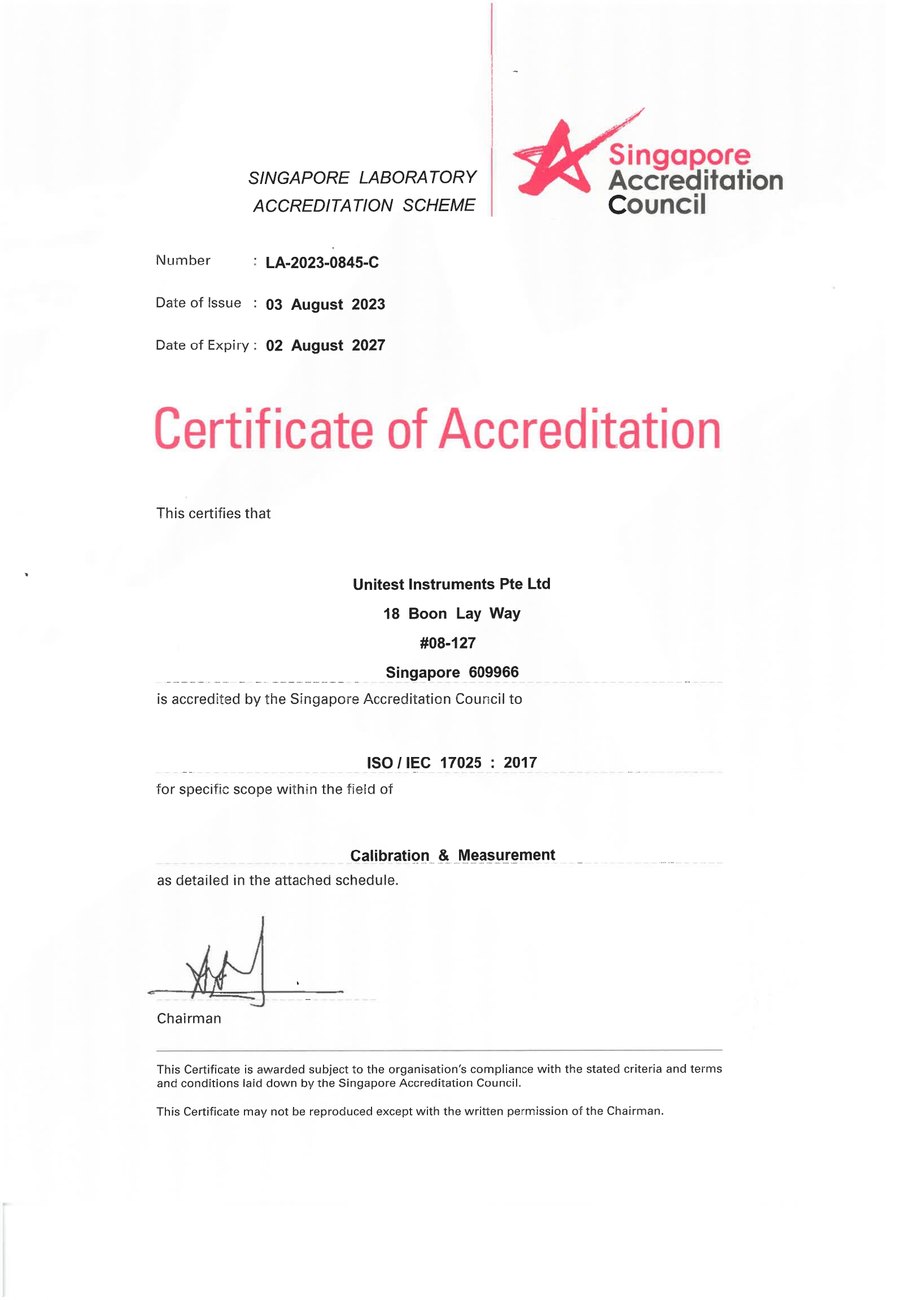
SAC-SINGLAS accredited calibration laboratory (Acc. No. LA-2023-0845-C) serving Singapore's industrial, pharmaceutical, and manufacturing sectors. All content reflects our ISO/IEC 17025 accredited scope and is reviewed by our technical calibration team.
Need water activity meter calibration in Singapore?
Unitest Instruments is SAC-SINGLAS accredited (Acc. No. LA-2023-0845-C) to ISO/IEC 17025. Same-week turnaround, certificates accepted by SFA, HSA, ISO 22000, and ISO 9001 auditors.