
Key Takeaways
- Conductivity is the primary electrochemical measurement; TDS is always a derived, approximate value calculated from conductivity using a sample-specific conversion factor.
- All conductivity values must be referenced to 25°C. Temperature compensation is mandatory, as conductivity rises approximately 2% per °C in most natural waters.
- The probe's cell constant (K, in cm⁻¹) must be traceable and periodically recertified. Drift in K causes proportional systematic error in every reading.
- Singapore's SS 333:2018 sets a 250 µS/cm conductivity guideline and 500 mg/L TDS limit for drinking water; pharmaceutical purified water must be ≤1.3 µS/cm at 25°C (USP <645>).
- Ultrapure water absorbs atmospheric CO₂ within minutes of exposure, raising conductivity from below 0.1 µS/cm to above 1 µS/cm. Samples must be measured in a closed system or immediately.
What Conductivity and TDS Actually Measure
Electrical conductivity (EC) quantifies a solution's ability to transmit an alternating electrical current between two electrodes. When ionic compounds dissolve in water (salts, acids, bases, metallic compounds), they dissociate into positively and negatively charged ions. These mobile ions are the charge carriers. A sample with more dissolved ions carries more current; a sample with fewer carries less. The relationship is direct and, within normal ionic strength ranges, approximately linear.
The SI unit for conductance is the siemen (S), and because conductivity is a property normalised per unit length and area of the measurement cell, the practical unit becomes siemens per metre (S/m). For water testing, this is far too large: drinking water typically ranges from 50 to 500 µS/cm, ultrapure pharmaceutical water sits below 0.1 µS/cm, and seawater reaches approximately 53,000 µS/cm (53 mS/cm). The reciprocal of conductivity is resistivity, expressed in ohm-metres (Ω·m) or, for high-purity applications, megohm-centimetres (MΩ·cm). Absolutely pure water at 25°C has a theoretical resistivity of 18.18 MΩ·cm, corresponding to a conductivity of 0.0550 µS/cm. A value achievable only momentarily under tightly controlled laboratory conditions.
Total Dissolved Solids (TDS), by contrast, is not an electrochemical measurement. It is a gravimetric concept: the mass of all dissolved material remaining after a water sample is filtered (to remove suspended solids) and evaporated to dryness at 180°C per ASTM D5907. In practice, this gravimetric procedure is slow and impractical for routine monitoring. The near-universal alternative is to measure conductivity and multiply by a factor (the TDS factor), to approximate the dissolved mass. This factor varies from approximately 0.4 (for waters dominated by calcium bicarbonate) to 0.9 (for waters with high sulphate or chloride content), with 0.5 and 0.67 being common defaults for mixed natural waters. The important implication: a TDS reading from a conductivity meter is always an estimate whose accuracy depends on how well the assumed ionic composition matches the actual sample.
The Physics and Chemistry Behind the Measurement
Conductivity measurement relies on Ohm's Law applied to the solution between the probe electrodes. An alternating current (AC) (not DC), is applied at a frequency typically between 1 kHz and 10 kHz to prevent polarisation of the electrodes. The instrument measures the resulting current and computes resistance, then converts resistance to conductance using the cell constant.
The cell constant (K) is the ratio of the effective distance between electrodes (L) to their effective cross-sectional area (A), expressed in cm⁻¹:
K = L / A
A cell with K = 1.0 cm⁻¹ is a standard general-purpose probe. For ultrapure or deionised water (below 10 µS/cm), a low cell-constant probe (K = 0.01–0.1 cm⁻¹) is used to maximise signal. For concentrated process streams or wastewater (above 200 mS/cm), a high cell-constant probe (K = 10–50 cm⁻¹) is required to prevent electrode saturation. The conductivity of the sample is then:
σ = K / R
where R is the measured resistance in ohms and σ is conductivity. If K drifts (due to electrode fouling, scaling, corrosion, or mechanical deformation), every reading becomes proportionally incorrect without any visible instrument fault. This is why traceable calibration of the cell constant is not optional; it is the foundation of valid measurement.
Temperature Dependence
Ion mobility in solution increases with temperature as viscosity decreases. For most natural waters, conductivity rises by approximately 1.9–2.1% per degree Celsius. This means a sample at 30°C will read roughly 10% higher than the same sample at 25°C. All internationally recognised standards (including ISO 7888, ASTM D1125, and SS 333), specify reporting conductivity at a reference temperature of 25°C. Temperature compensation is either applied automatically by the instrument using a stored temperature coefficient (TC, expressed as %/°C), or corrected manually using the formula:
σ₂₅ = σ_T / [1 + TC × (T − 25)]
For high-purity water, the relationship between conductivity and temperature is nonlinear and the simple linear correction introduces unacceptable error. Standards such as USP <645> and ASTM D5391 specify the use of non-linear temperature correction algorithms derived from the Kohlrausch relationship. Many modern laboratory conductivity meters include selectable compensation modes (linear, natural water, and pure-water), and the operator must select the correct mode for the application.
Need traceable conductivity or water quality meter calibration in Singapore?
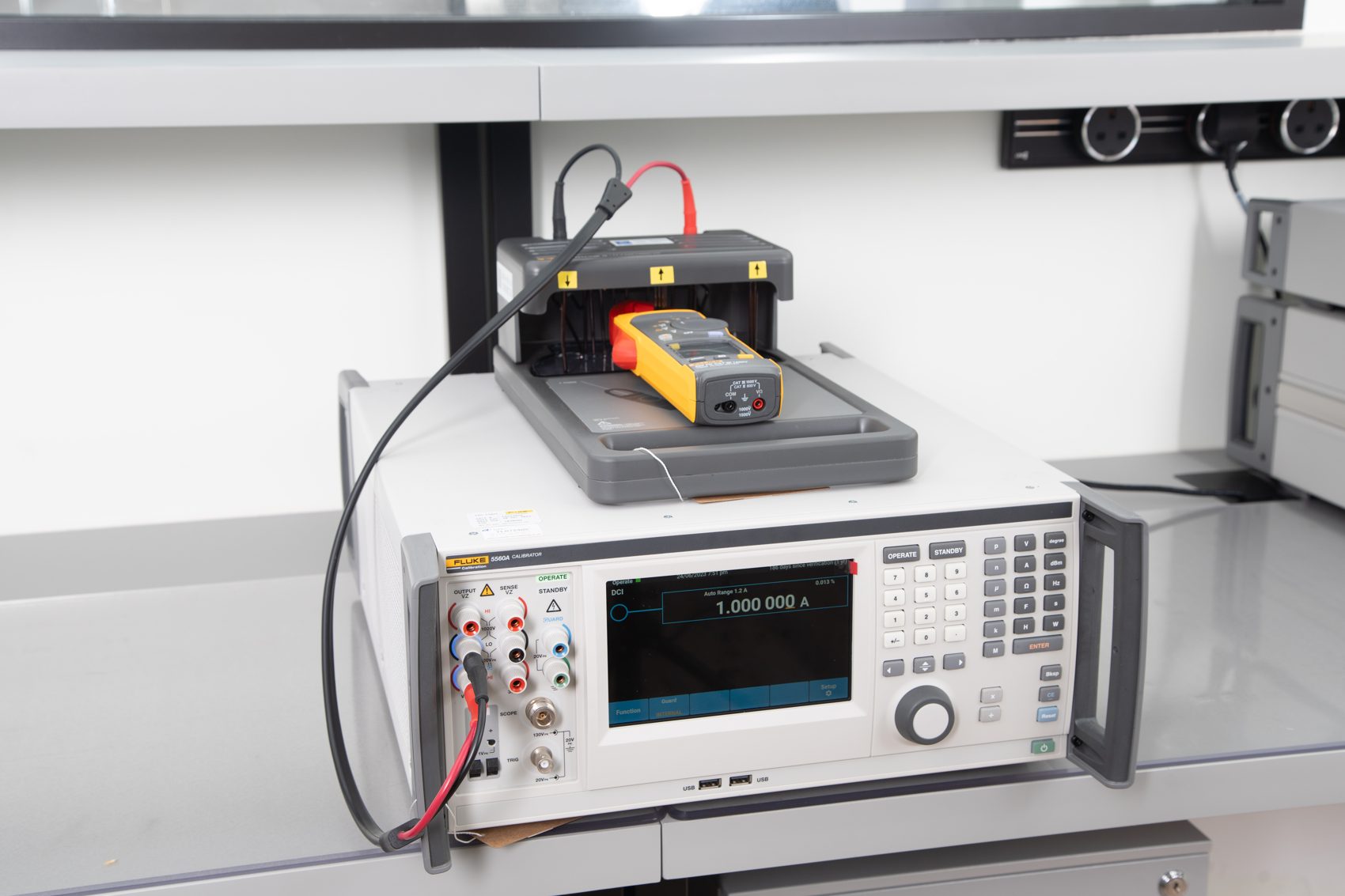
Unitest Instruments calibrates conductivity meters, TDS meters, and reference standard solutions with full traceability to Singapore's NMC. Certificates accepted by ISO 9001 and GMP auditors.
Applicable Standards and Regulatory Requirements
Conductivity measurement in water testing is governed by a layered framework of international and national standards. Understanding which standard applies to your application is essential for audit compliance.
| Standard | Scope | Reference Temperature | Key Requirement |
|---|---|---|---|
| ISO 7888:1985 | Natural, treated, and drinking water | 25°C | Cell constant verified with KCl reference solution; report corrected to 25°C |
| ASTM D1125 | Electrical conductivity and resistivity of water | 25°C | Two methods: A (referee, up to 100 µS/cm); B (routine, ≥1 µS/cm) |
| ASTM D5907 | Filterable and nonfilterable residue (gravimetric TDS) | 180°C evaporation | Gravimetric primary method; conductivity-derived TDS is an approximation |
| SS 333:2018 | Singapore drinking water quality | 25°C | Conductivity ≤250 µS/cm; TDS ≤500 mg/L; tests by PUB-recognised labs |
| USP <645> | Pharmaceutical purified water and WFI | Multiple (stage-dependent) | Purified water ≤1.3 µS/cm at 25°C; WFI ≤1.1 µS/cm at 20°C; 3-stage test |
| ASTM D1193 | Reagent-grade water (Types I–IV) | 25°C | Type I: ≤0.056 µS/cm; Type II: ≤1.0 µS/cm; Type III: ≤0.25 µS/cm; Type IV: ≤5.0 µS/cm |
| IEC 60746-3 | Electrolytic conductivity measurement instruments | 25°C | Performance requirements for on-line and laboratory analysers |
Singapore Regulatory Context
In Singapore, PUB (the national water authority) is the primary enforcer of water quality for potable supply. The standard SS 333:2018 adopts the WHO drinking water guidelines and adds locally relevant parameters. For industrial water users (food manufacturers, pharmaceutical manufacturers, semiconductor fabs), the applicable standards are sector-specific: the Health Sciences Authority (HSA) enforces USP/Ph. Eur. limits for pharmaceutical water, while the Singapore Food Agency (SFA) governs food-process water quality. Environmental discharge is regulated by PUB's Trade Effluent Regulations, which set conductivity-correlated parameters for wastewater discharged to the sewer network.
Any laboratory conducting water testing for third parties, or producing results used in regulatory submissions, must operate under an accreditation framework. In Singapore, this means SAC-SINGLAS accreditation to ISO/IEC 17025. An accredited calibration certificate (such as those issued by Unitest Instruments under Acc. No. LA-2023-0845-C), provides the documented traceability chain required by ISO 9001, GMP, and regulatory auditors. For more on what this means in practice, see our article on accredited versus non-accredited calibration.
Measurement Methods: Laboratory vs. Field
Conductivity measurement falls into two broad categories: laboratory benchtop analysis, which prioritises accuracy and traceability; and field or in-line measurement, which prioritises speed and continuity.
Laboratory Benchtop
A laboratory conductivity meter consists of a high-precision impedance measurement circuit connected to a two- or four-electrode cell. Four-electrode (or multi-electrode) cells are preferred for high-accuracy work because they eliminate polarisation errors at the measurement electrodes by using separate current-injection and voltage-sensing electrode pairs. The sample is typically placed in a beaker or flow-through cell, allowed to stabilise at a controlled temperature, and read after equilibration. Calibration is performed using certified reference standard solutions. Typically potassium chloride (KCl) at defined concentrations. The most common reference points are:
- 0.01 mol/L KCl: 1413 µS/cm at 25°C (NIST Standard Reference Material 3191)
- 0.1 mol/L KCl: 12,880 µS/cm at 25°C
- 1.0 mol/L KCl: 111,800 µS/cm at 25°C
- Ultrapure water / ASTM Type I water: ≤0.056 µS/cm at 25°C (cell validation point)
The calibration solution must be selected to bracket the expected sample range. Using a 1413 µS/cm standard to validate a meter measuring 0.1 µS/cm pure water samples introduces large relative uncertainty. The signal of interest is 14,000 times smaller than the calibration point.
In-Line and Field Measurement
Process industries (water treatment plants, semiconductor ultrapure water systems, pharmaceutical manufacturing), rely on continuous in-line conductivity sensors installed directly in the process pipework. These sensors require robust housing (typically stainless steel or PEEK), pressure and temperature ratings matching the process, and a calibration verification schedule defined in the site's instrument management plan. Field instruments used in environmental sampling (rivers, reservoirs, coastal monitoring) are typically portable multiparameter probes that measure conductivity alongside pH, dissolved oxygen, and turbidity.
Field instruments present specific calibration challenges: they are transported, exposed to variable temperatures, and subject to fouling. Best practice requires verifying the instrument against a traceable reference solution at the start and end of each sampling campaign, with a mid-campaign check if the campaign extends beyond one day. Any reading with a pre- or post-campaign verification error exceeding the instrument's stated accuracy specification should be flagged and may require resampling.
Calibration Implications and Measurement Uncertainty
Calibration of a conductivity meter establishes the relationship between the instrument's indicated value and the true value of the measurand, with a stated uncertainty. For an accredited calibration, this uncertainty is calculated in accordance with the GUM (Guide to the Expression of Uncertainty in Measurement, JCGM 100:2008) and must be traceable to national measurement standards, in Singapore, the National Metrology Centre (NMC) at A*STAR.
The major contributors to measurement uncertainty in conductivity testing are:
- Cell constant uncertainty: The cell constant K is determined by measuring a reference solution of known conductivity. Any uncertainty in the reference solution's conductivity value propagates directly into K.
- Temperature measurement uncertainty: Because conductivity changes at 2%/°C, a temperature sensor with ±0.1°C uncertainty introduces approximately ±0.2% uncertainty in the temperature-corrected conductivity value.
- Reference solution uncertainty: Certified reference solutions have a stated conductivity with an associated uncertainty (typically ±0.5–1.0% at a 95% confidence level). This is irreducible.
- Electrode fouling and drift: Contamination of electrode surfaces between calibrations is a systematic error source that calibration alone cannot fully eliminate. Procedural controls (cleaning protocols, blanks, carry-over checks) are essential companions to calibration.
- Sample handling: CO₂ absorption, evaporation, and temperature changes during sample transport alter the measured conductivity of the actual sample, independent of the instrument's calibration state.
A well-maintained laboratory conductivity measurement chain (traceable calibration, temperature-controlled sample handling, four-electrode cell, certified reference standards), can achieve expanded measurement uncertainty (k=2, 95% confidence) of approximately ±0.5% for the mid-range (1–1000 µS/cm). Ultrapure water measurements below 0.1 µS/cm are significantly harder, with uncertainties of ±5–10% achievable under best-practice conditions. Understanding and reporting measurement uncertainty is not bureaucratic overhead. It is the information that tells the end user whether the measured value is compliant or not.
For a detailed treatment of how measurement uncertainty is calculated and reported on calibration certificates, see our article on measurement uncertainty explained.
Common Mistakes in Conductivity and TDS Testing
Despite the apparent simplicity of conductivity measurement, systematic errors are widespread in industrial and environmental testing programmes. The most consequential are described here so they can be avoided.
1. Wrong Calibration Range
Calibrating a meter with a 1413 µS/cm standard solution and then measuring samples at 0.5 µS/cm is a multi-order-of-magnitude extrapolation. The meter's reading at 0.5 µS/cm is effectively uncalibrated. Always select a reference standard that brackets your expected sample range, ideally within one decade (10×) of the measurement point.
2. Ignoring CO₂ Uptake in High-Purity Water
Deionised, reverse-osmosis, or distilled water absorbs atmospheric CO₂ rapidly. CO₂ dissolves to form carbonic acid, which partially dissociates to bicarbonate and hydrogen ions. All of which are mobile ionic species. A sample of ASTM Type I water (≤0.056 µS/cm) left exposed to air will exceed 1 µS/cm within 5–10 minutes at room temperature. Measure high-purity samples immediately, in a closed or nitrogen-blanketed system, and never assume a stored open sample represents the original water.
3. Applying the Wrong TDS Conversion Factor
The TDS conversion factor is not a universal constant. It depends on the specific ionic species present. Using a default factor of 0.5 for a groundwater sample dominated by calcium sulphate (appropriate factor ~0.8) will underestimate TDS by 37.5%. For regulatory compliance testing, gravimetric TDS (ASTM D5907) must be used if the ionic composition is unknown or variable. Conductivity-derived TDS is acceptable for routine process monitoring when the water chemistry is stable and the factor has been validated against the gravimetric method.
4. Not Accounting for Probe Fouling in Industrial Applications
Process water containing suspended particles, oils, biological matter, or scale-forming ions will coat and foul the probe electrodes over time. Fouling increases apparent resistance, causing the meter to under-read conductivity. Regular physical cleaning and periodic cell-constant reverification against a traceable reference are the controls. In pharmaceutical manufacturing, a documented cleaning validation for conductivity probes may be required.
5. Misinterpreting TDS as a Safety Metric
Low TDS does not equal safe water, and high TDS does not necessarily mean unsafe water. TDS measures total dissolved ions. It does not distinguish between beneficial minerals (calcium, magnesium) and harmful contaminants (lead, arsenic, nitrate). A water sample could have TDS of 50 mg/L but contain 50 µg/L of arsenic (well above the WHO guideline of 10 µg/L). Conductivity and TDS are screening parameters for water quality monitoring, not comprehensive safety assessments.
Frequently Asked Questions
Conductivity is a direct electrochemical measurement of a water sample's ability to carry an electrical current, expressed in microsiemens per centimetre (µS/cm) or millisiemens per centimetre (mS/cm). TDS (Total Dissolved Solids) is a derived value. It is calculated by multiplying the measured conductivity by a conversion factor (typically 0.5 to 0.7, depending on the ionic composition of the water). Conductivity is the primary, instrument-measured quantity; TDS is an approximation inferred from it and expressed in milligrams per litre (mg/L) or parts per million (ppm). For regulatory purposes, gravimetric TDS (ASTM D5907) is the reference method; conductivity-derived TDS is an acceptable approximation for routine monitoring.
Conductivity is reported in siemens per metre (S/m) in SI terms, but practical water testing uses microsiemens per centimetre (µS/cm) for low-conductivity samples such as purified or drinking water, and millisiemens per centimetre (mS/cm) for higher-conductivity process or wastewater samples. TDS is expressed in milligrams per litre (mg/L), which is numerically equivalent to parts per million (ppm) at normal water densities. For ultrapure water, resistivity in megohm-centimetres (MΩ·cm) is the preferred unit. Pure water at 25°C has a theoretical resistivity of 18.18 MΩ·cm (conductivity of 0.055 µS/cm). All values are referenced to 25°C per ISO 7888 and ASTM D1125.
Key standards include: ASTM D1125 (Standard Test Methods for Electrical Conductivity and Resistivity of Water), ISO 7888 (Water quality. Determination of electrical conductivity), and for Singapore specifically, SS 333:2018 (Singapore Standard for drinking water quality). The IEC 60746-3 standard covers electrolytic conductivity measurement instrument performance. Pharmaceutical-grade water must comply with USP <645> and Ph. Eur. 2.2.38. All instruments used in accredited testing must be calibrated against traceable reference standards under ISO/IEC 17025.
The conductivity of any ionic solution increases significantly with temperature, typically by 1.5% to 2.5% per degree Celsius for most natural waters, and up to 5% per °C for high-purity water. Without temperature compensation, a reading taken at 30°C will be roughly 10–15% higher than the same sample measured at 25°C, leading to false compliance or non-compliance decisions. Instruments either automatically compensate to the reference temperature of 25°C (per ISO 7888 and ASTM D1125) using a built-in temperature coefficient, or report both the actual reading and the temperature-corrected value. Pure-water applications use a non-linear temperature compensation model because pure water's conductivity–temperature relationship is not linear.
Calibration frequency depends on how the instrument is used. For accredited laboratory work under ISO/IEC 17025, annual calibration by an accredited provider is the minimum; high-frequency or critical process monitoring warrants 6-monthly calibration. Field instruments used in environmental sampling should be verified against a traceable reference solution before each measurement campaign. The cell constant (K) of the probe must also be verified regularly, as it drifts due to fouling, coating, or physical damage. A risk-based approach (considering usage frequency, instrument stability history, and the consequences of out-of-tolerance readings), should drive the final interval decision.
The cell constant (K) describes the geometry of the conductivity probe. Specifically the ratio of the effective distance between the electrodes to the effective electrode area, expressed in cm⁻¹. A cell with K = 1.0 cm⁻¹ is a general-purpose probe; K = 0.1 cm⁻¹ suits ultrapure water; K = 10 cm⁻¹ suits high-conductivity wastewater or process streams. If the cell constant drifts due to fouling or electrode wear and is not recertified, every subsequent reading will be systematically wrong by a proportional factor. Traceable calibration establishes the true cell constant value, which the meter uses as a correction factor to convert raw resistance into conductivity.
Singapore's national drinking water quality standard SS 333:2018 sets a conductivity guideline value of 250 µS/cm for tap water supplied by PUB, based on WHO Guidelines for Drinking-water Quality (4th edition). The TDS limit under SS 333 is 500 mg/L. PUB's NEWater (high-grade reclaimed water) is typically below 50 µS/cm. For industrial cooling water, boiler feedwater, and pharmaceutical purified water, the limits are set by application-specific standards: USP <645> requires pharmaceutical purified water at ≤1.3 µS/cm at 25°C, and Water for Injection (WFI) must be ≤1.1 µS/cm at 20°C under Ph. Eur. 2.2.38.
The five most frequent errors are: (1) Not allowing the sample to equilibrate to a stable temperature before reading, causing temperature-compensation errors. (2) Using a probe with a fouled or contaminated electrode surface without cleaning or verification. (3) Calibrating with a standard solution at the wrong conductivity range for the sample, for example, using a 1413 µS/cm standard to measure ultrapure water at 0.1 µS/cm introduces large uncertainty. (4) Ignoring CO₂ absorption. Ultrapure or deionised water rapidly absorbs atmospheric CO₂ and its conductivity rises from below 0.1 µS/cm to above 1 µS/cm within minutes of exposure to air. (5) Applying an incorrect TDS conversion factor: the factor varies from 0.4 to 0.9 depending on ionic composition, and using a generic default on an incompatible water chemistry will yield significantly inaccurate TDS estimates.
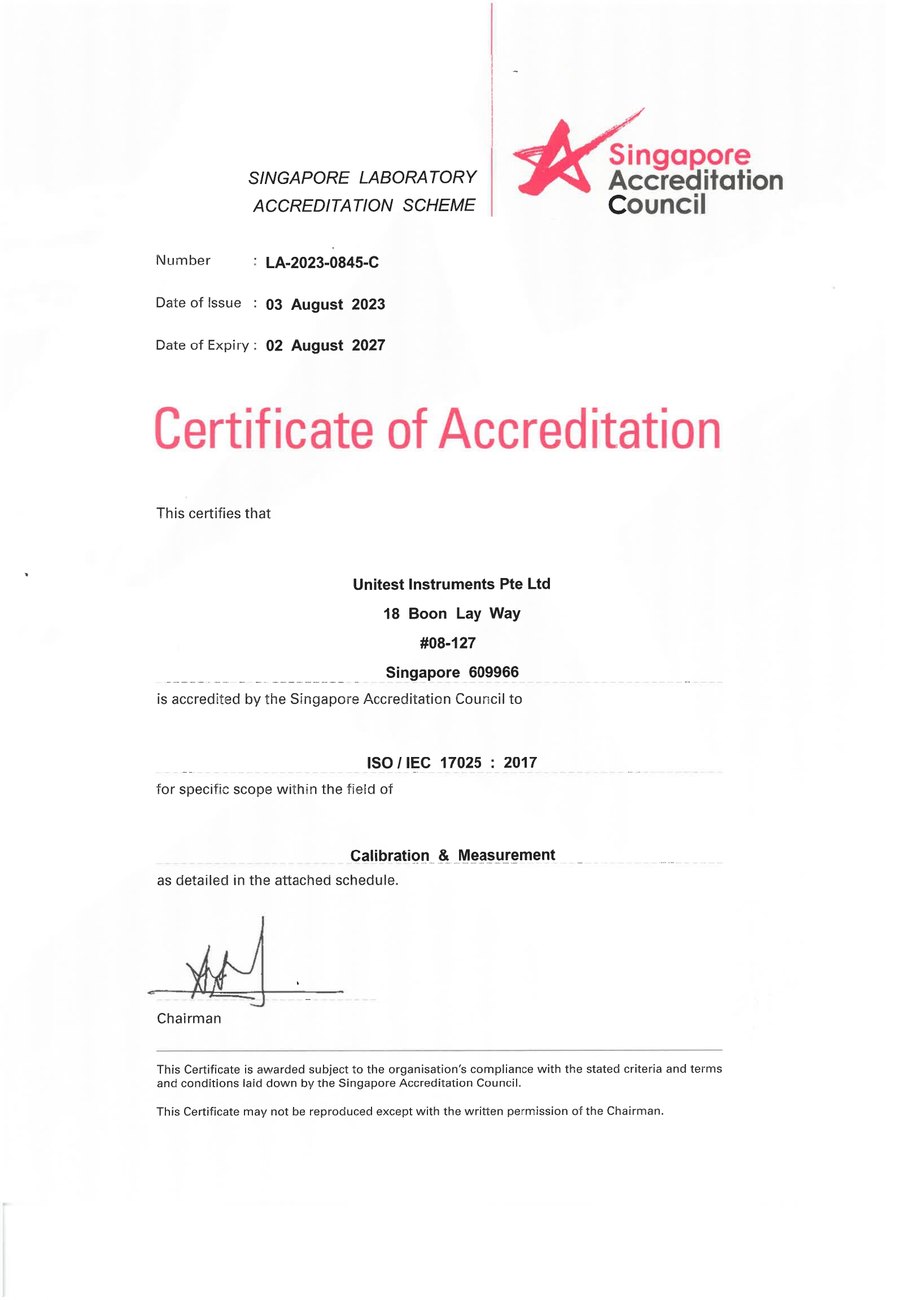
SAC-SINGLAS accredited calibration laboratory (Acc. No. LA-2023-0845-C) serving Singapore's industrial, pharmaceutical, and manufacturing sectors. All content reflects our ISO/IEC 17025 accredited scope and is reviewed by our technical calibration team.
Need conductivity or water quality meter calibration in Singapore?
Unitest Instruments is SAC-SINGLAS accredited (Acc. No. LA-2023-0845-C) to ISO/IEC 17025. Same-week turnaround, certificates accepted by ISO 9001 auditors.