
Key Takeaways
- Span gas concentration should be 50–80% of the instrument's full-scale range and supplied with a NMC-traceable certificate of analysis.
- CO meters for confined space entry require laboratory calibration every 6 months under MOM WSH Confined Spaces Regulations; CO₂ IAQ meters are typically calibrated annually.
- A valid calibration certificate must state measurement uncertainty, the traceability chain, and carry the SAC-SINGLAS mark (Acc. No. LA-2023-0845-C) to satisfy ISO 9001 auditors.
- A bump test is not a calibration. It verifies alarm function only and does not produce a compliant certificate.
- CO and CO₂ calibrations differ: CO sensors use electrochemical cells sensitive to cross-gas interference; CO₂ sensors use NDIR optics requiring temperature and pressure compensation.
- Field calibration can supplement but cannot replace accredited laboratory calibration for regulatory compliance in Singapore.
What Happens During CO and CO₂ Meter Calibration?
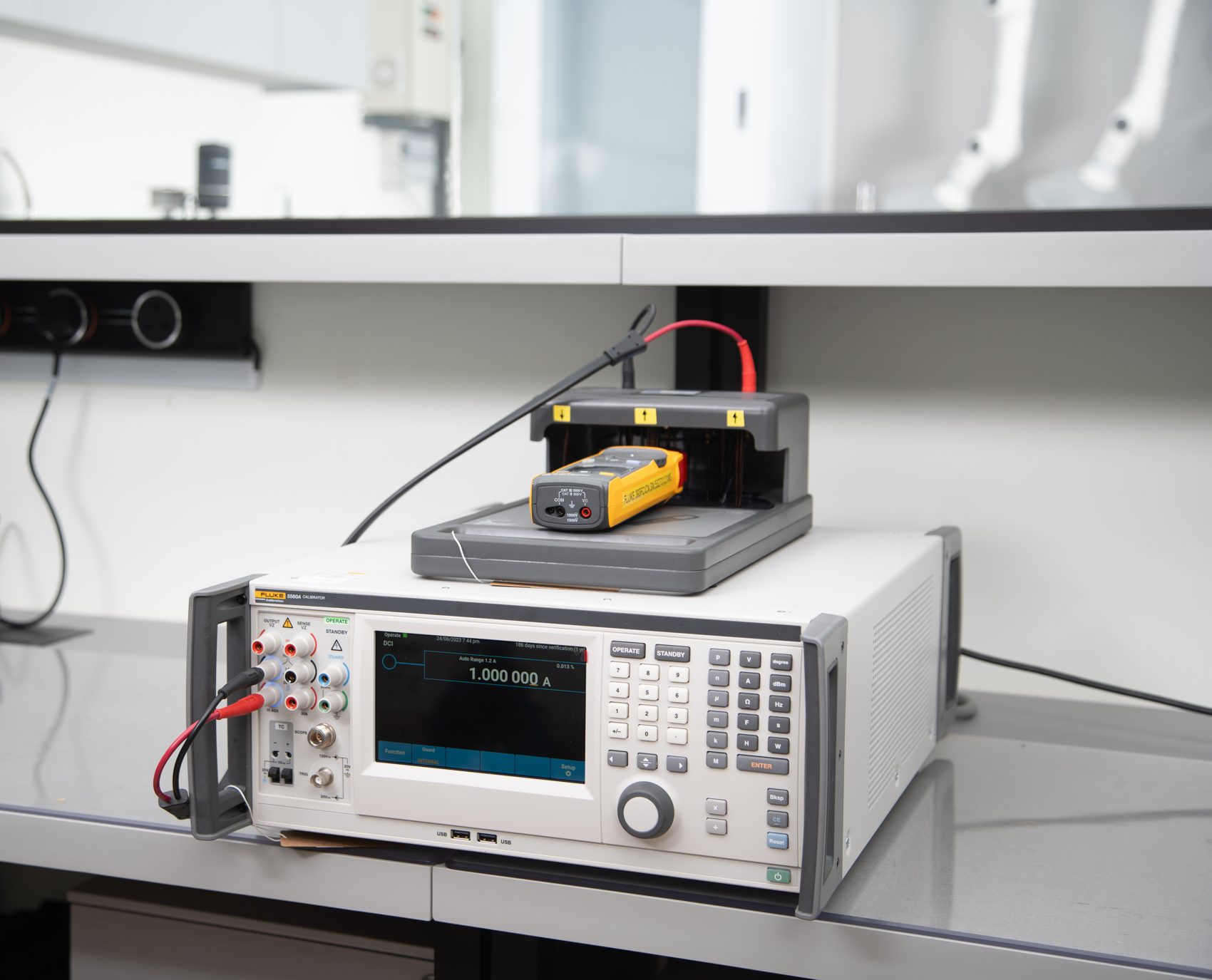
Calibrating a gas meter is a structured measurement process, not a simple button-press. When an instrument arrives at the Unitest Instruments laboratory, the technician first records the instrument's make, model, and serial number, then checks physical condition and performs a warm-up period in line with the manufacturer's specification. Typically 10–30 minutes for electrochemical CO sensors and up to 60 minutes for NDIR-based CO₂ analysers to allow the optics to stabilise thermally.
The calibration sequence begins with a zero gas purge. High-purity zero-grade air or nitrogen is flowed through the instrument at the specified flow rate, and the instrument's zero reading is recorded and adjusted if it falls outside tolerance. The technician then introduces the span gas (a certified reference gas mixture at a known concentration), at the same controlled flow rate. The instrument's response is compared to the certified concentration, and the as-found deviation is documented before any adjustment is made. If the deviation exceeds the instrument's specification or the customer's acceptance criteria, the span control is adjusted, and the as-left reading is recorded.
For instruments with multiple measurement ranges or alarm setpoints, the calibration may include additional span points, for example, a low-range span gas near the STEL (Short-Term Exposure Limit) and a high-range span near the IDLH (Immediately Dangerous to Life or Health). All readings, applied concentrations, and the expanded measurement uncertainty are captured in the calibration record. The completed certificate, bearing the SAC-SINGLAS accreditation no. LA-2023-0845-C, is then issued to the customer.
Span Gas Selection: Concentration, Balance Gas, and Traceability
Choosing the correct span gas is one of the most consequential decisions in the calibration process. A span gas that is too close to zero provides poor sensitivity; one that is too close to full scale may not represent the alarm-critical range. The general guidance from ISO/IEC 17025 and instrument manufacturers is to use a span gas at 50–80% of the instrument's full-scale reading.
CO Span Gases
Carbon monoxide meters in Singapore are most commonly deployed in two contexts: personal and area monitors for confined space entry (range typically 0–300 ppm, with alarms at 25 ppm TWA and 100 ppm STEL per MOM guidelines), and combustion or industrial process monitors (range up to 2000 ppm or higher). For a 0–300 ppm meter, a span gas of 150–200 ppm CO in nitrogen is appropriate. For a 0–1000 ppm meter, 500–750 ppm CO in nitrogen balance is standard. The balance gas matters: nitrogen is used when the instrument is designed for nitrogen-balance applications, while synthetic air balance (20.9% O₂ in nitrogen) is used when the electrochemical cell requires oxygen to function correctly. Consult the instrument datasheet to confirm.
CO₂ Span Gases
Carbon dioxide meters for indoor air quality monitoring typically cover 0–2000 ppm or 0–5000 ppm. The NEA IAQ guideline threshold for CO₂ is 1000 ppm (8-hour average), so a span gas of 1000–1500 ppm CO₂ in zero-grade air is well suited. For industrial or controlled-atmosphere applications with a 0–5% (50,000 ppm) range, a span gas of 2.5–4% CO₂ is appropriate. All span gases used by Unitest Instruments are certified reference materials with traceability to NMC Singapore (or a recognised NMI signatory to the CIPM MRA), with a stated uncertainty of ±1% or better at the 95% confidence level.
Calibration Interval Recommendations for Singapore
How often a CO or CO₂ meter should be sent for laboratory calibration depends on regulatory requirements, the manufacturer's recommendation, and the operating environment. Singapore does not prescribe a universal interval in a single document; instead, the requirements emerge from several overlapping frameworks.
| Instrument Type | Application | Recommended Interval | Singapore Regulatory Driver |
|---|---|---|---|
| CO meter (personal/area monitor) | Confined space entry atmosphere testing | Every 6 months (laboratory); before each entry (bump test) | WSH (Confined Spaces) Regulations 2009, MOM |
| CO meter (fixed area monitor) | Car park, boiler room, loading bay | Annually (minimum); 6-monthly recommended | WSH (General Provisions) Regulations; BCA / ACMV codes |
| CO₂ meter (IAQ monitor) | Office, school, healthcare facility | Annually | NEA IAQ guidelines; BCA Green Mark requirements |
| CO₂ analyser (process / controlled atmosphere) | Cold storage, fermentation, welding enclosures | Every 6 months | ISO 9001 internal quality requirements; MOM WSH |
| Combination gas detector (CO + CO₂ + O₂) | Multi-gas confined space monitor | Every 6 months (laboratory); before each entry (bump) | WSH (Confined Spaces) Regulations 2009 |
These intervals should be treated as maximum intervals under normal operating conditions. Instruments exposed to high humidity, corrosive atmospheres, or physical shock (common in Singapore's construction, marine, and petrochemical sectors), should be calibrated more frequently. Any instrument that fails a bump test must be taken out of service and sent for full laboratory calibration before further use.
For guidance on building an interval schedule that satisfies both regulatory requirements and your internal quality management system, see our article on how to determine your calibration interval.
Book CO or CO₂ Meter Calibration at Our Singapore Lab
Unitest Instruments (Acc. No. LA-2023-0845-C) calibrates CO and CO₂ meters with NMC-traceable span gases. Accredited certificates issued, same-week turnaround available.
Field Calibration vs. Laboratory Calibration: Key Differences
Singapore workplaces often use portable span gas kits for field calibration. Particularly on construction sites and in the marine and oil and gas sectors. While field calibration serves an important role in day-to-day operations, it is not equivalent to laboratory calibration for compliance purposes.
| Factor | Field Calibration | Laboratory Calibration (SAC-SINGLAS) |
|---|---|---|
| Location | On-site, any environment | Controlled laboratory (temperature, humidity, pressure) |
| Reference standard traceability | Depends on cylinder COA. Often unverified | Fully traceable to NMC Singapore via accredited chain |
| Measurement uncertainty | Not quantified; not reported | Calculated and stated on certificate (k=2, 95%) |
| Certificate issued | No formal certificate; field record only | Accredited calibration certificate bearing SAC-SINGLAS mark |
| Accepted by MOM / ISO 9001 auditors | Not for compliance; may satisfy internal SOP only | Yes. ILAC MRA recognised, accepted internationally |
| Cross-interference testing | Not performed | Can be included in scope for electrochemical CO sensors |
| Turnaround | Immediate | 1–5 business days (same-week available) |
Field calibration is best used as a routine operational check (confirming that the instrument is responding to gas and that alarms are functional), between formal laboratory calibration intervals. It supplements but does not replace accredited calibration. For a deeper look at what distinguishes accredited from non-accredited providers, read our guide on accredited vs. non-accredited calibration in Singapore.
Singapore Regulatory Context: MOM, WSH, NEA, and BCA
Multiple Singapore regulatory bodies have a stake in CO and CO₂ meter calibration, and understanding which framework applies to your operation determines the documentation standard you must meet.
Ministry of Manpower (MOM) and Workplace Safety and Health (WSH)
The WSH (Confined Spaces) Regulations 2009 are the most prescriptive framework for CO meter calibration. Regulation 7 requires that atmosphere testing be carried out using instruments that are calibrated and in good working order. MOM's Approved Code of Practice for Safe Work in Confined Spaces explicitly states that calibration records must be maintained and available for inspection. Instruments used for pre-entry testing of confined spaces (including CO, O₂, and flammable gas), must be calibrated at intervals that do not exceed the manufacturer's maximum recommended interval, with most manufacturers specifying 6 months for CO sensors.
The broader WSH (General Provisions) Regulations require employers to maintain monitoring equipment in good working order. While these regulations do not specify calibration intervals, MOM inspectors have accepted the industry standard of annual laboratory calibration for fixed CO area monitors as compliant, provided bump tests are documented at the manufacturer-specified frequency.
National Environment Agency (NEA). Indoor Air Quality
NEA's Guidelines for Good Indoor Air Quality in Office Premises recommends CO₂ concentration be kept below 1000 ppm as an indicator of adequate ventilation. Facilities that conduct formal IAQ assessments (required for Green Mark certification and recommended for healthcare and education facilities), must use calibrated CO₂ measurement instruments. Calibration records are expected to accompany IAQ assessment reports submitted to authorities.
Building and Construction Authority (BCA). Green Mark
BCA's Green Mark scheme awards credits for real-time IAQ monitoring, including CO₂. The scheme's technical requirements specify that monitoring systems be calibrated, and the supporting documentation (including calibration certificates), forms part of the Green Mark submission evidence package.
Health Sciences Authority (HSA). Pharmaceutical and Healthcare Facilities
CO₂ is widely used in pharmaceutical controlled atmospheres, cell culture environments, and incubators. HSA's GMP guidelines and the relevant PIC/S annexes require that instruments used in controlled environments be calibrated at defined intervals with traceable reference standards. SAC-SINGLAS accredited calibration certificates satisfy these requirements directly.
What a Valid CO/CO₂ Calibration Certificate Must Show
Not all calibration certificates are equal. A certificate that lacks key elements is not compliant with ISO/IEC 17025:2017 and will not satisfy a rigorous audit. Below are the mandatory elements that every CO or CO₂ calibration certificate from an accredited laboratory must include.
- Laboratory identification and accreditation number. The laboratory name, address, and SAC-SINGLAS accreditation number (e.g. LA-2023-0845-C).
- Instrument identification. Make, model, serial number, and asset tag if applicable.
- Calibration date and the date by which the next calibration is recommended.
- Reference standard details. The span gas certified concentration, uncertainty, cylinder reference number, and its own traceability statement linking to NMC Singapore or another BIPM CIPM MRA signatory.
- Environmental conditions. Temperature, relative humidity, and atmospheric pressure in the calibration laboratory at the time of measurement.
- Applied concentrations and instrument readings, as-found and as-left values for each calibration point (zero and each span level).
- Measurement uncertainty. The expanded uncertainty at a stated coverage factor (k=2 for 95% confidence is standard) for each calibration point.
- Authorised signatory. Name, signature, and title of the responsible technical person.
If a calibration certificate you receive does not include measurement uncertainty, it is almost certainly not ISO/IEC 17025 compliant. Our article on what a calibration certificate must contain provides a full annotated breakdown of each required field and common non-conformances to watch for.
For more detail on measurement uncertainty specifically, see our explainer on measurement uncertainty in calibration.
CO vs. CO₂ Sensor Technology: Calibration Implications
Understanding the underlying sensor technology is important because it determines what can go wrong during calibration, and what a thorough calibration should check for.
Electrochemical CO Sensors
The vast majority of portable and fixed CO detectors use electrochemical (amperometric) sensors. These sensors consume a small quantity of CO at the working electrode and generate a proportional current. Electrochemical CO sensors are subject to cross-gas interference: hydrogen (H₂) causes a strong positive cross-sensitivity in many sensor designs, meaning that environments with diesel exhaust, battery charging, or welding fumes may give falsely elevated CO readings. A comprehensive calibration can include cross-sensitivity characterisation, which is particularly valuable for instruments deployed in mixed-gas environments. Electrochemical sensors also have a finite service life (typically 2–4 years), and degraded sensors will exhibit increasing zero drift and reduced span sensitivity, making regular calibration an important early-warning system for sensor replacement.
NDIR CO₂ Sensors
Non-dispersive infrared (NDIR) sensors measure CO₂ by detecting the absorption of infrared radiation at the 4.26 µm wavelength. NDIR sensors are inherently more stable than electrochemical cells and are less susceptible to cross-gas interference. However, they require temperature and pressure compensation: CO₂ absorption is temperature-dependent, and at Singapore's ambient temperatures (28–34°C) an uncompensated sensor can read several percent low. Properly designed instruments include on-board compensation algorithms, but calibration in a controlled laboratory environment (where temperature and pressure are documented), is necessary to verify that the compensation is functioning correctly. NDIR sensors can also suffer from optical drift due to contamination of the optical path, which calibration will reveal as a systematic offset.
Why Calibration Must Verify the Alarm, Not Just the Reading
Most discussion of gas meter calibration focuses on measurement accuracy: does the instrument report the correct ppm value against a traceable reference. For CO and combination gas detectors used in confined space entry, there is a second, equally critical check that a numeric accuracy result does not cover on its own. Does the instrument's alarm actually trigger, audibly and visibly, at the concentration your risk assessment says it should?
Under MOM's WSH framework, confined space gas detectors are configured with defined alarm setpoints, typically a low alarm at the Time-Weighted Average (TWA) exposure limit and a high alarm at the Short-Term Exposure Limit (STEL) or a site-specific action level set out in the permit-to-work risk assessment. These setpoints are programmed into the instrument's firmware and can drift out of alignment with the intended value through a firmware reset, a battery replacement that restores factory defaults, or simple human error during configuration. All entirely independent of whether the sensor's underlying measurement accuracy is still within tolerance. An instrument can pass a span gas accuracy check with a clean certificate and still have a low or high alarm setpoint that no longer matches what the confined space entry permit actually requires.
A thorough laboratory calibration addresses this directly. In addition to the zero and span accuracy checks described above, the technician applies a test concentration just below and just above each configured alarm setpoint and confirms that the audible and visual alarm activates within the expected band, then records the actual trigger point against the configured setpoint. This is distinct from a bump test, which only confirms the alarm fires at some concentration without quantifying where. It is also distinct from span accuracy verification, which confirms the displayed reading is correct but says nothing about the alarm logic sitting behind it. Where an instrument's actual alarm trigger point has drifted from its configured setpoint, this is flagged and corrected before the instrument is returned to service.
For safety officers and FM teams managing confined space entry programmes, this distinction is worth building into your internal specification when you send instruments for calibration. Ask your calibration provider to confirm, in writing, that alarm threshold verification was performed alongside span accuracy calibration, and keep that confirmation with your permit-to-work records. A calibration certificate that only states measurement accuracy tells you the number on the screen is trustworthy. It does not, on its own, tell you the alarm will sound when a worker needs it to. Unitest Instruments includes alarm threshold verification as part of standard laboratory calibration for confined space and multi-gas detectors, and documents the result separately from span accuracy on the certificate.
Frequently Asked Questions
The span gas concentration should be chosen to bracket your measurement range of interest. Typically 50–80% of the instrument's full-scale reading. For a CO meter with a 0–300 ppm range, a span gas of 150–200 ppm CO in nitrogen (balance gas) is commonly used. The span gas must have a stated accuracy of ±1% or better, supplied in a DAkkS- or NMC-traceable cylinder with a valid certificate of analysis. Unitest Instruments uses NMC Singapore-traceable reference gas standards for all CO and CO₂ calibrations under SAC-SINGLAS accreditation no. LA-2023-0845-C.
Singapore's MOM Workplace Safety and Health (WSH) framework and manufacturer guidance both influence calibration intervals. For CO meters used in confined space entry or continuous area monitoring, a 6-month laboratory calibration interval is widely adopted. CO₂ meters used for indoor air quality (IAQ) monitoring under NEA guidelines are typically calibrated annually. Instruments in harsh environments (high humidity, chemical exposure) or those that have failed a bump test should be calibrated immediately regardless of interval. Always confirm intervals against your specific instrument manufacturer's recommendation and your organisation's internal calibration schedule.
A bump test (functional test) briefly exposes the sensor to a known gas concentration to verify the alarm triggers. It does not produce a calibration certificate or adjust the instrument's output. A full calibration applies a traceable span gas, measures the instrument's response against a reference standard, calculates measurement uncertainty, makes any necessary zero and span adjustments, and issues a formal certificate. MOM and most safety management systems require documented calibration certificates; a bump test log alone does not satisfy this requirement.
Yes. Unitest Instruments holds SAC-SINGLAS accreditation no. LA-2023-0845-C under ISO/IEC 17025:2017, covering gas analyser and detector calibration including CO and CO₂ meters. Calibration certificates issued under this accreditation bear the SAC-SINGLAS mark and are accepted by ISO 9001 auditors, MOM inspectors, and clients requiring ILAC MRA-recognised results. Accredited certificates include stated measurement uncertainty, which non-accredited providers typically do not report.
A valid ISO/IEC 17025-compliant calibration certificate for a CO or CO₂ meter must include: the laboratory name and accreditation number (e.g. LA-2023-0845-C); instrument identification (make, model, serial number); the reference standard used and its traceability chain to NMC Singapore; calibration date and recommended next calibration date; applied concentrations (zero and at least one span point); as-found and as-left readings; measurement uncertainty at a stated coverage factor (typically k=2, 95% confidence); and the name and signature of the authorised signatory. Certificates missing uncertainty values or traceability statements do not comply with ISO/IEC 17025.
Several regulatory frameworks apply. The Workplace Safety and Health (Confined Spaces) Regulations 2009 under MOM require atmosphere testing with calibrated instruments before and during confined space entry. CO is a primary test gas. The WSH (General Provisions) Regulations require that monitoring equipment be maintained in good working order, which includes calibration. For indoor air quality, NEA's IAQ guidelines reference CO₂ as a key indicator and recommend calibrated instruments. BCA's Green Mark scheme awards points for IAQ monitoring using calibrated CO₂ sensors. Healthcare and pharmaceutical facilities may additionally fall under HSA requirements for controlled environment monitoring.
Both field calibration and laboratory calibration are possible, but they serve different purposes and offer different levels of assurance. Field calibration using a portable span gas cylinder is quick and practical for bump testing and minor adjustments, but it typically cannot deliver the measurement uncertainty documentation or accredited certificate that regulators and auditors require. Laboratory calibration at a SAC-SINGLAS accredited facility such as Unitest Instruments provides full traceability, measurement uncertainty quantification, and an accredited certificate. For compliance with MOM, ISO 9001, and contractual requirements, laboratory calibration is the appropriate route.
The fundamental calibration process is similar (zero gas followed by one or more span gases), but the concentration ranges and reference materials differ significantly. CO meters typically cover 0–300 ppm (safety monitoring) or 0–1000 ppm (industrial process), while CO₂ meters for IAQ cover 0–5000 ppm and high-concentration units for industrial use can reach 0–100% v/v. The electrochemical cells used in CO sensors are sensitive to cross-interference from other gases (hydrogen, NO₂), so cross-sensitivity testing may be part of a full characterisation. CO₂ sensors based on non-dispersive infrared (NDIR) technology require temperature and pressure compensation checks during calibration. Reference gas concentrations and certified reference material (CRM) requirements also differ by range.
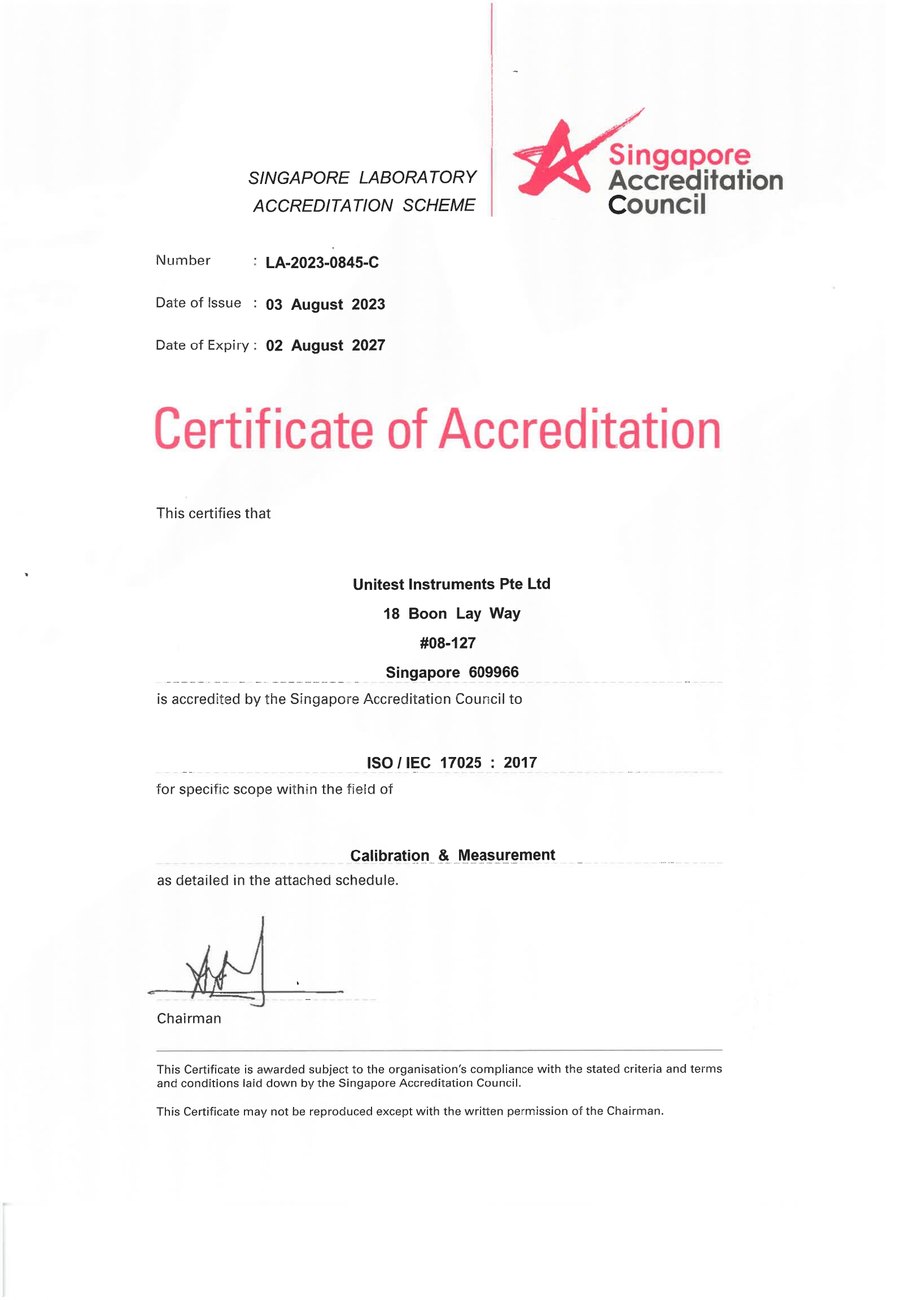
SAC-SINGLAS accredited calibration laboratory (Acc. No. LA-2023-0845-C) serving Singapore's industrial, pharmaceutical, and manufacturing sectors. All content reflects our ISO/IEC 17025 accredited scope and is reviewed by our technical calibration team.
Need CO or CO₂ meter calibration in Singapore?
Unitest Instruments is SAC-SINGLAS accredited (Acc. No. LA-2023-0845-C) to ISO/IEC 17025. NMC-traceable span gases, same-week turnaround, certificates accepted by ISO 9001 auditors and MOM inspectors.