
Key Takeaways
- SOLAS Chapter II-2 and the IMO FSS Code Chapter 5 govern fixed CO₂ systems; MPA enforces these requirements for all vessels in Singapore waters.
- Annual surveys cover functional checks of release mechanisms, alarms, and gauges; five-yearly special surveys require full cylinder weighing and pipe pressure testing.
- CO₂ cylinder charge must not fall below 95% of nominal weight. Exceeding the 5% loss tolerance triggers mandatory recharge before departure.
- Weighing scales and pressure gauges used in surveys must carry current calibration certificates from an accredited laboratory, traceable to national standards.
- Detention by MPA Port State Control for CO₂ system deficiencies is published on Tokyo MOU and Paris MOU databases, with direct reputational and commercial consequences.
Why CO₂ System Integrity Matters on Vessels
Fixed CO₂ fire suppression systems are the primary defence against catastrophic engine room and cargo hold fires on commercial vessels. Unlike water deluge or sprinkler systems, CO₂ systems operate by displacing oxygen, which makes them effective on flammable liquid and electrical fires, but equally dangerous to crew if activated incorrectly or if the system discharges incompletely due to depleted cylinders.
The maritime record of CO₂-related fatalities (both from fires caused by system failure and from accidental discharges into occupied spaces), drove IMO to codify detailed integrity requirements in the Fire Safety Systems (FSS) Code. Singapore, as a major shipping registry and port state, has adopted these requirements in full through MPA and applies them rigorously through Port State Control inspections.
For facilities managers and ship operators based in Singapore, the practical implication is clear: a CO₂ system that is overdue for survey, carries undercharged cylinders, or lacks calibration evidence for its test instruments is a vessel detention risk. Understanding what the standard requires (and exactly what "calibrated" means in this context), is not optional.
The Regulatory Framework: SOLAS, FSS Code, and MPA
The regulatory chain governing marine CO₂ systems in Singapore flows from international treaty to local enforcement as follows:
- SOLAS Chapter II-2 (International Convention for the Safety of Life at Sea): Establishes the top-level requirement for fixed fire-extinguishing systems on applicable vessel classes, including cargo ships, tankers, passenger vessels, and certain fishing vessels above 500 GT.
- IMO FSS Code Chapter 5 (International Code for Fire Safety Systems): Provides the detailed technical standard. System design quantities, pipe sizing, nozzle placement, control system requirements, and cylinder charge tolerances. It is incorporated by reference into SOLAS and is equally mandatory.
- MSC/Circ.1318 (Guidelines for the Maintenance and Inspections of Fixed CO₂ Fire-Extinguishing Systems): Provides the surveyor-level inspection checklist and the 5% cylinder weight tolerance. Surveyors in Singapore reference this circular directly.
- MPA Merchant Shipping (Safety) Regulations: Implement SOLAS in Singapore law. MPA Nautical Surveyors and MPA-authorised Recognised Organisations (ROs) carry out statutory surveys under these regulations. Vessels without a valid Safety Certificate issued under these regulations cannot legally operate in Singapore waters.
Facilities managers operating vessel fleets or managing shipyard maintenance programmes should note that MPA does not distinguish between Singapore-flagged vessels and foreign vessels for the purpose of Port State Control. Any vessel calling at a Singapore port is subject to PSC inspection, and CO₂ system deficiencies are a documented area of PSC focus in the Asia-Pacific region under the Tokyo MOU.
What the Standard Requires: Annual and Five-Yearly Surveys
Compliance with SOLAS CO₂ system requirements is verified through a structured survey programme. The two primary survey types have very different scopes, and confusing them is a common source of non-compliance.
Annual Survey
The annual survey is a functional verification rather than a full discharge-capability test. The surveyor will confirm:
- All CO₂ cylinder pressure gauges read within the acceptable range (green zone), indicating no significant leakage since the last survey.
- Manual and automatic release controls operate freely, without mechanical obstruction or corrosion.
- Pre-discharge alarms activate and are audible in all protected spaces.
- Warning signs, labels, and operating instructions are legible and correctly positioned at all control stations.
- Pilot cylinders (where fitted) are visually inspected and weighed if gauge pressure is suspect.
- Discharge piping is visually clear. No obvious damage, unsupported runs, or blocked nozzles.
- The system's survey record book is up to date.
Critically, the annual survey does not require individual cylinder weighing unless the surveyor has cause for concern (e.g. a gauge reading at or below the minimum). This means a system that passes annual surveys could still accumulate slow cylinder losses that only become visible at the five-yearly survey. Reinforcing why the five-year inspection is the more consequential event.
Five-Yearly Special Survey
The five-yearly survey is the comprehensive integrity test. Every element of the system is verified to its design specification, not just visually inspected. Key requirements include:
- Individual cylinder weighing: Every CO₂ cylinder must be weighed and the actual charge compared to the nameplate nominal weight. Any cylinder below 95% of nominal must be recharged or replaced.
- Pneumatic pressure test of distribution piping: The entire pipe network (excluding nozzles) is pressure-tested, typically at 1.5 times the maximum working pressure, to confirm there are no leaks in joints, fittings, or pipe runs.
- Nozzle inspection: Each nozzle is removed and inspected for blockage, corrosion, and correct orifice diameter against the system design.
- Control system end-to-end function test: The automatic detection trigger, time-delay mechanism, and solenoid release are tested from detection through to the point of cylinder release (without actually opening cylinders).
- Documentation review: Survey records, recharge certificates, and any modification history must be available for review.
| Survey Type | Frequency | Cylinder Weighing? | Pipe Pressure Test? | Alarm Function Test? | Calibrated Instruments Required? |
|---|---|---|---|---|---|
| Annual Survey | Every 12 months | Only if gauge suspect | No | Yes | Yes (pressure gauge calibration recommended) |
| Five-Yearly Special Survey | Every 5 years | Yes. Every cylinder | Yes. Full system | Yes | Yes. Weighing scale and pressure gauge calibration mandatory |
| Post-Discharge Survey | After any discharge | Yes. Full recharge verification | Discretion of surveyor | Yes | Yes |
Need calibrated weighing scales or pressure gauges for a CO₂ system survey?
Unitest Instruments provides SAC-SINGLAS accredited calibration of weighing equipment and pressure instruments, with certificates accepted by MPA-authorised surveyors and all major Recognised Organisations operating in Singapore.
Calibration Instrument Requirements for CO₂ System Testing
The FSS Code and MSC/Circ.1318 both implicitly (and in surveyor guidance, explicitly), require that instruments used to verify CO₂ system integrity are fit for purpose and calibrated. This is not a bureaucratic formality: the core SOLAS tolerance of 5% cylinder charge loss means that a weighing scale with 2% error could declare a compliant cylinder as deficient, or (more dangerously), pass a borderline cylinder that should be condemned.
Weighing Scales and Load Cells
Cylinder weighing is the single most measurement-critical step in the five-yearly survey. The instrument must be calibrated to confirm accuracy within a small fraction of the 5% SOLAS tolerance. In practice, surveyors expect a calibration certificate demonstrating the scale's error is no more than ±0.5% of reading across the relevant range (typically 40–80 kg for standard marine CO₂ cylinders). The certificate must state the measurement uncertainty. See our article on measurement uncertainty in calibration for a detailed explanation of why this matters.
Key calibration parameters to confirm: linearity across the full weighing range, repeatability at nominal cylinder weights, and temperature coefficient (scales exposed to engine room temperatures can drift significantly from their ambient-condition calibration). Calibration must be traceable to national measurement standards, in Singapore, this means the National Metrology Centre (NMC). An SAC-SINGLAS accredited laboratory such as Unitest Instruments provides the chain of traceability required.
Pressure Gauges
Pressure gauges used during the pneumatic pipe pressure test must be calibrated across the test pressure range. Marine CO₂ systems typically operate at storage pressures of 5.17 MPa (750 psi) at 15°C, and the pipe pressure test is typically conducted at 1.5× working pressure. Meaning the test gauge must be calibrated to at least 10 MPa (1450 psi). Gauge accuracy should be ±0.5% of full scale or better. The calibration certificate should be current, for instruments used in safety-critical surveys, a 12-month calibration interval is standard. For guidance on calibration intervals more broadly, see our article on how often calibration should occur.
CO₂ Concentration Analysers
Where the survey includes verification of alarm trigger concentration levels (typically 5% CO₂ by volume for pre-discharge warnings), the analyser used must itself be calibrated against certified reference gas standards. This is a less commonly discussed but equally important instrument. A miscalibrated analyser could pass an alarm system that would fail to warn crew at the correct concentration.
Temperature Sensors
Temperature correction is required when cylinder weights are checked under conditions significantly different from the reference temperature (typically 15°C). CO₂ is a supercritical fluid in standard cylinders, and its density varies with temperature. A calibrated thermometer is necessary to apply the manufacturer's correction factors correctly. Most surveyors use a simple certified reference thermometer for this purpose.
Step-by-Step Compliance Process for Singapore Operators
The following workflow applies to vessel operators and ship management companies maintaining CO₂ system compliance under the MPA regulatory framework. Facilities managers responsible for docked or idle vessels should follow the same process through their appointed service agents.
- Identify survey due dates: Confirm the dates of the last annual survey and the last five-yearly survey from the vessel's survey record book. If the vessel is within six months of either due date, initiate planning immediately. Surveyors and calibration laboratories in Singapore can be booked out during peak dry-dock periods.
- Appoint an MPA-accepted Recognised Organisation or service agent: Only RO surveyors and MPA Nautical Surveyors can issue the required survey endorsement. Confirm the RO's scope of acceptance with MPA before engagement.
- Calibrate all test instruments: At least two to four weeks before the survey, send weighing scales, pressure gauges, and CO₂ analysers to a SAC-SINGLAS accredited calibration laboratory. Request certificates showing measurement uncertainty and confirm that the calibration interval will not expire before the survey date.
- Pre-survey internal check: Conduct an internal walkthrough using the MSC/Circ.1318 checklist to identify any obvious deficiencies (damaged signage, seized release handles, or pilot cylinders with suspect gauges), so these can be rectified before the formal survey.
- Conduct the survey: The RO surveyor or MPA Nautical Surveyor witnesses the cylinder weighing, pipe pressure test, and alarm function test. Calibration certificates for all test instruments are presented to the surveyor at this stage. Any cylinder below 95% nominal is set aside for recharge.
- Rectify deficiencies and recharge: Deficient cylinders are sent to an approved recharge facility. Recharge certificates are obtained for each cylinder and retained as part of the permanent system record.
- Obtain survey endorsement: Once all deficiencies are closed, the surveyor endorses the vessel's Safety Certificate or issues a Statement of Compliance. This document must be kept on board at all times.
- Update the survey record book: All findings, instrument calibration certificate numbers, and recharge records are entered into the survey record book. This book is the primary evidence document in any future PSC inspection.
Penalties for Non-Compliance in Singapore
MPA enforces CO₂ system compliance through the Port State Control regime and through the survey conditions attached to Singapore vessel registration. The consequences of non-compliance operate at several levels:
Vessel Detention
A PSC inspector who finds CO₂ system deficiencies (overdue surveys, undercharged cylinders, absent calibration records, or non-functional alarms), will issue a deficiency notice. If the deficiency is classified as a ground for detention (which CO₂ system failures typically are, given their safety-critical nature), the vessel cannot depart until the deficiency is rectified and verified by a follow-up inspection. Detention in Singapore's commercial port environment can cost tens of thousands of dollars per day in berth fees, cargo demurrage, and crew costs.
Publication and Reputational Damage
All Singapore PSC detentions are reported to the Tokyo MOU, which maintains a publicly searchable database. A vessel with a CO₂ system detention record will face heightened scrutiny at subsequent PSC inspections throughout the Asia-Pacific region for up to three years. Charter parties and cargo shippers increasingly require PSC inspection records as part of due diligence. A detention history directly affects chartering rates and insurance premiums.
Safety Certificate Suspension
In extreme cases (for example, where an MPA survey reveals that a vessel's CO₂ system has been inoperable for multiple voyages), MPA has the power to suspend or refuse to renew the vessel's Safety Certificate under the Merchant Shipping Act. Operating without a valid certificate is a criminal offence carrying fines and, in serious cases, the possibility of prosecution of the shipowner or manager.
Choosing a Calibration Laboratory for Marine CO₂ Testing Instruments
Not all calibration providers are equal in the eyes of MPA and Recognised Organisation surveyors. The calibration must be accredited. Meaning the laboratory itself has been assessed by a national accreditation body as competent to perform the specific measurement type. In Singapore, the relevant accreditation is SAC-SINGLAS (Singapore Accreditation Council. Singapore Laboratory Accreditation Scheme), which is the MRA-signatory accreditation that gives the certificate international recognition.
Understanding the difference between accredited and non-accredited calibration is important here. A non-accredited calibration certificate may be accepted for low-stakes internal use, but for a regulatory survey conducted under SOLAS, surveyors expect accredited certificates. Our article on accredited vs non-accredited calibration explains this distinction in detail. Unitest Instruments holds SAC-SINGLAS accreditation number LA-2023-0845-C and calibrates weighing instruments, pressure gauges, and temperature sensors within scopes accepted by the calibration community for marine compliance work.
When requesting calibration for CO₂ survey instruments, specify to the laboratory: the measurement range required, the target measurement uncertainty, the survey date (so the certificate issue date and next calibration due date bracket the survey window), and whether you need the certificate in a format that names the specific instrument serial number. Surveyors and auditors will typically check that the certificate serial number matches the instrument used.
Frequently Asked Questions
SOLAS Chapter II-2 (Construction. Fire Protection, Detection and Extinction) and the IMO International Code for Fire Safety Systems (FSS Code) Chapter 5 mandate fixed CO₂ fire-extinguishing systems on applicable vessels. In Singapore, the Maritime and Port Authority (MPA) enforces these requirements under the Merchant Shipping (Safety) Regulations. All Singapore-flagged vessels and foreign vessels calling at Singapore ports must carry valid Survey Reports confirming system integrity, typically renewed at annual or five-yearly surveys.
Under MPA survey requirements aligned with SOLAS: annual surveys must confirm system readiness, control box integrity, and alarm function; five-yearly special surveys require a full cylinder weighing or pressure test to confirm CO₂ charge within 5% of nominal weight, pipe pressure integrity test, and nozzle flow verification. Additionally, any vessel that has discharged the system (including accidental discharge) must undergo a full recharge and re-commissioning survey before the next voyage.
Failure results in a deficiency notice under the MPA Port State Control (PSC) regime. Depending on severity, the vessel may be detained in port until the deficiency is rectified, subjected to a follow-up inspection, or face suspension of its safety certificate. Detentions are published on the Tokyo MOU and Paris MOU databases, which can damage charter relationships and insurance ratings. There is no fixed statutory fine for the CO₂ deficiency itself, but operating without a valid Safety Certificate can attract fines under the Merchant Shipping Act.
The primary instruments requiring calibration are: (1) Weighing scales or load cells used to weigh CO₂ cylinders. Must be calibrated to confirm accuracy within ±0.5% of the nominal cylinder charge; (2) Pressure gauges used during pneumatic pipe pressure tests, typically tested to 1.5× working pressure; (3) CO₂ concentration analysers used to verify alarm trigger levels; and (4) Temperature sensors used to correct cylinder mass for thermal expansion. All calibration must be traceable to national measurement standards, and in Singapore, a SAC-SINGLAS accredited laboratory such as Unitest Instruments provides the legally recognised calibration certificates.
Yes. The FSS Code Chapter 5 and the SOLAS-referenced MSC/Circ.1318 require that each CO₂ cylinder's charge must not be less than 95% of the nominal charge weight (i.e. a maximum 5% loss is permitted). Cylinders found to be below 95% must be recharged or replaced before the vessel may proceed. This tolerance makes the calibration accuracy of the weighing equipment critical. A weighing scale with a ±1% error could mask a borderline cylinder that should be condemned.
Surveys must be carried out by or under the supervision of a Recognised Organisation (RO) surveyor authorised by MPA, or by an MPA Nautical Surveyor. The main ROs accepted by MPA include Lloyd's Register, DNV, Bureau Veritas, ClassNK, American Bureau of Shipping, and several others. The physical maintenance and recharge work is typically carried out by an approved service agent holding the system manufacturer's authorisation. The calibration of test instruments used during the survey must be traceable; using uncalibrated scales or gauges can invalidate the survey findings.
The annual survey is a visual and functional check: the surveyor confirms that cylinder pressure gauges are in the green zone, manual and automatic release mechanisms operate freely, alarm systems activate correctly, and all labelling and signage complies with FSS Code requirements. The five-yearly special survey is more rigorous: every cylinder must be individually weighed (or pressure-tested using an approved alternative method), all distribution pipes are pressure-tested for leakage, nozzles are inspected for blockage, pilot cylinders are weighed, and control systems are function-tested end-to-end. Documentation from both surveys must be retained on board.
Yes, provided the calibration certificate is current (within the calibration interval), the scale's capacity and resolution are appropriate for the cylinder weights being checked, and the certificate is issued by an accredited laboratory traceable to national standards. In Singapore, certificates from SAC-SINGLAS accredited laboratories (such as Unitest Instruments, Acc. No. LA-2023-0845-C) are accepted by MPA-authorised surveyors and Recognised Organisation surveyors. The certificate should state the measurement uncertainty, which must be small relative to the 5% SOLAS tolerance.
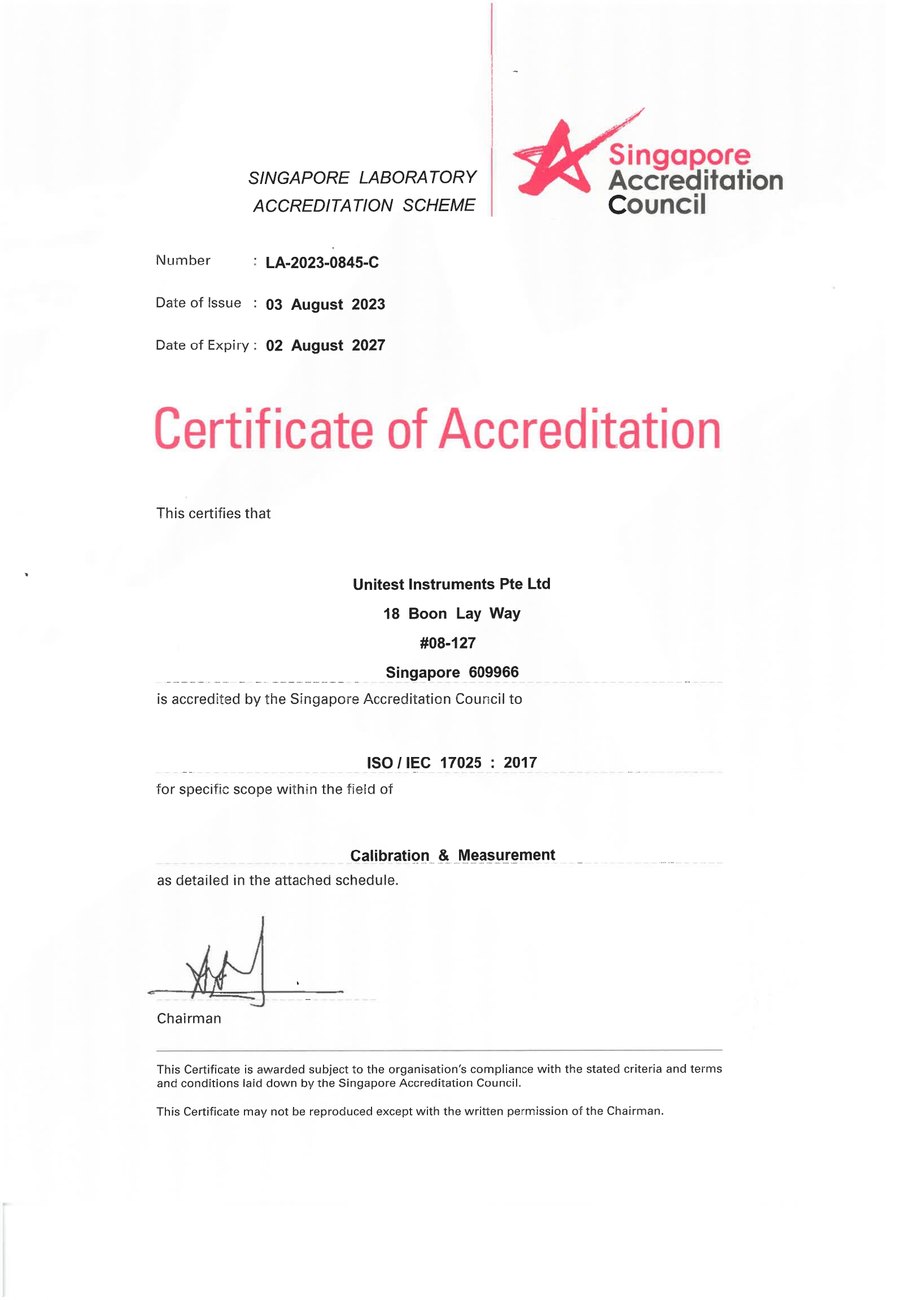
SAC-SINGLAS accredited calibration laboratory (Acc. No. LA-2023-0845-C) serving Singapore's industrial, pharmaceutical, and manufacturing sectors. All content reflects our ISO/IEC 17025 accredited scope and is reviewed by our technical calibration team.
Need marine CO₂ survey instrument calibration in Singapore?
Unitest Instruments is SAC-SINGLAS accredited (Acc. No. LA-2023-0845-C) to ISO/IEC 17025. Same-week turnaround, certificates accepted by ISO 9001 auditors, MPA surveyors, and all major Recognised Organisations.