
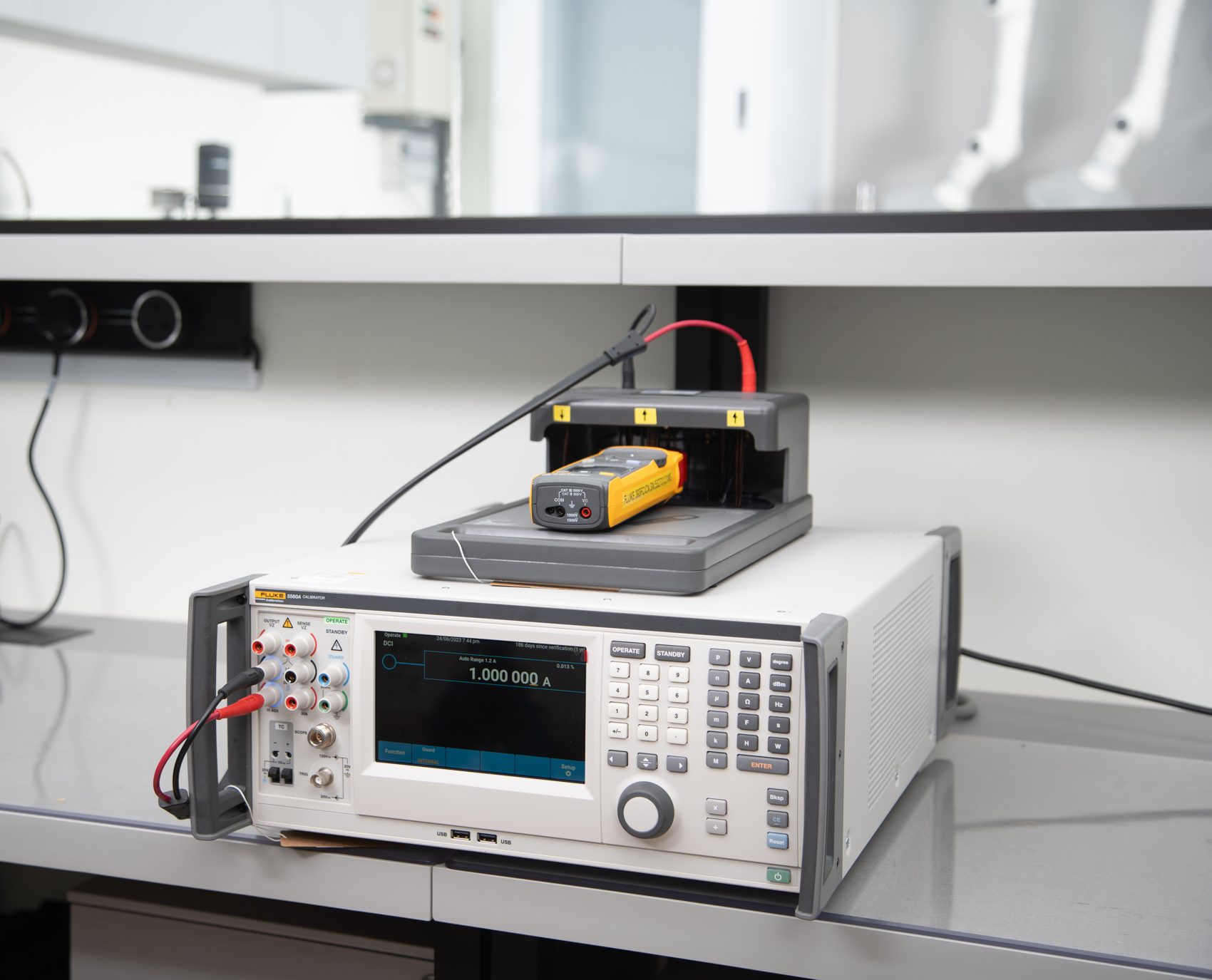
Key Takeaways
- A multifunction process calibrator handles 4–20 mA, voltage, temperature (RTD/thermocouple), and pressure. Replacing multiple single-function tools for field teams.
- The Fluke 725 is the benchmark mid-range calibrator; the Fluke 754 adds HART communication for smart transmitter commissioning and trimming.
- For basic loop-only work, the Amprobe PCE-123 offers a cost-effective entry point without sacrificing accuracy on current signals.
- Singapore's regulated industries (pharmaceutical, oil and gas, food manufacturing) require calibration certificates traceable to SAC-SINGLAS and NMC Singapore.
- New process calibrators should be calibrated by an accredited laboratory before first use to establish a documented baseline. A ship-from-factory report is not a substitute.
Who Needs a Process Calibrator?
Process calibrators are the essential toolkit for anyone responsible for keeping industrial instrumentation accurate and compliant. In Singapore's dense industrial corridor. Spanning Jurong Island petrochemical plants, Tuas pharmaceutical facilities, Changi water treatment infrastructure, and semiconductor fabs. Field technicians routinely need to verify or simulate control loop signals without taking equipment offline.
Unlike bench multimeters, a process calibrator is purpose-built for the 4–20 mA current loop standard that underpins the vast majority of field transmitters: pressure, flow, level, and temperature sensors all communicate over this protocol. A calibrator lets you source a known current to test a PLC input card, measure the actual output of a transmitter to check for drift, or simulate a thermocouple signal to verify a temperature controller. All with the accuracy and traceability documentation that ISO 9001 and GMP auditors expect.
Common user profiles in Singapore include: instrumentation engineers at petrochemical plants on Jurong Island, maintenance technicians at food and beverage factories regulated by SFA, calibration technicians at pharmaceutical manufacturers under HPB/HSA GMP requirements, and field service engineers supporting utilities and water treatment plants under PUB contracts.
Key Specifications to Evaluate Before Buying
Not all process calibrators are equal. Before choosing a model, consider the following parameters carefully against your actual field requirements:
- Signal types supported: At minimum, current (mA source/measure), voltage (mV and V), and resistance. Temperature (RTD and thermocouple types J, K, T, E, R, S, B) and pressure (via interchangeable modules) are essential for a true multifunction unit.
- Current loop accuracy: Look for ±0.02% of reading or better on mA source and measure. This governs how precisely you can verify a transmitter's output against its specification.
- HART communication: If your plant uses smart (HART-enabled) transmitters (increasingly standard in Singapore process industries), choose a model with built-in HART capability for in-field device diagnostics and trimming.
- Documenting capability: Higher-end calibrators store as-found/as-left results with timestamps, generating calibration records that satisfy 21 CFR Part 11 and GMP documentation requirements without manual transcription.
- Pressure module compatibility: Interchangeable pressure modules extend range without buying a separate pressure calibrator. Confirm the module ranges cover your plant's typical transmitter spans (e.g. 0–1 bar, 0–10 bar, 0–100 bar).
- Battery life and IP rating: Field use in Singapore's outdoor industrial environments demands at least 8 hours of battery life and an IP54 or better dust/moisture rating.
Understanding these specifications puts you in a position to evaluate the five models below (ranging from a focused loop-only instrument to a fully documenting HART calibrator), against your actual field use case and budget.
Top Process Calibrators Available in Singapore. Model Comparison
The following five models represent the strongest options across the price and capability spectrum for Singapore field instrumentation teams. All are available or orderable through Unitest Instruments and its supplier network (Fluke, Amprobe).
| Model | Key Capability | mA Accuracy | HART | Price Range (SGD) | Best For |
|---|---|---|---|---|---|
| Fluke 725 | Multifunction: mA, V, pressure, RTD, T/C, resistance | ±0.02% rdg | No | S$1,800–2,400 | General-purpose field instrumentation teams |
| Fluke 754 | Documenting multifunction + HART communicator | ±0.01% rdg | Yes | S$5,500–7,200 | Pharma / oil & gas. Smart transmitters + GMP records |
| Fluke 707 | Loop calibrator only: source/measure/simulate mA | ±0.015% rdg | No | S$700–950 | Dedicated loop technicians; cost-conscious teams |
| Amprobe PCE-123 | Loop + voltage + thermocouple (types J, K) | ±0.05% rdg | No | S$400–650 | Entry-level; light industrial & facilities maintenance |
| Fluke 726 | Precision multifunction; dual-channel simultaneous measure & source | ±0.015% rdg | No | S$3,200–4,200 | High-accuracy calibration labs and critical process verification |
For most Singapore maintenance teams running scheduled loop checks across a plant, the Fluke 725 hits the right balance of breadth and accuracy at a mid-range price. The Fluke 754 is the right upgrade when your plant has moved to HART-enabled smart transmitters, or when your quality system requires documented as-found/as-left records with no manual data entry. The Fluke 707 is ideal for a dedicated loop technician whose sole job is verifying 4–20 mA signals. It is faster to use and lighter to carry than a multifunction unit.
Need your process calibrator calibrated to traceable Singapore standards?
Unitest Instruments provides SAC-SINGLAS accredited calibration for process calibrators, loop calibrators, and multifunction field instruments. Certificates accepted by ISO 9001, GMP, and PUB auditors.
Model Deep-Dives: What to Expect in the Field
Fluke 725. The Field Workhorse
The Fluke 725 has been the de facto standard multifunction process calibrator in Singapore's process industries for over a decade. Its ability to source and measure 4–20 mA (with 24 V loop power supply built in), simultaneously measure DC voltage, simulate or measure RTDs (PT100, PT200, PT500, PT1000, Cu10) and six thermocouple types, and interface with interchangeable pressure modules covers roughly 90% of the calibration tasks a typical field instrumentation engineer encounters in a day.
The 725's user interface is pragmatic: a rotary selector for measurement mode, a numeric keypad for entering source values, and a large two-line display that shows both source and measure simultaneously. There is no touchscreen and no Bluetooth. This is a tool built for reliability in hot, humid Singapore plant environments, not for connectivity. Battery life is typically 10–12 hours with alkaline cells, sufficient for a full shift without recharging.
Where the 725 falls short: it has no HART communication, no internal memory for storing calibration records, and no automated test sequences. For a team that needs to generate digital calibration records (e.g. in a pharmaceutical plant under GMP), the 725 requires manual transcription of as-found/as-left readings. A process error risk that the Fluke 754 eliminates.
Fluke 754. The Documenting HART Calibrator
The Fluke 754 is the instrument of choice for Singapore's pharmaceutical, refinery, and advanced manufacturing sectors. Its HART communication capability allows a technician to connect to any HART-enabled transmitter and read the primary variable, device tag, engineering unit, and trim values directly from the instrument. Without needing a separate HART handheld communicator. This alone can save 20–30 minutes per transmitter on a typical calibration round.
The documenting function is the 754's defining feature for regulated industries. The instrument stores as-found and as-left readings for each tagged instrument, generates a pass/fail result against configurable tolerance limits, and can download the complete calibration history via USB or PC software. For 21 CFR Part 11 environments or ISO 9001 quality systems, this eliminates the paper trail entirely.
The 754 also features improved mA accuracy (±0.01% reading vs the 725's ±0.02%), making it the right choice for high-criticality loops where a 0.02% uncertainty would be material. Flow measurement for fiscal metering, for example, or temperature control in a cleanroom.
Fluke 707. The Specialist Loop Tool
For a technician whose sole responsibility is 4–20 mA loop verification, the Fluke 707 offers the best combination of simplicity, speed, and accuracy at a fraction of the multifunction calibrator price. It sources, measures, and simulates mA signals, powers the loop from an internal 24 V supply, and displays both the source value and measured loop current simultaneously. The 707 fits in a shirt pocket and weighs under 300 g. A meaningful advantage for technicians climbing structures or working in confined spaces on Jurong Island.
Singapore Regulatory Context: What Standards Apply?
Singapore's process industries operate under a layered regulatory environment that directly determines the type of calibration documentation required for your process calibrator:
- ISO 9001:2015. Requires documented evidence that measuring equipment is calibrated at specified intervals, with results traceable to national or international measurement standards. A SAC-SINGLAS accredited certificate satisfies this requirement directly.
- MOM Pressure Systems Safety Regulations (PSSR). Applies to pressure instrumentation in plants handling pressurised systems above defined thresholds. Calibration of pressure-measuring instruments used for safety functions must be documented and traceable.
- HSA Good Manufacturing Practice (GMP). Pharmaceutical manufacturers in Singapore must calibrate all equipment used in production and quality control per scheduled intervals, with records retained for audit. Process calibrators used to verify temperature or pressure transmitters in cleanrooms fall squarely in scope.
- SS 508 (Singapore Standard for Electrical Installations). Relevant for electrical measurement functions, though process calibrators used for loop calibration are primarily subject to ISO 9001 requirements rather than SS 508 directly.
For all these environments, the critical requirement is that calibration is performed by a laboratory accredited under SS ISO/IEC 17025, which in Singapore means SAC-SINGLAS accreditation. Unitest Instruments holds SAC-SINGLAS accreditation (Acc. No. LA-2023-0845-C), and our certificates are recognised under the ILAC Mutual Recognition Arrangement (MRA), accepted in over 90 economies. Read more in our guide to accredited vs non-accredited calibration and what the difference means for your quality system.
SAC-SINGLAS Calibration for Your New Process Calibrator
A common misconception among Singapore instrumentation teams is that a new process calibrator from a reputable manufacturer is ready to use without further calibration. In reality, the factory calibration data sheet that ships with the instrument confirms the unit met specification at the time of manufacture. It does not constitute an ISO/IEC 17025 accredited certificate with traceability to Singapore's National Metrology Centre (NMC).
For any regulated quality system, a process calibrator used as a reference standard for verifying other instruments must itself be calibrated by an accredited laboratory. This establishes:
- A documented baseline (as-found condition at time of first calibration)
- Traceability to NMC Singapore through an unbroken chain of comparisons
- An accreditation certificate number that auditors can verify against the SAC register
- A recommended recalibration interval based on observed drift and manufacturer specification
Unitest Instruments can calibrate process calibrators for all the parameters covered by the instruments above: DC current (4–20 mA), DC voltage, resistance, and temperature (RTD and thermocouple). Our SAC-SINGLAS scope covers the measurement ranges relevant to field process calibrators, and we offer same-week turnaround for most instruments.
For a full explanation of what your calibration certificate should contain and how to read it, see our article on understanding your calibration certificate.
Where to Buy Process Calibrators in Singapore
Unitest Instruments is an authorised distributor for Fluke and Amprobe test and measurement products in Singapore. Our shop at unitestshop.com carries the full Fluke process calibrator range including:
- Fluke 725 Multifunction Process Calibrator. Singapore stock, same-week dispatch
- Fluke 754 Documenting Process Calibrator. Available with bundled SAC-SINGLAS calibration certificate
- Fluke 707 Loop Calibrator, in stock, fast dispatch
- Fluke 726 Precision Multifunction Calibrator, for laboratory and high-accuracy field use
- Amprobe PCE-123 Loop and Process Calibrator. Entry-level; suitable for facilities maintenance
We recommend bundling your process calibrator purchase with an initial SAC-SINGLAS accredited calibration. This saves time (instrument goes direct to our calibration laboratory before delivery), ensures you receive a compliant certificate from day one, and establishes the as-found baseline needed to set a scientifically justified recalibration interval. Contact us to discuss a purchase-plus-calibration package and current Singapore pricing.
Rent, Buy, or Share Across Sites? A Practical Framework
Not every Singapore facility needs to own a process calibrator outright, and treating the purchase decision as automatic can tie up capital that a rental or shared-fleet arrangement would use more efficiently. As a rough guide, a facility performing fewer than 20 loop verifications a year (a small F&B plant with a handful of instrumented tanks, for example, or a contractor doing occasional commissioning work) is often better served renting a Fluke 725 or 754 for the duration of a shutdown or commissioning window than carrying the capital cost, insurance, and recalibration obligation of an idle instrument sitting in a cabinet for 11 months of the year. Rental typically runs S$80–150 per day for a multifunction unit in Singapore, which for an occasional two-week shutdown campaign is a fraction of the purchase price.
The calculus flips for any facility running continuous scheduled maintenance, where a technician needs the calibrator on hand daily rather than provisioned around a rental booking window; at that point, ownership plus an annual SAC-SINGLAS calibration is the more defensible cost position, and it also avoids the compliance grey area of using a rental instrument whose calibration history and as-found condition you cannot fully verify before a critical loop check. Multi-site organisations (a group running several F&B or pharmaceutical plants across Singapore) sometimes land on a hybrid: one or two documenting Fluke 754 units shared centrally for HART and GMP-critical work, with cheaper Fluke 707 loop calibrators owned locally at each site for routine verification. This spreads the cost of the expensive documenting instrument across the group while keeping day-to-day loop checks fast and local.
Common Field Errors That Get Misdiagnosed as Calibrator Faults
A meaningful share of the "my calibrator is reading wrong" service calls we see at Unitest turn out to be a field wiring or configuration issue rather than an actual instrument fault, and knowing the common patterns saves a technician an unnecessary trip to the lab. The most frequent is a burden resistor mismatch: when sourcing mA into a PLC input card that already has its own internal loop power supply, powering the loop from both the calibrator and the PLC simultaneously produces an unstable or clamped reading that looks exactly like a faulty source function. The fix is confirming which device is meant to supply loop power before connecting, not recalibrating the instrument.
A second common pattern on HART-capable calibrators is a missing or incorrect 250 ohm resistor in the loop; HART communication requires this resistance to be present for the superimposed digital signal to be read correctly, and its absence produces intermittent or failed HART connection that technicians sometimes (incorrectly) attribute to a calibrator communication fault. A third, specific to Singapore's outdoor and semi-outdoor plant environments, is moisture ingress at the test lead connectors during the wetter months, which introduces a resistive leakage path that shows up as small, unstable errors on high-impedance measurements like RTD or thermocouple simulation; drying and reseating the connections, rather than sending the calibrator for recalibration, resolves the majority of these cases. When in doubt, a quick cross-check against a second calibrator or a known reference resistor is the fastest way to confirm whether the fault is in the field wiring or the instrument itself before booking a full accredited calibration.
Building an In-House Calibration Register Around Your Process Calibrator
Once your process calibrator itself carries a current SAC-SINGLAS certificate, it becomes the reference standard your team uses to verify every transmitter, controller input, and recorder on the plant, which means its own calibration due-date sits upstream of every other record in your instrumentation register. A practical register tracks, per field instrument: the last as-found and as-left readings, the specific process calibrator (by serial number) and its calibration due date used to perform the check, and the next scheduled verification date. This traceable chain, from NMC Singapore through your accredited calibrator down to the field transmitter, is precisely what an ISO 9001 or GMP auditor is checking for when they pull a random instrument's calibration history, and it is the difference between a five-minute audit conversation and a documented non-conformance.
Frequently Asked Questions
A process calibrator is a portable, multifunction instrument used by field instrumentation engineers and maintenance technicians to simulate, source, and measure process signals. Including 4–20 mA current loops, pressure, temperature (RTD/thermocouple), and voltage. They are essential in industries such as oil and gas, pharmaceutical manufacturing, food processing, and utilities where accurate process control is critical. Any team responsible for maintaining control loops, transmitters, or PLCs in a Singapore industrial plant will typically require one or more process calibrators.
For 4–20 mA current loop calibration, the Fluke 725 and Fluke 754 are industry standards. The Fluke 725 covers mA source/measure plus voltage, pressure, resistance, and thermocouple. Making it the most versatile entry for general field use. The Fluke 754 adds HART communication for smart transmitter diagnostics. Both are available through Unitest Instruments and can be calibrated to SAC-SINGLAS ISO/IEC 17025 standards at our Singapore laboratory.
Yes. A new process calibrator shipped from a distributor does not always arrive with an accredited calibration certificate traceable to national standards. For use in regulated environments (ISO 9001 audits, pharmaceutical GMP, or any SAC-SINGLAS-referenced quality system), you need a calibration certificate from an accredited laboratory. Unitest Instruments provides SAC-SINGLAS accredited calibration (Acc. No. LA-2023-0845-C) for process calibrators, ensuring traceability to Singapore's National Metrology Centre (NMC).
A loop calibrator is a single-function instrument that sources and measures 4–20 mA current signals. It is compact and cost-effective for technicians who only work with current loop transmitters. A multifunction process calibrator can handle multiple signal types (current, voltage, pressure, temperature (RTDs and thermocouples), frequency, and resistance), in a single device. For Singapore field teams working across diverse instrumentation, a multifunction calibrator reduces the number of instruments carried and is the more practical long-term investment.
Process calibration in Singapore is governed by SS ISO/IEC 17025, which sets requirements for the competence of testing and calibration laboratories. SAC-SINGLAS (Singapore Accreditation Council – Singapore Laboratory Accreditation Scheme) is the national accreditation body that certifies laboratories against this standard. Industries such as pharmaceutical (HPB/GMP), oil and gas (MOM PSSR), and food manufacturing (SFA) routinely require instrumentation to be calibrated by a SAC-SINGLAS accredited laboratory. Certificates from accredited labs are accepted in mutual recognition agreements (MRAs) with 90+ economies.
Most manufacturers recommend annual recalibration for process calibrators under normal use conditions. However, calibration intervals should be risk-based: high-use field instruments in harsh environments (humidity, vibration, heat) may need 6-monthly checks. ISO 9001 and ISO/IEC 17025 both require documented calibration intervals with records. Our article on how often to calibrate instruments provides a full methodology for setting intervals based on historical drift data and criticality.
Yes, but only if the process calibrator includes built-in HART communication capability. The Fluke 754 Documenting Process Calibrator is the most widely used model for this application. It can communicate with HART-enabled transmitters to read device variables, trim the sensor, and adjust the output range, all from a single handheld unit. Entry-level calibrators like the Fluke 725 do not have HART capability and are limited to analogue signal sourcing and measurement.
Entry-level loop calibrators start from around S$300–600. Mid-range multifunction process calibrators such as the Fluke 725 typically range from S$1,800–2,400. Advanced documenting calibrators with HART communication (e.g. Fluke 754) are generally priced from S$5,500–7,200. Prices vary based on the number of supported signal types, accuracy specification, and whether documentation/data logging features are included. Unitest Instruments can provide current Singapore pricing and availability , contact us for a quote.
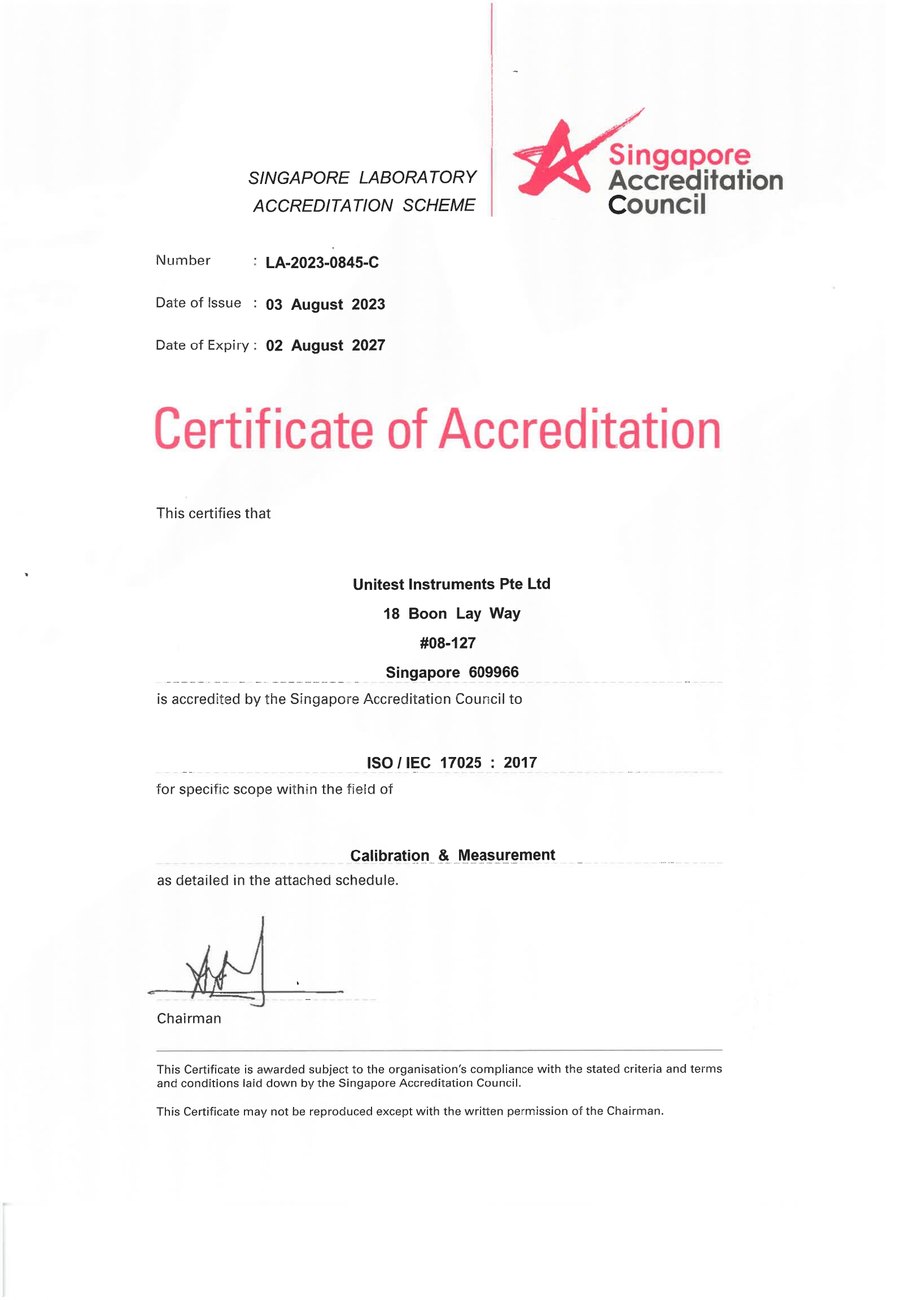
SAC-SINGLAS accredited calibration laboratory (Acc. No. LA-2023-0845-C) serving Singapore's industrial, pharmaceutical, and manufacturing sectors. All content reflects our ISO/IEC 17025 accredited scope and is reviewed by our technical calibration team.
Need process calibrator calibration in Singapore?
Unitest Instruments is SAC-SINGLAS accredited (Acc. No. LA-2023-0845-C) to ISO/IEC 17025. Same-week turnaround, certificates accepted by ISO 9001 auditors.